You're in a contract review where procurement says a supplier clause is “low risk” because it sits in the green box on a 5×5 matrix, while legal flags the same clause as a serious exposure because one weak obligation can cascade into renewal, audit, and termination problems. Both teams may be right inside their own method, and that's exactly why risk analysis methods can't be treated as interchangeable. The method shapes the answer, which means the method choice is itself a risk decision.
That mismatch shows up constantly in contract management, procurement, CLM software, and legal operations. If you want a practical way to avoid it, a solid starting point is the broader Visbanking risk assessment guide, then map what matters for contracts and third-party workflows against your own review process. For teams already dealing with contract intake, clause review, approvals, and renewals, the more specific issue is usually not whether risk exists, but which technique can defend the decision in front of legal, finance, and the business. Related contract-risk context is also covered in this overview of contract management risks.
Why the Method You Pick Changes the Answer You Get
A procurement team can look at a vendor's data processing clause and score it as routine because the clause has a low likelihood of breach on a simple matrix. Legal can run a fault tree and see a different picture, one where a missed subprocessor notice, a regional data transfer issue, and an audit-right gap combine into a harder-to-fix failure path. Same clause, different lens, different recommendation.
That's not a problem with the people. It's a problem with the method. A matrix is built for fast prioritization, while a fault tree is built to show how failure propagates. If the team only needs to decide whether to escalate a redline today, a quick ranking method works. If the decision is about whether the contract can survive operational, legal, or regulatory stress, the causal model matters more.
Practical rule: Use the simplest method that still answers the actual business question. Don't ask a heat map to do the work of a causal model.
In contract review, that distinction changes workflow. A junior reviewer may use a matrix to sort third-party paper into “approve, escalate, reject,” while a legal ops lead may use structured analysis to identify which clause families keep creating repeat exceptions. That's also why a useful contract review stack often pairs structured triage with deeper analysis, as discussed in contract review workflow guidance.
For readers who want to compare methods against an operating model rather than an abstract framework, the right path is simple. Start with a fast screen when the question is routing. Move to structured cause-and-effect when the question is control design. Use quantitative modeling when the question is how much exposure sits in the tail of the distribution.
The Three Families Every Risk Analysis Method Falls Into
Qualitative methods fit fast triage
Qualitative methods are the first-pass conversation. Think of them like a doctor's initial triage call, where the goal is to sort urgent from non-urgent, not to calculate the exact likelihood of every outcome. In contracts, that usually means risk matrices, workshops, Delphi-style expert input, SWIFT, and Bow-Tie reviews that help teams decide what needs escalation.
These methods work best when the document set is messy, the data is thin, or the review queue is moving quickly. They also fit legal and procurement because the output is easy to act on, a clear priority, a red flag, or a control gap. The trade-off is obvious, they can be defensible without being numerically precise.
Semi-quantitative methods add structure without pretending certainty
Semi-quantitative methods sit in the middle. They use scoring systems, weights, and ranked criteria, which gives teams more structure than a narrative review without requiring full probability modeling. In practice, that's where FMEA often lands, especially when reviewers want to compare failure modes across clauses, suppliers, or workflow steps.
This middle layer is useful when a team has enough consistency to rank risks, but not enough clean history to justify full statistical treatment. It's also where many contract teams stay for a long time, because the output is usable in approvals, vendor management, and renewal decisions. The risk is false confidence, so the scale needs to be documented and applied consistently, not improvised case by case.
Quantitative methods answer distribution questions
Quantitative methods are for decisions where the core question is not “Is this risky?” but “What does the distribution of outcomes look like?” That's where Monte Carlo simulation, sensitivity analysis, Bayesian networks, and scenario analysis earn their keep. They're better when the decision is high-stakes, the data are usable, and leadership needs a range, not a label.
The same logic applies to contract governance processes. Governance rules only work when the method matches the decision owner, the cadence, and the level of evidence available. If the team can't defend the assumptions, quantification becomes decoration.
Bottom line: Choose qualitative for speed, semi-quantitative for consistent ranking, quantitative for defensible ranges and tail risk.
Qualitative and Semi-Quantitative Methods Compared
In contract and procurement work, the structured qualitative tools are the ones that get used first because they're practical. The right choice depends on whether the team needs simple prioritization, clause-level failure mapping, or a barrier view that shows where controls break down. The best-run reviews don't use these methods as substitutes for judgment, they use them to make judgment visible.
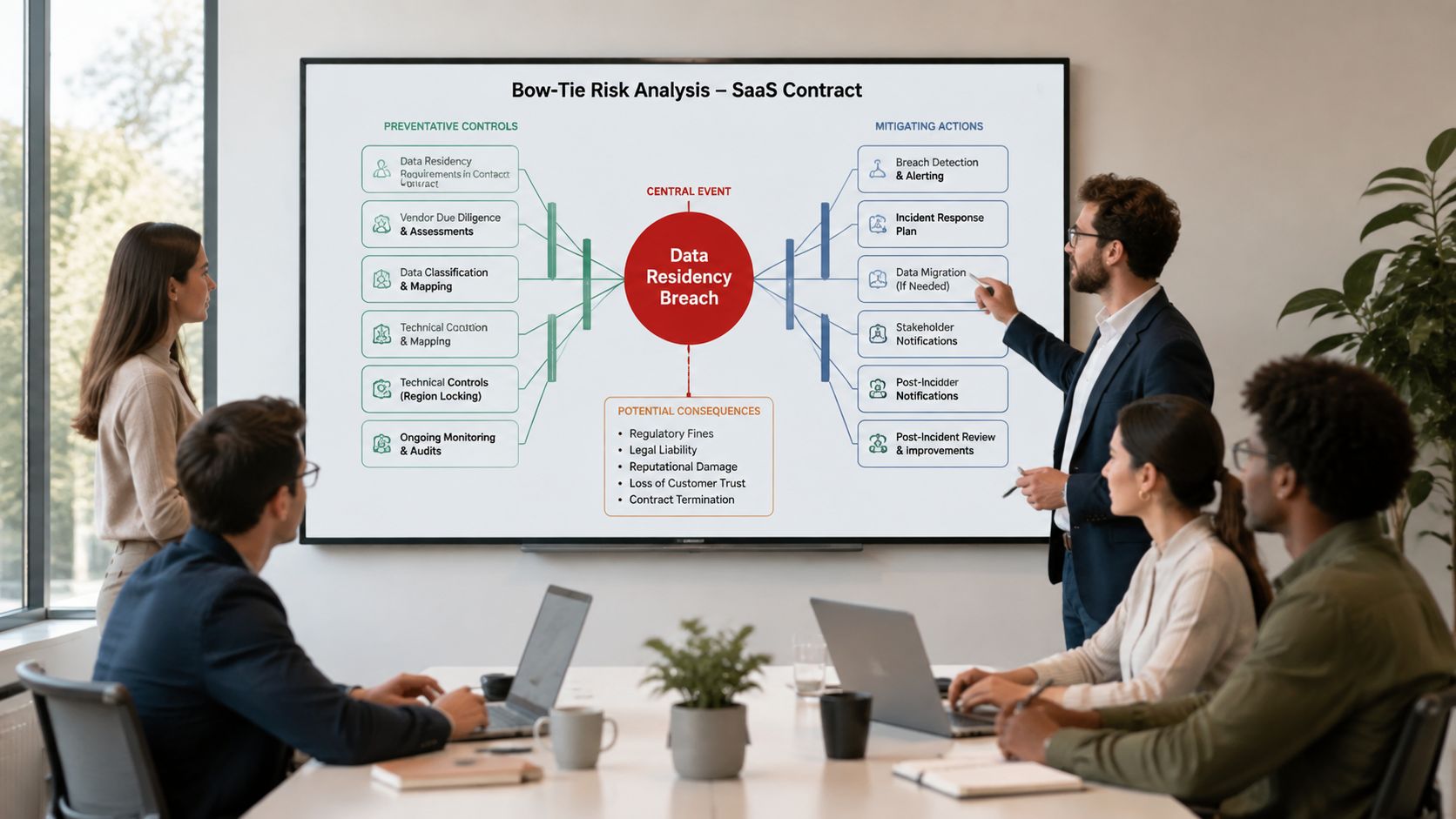
A useful way to look at them is this. A risk matrix helps a team sort third-party paper quickly. FMEA helps rank clause or supplier failure modes. Bow-Tie shows threats, top events, preventive controls, and mitigative controls in one model. Fault and event trees show how a trigger can cascade through connected steps.
The U.S. Army Corps of Engineers' qualitative methods module is a good practical reference for screening, rating, ranking, and risk narratives in operational settings, especially before quantification is worth the effort. For manufacturing teams, this FMEA for manufacturing guide shows how the same logic is used to structure component failure thinking, which maps cleanly to clause-level and supplier-level analysis in contracts.
| Method | Core Structure | Best For | Main Limitation |
|---|---|---|---|
| Risk Matrix | Likelihood vs. impact grid | Fast triage of contract or vendor issues | Can flatten different risks into the same score |
| FMEA | Failure modes scored by severity, occurrence, detectability | Ranking clause, supplier, or process failure points | Needs disciplined scoring rules |
| Bow-Tie | Causes on the left, top event in the center, consequences on the right | Testing preventive and mitigative controls | Can get cluttered if teams add too many branches |
| Fault or Event Tree | Branching logic that maps propagation paths | Showing how one trigger cascades through a workflow | Needs careful definition of the trigger and branches |
FMEA is especially useful when the question is, “Which failure mode deserves attention first?” Bow-Tie is better when the question is, “Which control actually breaks the chain before loss?” A matrix is faster, but it doesn't show causal leverage. That's why many legal and procurement teams start there, then move up the ladder only when the contract, supplier, or renewal risk deserves a deeper review.
Quantitative Methods That Move Beyond Rankings
Quantitative methods matter when leadership wants a range, not a label. A contract manager asking, “What's the likely renewal-cost spread if fallback terms are rejected?” is asking a different question than a reviewer asking, “Is this clause high or low risk?” The first question needs distributions and assumptions. The second can often be handled with a matrix.
Monte Carlo simulation is the most familiar bridge from contract judgment to numeric output. In a renewal context, you define ranges for variables like price uplift, fallback concessions, and implementation delay, then simulate outcomes across many runs. The result is not a single answer, it's a set of probable outcomes that helps procurement and finance decide whether a deal is acceptable.
Sensitivity analysis answers a narrower question, which input changes the result the most. That matters in contract negotiation because not every clause carries the same weight. A business can waste time debating small wording changes while the primary driver is a renewal indexation formula or a liability cap.
Bayesian networks are useful when evidence changes over time. If a counterparty revises its security posture, adds a new subprocessor, or submits updated audit results, the model can update belief about risk instead of freezing the old assessment in place. That makes them useful for active vendor oversight, not just one-time review.
Scenario analysis is the stress test. It's the right fit when a team wants to compare a normal renewal path with a disrupted path, such as delayed legal sign-off or a supplier transition.
For teams working with contract analytics, the point is to use quantitative methods only when the output will change a decision. If the model won't alter pricing, escalation, or approval, it's probably too much work for the value.
Rule of thumb: Quantitative methods are worth it when the business needs a distribution, a driver analysis, or a dynamic update, not just a ranked list.
How to Choose the Right Risk Analysis Method
Start with the decision, not the tool. If the team needs to route a contract, a risk matrix is usually enough. If the team needs to explain why one clause triggers a stronger control posture, FMEA or Bow-Tie is a better fit. If leadership needs a defensible range for cost, timing, or exposure, move toward Monte Carlo or Bayesian methods.
Then check the data. Sparse or unstable information argues for qualitative or semi-quantitative methods, because they reduce false precision. Stable operational history, recurring supplier data, or well-defined clause performance opens the door to quantitative modeling. The source material behind this article, including the Allied Tax Advisors forecasting methods guide, reflects the same practical principle, the method has to fit the reliability of the inputs.
Third, look at the audience. A procurement lead may need a quick route to approval. A GC may need a defensible audit trail. Finance may need a range and a downside view. The same analysis can support all three, but not with the same output format.
A simple selection check
- Decision type: Is this a routing question, a control-design question, or a financial exposure question?
- Data availability: Are you working from clean history, partial evidence, or expert judgment?
- Audience: Will the output be read by an analyst, an approver, or an auditor?
- Refresh cadence: Does the risk need one-time review, or continuous updates in a live workflow?
Practical rule: If the data are weak, don't fake precision. If the stakes are high, don't stop at a label.
That logic aligns well with contract review and approval workflows, where the right method often changes by stage. Intake can start qualitative. Negotiation can use structured scoring. Renewal and obligation tracking can justify deeper modeling when values or exposure are material.
Applying These Methods to a Real Contract Workflow
A multi-year SaaS renewal is a clean example because it forces the team to deal with legal, procurement, finance, and operational risk at the same time. The contract includes data residency commitments, an exit-assistance clause, and a renewal term that could shift total cost if negotiations drift. That makes it a good candidate for layered analysis instead of one blunt score.
The workflow starts in intake. A Bow-Tie map can show the threats on the left, such as vendor staffing gaps, hosting changes, or unresolved data-transfer concerns, with the top event in the center, a data-residency breach, and consequences on the right, such as compliance exposure, customer friction, and incident response work. The value is that legal can see which preventive controls matter before the issue becomes a dispute.
Next comes review and approval. A risk matrix helps route fallback positions, so a routine wording tweak doesn't get the same treatment as a weak residency commitment. That saves time in the approval queue and keeps legal focused on the issues that change risk posture.
The exit-assistance clause is a better fit for FMEA. The team can score failure modes like poor handover support, missing export formats, or delayed transition help, then decide which clause changes reduce the biggest exposure. In a CLM workspace, that score belongs beside redlines, comments, and approval notes, not in a separate spreadsheet no one revisits.
Finally, a Monte Carlo run on renewal cost variance gives procurement and finance a range for budget planning. That's the point where contract intelligence becomes operational, because the analysis informs whether the team accepts, renegotiates, or escalates the deal.
Legitt AI fits naturally here as one option for contract risk analysis inside a CLM-style workspace. Its contract review and risk scoring features can support clause extraction, deviation analysis, obligation tracking, and renewal alerts alongside the review cycle already in place, which is where layered methods become useful in practice. The key is not the tool alone, it's whether the workflow lets each method live where it adds value.
Common Mistakes That Undermine Any Risk Analysis Method
The most common failure is treating a matrix score as if it were objective. It isn't. The score reflects the scale, the scorer, and the way the team defined impact and likelihood. The fix is simple, document the scoring rule and keep it stable.
The second mistake is ignoring correlation. In contracts, risks rarely travel alone. A security shortfall can affect breach risk, renewal negotiation power, and audit exposure at the same time. The fix is to map connected risks together instead of scoring each one in isolation.
The third mistake is skipping sensitivity analysis on a quantitative output. A model that gives a neat result but hides the dominant driver is fragile. The fix is to test which input variables move the output most before trusting the number.
The fourth mistake is using one round of expert input and calling it consensus. Delphi-style iteration exists for a reason, people revise their views when they see the group's reasoning. The fix is to circulate the first pass, collect challenge comments, and rerun the ranking where the stakes justify it.
The fifth mistake is failing to document assumptions. That's the fastest way to make an analysis impossible to audit later. The fix is to record what was assumed, what data was used, and what would trigger a re-run.
Audit test: If another reviewer can't trace the logic from input to recommendation, the analysis isn't finished.
Frequently Asked Questions About Risk Analysis Methods
Which method should I start with if I don't have historical data? Start with a qualitative method, usually a risk matrix, Bow-Tie, or SWIFT-style workshop. Then capture the assumptions so you can upgrade later if better data appears in the CLM or procurement workflow.
Can I combine qualitative and quantitative methods? Yes, and most teams should. A practical pattern is to triage with a matrix, map causal paths with Bow-Tie or FMEA, then run Monte Carlo only on the few items that affect budget, liability, or renewal.
How do I defend a risk matrix score to an auditor? Show the criteria, the scorer, the evidence used, and the reason the item was routed that way. A good audit trail matters more than a dramatic score.
How often should risk analysis be re-run for active contracts? Re-run it when the contract changes, when the counterparty changes posture, or when a renewal or obligation milestone is approaching. In live contract operations, the right answer is usually event-driven review, not a fixed calendar alone.
If you're standardizing contract review, renewal tracking, or supplier approval workflows, Legitt AI gives you a way to keep the analysis tied to the contract itself rather than scattered across spreadsheets and email threads. Visit Legitt AI to see how AI contract review, obligation tracking, and contract intelligence can support a more defensible risk workflow.