Organizations routinely lose contract value through missed obligations and weak follow-through. In service agreements, that loss rarely comes from bad drafting alone. It shows up in margin leakage, disputed invoices, missed service credits, avoidable renewals, and vendor relationships that underperform the business case.
I have seen the same pattern across procurement, legal ops, finance, and service delivery. The contract gets signed, then the operating terms disappear into email threads, shared drives, and PDF attachments. A renewal notice sits in one inbox. An SLA commitment lives in a signed exhibit nobody checks. Finance bills against one interpretation, operations works from another, and leadership finds out only when costs rise or performance slips.
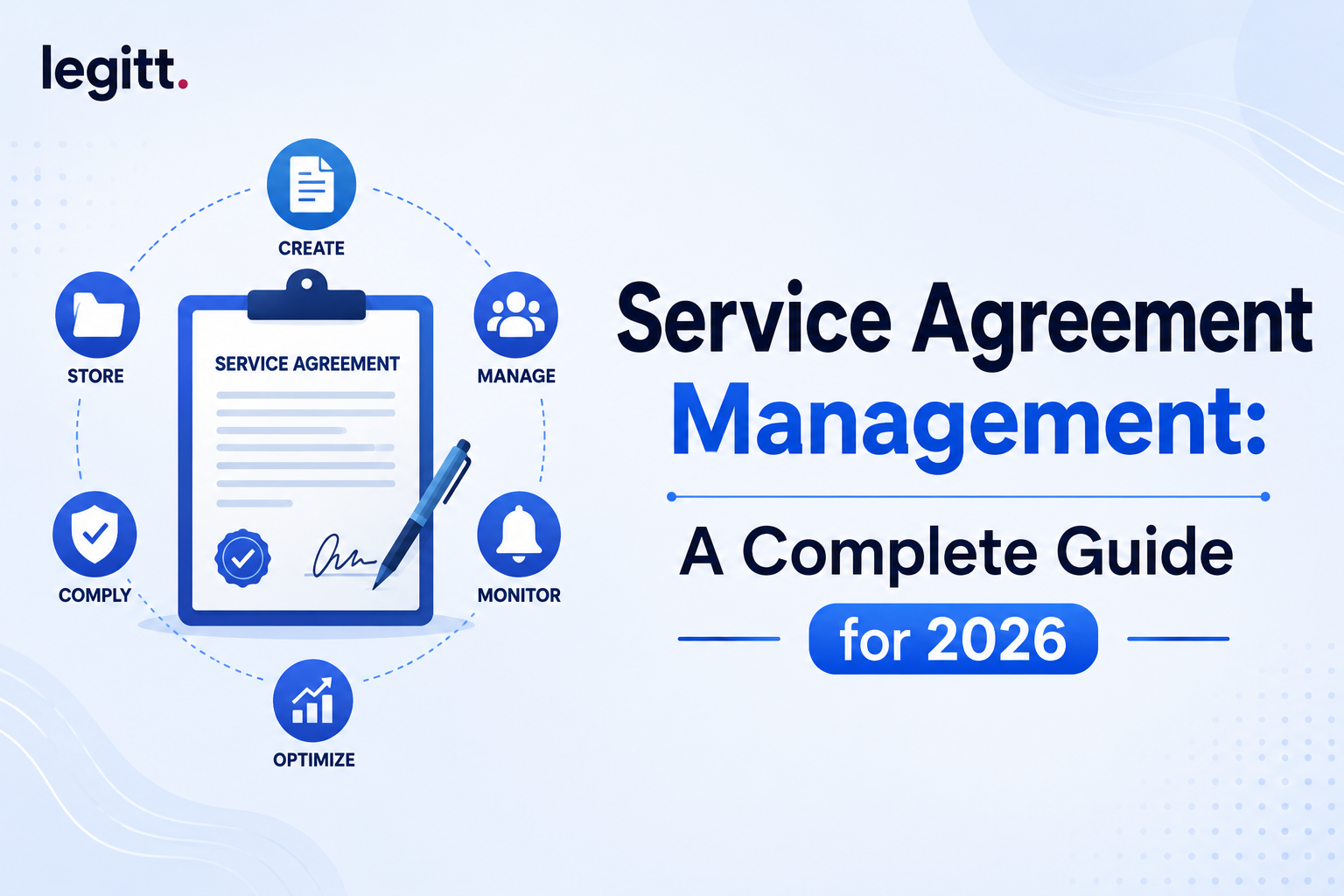
Service agreement management has changed. Strong teams no longer treat agreements as documents to store. They manage them as active systems of record for obligations, performance, commercial controls, and renewal decisions.
That shift matters because service agreements create value only when terms are visible, tracked, and tied to day-to-day execution. Modern AI-powered CLM helps teams extract obligations, route approvals, monitor milestones, and surface risk before it becomes revenue loss or operational disruption. The payoff is broader than legal efficiency. Procurement gets better vendor accountability. Finance gets cleaner billing and forecast inputs. Operations gets clearer service requirements. Leadership gets a firmer view of whether the agreement is delivering what the business paid for.
The Strategic Imperative of Service Agreement Management
Poor agreement management shows up in P&L results long before it shows up in a legal report. The cost appears in missed service credits, auto-renewals nobody intended to accept, invoices that do not match rate cards, and vendors held to a different standard than the signed terms require.
Service agreements also cut across more functions than many teams plan for. Legal may control templates and approvals, but operations runs delivery, procurement manages supplier accountability, finance feels the billing impact, and business owners carry the performance risk. Once that handoff breaks, the agreement stops working as a control mechanism and becomes a static file.
That is the strategic issue. Service agreement management is no longer a document-storage task. It is a performance and value-management discipline.
Why manual control breaks down
Manual service agreement management usually depends on three weak controls:
- Someone remembers the date. In practice, notice periods, benchmarking rights, price reviews, and cure windows sit in different places and get missed.
- The final signed version is easy to find. In practice, teams split drafts across email, shared drives, procurement portals, and local folders, with amendments stored separately.
- The business owner understands the operational terms. In practice, they know the commercial headline but not the reporting duties, SLA thresholds, approval steps, or service-credit mechanics that drive disputes.
Practical rule: If an obligation depends on memory, it is not under control.
I have seen this most often after signature. The contract is executed, then the actual operating terms disappear into inboxes and PDFs. Finance bills from one version, operations manages to another, procurement tracks performance in a spreadsheet, and legal gets pulled back in only when there is a dispute or a bad renewal.
A better model starts with a simple question: what does this agreement require the business to do, who owns each action, and how will the team know when value is slipping? That is also where AI contract review workflows start to matter. They help teams identify obligations early, standardize review across functions, and turn signed terms into trackable data instead of buried text.
What leadership should care about
Executives do not need another repository. They need tighter control over commercial outcomes.
Strong service agreement management supports:
| Business area | What better management changes |
|---|---|
| Revenue protection | Reduces missed billing triggers, renewal failures, and service-credit disputes |
| Vendor oversight | Makes underperformance visible while there is still time to enforce remedies or renegotiate |
| Compliance | Creates a clearer record of approvals, obligations, and service commitments for audit and regulatory review |
| Operational handoffs | Connects legal terms to procurement, finance, and delivery workflows so teams act from the same source of truth |
For this reason, the discipline has moved beyond storage. Modern AI-powered CLM gives teams a way to extract obligations, assign owners, monitor milestones, and compare actual service performance against the deal the business approved. That shift turns service agreements from an administrative burden into an active control point for value, risk, and supplier performance.
Beyond the PDF What Service Agreement Management Means Today
A service agreement isn’t just a legal promise. It’s a working model for how one party delivers recurring value and how the other measures, approves, pays for, and, if necessary, exits that relationship.
Old-school contract management treated agreements like library items. The goal was to file them correctly and retrieve them later. Modern service agreement management works more like an operational dashboard. It tracks what the agreement requires, who must act, what dates matter, whether service levels are being met, and when commercial intervention is needed.
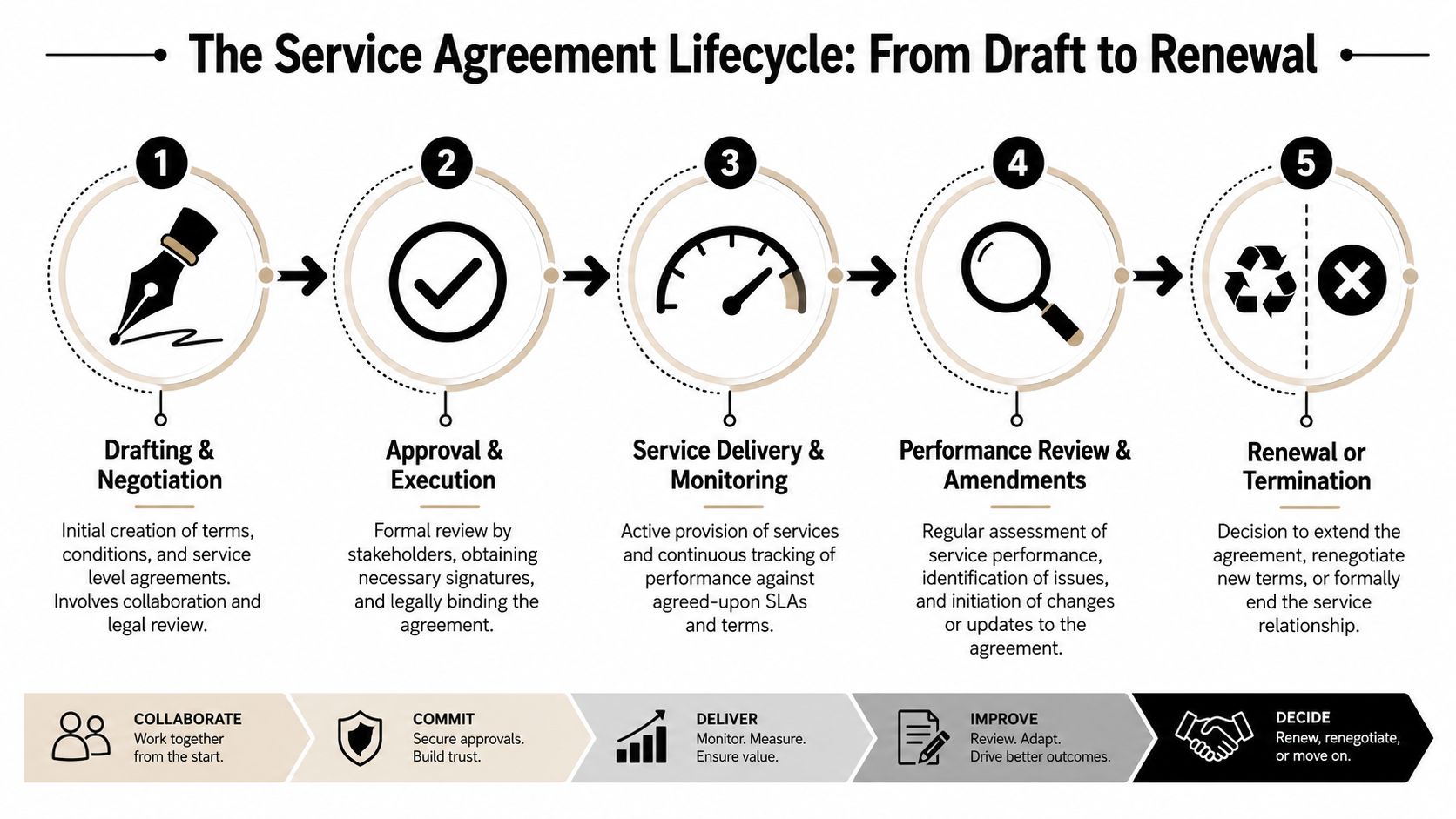
The fields that make an agreement manageable
A well-structured service agreement should explicitly define the service scope, SLA metrics, pricing model, contract duration, renewal and termination logic, compliance obligations, and the named owner responsible for monitoring performance and SLA adherence, according to Aptien’s guidance on service agreement structure.
That list sounds basic. It isn’t. Most service agreement failures trace back to one of those fields being vague, missing, or owned by nobody.
For example:
- Service scope prevents delivery disputes. Without it, teams argue about what was included.
- SLA metrics create a measurable baseline. Without them, “good service” becomes subjective.
- Pricing model clarifies whether the deal is fixed-fee, usage-based, milestone-based, or mixed.
- Renewal and termination logic controls bargaining power. If those terms are buried or ambiguous, teams lose options at exactly the wrong moment.
- Named ownership is what turns a contract into a managed process.
What modern workflows actually look like
A practical workflow usually includes a standard intake, approved templates, legal review for exceptions, business approval, signature routing, post-signature extraction of obligations, and ongoing monitoring. The best teams also connect review to playbooks, so negotiators can tell the difference between acceptable fallback language and terms that need escalation.
If your current process still depends on email attachments and manual redline comparison, it’s worth looking at tools built for AI-supported contract review workflows. The point isn’t to automate judgment. It’s to remove repetitive friction so legal and procurement can focus on risk, value, and negotiation advantage.
A signed PDF is evidence. A managed agreement is a control system.
Static documents versus active governance
The difference is simple.
| Static document management | Active service agreement management |
|---|---|
| Stores the final contract | Tracks commitments throughout the lifecycle |
| Finds documents by filename | Finds obligations, terms, clauses, and owners |
| Depends on calendar reminders | Uses workflow, alerts, and accountability |
| Focuses on execution | Focuses on execution plus delivery, value, and exit |
That shift is what separates administrative contracting from operational control.
Mapping the Service Agreement Lifecycle from Draft to Renewal
Most service agreements don’t fail at drafting. They fail in the handoffs. A sales lead asks for a rush review. Procurement negotiates commercial terms in parallel. Legal edits liability language. Operations doesn’t see the final service levels until after execution. Finance inherits billing terms secondhand. Then everyone assumes the signed agreement will somehow run itself.
It won’t.
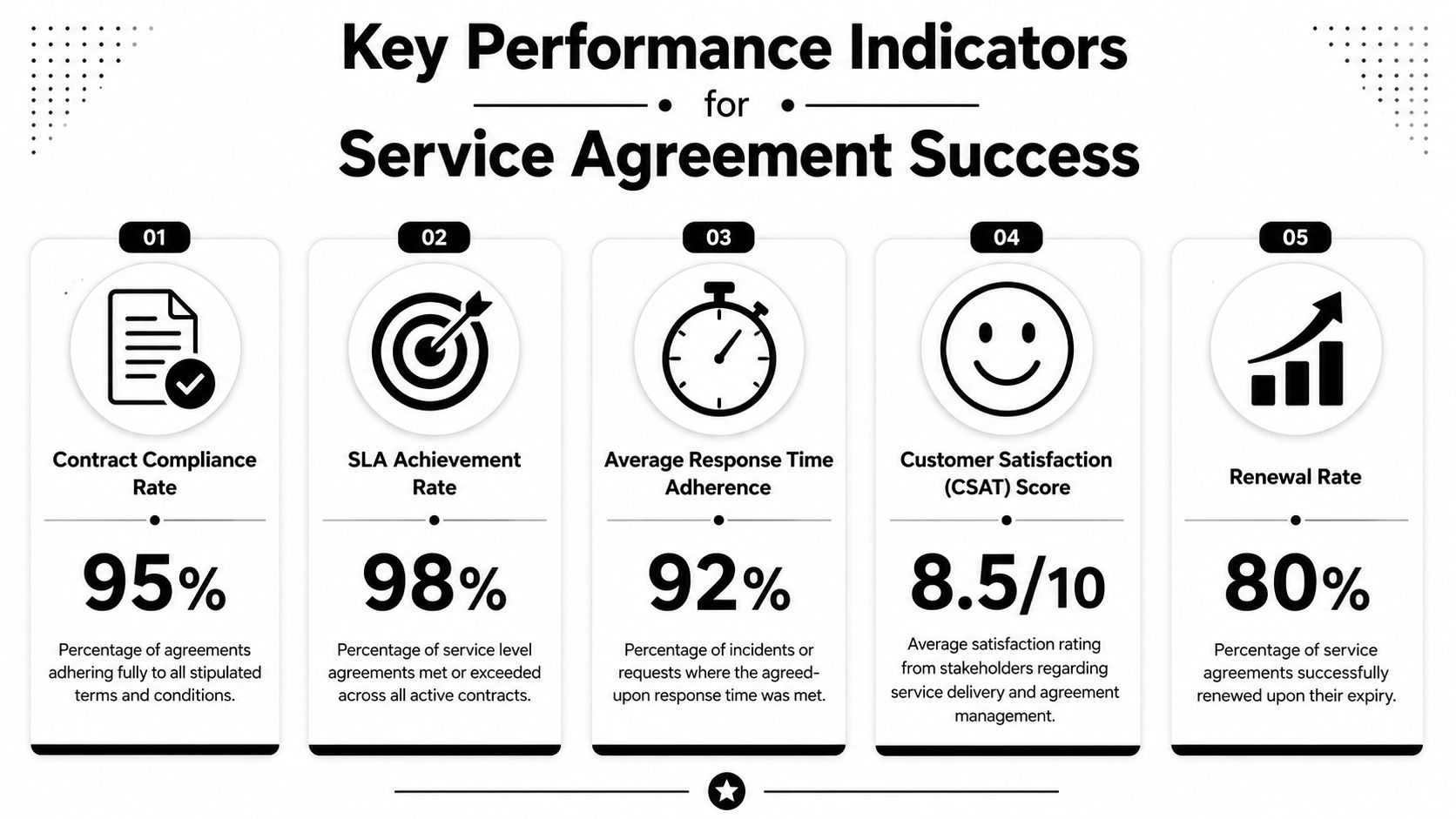
Drafting and authoring
Discipline begins with these elements. Teams need approved templates, fallback clauses, and a clean intake process that captures deal context before anyone starts editing language. If intake is weak, legal spends time reconstructing facts instead of reviewing risk.
In service agreements, the drafting phase should lock down a few essentials early:
- Delivery model: What service is being provided, by whom, and under what assumptions.
- Commercial structure: How fees, price changes, credits, and reimbursement work.
- Operational dependencies: What the customer or vendor must provide for performance to be possible.
A common failure point is starting from the last deal instead of the right template. That copies old mistakes forward.
Negotiation and internal alignment
Negotiation isn’t just redlining. It’s coordination. Legal, procurement, sales, security, finance, and service owners often care about different sections for valid reasons.
The strongest teams separate issues into lanes:
| Lane | Typical owner | Main concern |
|---|---|---|
| Legal terms | Legal | Liability, indemnity, IP, data use, governing terms |
| Commercial terms | Procurement or sales | Fees, discounts, price reviews, credits |
| Operational terms | Delivery or operations | SLAs, service windows, support model, escalation |
| Risk controls | Security, compliance, legal | Audit rights, regulatory obligations, data handling |
That structure matters because not every clause needs the same escalation path. If every deviation goes to the same person, review stalls.
Keep negotiations tied to approved fallback positions. Otherwise, every agreement becomes a custom project.
Approval and execution
Approvals should answer one question: who needs to sign off on which risk, and under what conditions? Many teams get this wrong by routing every agreement through the same chain.
A better model uses conditional approvals. A standard services agreement with approved terms shouldn’t wait behind a heavily negotiated outsourcing deal. The approval workflow should reflect clause deviation, spend threshold, business unit, and data sensitivity.
Execution is the easiest part to digitize and often the least controversial. eSignature tools remove chasing and version confusion. They also create a reliable audit trail around who signed what and when.
Post-signature obligation management
At this stage, manual systems typically prove insufficient. Once the agreement is executed, the business needs visibility into action items, dates, dependencies, and service commitments.
Post-signature management should include:
- Key date capture: Renewals, termination notices, review windows, price increases, and milestone deadlines.
- Obligation assignment: A named owner for each operational or commercial obligation.
- Evidence collection: Records showing whether commitments were met.
- Amendment control: A clear link between the base agreement and every change that follows.
For teams trying to operationalize this step, contract obligation tracking workflows are usually the difference between knowing your terms and using them.
Performance review and amendments
Service agreements need active review after signature because business conditions change. Volumes shift. Support expectations rise. A vendor that looked cost-effective at the start may become expensive or operationally weak over time.
A disciplined review cycle asks:
- Are the SLA commitments still aligned with the business need?
- Is the provider meeting the commercial and operational case?
- Do pricing, scope, or support terms need amendment?
- Has the relationship created new compliance or dependency risks?
Version control matters here. If a team can’t quickly determine whether an amendment changed pricing, term length, or service credits, it can’t govern the relationship confidently.
Renewal or termination
Renewal shouldn’t be a calendar surprise. It should be a decision based on performance, cost, risk, and strategic fit. Some agreements should renew quickly. Others should trigger renegotiation. Some should exit cleanly.
The organizations that handle this well don’t wait until the notice window opens. They review in advance, gather performance evidence, and decide whether to renew, reprice, restructure, or replace.
That’s the full lifecycle in practice. Drafting starts the record. Governance after signature determines whether the agreement creates value or just paperwork.
Navigating Common Challenges and Compliance Risks
Most service agreement problems fall into three buckets. The first is operational friction. The second is financial leakage. The third is legal and compliance exposure. They overlap, but separating them helps teams diagnose what’s broken.
Operational risks that look small until they aren’t
Operational failures usually start as visibility problems. Nobody knows which version is current. Nobody can say who owns a service review. Notice dates sit in personal calendars. Amendments get signed but never reflected in delivery playbooks.
Those failures create familiar symptoms:
- Missed renewals: Teams lose their advantage because they spot the notice deadline too late.
- Unclear ownership: Service issues bounce between legal, procurement, and operations with no accountable manager.
- Weak handoffs: The people delivering or consuming the service never see the negotiated details.
This is also where vendor dependency becomes a governance issue, not just a sourcing issue. If your service agreements rely heavily on outside providers, a stronger approach to third-party risk management helps teams evaluate operational, regulatory, and continuity exposure before a contract turns into a business problem.
Financial leakage hides inside routine work
Finance teams usually see the result, not the cause. Leakage shows up as disputed invoices, lost service credits, auto-renewed contracts that should have been renegotiated, or vendors charging against outdated scopes.
Common patterns include:
| Risk type | What typically causes it |
|---|---|
| Overpayment | Pricing schedules don’t match current scope or actual usage |
| Lost leverage | Teams miss review windows for repricing or benchmark discussions |
| Uncaptured remedies | Service credits exist in the agreement but nobody claims them |
| Spend fragmentation | Similar services are contracted separately with inconsistent terms |
A legally valid agreement can still be commercially weak if nobody checks whether the business is getting what it pays for.
Termination risk is often the most neglected
A critical but often overlooked challenge is managing contract termination. Best-practice guidance says agreements should specify notice periods, data handover procedures, and how prepaid fees or unfinished work are handled, as described in this ASPPA article on service agreement best practices.
That matters because exit isn’t just a legal event. It’s an operational transition.
The quality of a termination clause often determines whether a failed service relationship ends cleanly or turns into a months-long disruption.
Teams should review at least four issues before signing:
- Notice mechanics: How and when termination notice must be delivered.
- Transition assistance: Whether the provider must support handover for a defined period.
- Data and document return: What must be returned, transferred, or deleted.
- Open work and prepaid fees: How incomplete work, deposits, and final charges are handled.
If those points are fuzzy, the organization may technically have a termination right but still face disruption, dispute, or both.
Key KPIs for Measuring Service Agreement Performance
Most organizations collect contract data without turning it into decisions. They can count signed agreements, but they can’t say whether a service contract is performing well, costing too much, or heading toward a bad renewal outcome.
Effective service agreement management involves tracking KPIs such as response time, service quality, and service cost, and benchmarking costs against peer data to avoid overpaying, according to Partssource guidance on data-driven service contract management. That’s the point where contract management becomes value management.
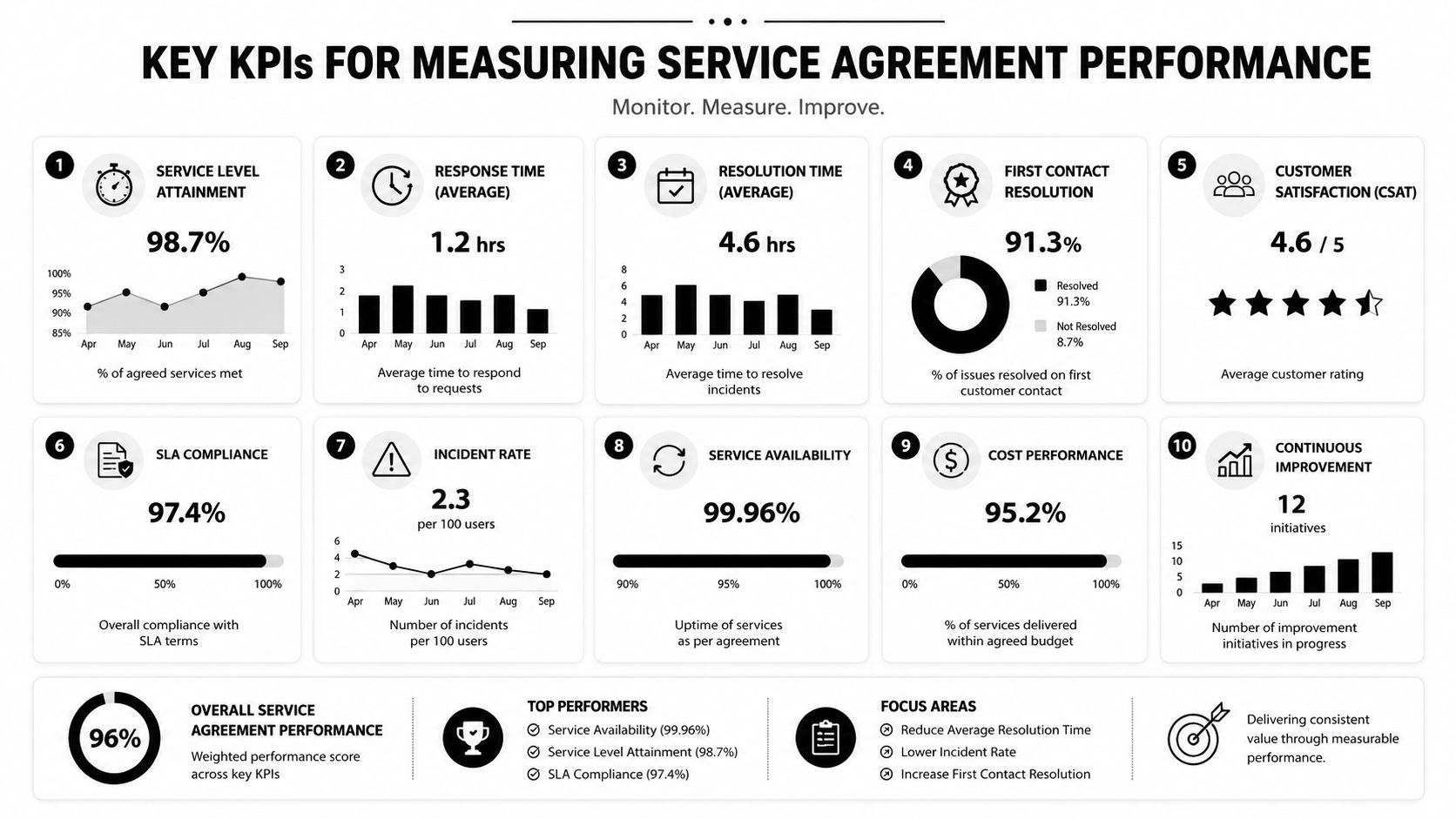
The metrics that matter by function
Different teams need different views of the same agreement data.
- Procurement cares about economic value: Compare service cost against market context, supplier performance history, and renewal alternatives.
- Operations cares about delivery reliability: Track response times, issue resolution patterns, and recurring service failures.
- Legal cares about adherence: Watch obligation completion, deviation from approved terms, and unresolved exceptions.
- Finance cares about predictability: Monitor invoice alignment, cost drift, and whether pricing still matches actual service use.
- Sales or account teams care about retention: Review renewal readiness, amendment activity, and recurring points of friction.
A practical KPI framework
A useful scorecard usually combines service, commercial, and governance metrics.
| KPI category | What to monitor | Why it matters |
|---|---|---|
| Service performance | Response time, service quality, incident handling | Shows whether the provider is meeting the operating need |
| Commercial health | Total cost, pricing changes, credit recovery | Reveals leakage and renegotiation opportunities |
| Governance discipline | Obligation completion, review cadence, amendment control | Indicates whether the contract is actively managed |
| Relationship outlook | Renewal readiness, dispute frequency, stakeholder satisfaction | Helps decide whether to renew, reprice, or exit |
If a team can’t measure service quality and cost together, it usually ends up defending one at the expense of the other.
What good measurement changes
Once KPIs live in a central system, teams stop reacting only when something breaks. They can flag underperforming vendors earlier, prepare for renewals with evidence, and escalate amendments before a service gap becomes a dispute.
That’s also where benchmarking matters. A provider may be meeting SLA terms and still be expensive relative to comparable arrangements. Conversely, a low-cost provider may create hidden operational costs through poor responsiveness or quality issues. The agreement should be judged on total value, not legal sufficiency alone.
Your Roadmap to Modern Service Agreement Management
Transforming service agreement management should generally not be attempted in one project. The cleaner path is phased. Start by making the process visible. Then automate the repeatable parts. Then connect contract data to the rest of the business.
Industry reporting summarized in AdminRemix’s service contract management overview says digitization and automation can lead to 90% fewer missed deadlines, 75% faster contract cycles, and up to $2.1 million in annual savings. The same source says the global CLM market is projected to reach $12 billion by 2025. Those figures don’t mean every implementation succeeds automatically. They do show why enterprises keep investing.
Phase one standardize and centralize
Before adding AI or automation, get the basics under control.
Start with a repository strategy. Every active service agreement, amendment, order form, and executed version should live in one searchable system. If the business can’t find the current contract package quickly, every later improvement will be weaker than it should be.
Then standardize the front end:
- Approved templates: Separate low-risk standard forms from agreements that need heavier review.
- Clause playbooks: Define preferred, acceptable, and escalation language.
- Intake forms: Capture service type, pricing structure, business owner, and data sensitivity at the start.
- Ownership rules: Assign who owns legal review, commercial review, and post-signature monitoring.
This phase often delivers the fastest operational relief because it removes file chaos and reduces avoidable drafting variation.
Phase two digitize and automate
Once templates and ownership are stable, automate the handoffs that consume time and create inconsistency.
Good candidates include:
| Workflow | What to automate |
|---|---|
| Approvals | Routing based on clause deviation, spend, business unit, or risk factors |
| Execution | eSignature sequencing, signer reminders, final document storage |
| Date management | Alerts for renewals, notice windows, pricing reviews, and milestones |
| Obligation tracking | Task creation tied to specific contractual commitments |
Many legal ops and procurement teams also add adjacent tooling. For example, customer-facing service operations may automate customer assistance to align support delivery with SLA commitments captured in agreements. The contract system and the service environment don’t need to be identical, but they should inform each other.
Phase three integrate and optimize
The final phase is where service agreement management becomes a business system instead of a legal archive.
Integrations matter here. CRM connections help sales and account teams initiate contracts from approved data. ERP and finance links improve visibility into billing, pricing, and spend. Collaboration tools reduce status-chasing. Repository analytics surface recurring deviations, concentration risk, and upcoming decision points.
This is also the stage where AI becomes useful. Used well, it can extract key terms from third-party paper, flag deviations from playbooks, summarize changes across versions, identify renewal events, and pull obligation data into operational workflows. Tools in this category include full CLM suites, specialized review products, and platforms such as Legitt AI, which combines drafting, review, eSignature, repository management, obligation alerts, and contract intelligence in one workspace.
What works and what doesn’t
The trade-offs are predictable.
What works
- Start with one agreement type and one clear workflow.
- Clean templates before migration.
- Design approvals around risk, not hierarchy.
- Give business owners visibility after signature, not just legal admins.
- Build reports around decisions, such as renew, renegotiate, terminate, or amend.
What doesn’t
- Migrating bad templates into a new system and calling it transformation.
- Over-automating edge cases before standardizing the common path.
- Treating metadata capture as optional.
- Assuming eSignature alone solves lifecycle management.
- Leaving post-signature accountability undefined.
Buy software for the workflow you want to run, not the screenshots you want to show in a steering committee.
The maturity model is straightforward. Centralize first. Automate next. Optimize with integration and intelligence after the process is stable.
Your Service Agreement Management Evaluation Checklist
A useful evaluation doesn’t ask whether you have contracts stored somewhere. It asks whether your agreements are searchable, actionable, measurable, and connected to business decisions.
Use this checklist to assess your current process or compare CLM software options.
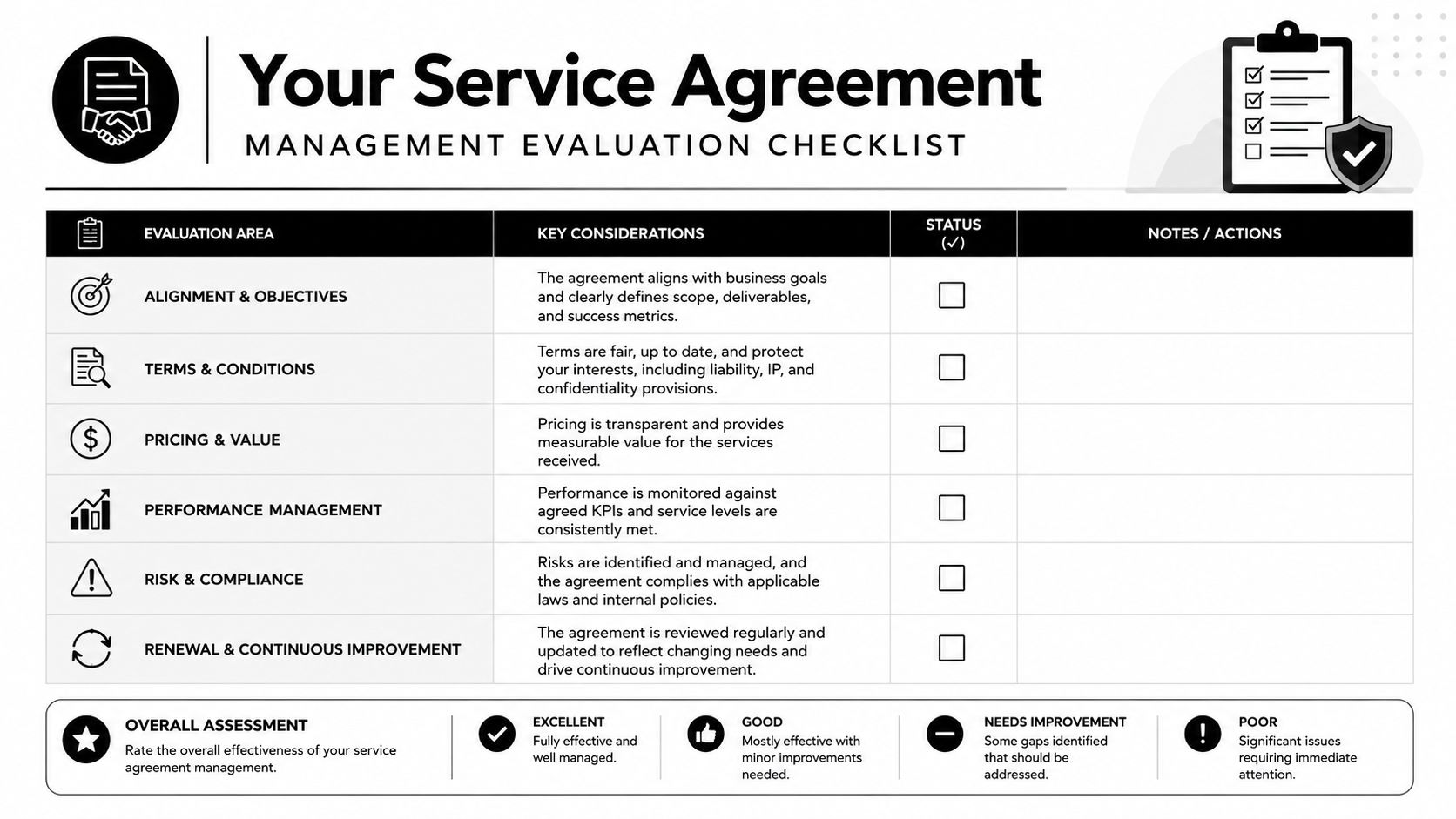
Core evaluation areas
- Repository and searchability: Can your team find the executed agreement, amendments, and key clauses without digging through email and shared drives?
- Workflow control: Are intake, review, approval, and signature steps standardized, or does each team run its own process?
- Obligation and date management: Can you track renewal windows, notice periods, service reviews, and performance commitments in one place?
- Performance visibility: Do you measure service quality, cost, and compliance after signature?
- Version and amendment control: Can users identify the current contractual position without manual comparison?
- Cross-functional access: Can legal, procurement, finance, and operations each see what they need without creating duplicate records?
- Integration readiness: Does the system connect with CRM, ERP, collaboration tools, and eSignature workflows?
- Template discipline: Are teams starting from approved language instead of recycling old agreements?
- Termination readiness: Can you quickly confirm notice requirements, handover duties, and post-exit responsibilities?
- Practical usability: Will business users use the system, or will they bypass it?
A simple scoring lens
| Maturity level | What it usually looks like |
|---|---|
| Manual | Shared drives, email approvals, calendar reminders, scattered ownership |
| Managed | Central repository, standard templates, defined review paths |
| Operational | Automated alerts, obligation tracking, measurable performance oversight |
| Strategic | Integrated CLM, analytics, AI-assisted review, renewal and vendor decisions based on evidence |
If your team is still piecing together service obligations from PDFs, start with structure. If the structure already exists, move toward automation and measurable oversight. For teams that need a faster starting point, service agreement templates built for business workflows can help standardize drafting before deeper lifecycle improvements are rolled out.
If you’re evaluating how to modernize service agreement management, Legitt AI is one option to review alongside your current CLM and legal ops stack. It supports drafting, review, negotiation, eSignature, repository management, obligation tracking, renewals, and contract intelligence in a single workflow, which is exactly what teams need when they’re moving from static document storage to active performance management.