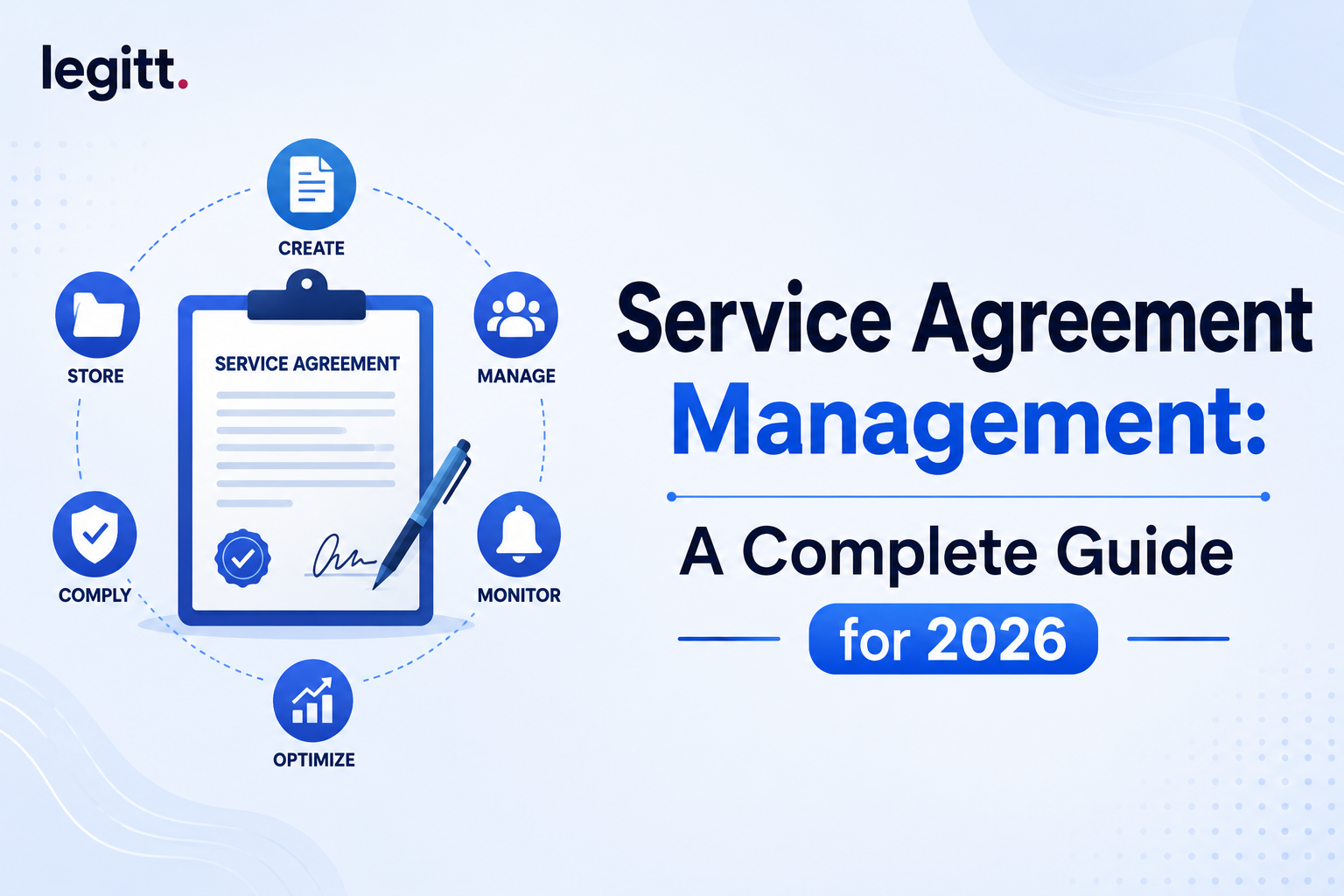
A service agreement rarely fails because one clause was badly drafted. It usually fails because nobody owned the agreement once it left legal.
A renewal notice sits in a sales leader’s inbox. Finance doesn’t see the billing change. Procurement negotiates a new vendor term without the service owner reviewing the support model. Operations logs a service issue, but the contract’s escalation path is buried in a PDF on a shared drive. By the time someone notices, the business is paying for terms it wouldn’t have accepted, or missing service levels it thought were protected.
That’s why service agreement management matters. It isn’t a filing exercise. It’s the operating system for recurring commercial commitments across legal, sales, procurement, finance, and delivery teams.
Why Modern Teams Must Master Service Agreements
The strongest service organizations treat agreements as live operating documents. They don’t wait until a dispute, renewal, or audit to read them again.
That approach has deep roots. A U.S. government paper on service contracting explains that oversight requires measurable criteria such as cost, punctuality, and quality, which is why modern service agreements are built around trackable performance rather than legal wording alone. That operational view is what now powers workflow-driven contract systems and alerts in practice, as described in Measuring Service Contract Performance.
The practical shift is simple. A service agreement should answer business questions, not just legal ones:
- What exactly must be delivered
- Who responds when service fails
- Which team approves changes
- When pricing, notice, and renewal windows trigger
- How performance gets measured and reported
When those answers live in disconnected inboxes, teams work from different assumptions. Legal thinks the approved fallback clause controls. Sales thinks the commercial email thread does. Finance invoices against an old rate card. Procurement assumes the vendor’s latest statement of work replaced earlier obligations.
Practical rule: If a service agreement can’t drive a task, alert, approval, or report, the business is still managing it manually.
This is why centralized service agreement management becomes the connective tissue across departments. Legal owns standards and risk controls. Sales owns commercial momentum. Procurement owns vendor discipline. Finance owns billing, spend, and renewals. Operations owns delivery. The agreement sits in the middle of all of them.
In regulated or audit-heavy environments, this discipline also supports broader governance work. Teams that are maturing their controls often find it useful to align contract operations with broader mastering engineering RCG practices so obligations, approvals, and service accountability don’t stay trapped inside separate functions.
The Complete Service Agreement Lifecycle Explained
A clean lifecycle is the difference between a controlled process and a chain of exceptions.
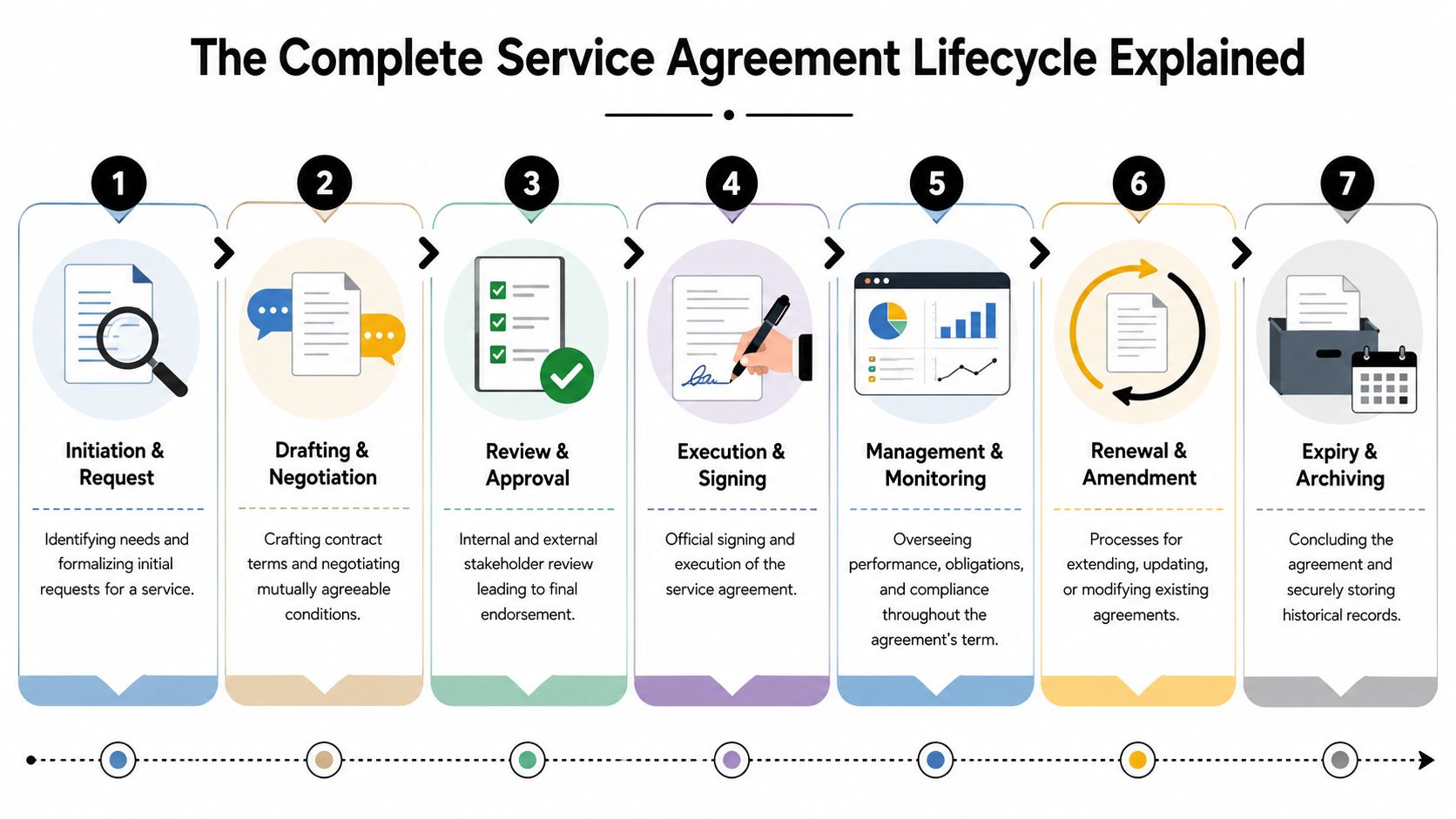
Initiation and request
Every good agreement starts with a structured intake. Someone requests a new service, renewal, expansion, or vendor engagement. The intake should capture core business facts early: parties, service type, pricing model, security needs, service owner, and target dates.
What doesn’t work is informal intake through chat messages, email chains, or verbal requests. That creates rework before legal even opens the first draft.
Drafting and negotiation
Drafting should begin from an approved template, not a copy of the last “similar” contract. For recurring services, teams usually need a master agreement, service schedule, order form, and SLA language that matches the actual support model.
A robust service agreement also needs measurable execution controls. Canada’s official guidance highlights the importance of defining elements such as customer relationship processes, dispute resolution, signing authorities, infrastructure responsibility, and business continuity planning in Canada’s Guideline on Service Agreements. In plain terms, the contract should tell people what happens when things go wrong.
For teams standardizing first drafts, a practical starting point is a master service agreement template that already separates core legal terms from service-specific schedules and operational commitments.
Review and approval
This stage breaks down most often because companies confuse review with approval. Review means subject matter experts comment on terms. Approval means named stakeholders accept the risk, price, and operational commitments.
Common approvers include:
- Legal: fallback language, risk, deviation from standards
- Finance: pricing, billing structure, payment terms
- Security or IT: access, systems, hosting, data handling
- Operations: support hours, staffing assumptions, deliverability
- Sales or procurement leadership: commercial ownership
If there’s no approval matrix, people escalate everything. Then urgent deals and low-risk renewals clog the same queue.
Execution and signing
Execution should be controlled, traceable, and fast. eSignature helps, but its greatest benefit comes from role-based routing, signature authority checks, and an audit trail showing who signed what version.
A signed PDF alone isn’t enough. At signature, the business should also capture the governing metadata that drives downstream work.
Signed isn’t finished. Signed is the point when delivery risk becomes real.
Obligation management
Once the agreement is active, the contract must turn into tasks. SLA reviews, notice dates, reporting duties, invoice rules, implementation milestones, and escalation paths should all move into operational workflows.
Many organizations often revert to spreadsheets. That usually means ownership drifts and key commitments become invisible until someone complains.
Amendments
Amendments need tighter control than many teams expect. Small edits to scope, pricing, service hours, or technical dependencies can create bigger downstream impacts than the original contract.
Strong amendment handling requires:
- Version clarity: everyone knows the current controlling set of terms.
- Impact review: legal, finance, and service owners confirm operational consequences.
- Linked records: the amendment stays connected to the parent agreement and any affected schedules.
Renewals and archiving
Renewal management should start long before the final notice window. Teams need time to review service performance, negotiate pricing, assess usage, and decide whether to renew, replace, or exit.
Archiving matters too. Closed agreements should remain searchable, linked to amendments and signature history, and retained under the company’s records policy. A repository that can’t distinguish active, expired, terminated, and superseded agreements creates unnecessary confusion.
Common Challenges and Their Hidden Costs
Most service agreement problems don’t look dramatic at first. They show up as delays, exceptions, duplicated work, and “quick fixes” that become standard practice.
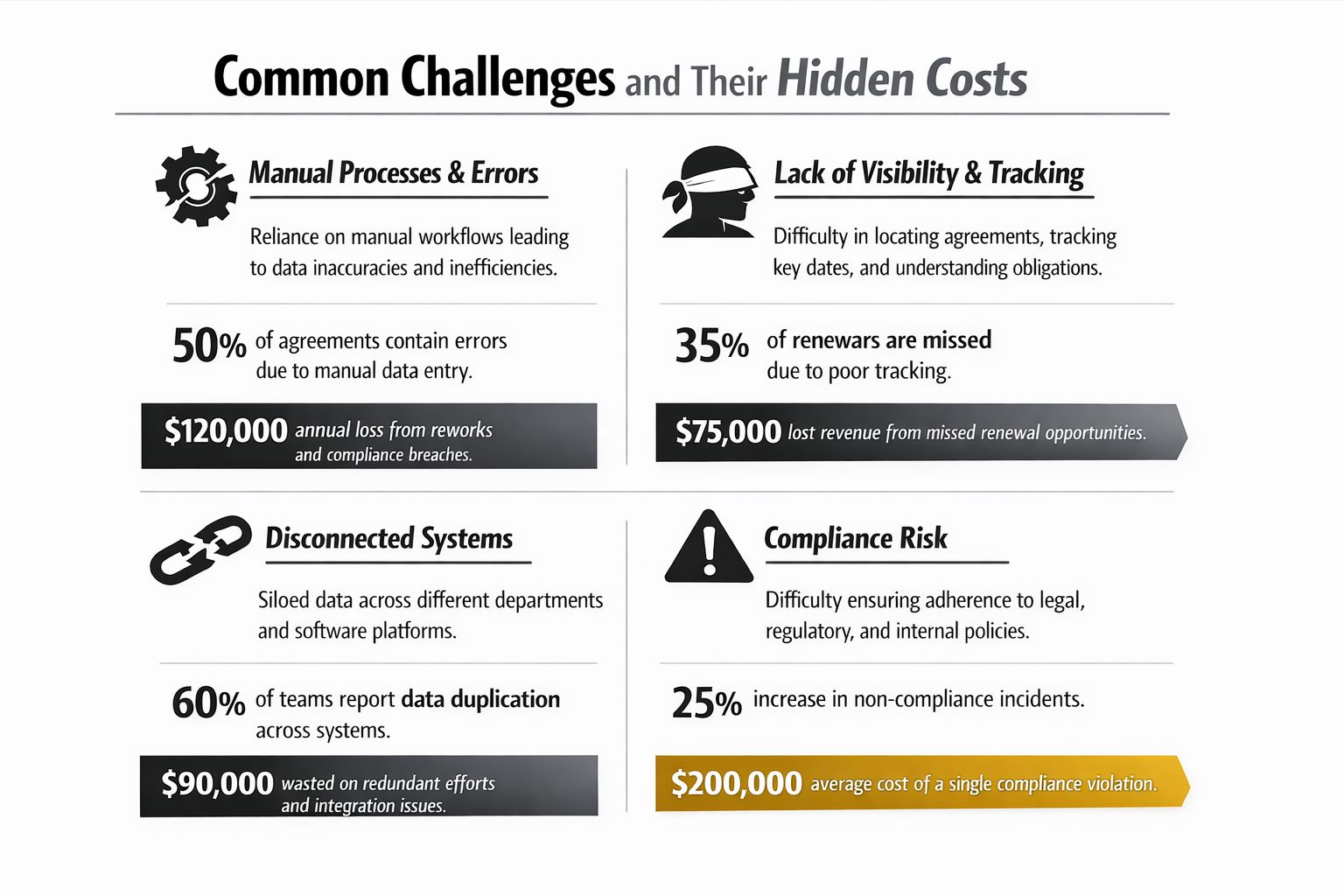
The financial impact is bigger than many leadership teams expect. Industry reporting cited in these contract management statistics and trends says organizations lose about 8.6% of contract value because obligations are missed, and companies lose 8% to 9% of annual revenue due to poor contracting practices. The same source reports that 29% of the average company’s workforce participates in contract management, while 60% of companies are still not fully automating their contracting processes.
Where the cost actually lands
Legal teams feel it as review volume and policy drift. They spend time fixing preventable errors, searching for precedent, and reconciling versions instead of focusing on real risk.
Sales teams feel it as delay. A contract that waits on unclear approvals or scattered redlines slows deal momentum and creates pressure to bypass controls.
Finance feels it later, and often harder. Billing terms don’t match what was approved. Auto-renewals hit without enough notice. Credits, penalties, and pricing adjustments get handled manually.
Procurement sees a different pattern. Supplier commitments may be documented, but performance obligations and notice windows are often disconnected from actual vendor management.
What manual environments usually get wrong
The hidden cost isn’t just that work takes longer. It’s that the same work gets repeated by different teams.
- Template sprawl: business users start from outdated drafts stored in folders or email threads.
- Version confusion: nobody knows whether the latest redline, the signed copy, or the amendment controls.
- Approval ambiguity: reviewers comment, but no one records who accepted the commercial or operational risk.
- Repository failure: the contract exists somewhere, but key fields can’t be searched or reported.
- Renewal blindness: teams notice a trigger only after their advantage is lost.
One reason CLM initiatives disappoint is that companies buy software before fixing ownership, intake, and data standards. That’s why many teams benefit from understanding why CLM platforms fail before selecting a system. The failure usually isn’t the technology itself. It’s the attempt to automate a process nobody has designed.
The expensive part of manual contracting isn’t the document. It’s the cross-departmental cleanup after the document is signed.
Managing Obligations Renewals and Amendments
Post-signature work is where most organizations lose control. They negotiate carefully, sign confidently, and then treat the agreement like a record instead of a management tool.
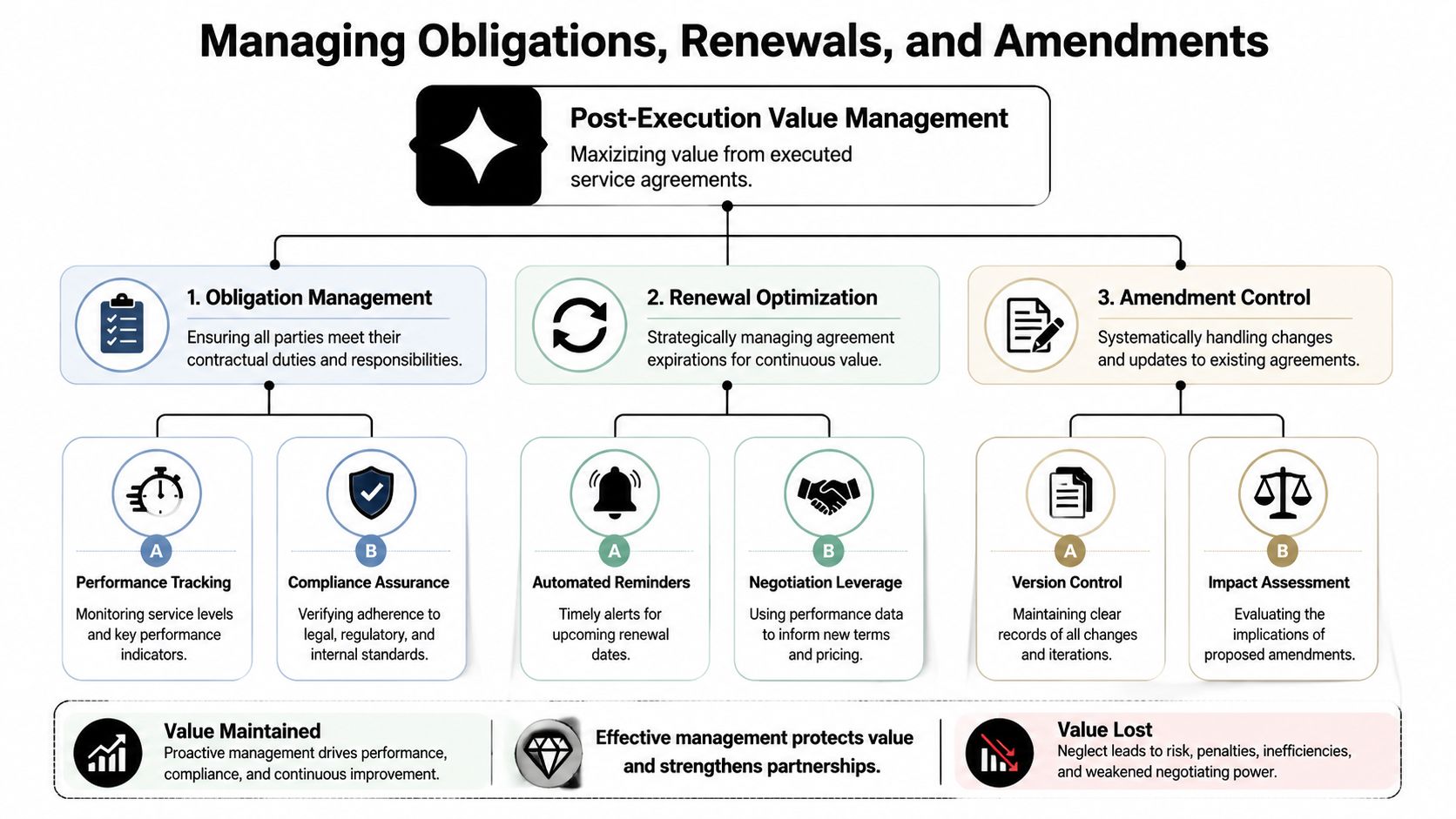
That’s a costly mistake. 62% of organizations fail to track SLA compliance or renewal triggers after a contract is signed, and companies with integrated obligation tracking reduce compliance risk by 45% by actively managing contract outcomes. Those numbers point to the same problem: the contract sits in storage while the business operates somewhere else.
Obligation management needs named owners
The fix isn’t more reminders in someone’s inbox. The fix is converting commitments into assigned work.
For service agreements, obligations usually include:
- Service levels: response times, uptime commitments, resolution targets
- Commercial terms: invoice timing, credits, price reviews, usage thresholds
- Governance duties: reporting, meetings, escalation procedures, audit support
- Compliance items: security reviews, notice obligations, approvals for changes
- Termination and notice triggers: non-renewal windows, cure periods, step-in rights
Each obligation should have an owner, deadline logic, and supporting context. If nobody owns the task after signature, the contract has already gone partially dark.
Renewal management should start early
Many organizations still manage renewals as a calendar event. That’s too late. A useful renewal workflow starts with performance review, not just date tracking.
Before a renewal discussion, teams should know:
| Review area | Questions to answer |
|---|---|
| Service performance | Did the provider meet the committed service levels? |
| Commercial fit | Does pricing still reflect actual usage and support demand? |
| Risk posture | Were there disputes, credits, incidents, or repeated deviations? |
| Strategic value | Is this agreement still aligned with current business needs? |
That information changes the conversation. Instead of reacting to an auto-renewal clock, the business negotiates with evidence.
Amendments need discipline, not convenience
Amendments often get treated like shortcuts. Someone wants to change scope, expand users, alter support hours, or add a new site, so the business rushes a short addendum through signature. That may solve the immediate issue, but it also creates interpretation risk if the amendment doesn’t clearly override the right provisions.
A controlled amendment process should preserve version history, surface impacted terms, and keep the current governing set of documents obvious to everyone who relies on it.
For teams building post-signature visibility, AI-assisted review can help identify duties and deviations buried in dense third-party language. A practical example is using tools that analyze legal documents with AI before obligations enter your workflow, especially when contracts arrive on supplier paper.
This is also where a purpose-built obligation workflow matters. Platforms such as Legitt AI obligations management are designed to extract duties, track milestones, and connect post-signature commitments to accountable teams instead of leaving them inside static files.
If your repository stores signed agreements but can’t answer “what must happen next, and who owns it?”, it’s a library, not a management system.
Key Metrics for Success KPIs and Reporting
A service agreement process is only credible if each department can see whether it’s improving. The right KPI set is practical, role-specific, and tied to decisions.
Legal metrics
Legal usually needs a view into control, consistency, and workload quality.
Track metrics such as:
- Cycle time by contract type: useful for spotting slow review paths or overloaded approvers
- Deviation from standard terms: shows where non-standard language is appearing most often
- Approval exception volume: highlights whether policies are being followed or bypassed
- Amendment frequency: can reveal weak initial scoping or recurring commercial friction
A useful legal dashboard doesn’t just show volume. It shows where the process creates avoidable risk.
Sales and revenue metrics
Sales leaders care about speed, but speed alone can be misleading. A fast contract signed on weak operational terms still creates trouble later.
The most useful measures tend to include:
- Time to first draft
- Time from final redline to signature
- Contracts stalled in approval
- Renewal decision status by account segment
These metrics help revenue teams separate healthy velocity from rushed, uncontrolled execution.
Finance and procurement metrics
Finance and procurement need visibility into money, timing, and supplier discipline. Their reporting should answer whether agreements are enforceable given how the business buys and pays.
A compact way to structure that reporting looks like this:
| Team | Useful KPI | Why it matters |
|---|---|---|
| Finance | Billing term adherence | Reduces invoice disputes and unexpected revenue leakage |
| Finance | Renewal pipeline visibility | Supports forecasting and notice planning |
| Procurement | Vendor obligation completion | Confirms whether suppliers are meeting agreed commitments |
| Procurement | Contracted service coverage | Shows whether active spend maps to current signed agreements |
What good reporting changes
Good reporting reduces arguments about where the problem sits. If cycle time is high because security review starts too late, the data will show it. If renewals are missed because the repository doesn’t capture notice dates consistently, the data will show that too.
The point of KPI design isn’t to create more dashboards. It’s to help each function act earlier and with better context.
Your Implementation Roadmap and Best Practices
Teams usually know their current process is broken before they know how to fix it. The path forward isn’t “buy CLM and automate everything.” It’s to build a reliable operating model, then use technology to enforce it.
A strong implementation starts with one principle: contracts need to become structured data. Best practice in contract data management distinguishes operational, substantive, metadata, and performance data, and recommends centralizing them in a searchable repository so workflows can trigger alerts and track obligations reliably.
Phase one fixes the process before the platform
Start by mapping the current workflow. Don’t map the policy version. Map what people do.
Look for friction points such as:
- Intake chaos: requests arrive through multiple channels with inconsistent information
- Template inconsistency: business users create drafts from old documents
- Approval confusion: teams review agreements without clear decision rights
- No post-signature handoff: signed contracts never become operational tasks
This step usually reveals that the biggest problem isn’t drafting. It’s the absence of a handoff model between departments.
Phase two defines what must be structured
Not every clause needs to become a tracked field on day one. Start with the terms that drive action.
That usually includes:
| Feature/Capability | Core Requirement | Ideal State with CLM/Automation |
|---|---|---|
| Intake workflow | Standard request capture | Guided forms route requests by agreement type |
| Template control | Approved starting documents | Central template library with clause controls |
| Approval routing | Named reviewers and approvers | Rules-based workflows by value, risk, or contract type |
| eSignature | Valid execution trail | Role-based signing with status visibility |
| Repository | Central storage | Searchable record linked to versions and amendments |
| Renewal tracking | Date reminders | Alerts tied to notice windows and owner assignments |
| Obligation tracking | Manual follow-up | Extracted duties converted into tasks and reminders |
| Reporting | Ad hoc spreadsheet reporting | Dashboards by team, contract type, and risk area |
| Integration | Manual copy-paste | CRM, ERP, and collaboration system handoffs |
| Auditability | File history | Complete version, approval, and execution trail |
Phase three selects technology that fits the workflow
Once the process is clear, evaluate software against the actual operating model. If your main pain point is third-party paper and redline control, prioritize review and negotiation workflows. If it’s missed renewals and hidden duties, prioritize extraction, metadata, and obligation tracking.
A platform like Legitt AI may fit for teams that need drafting, review, eSignature, repository management, renewals, and obligation tracking in one workflow, especially when they also want CRM or collaboration integrations. The right choice still depends on your approval structure, contract volume, data requirements, and internal adoption capacity.
Phase four drives adoption
Most implementations falter in practical application here. The system goes live, but sales keeps emailing Word files, procurement keeps tracking dates in spreadsheets, and legal becomes the cleanup team again.
Adoption improves when companies do three things well:
- Assign process owners: every stage needs a business owner, not just a system admin.
- Train by role: legal, sales, finance, and procurement shouldn’t all get the same workflow training.
- Establish firm rules: no signature outside approved routing, no unmanaged templates, no renewal handled off-system.
Technology helps only after the business decides which fields matter, who owns each action, and which exceptions are allowed.
FAQs About Service Agreement Management
What is service agreement management in simple terms
It’s the process of creating, approving, signing, tracking, updating, and renewing service contracts in a controlled way. The key difference from basic contract storage is that service agreement management also handles performance commitments, service levels, notice dates, and operational obligations after signature.
Who should own service agreement management
No single department can own it alone. Legal usually owns standards, templates, and risk controls. Sales or procurement owns commercial momentum depending on whether the agreement is customer-side or vendor-side. Finance owns billing and renewal visibility. Operations or service delivery owns performance execution. The best model is shared ownership with clear stage-by-stage accountability.
What’s the difference between a service agreement and an SLA
A service agreement is the broader contract framework. It covers commercial terms, legal protections, governance, responsibilities, and service scope. An SLA usually sits inside the agreement, or alongside it, and defines measurable service targets such as response or resolution expectations.
When should a company move from spreadsheets to CLM
The move usually makes sense when teams are missing dates, reusing outdated templates, struggling with approvals, or lacking visibility into active obligations. If people are asking multiple departments for the same contract information, the process has already outgrown spreadsheets.
What should be automated first
Start with the highest-friction, highest-volume parts of the workflow. For most companies, that means intake, approved templates, approval routing, eSignature, repository search, and renewal alerts. Obligation extraction is the next major step once the organization has a clean source of executed agreements.
How do you reduce disputes in service agreements
Reduce ambiguity before signature. Define service scope, response expectations, escalation paths, change handling, business continuity responsibilities, and named owners. Most disputes come from unclear operating assumptions, not from obscure legal drafting.
If your team is trying to move service agreements out of inboxes, spreadsheets, and static PDFs, Legitt AI is one option to evaluate for drafting, negotiation, eSignature, repository management, renewals, and obligation tracking in a single workflow. The value isn’t just faster paperwork. It’s giving legal, sales, finance, and procurement one system for managing the agreement as a live business asset.