A sales rep has a quarter-end deal sitting in procurement. A vendor onboarding package is waiting on security review. Finance wants to confirm renewal mechanics before a budget closes. Legal gets the contract, opens a third-party paper draft, and finds the usual mess: layered schedules, defined terms scattered across exhibits, one-sided liability language, and business owners who need an answer today.
That's where most contract friction starts. Not because legal is slow, but because the organization treats third party contract review like a single handoff instead of a managed workflow.
The old model breaks in predictable ways. Sales sends paper too late. Procurement triages by instinct. Finance only sees the deal after pricing or renewal language is already locked. Then legal has to untangle both legal risk and commercial leakage under deadline pressure.
A more durable model treats contract review as an enterprise process. Intake is standardized. business stakeholders know what to flag before legal touches the draft. Critical clauses are reviewed for both legal exposure and financial impact. AI contract management and CLM software then help move the document from review to redlines, approvals, eSignature, repository storage, and post-signature obligation tracking without losing context.
Beyond the Legal Bottleneck in Contract Review
The common failure point isn't the clause review itself. It's the assumption that every contract problem should be solved only after legal receives the document.
That sounds manageable until volume rises. Then legal becomes the visible bottleneck for delays that started upstream. Sales may accept third-party paper without checking data use rights. Procurement may route a vendor agreement without confirming whether there's a service level commitment. Finance may miss an auto-renewal provision until after signature. By the time counsel opens the file, the business already expects a quick yes.
That's why the shift toward specialized contract handling matters. 90% of CEOs believe their companies are leaving money on the table in contract negotiations, and the broader contract management market is projected to reach approximately $53.18 billion in 2025 according to contract review service market analysis. Contract review isn't just a legal hygiene exercise anymore. It sits directly inside revenue protection, procurement control, and enterprise risk management.
What the old workflow gets wrong
The legacy process usually looks like this:
- Email-based intake: Contracts arrive with partial context, outdated attachments, or no owner identified.
- Late-stage escalation: Legal sees the document only after business terms are already promised externally.
- Clause-by-clause rework: Reviewers spend time chasing missing exhibits and broken cross-references instead of deciding material issues.
- No lifecycle continuity: After execution, the same organization that argued over clauses often forgets to track them.
A lot of teams discover that a “review delay” is really a systems problem. If the business can't classify the contract, define the request, and surface key facts before legal review, turnaround time will stay unpredictable no matter how strong the legal team is.
Practical rule: If legal has to ask who owns the deal, what data is involved, and which fallback terms are acceptable, the contract wasn't ready for review.
Why a business-wide model works better
The better approach starts earlier and ends later. Intake, triage, review, negotiation, approvals, contract intelligence, eSignatures, repository management, renewals, and obligations tracking need to work as one chain.
That's the gap many teams run into when they rely on disconnected tools and manual habits. The limitations are clear in why traditional CLM is no longer enough, especially when third-party paper moves across legal, procurement, sales, security, and finance at once.
Third party contract review works best when legal owns standards, but not every task. Frontline teams should identify risk signals. Legal should focus on exceptions and strategy. Operations should make sure the signed agreement becomes a managed business asset, not a forgotten PDF.
A Frontline Playbook for Intake and Triage
The fastest legal review starts before legal reads a word of the contract. Business teams need a simple intake and triage method that removes guesswork and gives legal the facts needed to move quickly.
Here is the frontline workflow:
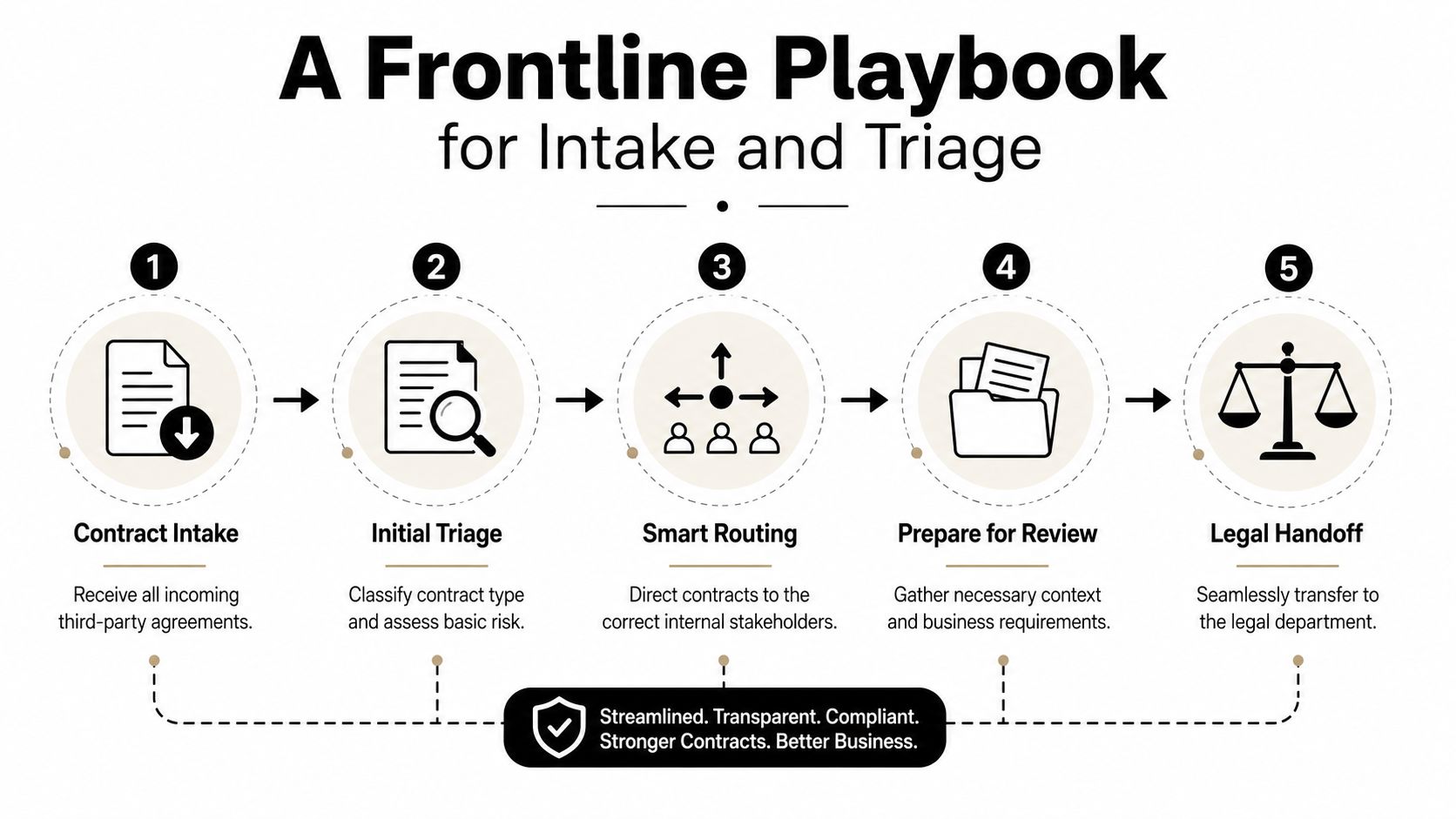
Start with one intake channel
If contracts arrive through inboxes, chat threads, and CRM notes, triage will fail. Use one intake path for all incoming third-party paper. That can live inside CLM software, a procurement workflow, or a structured request form.
The intake form should require:
- Contract owner: Who is accountable for the commercial relationship.
- Counterparty and contract type: NDA, MSA, SaaS terms, reseller agreement, order form, vendor paper, and so on.
- Business purpose: What the team is buying, selling, or authorizing.
- Urgency and timeline: Actual business deadline, not “ASAP.”
- Attachments: Main agreement, exhibits, statement of work, security addendum, data processing addendum, prior versions.
Without that baseline, legal ends up doing intake cleanup instead of contract review.
Give non-legal teams a real triage checklist
A legal-only model misses operational risk. With 70% of third-party risks stemming from operational and compliance failures rather than pure legal disputes, business teams need a standardized checklist before legal review, as noted in NCUA guidance on evaluating third-party relationships.
A usable triage checklist should ask:
| Intake question | Why it matters | Typical routing |
|---|---|---|
| Does the contract involve customer, employee, or regulated data? | Data privacy and security terms may need specialist review | Legal, security, privacy |
| Is there an auto-renewal or notice deadline? | Finance and operations need visibility early | Legal, finance, procurement |
| Are there service levels, credits, or uptime commitments? | Missed SLA language creates business exposure | Legal, operations, procurement |
| Does the paper contain uncapped liability or one-sided indemnity? | These are classic escalation triggers | Legal |
| Is the contract based on a pre-approved template? | Standard paper may move faster | Business owner, legal by exception |
This doesn't turn sales or procurement into lawyers. It helps them identify what kind of contract is in front of them.
The point of triage isn't to negotiate law. It's to stop avoidable surprises from reaching legal at the worst possible moment.
Route by risk, not by habit
Not every agreement deserves the same level of attention. A routine NDA on approved paper should not wait behind a strategic outsourcing agreement with security, data processing, and service level dependencies.
A practical routing model looks like this:
Low complexity
Standard template, low data sensitivity, no unusual liability position. These may move through pre-approved workflows and quick confirmation.Moderate complexity
Third-party paper with a limited set of deviations. Route to legal with a completed intake and business fallback guidance.High complexity
Material spend, sensitive data, operational dependencies, unusual indemnity, or broad termination restrictions. Bring in legal, security, procurement, and finance early.
Teams that manage portfolio-level visibility also get better at spotting repeat issues across vendors and contract types. That's where tools built for analyzing the entire contract portfolio in one go become useful, especially when intake patterns show the same red flags recurring across business units.
The Core Review Checklist for Critical Clauses
A sound third party contract review follows a disciplined sequence: high-level structural scan, definitions audit, marking of key provisions, and methodical sentence-by-sentence analysis of critical clauses. That workflow reduces oversight errors, especially around ambiguous cross-references that are common in 60% of poorly reviewed vendor contracts, according to Contract Nerds' guidance on reviewing third-party paper.
That structure matters because the most expensive mistakes often don't come from exotic legal issues. They come from ordinary clauses that nobody read closely enough.
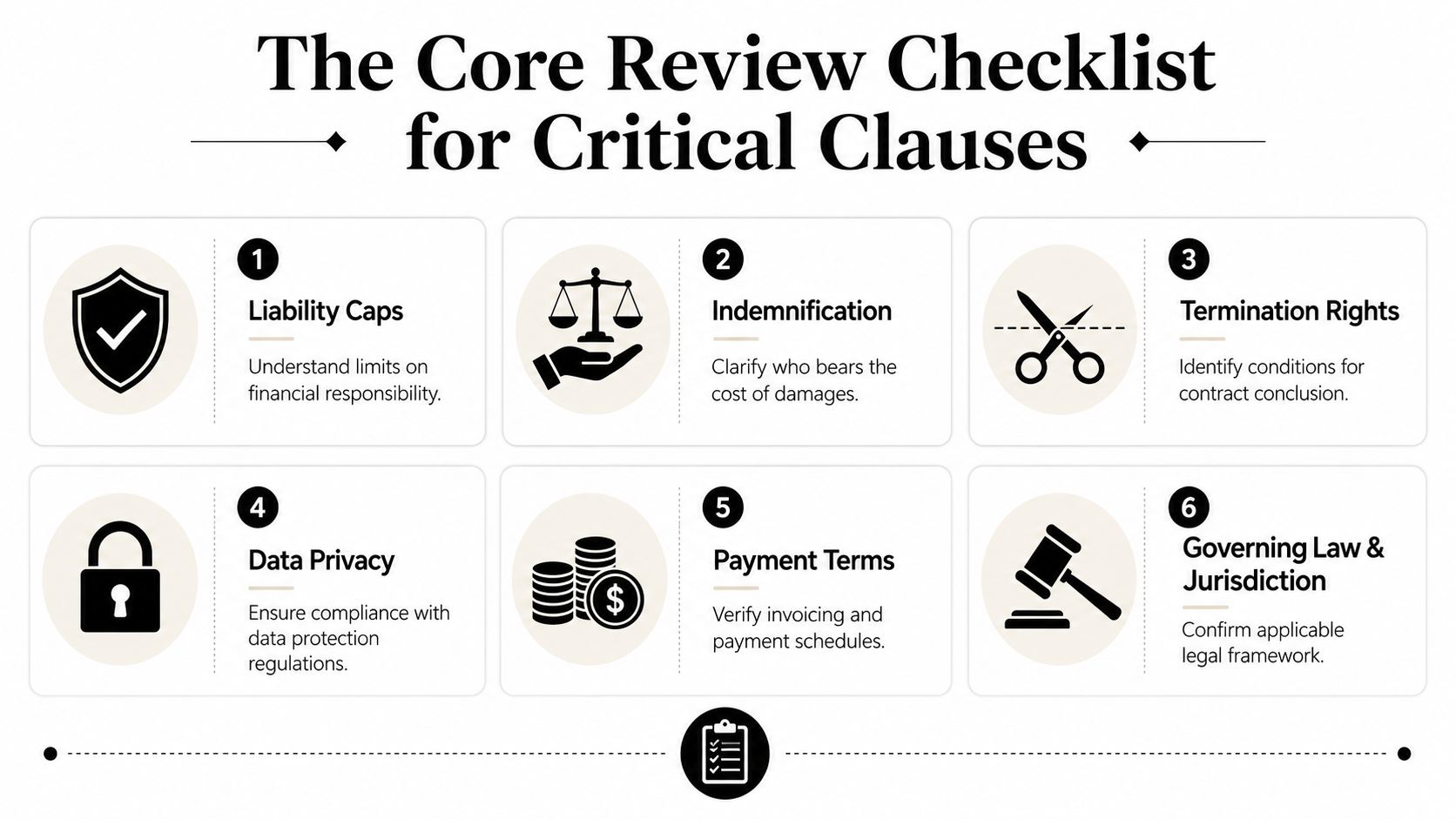
Liability and indemnity
These two clauses decide who pays when something goes wrong.
Good position: Liability is capped, the cap ties to fees or another negotiated commercial measure, and indemnity is limited to clearly defined claims.
Risky position: The counterparty asks for uncapped liability, broad indemnity for loosely defined losses, or indemnity triggered by events outside your control.
A procurement leader doesn't need to parse every doctrine here. They do need to recognize the commercial effect. If the contract value is modest but the liability language is open-ended, the risk isn't aligned with the deal.
Termination and renewal mechanics
Termination rights shape operational advantage. Renewal mechanics shape budget exposure.
Look for:
- Termination for convenience: Can either side exit on reasonable notice?
- Termination for cause: Is cure language clear and workable?
- Auto-renewal language: Are notice windows operationally realistic?
- Post-termination duties: What happens to data, fees, transition support, and IP?
The business-friendly version gives the company a clean path out if service fails or priorities change. The difficult version traps the company in a renewal cycle or leaves transition support undefined.
Data privacy and security
For software, outsourcing, and service contracts, this is often where business risk sits.
Reviewers should check for:
- Defined data ownership
- Permitted use restrictions
- Security commitments
- Breach notice obligations
- Subprocessor or subcontractor controls
- Deletion or return obligations at exit
If the contract is vague about who owns data or how the vendor may use it, legal and security shouldn't treat that as boilerplate. It affects compliance, customer commitments, and internal governance.
Key takeaway: In third-party paper, “standard terms” often mean “terms written for the other side's operating model.”
Service levels and payment terms
Often, commercial leakage begins at this point.
Service levels should state measurable commitments, consequences for failure, and reporting mechanics. If the agreement promises performance without defining service credits, reporting cadence, or escalation rights, the business may have no practical remedy.
Payment terms should cover invoice timing, acceptance criteria, dispute rights, taxes, credits, and any automatic price increase language. Watch for clauses that let one party adjust fees unilaterally or invoice against vague milestones.
Intellectual property and use rights
IP clauses matter in both buy-side and sell-side contracts.
Check whether the contract distinguishes between:
| Clause issue | Better position | Risk signal |
|---|---|---|
| Pre-existing IP | Each party retains what it owned before the deal | Broad transfer language |
| Work product | Ownership or license is clearly defined | Silence on deliverables |
| Feedback | Narrow use rights | Vendor claims broad ownership over suggestions |
| License scope | Specific internal/business use rights | Restrictions that block operational use |
For teams that want a clause-by-clause reference point, important clauses you cannot miss in a vendor contract is a useful companion read.
A practical way to train non-legal stakeholders is to borrow discipline from other diligence-heavy fields. For example, Homebase's guide for syndicators is a helpful reminder that good review work starts with structured checklists, clear ownership, and documentation, not intuition.
From Redlines to Approvals with AI Assistance
Once issues are identified, the next bottleneck is usually negotiation and internal approval. That's where AI contract review and contract automation earn their keep. The best systems don't replace judgment. They compress the repetitive work around issue spotting, playbook comparison, redline generation, and routing.
What AI changes in practice
On third-party paper, AI-driven review cuts average review times by 72% to 80%, reducing the process from 92 minutes to around 26 minutes per contract, and clause identification reaches up to 97% accuracy compared with a typical 80% accuracy for manual human review, according to AI contract review automation benchmarks.
Those numbers matter because first-pass review is where legal teams lose time to repetition. The contract may contain the same liability issue, the same renewal trap, and the same one-sided audit provision seen in dozens of prior drafts. AI can flag those deviations against a clause library or policy baseline quickly, then let counsel decide which ones matter for this deal.
A management-by-exception model
This is the operating model many teams are moving toward:
- AI reviews the incoming draft first: It extracts key terms, spots deviations, and highlights missing or nonstandard clauses.
- Playbook-based redlines are generated: Standard fallback language is inserted where internal policy is already settled.
- Approvals follow risk thresholds: Routine items can move faster. exceptions go to the right approver.
- Lawyers spend time on high-impact areas: Data use, liability, pricing mechanics, exclusivity, and termination strategy.
That doesn't remove legal from the process. It puts legal where judgment is highest-value.
Where CLM software fits
A mature CLM workflow ties together review, negotiation, approval workflows, repository management, contract intelligence, and eSignature. The benefit isn't just speed. It's continuity. The same metadata used in review should inform approvals and post-signature controls.
One example is Legitt AI, which supports AI-powered drafting, third-party paper analysis, approval routing, repository management, eSignatures, and downstream obligation tracking in one workspace. For teams building a structured review-to-approval flow, the operational logic behind streamlining contract approval processes with AI automation is the important takeaway: automate the routine path, escalate the exceptions, and keep the audit trail intact.
If the redline history, approval record, and executed version live in separate systems, the organization will eventually lose both time and accountability.
Post-Signature Management and Obligation Tracking
Many teams do disciplined contract review, then lose the value after signature. The agreement gets signed, downloaded, and buried in a folder. That's where renewal leakage, missed credits, and unmonitored obligations start.
A contract is a live operating record. If no one tracks the promises inside it, the negotiation work was only half-finished.
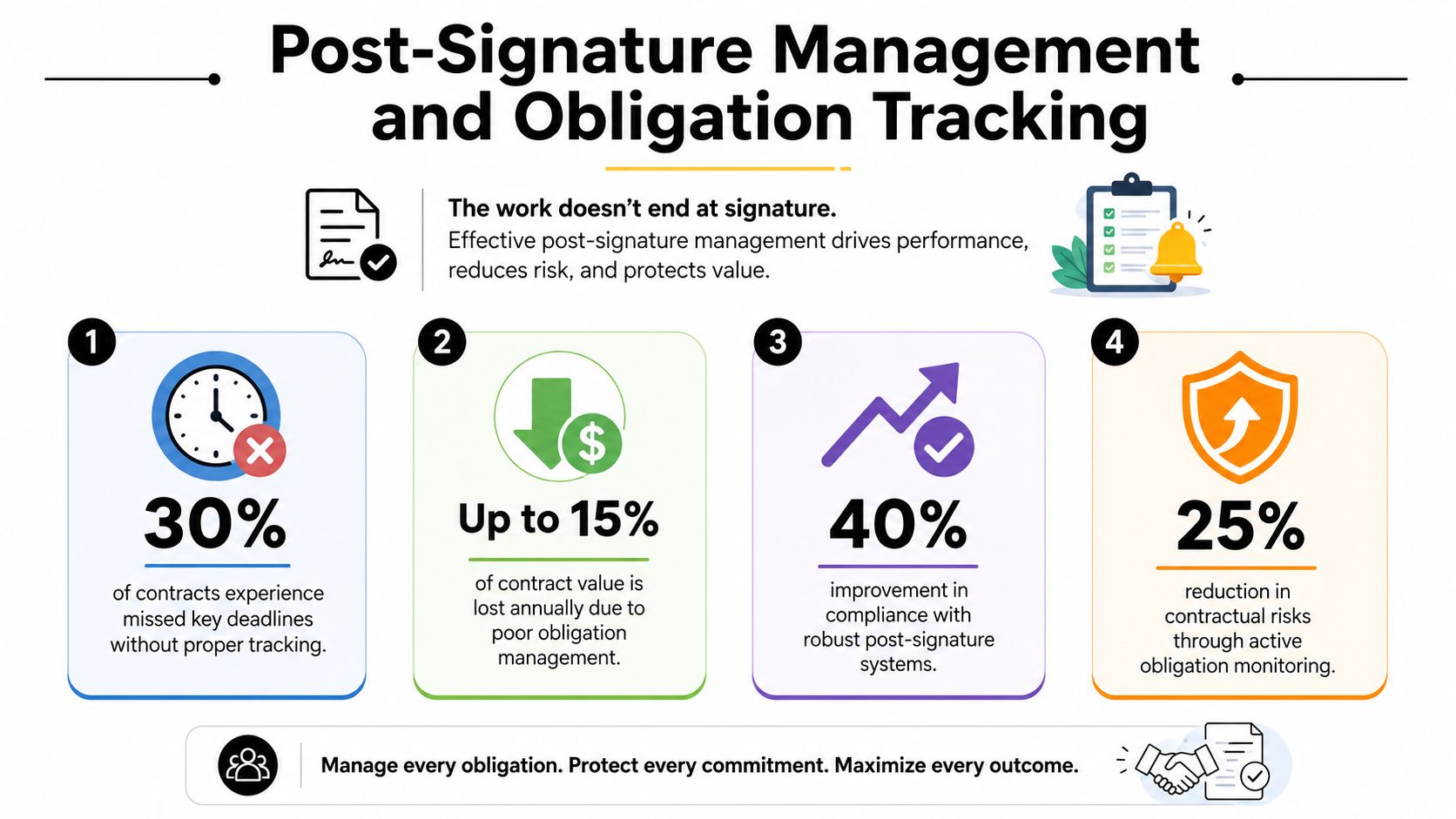
Why the repository matters
A searchable repository isn't just for document storage. It gives teams one place to find:
- Executed agreements and amendments
- Renewal dates and notice periods
- Payment obligations
- Service level commitments
- Insurance and certification requirements
- Termination assistance and data return duties
Without a central system, every milestone depends on somebody remembering that the clause exists. That doesn't scale across procurement, sales, operations, and finance.
The operational payoff of tracking
AI-powered CLM and contract intelligence tools become practical. They extract key terms from signed contracts, create structured records, and trigger alerts for deadlines and commitments that would otherwise sit unnoticed in prose.
The strongest case for post-signature tracking is operational. A 2025 Deloitte survey found that organizations using AI for obligation-tracking reduced missed SLA milestones by 68% and missed renewal windows by 74%, according to AI contract lifecycle management automation statistics.
That's not a theoretical benefit. It affects whether the business claims service credits, avoids unwanted renewals, and catches compliance failures before they become disputes.
What should be monitored after execution
A workable obligation model usually includes three categories:
| Obligation category | Typical examples | Owner |
|---|---|---|
| Commercial | Pricing changes, invoice timing, credits, renewals | Finance, procurement |
| Operational | SLAs, deliverables, audit support, implementation milestones | Operations, vendor owner |
| Compliance | Security certifications, privacy duties, notice obligations | Legal, security, compliance |
The handoff matters here. The contract owner should know what was negotiated. Finance should know what changes at renewal. Operations should know what service commitments were promised. Legal should still have visibility, but not as the sole memory bank for the company.
That's the practical value behind how AI is revolutionizing post-signing contract management. The return on contract work often shows up after signature, not during redlining.
FAQs on Third Party Contract Review Automation
| Question | Answer |
|---|---|
| Where should a company start with third party contract review automation? | Start with one contract type that appears often and follows repeatable fallback positions, such as vendor agreements or NDAs. Build intake discipline first, then automate playbook-based review and approvals. |
| Does AI replace lawyers in contract review? | No. AI is most useful for first-pass review, clause extraction, deviation spotting, summarization, and workflow routing. Lawyers still decide what to accept, reject, or escalate. |
| Which teams should be involved besides legal? | Procurement, sales, finance, security, privacy, and operations should all have defined roles. Third-party paper usually creates obligations outside the legal team. |
| How do you handle unusual or heavily negotiated contracts? | Use automation to organize the draft, extract terms, and flag deviations, then move to lawyer-led review for business-specific judgment. Complex deals benefit from structure, even when they can't be standardized. |
| What makes approval workflows actually work? | Clear risk thresholds, named approvers, and a system that routes by contract type and issue. If every agreement follows the same approval path, turnaround slows and accountability gets blurry. |
| How do smaller teams evaluate a vendor before buying software? | Ask how the system handles clause libraries, fallback language, approval rules, eSignature, repository search, renewals, and audit history. For organizations that care about process transparency in regulated work, resources explaining how GovCon Reviews operates are a useful example of why review methods and decision criteria should be visible, not opaque. |
The best rollout is usually narrow and practical. Pick a high-volume use case. Define who owns intake. Identify the clause positions the business already agrees on. Then automate what repeats.
Don't start with a promise to “transform contracting.” Start with fewer review delays, better escalation discipline, and cleaner post-signature follow-through.
If your team wants one system for AI contract drafting, third-party review, approvals, eSignatures, repository management, renewals, and contract intelligence, Legitt AI is one option to evaluate. It's built for legal, procurement, sales, and operations teams that need contracts to move faster without losing control.