Many organizations still treat contract compliance like a filing exercise, something legal checks after signature and everyone else forgets. That approach misses critical risk. If the signed contract says one thing and execution does another, the business loses control over revenue, service levels, deadlines, and vendor performance.
What is contract compliance in practical terms? It's the discipline of turning negotiated terms into trackable obligations, then verifying that the business delivers what was promised. In that sense, a contract is less like a stack of paper and more like a blueprint for a building. Compliance is the ongoing inspection process that makes sure the structure is being built to spec, stays safe, and functions the way the business intended.
For a General Counsel, that shift matters. Contract compliance is not just a legal burden, it's a financial control and an operational system that connects legal language to measurable business outcomes. When procurement, finance, sales, and operations all work from the same obligations, the company can spot issues earlier, document them better, and fix them before they become losses.
What Contract Compliance Means for Your Business
Contract compliance means the company is following the agreed economic, operational, regulatory, and administrative terms throughout the life of the contract. That includes payment terms, service levels, delivery milestones, confidentiality duties, notice periods, reporting requirements, and renewal windows. In procurement, compliance is often managed as a recurring control, and a central, searchable repository is part of that control because it gives teams a reliable place to find obligations, compare terms, and track what has changed over time. A neglected agreement creates risk long before anyone treats it as a legal issue, as noted in why you should not neglect business agreements.
The useful way to think about it
A contract compliance program answers a simple question. Did the company get the value it negotiated, on the terms it negotiated, in the time it negotiated? If the answer is unclear, the business does not have compliance, it has a signed document.
This is why the strongest programs treat compliance as an operating discipline. They extract obligations into structured data, assign owners, monitor deadlines, and log exceptions. That shifts the work away from reactive chasing and toward measurable control, which is the difference between a legal archive and a functioning business process.
Practical rule: if a clause cannot be tied to an owner, a deadline, or an evidence trail, it is not under control yet.
The business benefit is straightforward. When legal, procurement, finance, and operations can all see the same obligations, they can manage renewals, pricing, performance, and escalation before small misses turn into disputes. A contract compliance process also helps teams spot where execution is drifting from the agreed terms, so corrective action happens while there is still time to protect revenue and limit exposure.
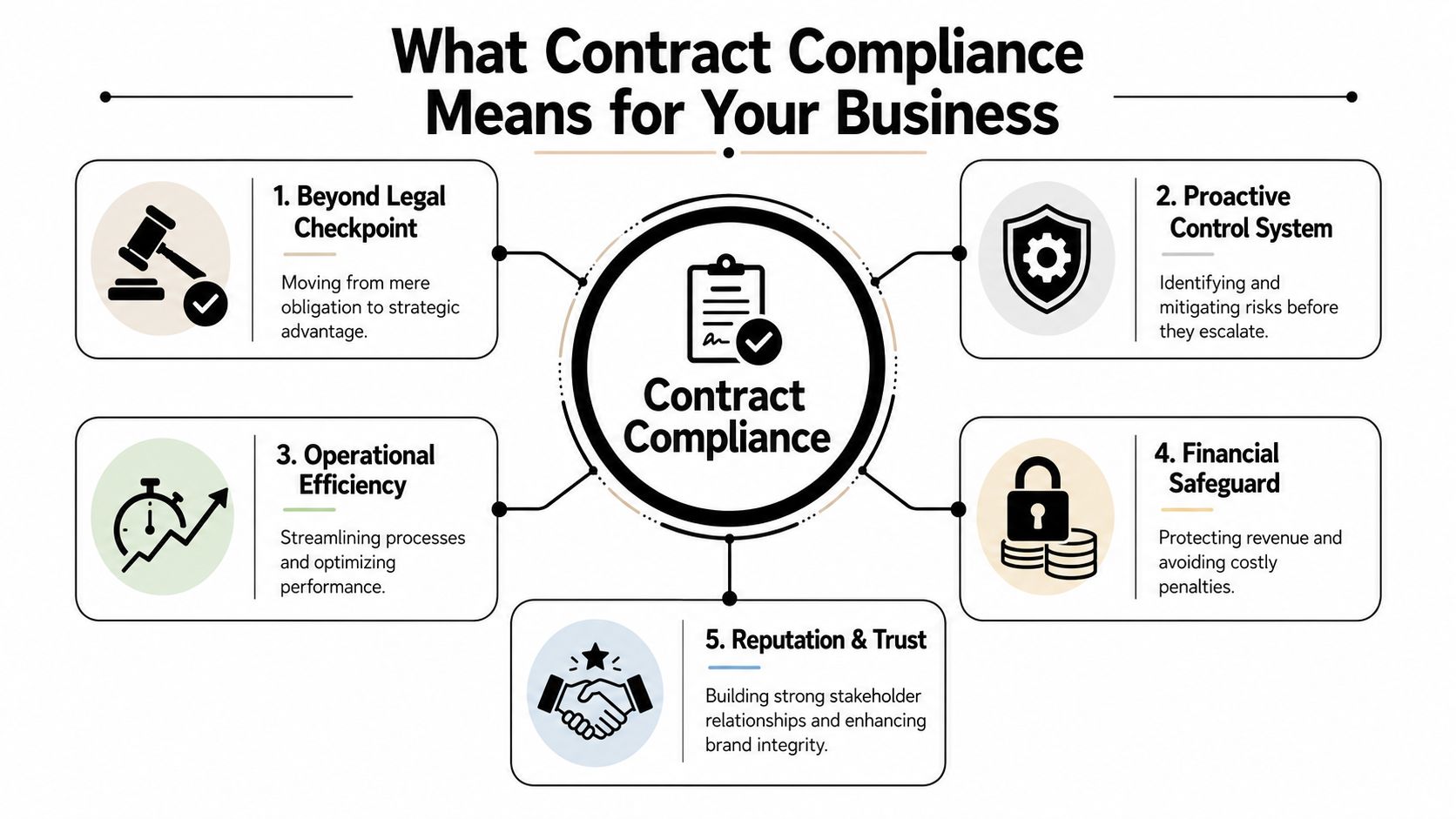
What changes when compliance is managed well
A mature contract compliance process makes obligations visible and actionable. Instead of reading a 40-page agreement line by line when something goes wrong, teams can see the clause, the owner, the due date, and the evidence of performance in one place. That gives the business a working control system, not just a legal record.
It also changes how leaders talk about contracts. The question stops being “Was this signed?” and becomes “Is execution still matching the agreement?” That is a much more useful question for a GC, because it ties contract management to revenue protection, vendor accountability, and operational reliability. Systems such as Legitt AI help make that shift practical by turning contract terms into a living workflow instead of a static file after signature.
Why Compliance Is a Financial and Strategic Imperative
A lot of contract programs are framed as risk avoidance. That framing is too narrow. Compliance is also how companies protect margin, verify billing, and preserve the negotiated value that often disappears between signature and execution. A compliance audit is the mechanism that compares the paper agreement with actual invoices, pricing, rebates, service levels, and deliverables, which is why it's really a financial controls exercise as much as a legal one (Apex Analytix on contract compliance audits).
The value question is bigger than legal exposure
Procurement teams use compliance to confirm suppliers are honoring pricing and service commitments. Finance uses it to reconcile invoices and catch leakage. Sales uses it to keep customer commitments aligned with delivery, while legal uses it to preserve the audit trail and control exceptions. Those goals are different, but they all depend on the same thing, accurate execution against the signed terms.
That's why the most effective leaders don't ask whether compliance is worth doing. They ask where compliance should focus first. High-value contracts, risky vendors, customer deals with service credits, and agreements with complex billing structures usually deserve the earliest attention because they carry the clearest financial upside when monitored properly.
Practical rule: if a contract affects billing, rebates, credits, renewals, or service obligations, it belongs on the compliance radar, not in a forgotten folder.
The strategic upside is real too. When the business has evidence-based compliance data, renewal conversations become sharper, supplier relationships become more accountable, and internal teams stop negotiating from memory. That's the difference between a reactive contract function and one that supports planning, forecasting, and commercial discipline.
For teams looking at the revenue side of the house, contract compliance on revenue realization is a useful lens because it ties contract terms to actual cash outcomes. Revenue isn't realized just because a deal was signed. It's realized when the company delivers, bills, collects, and documents the value promised in the agreement.
Why finance should care as much as legal
Finance leaders often have the clearest view of contract compliance failure because billing errors, missed credits, and inconsistent pricing show up in the general ledger long before they show up in a legal dispute. That's why a strong compliance program should include invoice review, rebate verification, and exception tracking, not just clause review.
The strongest organizations connect those controls. They use one set of contract data to support both legal oversight and financial reconciliation. That makes compliance a shared operating model instead of a siloed legal task.
The Core Components of Contract Compliance
A contract only becomes manageable when it is broken into trackable parts. The signed agreement may look like a single document, but compliance lives in specific obligations, dates, approvals, and controls. Modern guidance treats compliance as measurable, and the compliance rate formula, (Number of Obligations Met / Total Number of Obligations) * 100, makes that point clear, compliance is a measured state, not a binary yes-or-no judgment.
Obligations, dates, and regulatory rules
The first component is the obligation itself. A supplier may owe a delivery milestone, a customer may owe a payment term, and a service provider may owe a service level. If the business cannot name the obligation clearly, it cannot monitor it reliably.
The second component is timing. Renewal windows, reporting deadlines, pricing resets, termination notices, and performance checkpoints all need a calendar owner. A missed date can create a lost renewal, an unearned discount, or a compliance gap that is difficult to unwind later.
The third component is policy and regulation. Internal approval rules matter, and so do external requirements such as data protection, sector-specific controls, and confidentiality obligations. Contract compliance only works when these rules are translated into operating steps that people can follow.
Approval paths and evidence
Approval workflows are part of compliance too. A non-standard clause, a pricing exception, or a waiver needs a documented path so the company knows who approved it and why. Without that trail, the organization cannot defend its position during a dispute or audit.
The evidence trail matters just as much as the rule itself. If a vendor says it met a service commitment, the business should be able to show the report, invoice, delivery log, or performance record that supports that claim. That is where compliance becomes operational, not theoretical.
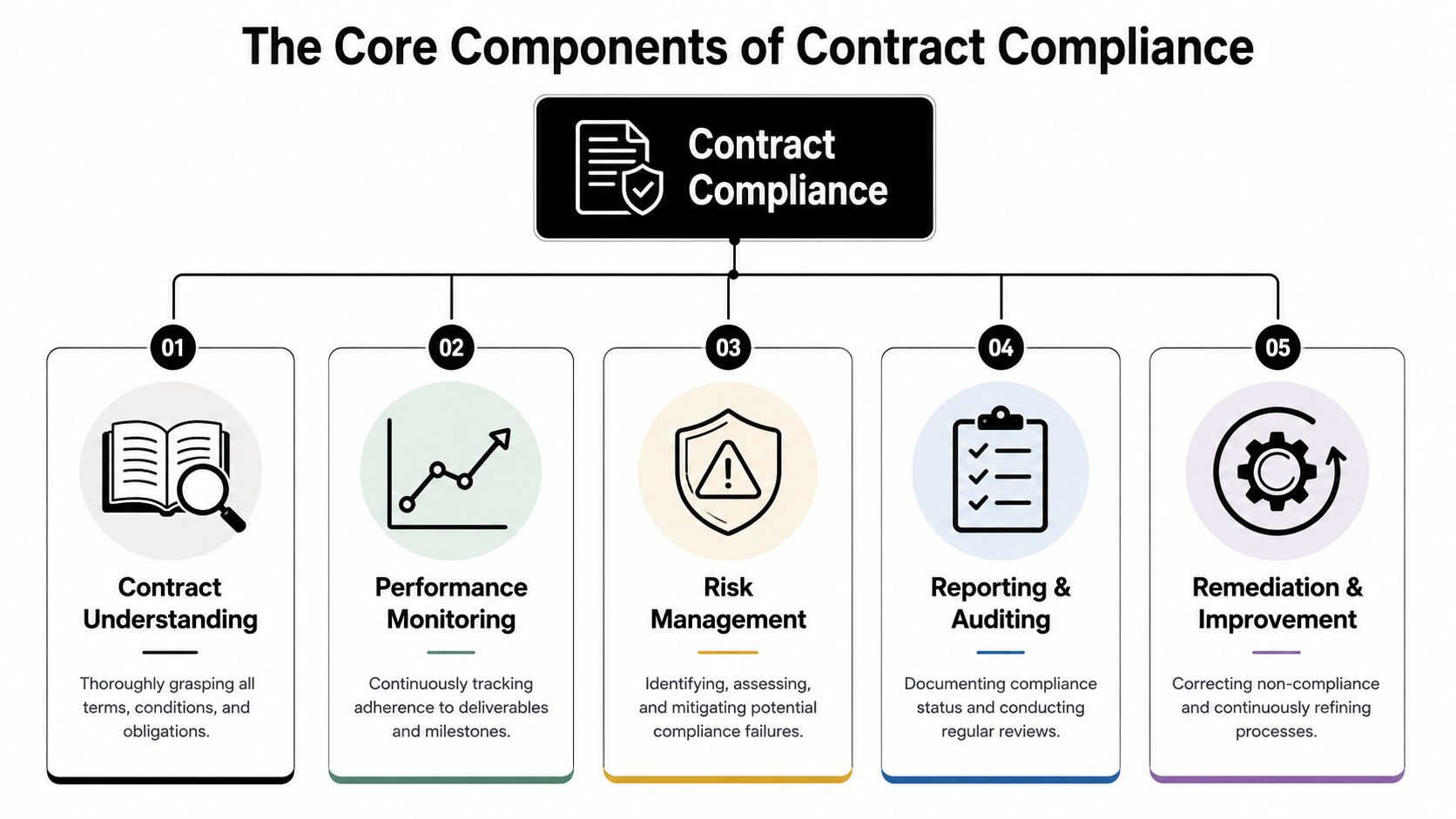
A useful way to simplify the work is to treat every material clause as a data point. Who owns it? When is it due? What evidence proves it happened? What happens if it does not? Once those answers are visible, the contract stops being a static document and starts functioning like a controlled business process.
If the organization already has a governance model, key components of effective contract governance frameworks is a helpful companion lens because contract compliance depends on governance discipline, not just a review checklist. For the mechanics of ownership, escalation, and recordkeeping, RNC Group's contract management insights is a useful reference.
Building a Modern Compliance Framework
A modern framework starts with ownership, not software. Someone has to be responsible for each obligation, each exception, and each escalation path. When ownership is vague, compliance becomes everybody's job and nobody's job at the same time.
Start with scope and ownership
The most practical first move is to define scope by risk and business impact. High-value supplier contracts, revenue-critical customer deals, and regulated agreements should be mapped first. Then every material clause needs a named owner, because a clause without an owner is a missed task waiting to happen.
That ownership model should extend beyond legal. Procurement should own supplier performance, finance should own billing and rebate checks, sales should own customer commitments, and operations should own service delivery where appropriate. Shared responsibility works only when responsibilities are explicit.
A useful resource on this point is RNC Group's contract management insights, which reinforces the value of disciplined process, clear ownership, and repeatable management practices.
Standardize the process and centralize the record
After ownership comes standardization. Approved clauses, playbooks, escalation rules, and exception criteria give the business a consistent way to create and manage obligations. That consistency matters because compliance fails most often at the seams, when one team works from a template and another team works from memory.
Centralization is the next control point. A single searchable repository lets teams find the current version, the amendments, the approvals, and the supporting documents without digging through inboxes or local drives. ISM's guidance on centralized repositories is useful here because it ties the repository directly to operational control, not just storage (ISM on contract compliance repositories).
If the organization is designing a formal operating model, governance in contract lifecycle management can serve as the next reference point, since governance is what keeps the framework from collapsing into ad hoc follow-up.
The best framework is the one people can actually use on a busy Tuesday. If the process depends on heroics, it won't scale.
Communication, escalation, and review
A strong framework also needs escalation paths. If a supplier misses a delivery milestone or a customer disputes a billing term, the issue should move through a defined route with clear thresholds for legal review, business approval, and remediation. That prevents delay, preserves evidence, and makes the response predictable.
Review cadence matters too. Contracts change, operating conditions change, and obligations drift if nobody checks them. A reliable framework treats compliance as a living process, with periodic review and continuous updates to the repository, playbooks, and approval rules.
The Role of AI and CLM in Automating Compliance
Manual compliance tracking breaks down fast. Spreadsheets drift out of date, email threads bury approvals, and no one wants to read every contract line by line just to answer a simple question about obligations or renewals. Modern Contract Lifecycle Management (CLM) platforms make compliance operational instead of theoretical.
What AI changes in the workflow
AI helps by extracting clauses, surfacing obligations, flagging deviations, and routing exceptions into a structured workflow. The business no longer has to rely on memory or manual reading to know where risk sits. The contract becomes searchable, monitorable, and auditable across its lifecycle.
Legitt AI is one example of this workflow in practice. Its platform brings drafting, redlining, approvals, eSignature, and repository management into one workspace, then uses AI agents to extract clauses, identify risk and deviation, and track obligations and renewals. In compliance terms, that turns the signed contract into a monitored record rather than a static file.
The repository layer matters because control improves when contracts sit in a central, searchable system. That is the operating logic behind centralization, and it is why the storage layer belongs in the control model, not just the filing cabinet. Lighthouse Consultants' audit technology insights make a similar point about how AI-supported review depends on structured records and clear evidence trails. A well-designed CLM setup gives compliance teams the same visibility across contracts, amendments, and supporting documents.
A workable AI-enabled compliance flow
A practical team can use CLM software in a clear sequence.
- Draft and standardize: use templates and clause libraries so common obligations start in approved language.
- Extract and structure: let AI pull out payment terms, SLAs, renewals, and reporting duties into data fields.
- Route approvals: send non-standard terms through controlled review instead of informal email chains.
- Monitor continuously: use alerts for milestones, expirations, and obligation deadlines.
- Preserve the trail: store versions, signatures, amendments, and evidence in one repository.
That workflow reduces the manual load on legal and operations teams while improving auditability. It also makes compliance easier to manage at scale, because monitoring happens continuously instead of only when someone remembers to check.
For teams evaluating automation through a governance lens, contract governance KPIs for legal operations provide a practical way to tie automation to measurable controls rather than vague efficiency claims.
Why this matters to legal ops and finance
AI-powered CLM does not remove accountability. It makes accountability visible. Legal still sets the guardrails, finance still checks the money, and procurement still owns vendor performance, but the platform helps them work from the same contract data in real time.
That visibility is where the operational payoff sits. Renewals get managed earlier, exceptions are documented better, and deviations are easier to escalate before they become losses.
Measuring and Auditing Contract Compliance Success
If compliance cannot be measured, it cannot be managed. The practical way to track it is to tie a small set of KPIs to obligations, financial outcomes, and audit readiness. The point is not to create a dashboard for its own sake. It is to show whether contract terms are being performed, whether value is leaking, and whether the organization can prove it under review.
A useful compliance program treats measurement as a control system. That means tracking completion, exceptions, and remediation speed across the contract lifecycle, not waiting until a post-signature review exposes the problem. In that sense, compliance is a data and operations issue as much as a legal one.
KPIs that actually tell you something
A useful compliance dashboard usually includes a few core measures.
- Contract compliance rate: the share of obligations met versus total obligations.
- Repository coverage: the percentage of executed contracts stored in a central, searchable system.
- Resolution time: how long it takes to close a compliance gap once it is identified.
- Recovery value: how much leaked value, missed credit, or billing error was identified and corrected.
- Audit readiness: how quickly the team can produce evidence for internal review or external scrutiny.
These metrics matter because they connect contract language to operational performance. If the compliance rate is weak, the issue may be ownership. If resolution time is slow, the issue may be escalation. If repository coverage is incomplete, the issue is usually process discipline, not legal drafting.
For a broader view of performance tracking, key performance indicators for contract governance is a useful companion because governance metrics and compliance metrics should line up around the same control objectives.
What a contract compliance audit looks like
A formal audit should follow a clear sequence. First, define scope and objectives. Then gather the contract, amendments, invoices, service reports, correspondence, and supporting records that show what happened in execution. After that, compare the terms against actual performance and the applicable regulatory or policy requirements.
The audit workflow in Malbek's contract compliance guide maps to a practical process, planning and scoping, document collection and review, stakeholder interviews, compliance testing, findings documentation, and recommendation development. That structure keeps the audit grounded in evidence instead of memory or assumption.
A good audit does not just find problems. It shows which controls failed, which team owns the fix, and what evidence will prove the fix worked.
The most important output is not the report itself, it is the follow-through. Findings need owners, deadlines, and remediation tracking. If the audit shows repeated issues, the company should adjust templates, playbooks, approval paths, or system controls so the same failure does not keep returning.
The best compliance programs use audits as a feedback loop. They do not wait for a dispute to learn what went wrong. They use audit findings to tighten the control system, improve negotiation positions, and protect future revenue.