Your contracts are probably sitting in too many places right now. Some are in email threads. Some are buried in shared drives. Some are inside a CLM, but only as PDFs that no one can search in a useful way.
Then a renewal date gets missed, a payment term is interpreted differently by finance and procurement, or legal gets asked the same question again: “What did we agree to in this vendor paper?”
That's the gap contract intelligence is designed to close. It turns contracts from static documents into usable business data.
Understanding contract intelligence
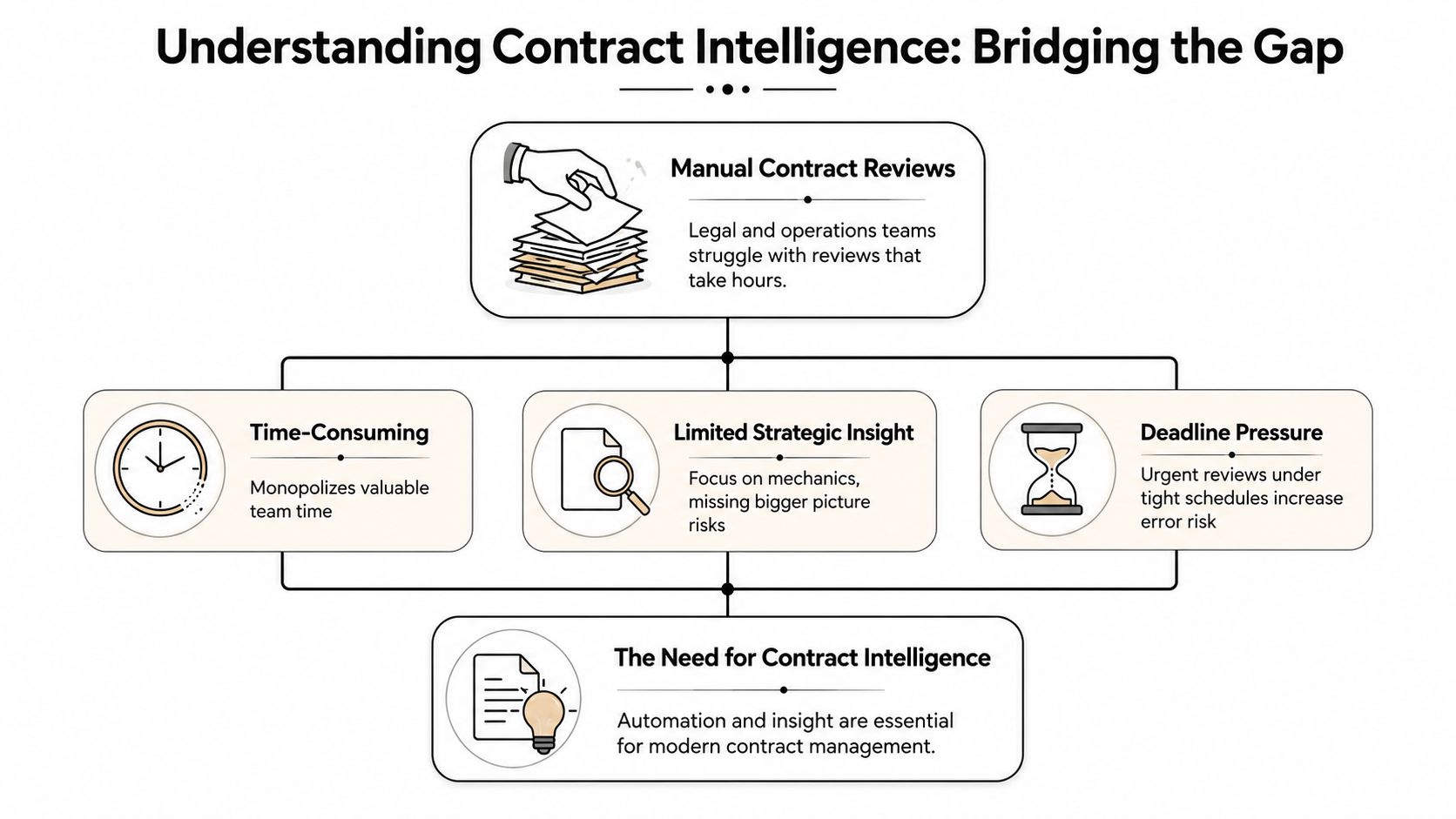
Manual contract review creates a familiar bottleneck. Legal teams read line by line. Procurement waits for answers on indemnity, auto-renewal, or price-change language. Sales wants redlines back before the quarter closes. Operations needs to know which agreements carry reporting duties or notice periods.
The work is important, but the format is the problem. Contracts are written for humans, not systems. Most of the value is locked inside dense, unstructured text.
The plain-English definition
What is contract intelligence? It's the use of AI, NLP, and machine learning to automate the management, analysis, and extraction of value from legal agreements. In practical terms, that means software can read contracts, identify important terms, structure the information, and make it searchable and actionable across the business. That definition aligns with Astute Analytica's contract intelligence market overview, which also notes the market was assessed at approximately US$1.59 billion in 2024.
A simple analogy helps. Think of a contract as a long medical report. A person can read it and understand it, but that doesn't make it easy to compare hundreds of reports at once. Contract intelligence works like a system that tags the diagnosis, dates, risks, and follow-up actions so teams can search and act without rereading every page.
Why it matters to business leaders
Business leaders usually don't need another repository. They need answers.
- Legal needs faster issue spotting. Which clauses depart from policy?
- Procurement needs visibility. Which vendor agreements auto-renew soon?
- Sales needs speed. Which fallback language is acceptable without legal review?
- Finance needs control. Which contracts contain rebates, notice requirements, or payment obligations?
Practical rule: If your team still has to open ten PDFs to answer one business question, you have document storage, not contract intelligence.
The shift matters because it changes the role of contracts in decision-making. Instead of treating agreements as files to archive, teams can treat them as operating data. That's why contract intelligence is increasingly discussed alongside CLM, contract review, contract automation, legal operations, and enterprise workflow design.
If you want a useful foundation on the broader move toward AI-enabled contract processes, this overview of AI-based contract management gives helpful context.
Key components of contract intelligence
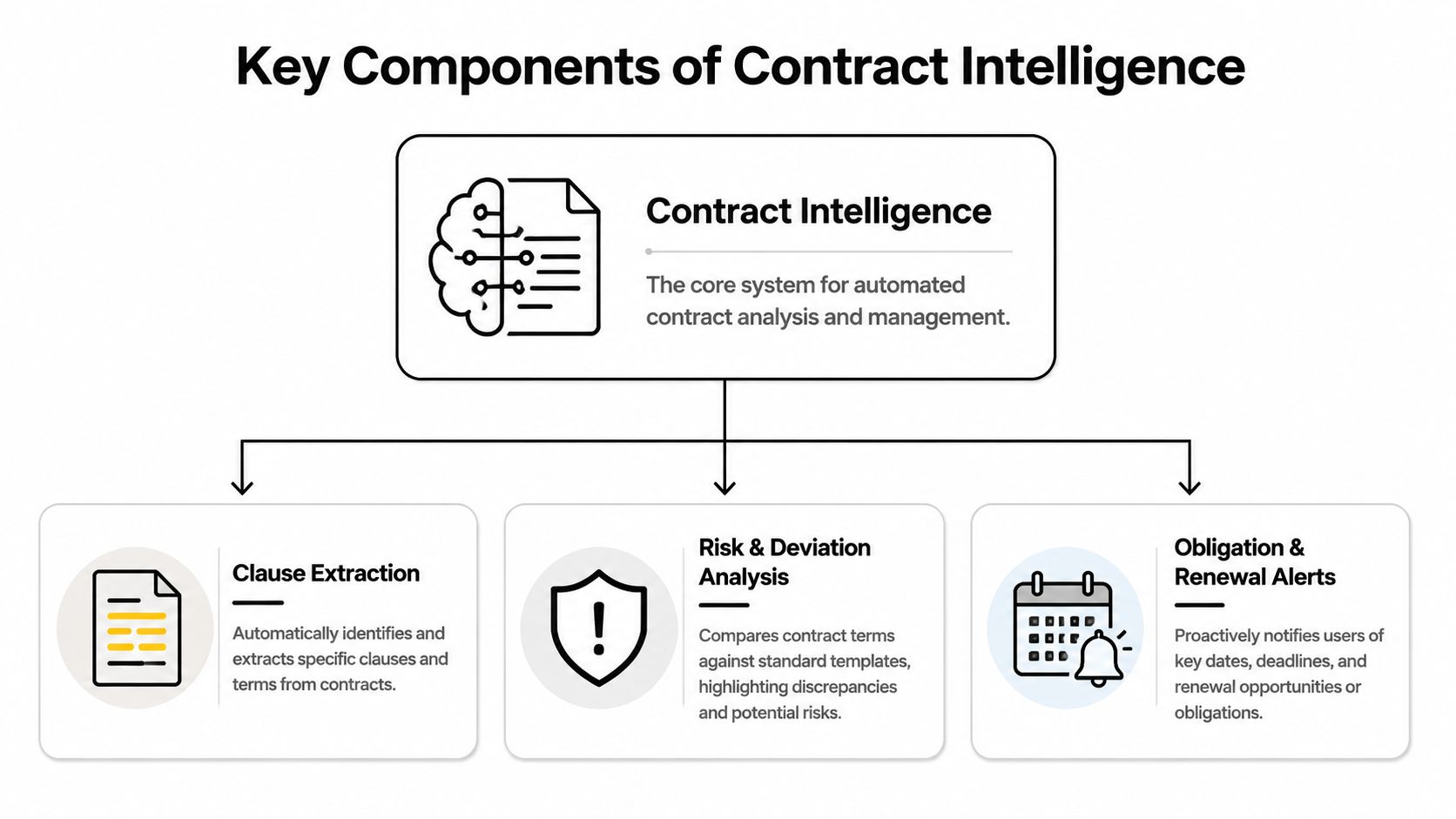
Contract intelligence sounds abstract until you break it into parts. Most platforms combine a few core capabilities that work together. If one is weak, the whole experience suffers.
Clause extraction
This is the engine typically observed first. The system reads a contract and pulls out items like parties, governing law, renewal dates, payment terms, assignment rights, limitation of liability language, and termination provisions.
In business terms, clause extraction is like highlighting the lines your team always hunts for, then putting those lines into fields you can search, filter, and report on.
A procurement example is straightforward. You upload a supplier agreement, and the system identifies:
- Commercial terms: pricing language, rebates, credits, and fee triggers
- Timing terms: effective dates, notice windows, renewal cycles
- Control terms: audit rights, data handling clauses, service levels
Risk and deviation analysis
Extraction tells you what's in the contract. Risk analysis tells you whether it's a problem.
A CLM or AI contract review tool compares incoming language against your approved playbook, clause library, fallback positions, or template standards. If the indemnity is broader than usual, if liability caps are missing, or if a confidentiality clause conflicts with policy, the system flags that deviation for review.
Legal operations teams often gain a significant advantage. The review process stops being “read everything from scratch” and becomes “inspect the exceptions.”
The fastest legal review often isn't reading quicker. It's reducing the volume of language that actually needs judgment.
Obligation tracking and renewal alerts
Many teams think review ends at signature. That's where a lot of value is lost.
Contract intelligence can track post-signature obligations such as reporting deadlines, payment milestones, notice periods, service-level commitments, and renewal windows. Instead of relying on calendar memory or spreadsheet discipline, the platform pushes those obligations into a managed workflow.
That capability depends on the quality of the underlying language processing. Context Capability's explanation of contract intelligence analysis notes that successful extraction from unstructured agreements relies on NLP infrastructure meeting minimum organizational CMC levels including Formality L3, Capture L3, Structure L4, Accessibility L3, Maintenance L3, and Integration L2.
Repository search and analytics
A strong repository doesn't just store signed PDFs. It lets users ask business questions in plain language and retrieve contract-backed answers.
That's similar in spirit to how teams use trusted SaaS metrics to create consistent, queryable business definitions. In contract work, the same logic applies. Terms need structure before they become reliable operational data.
A useful repository should help you answer questions like:
- Which agreements renew next quarter
- Which customer contracts cap liability below policy
- Which vendor contracts include audit rights
- Which NDAs use non-standard confidentiality periods
Contract intelligence in CLM workflows
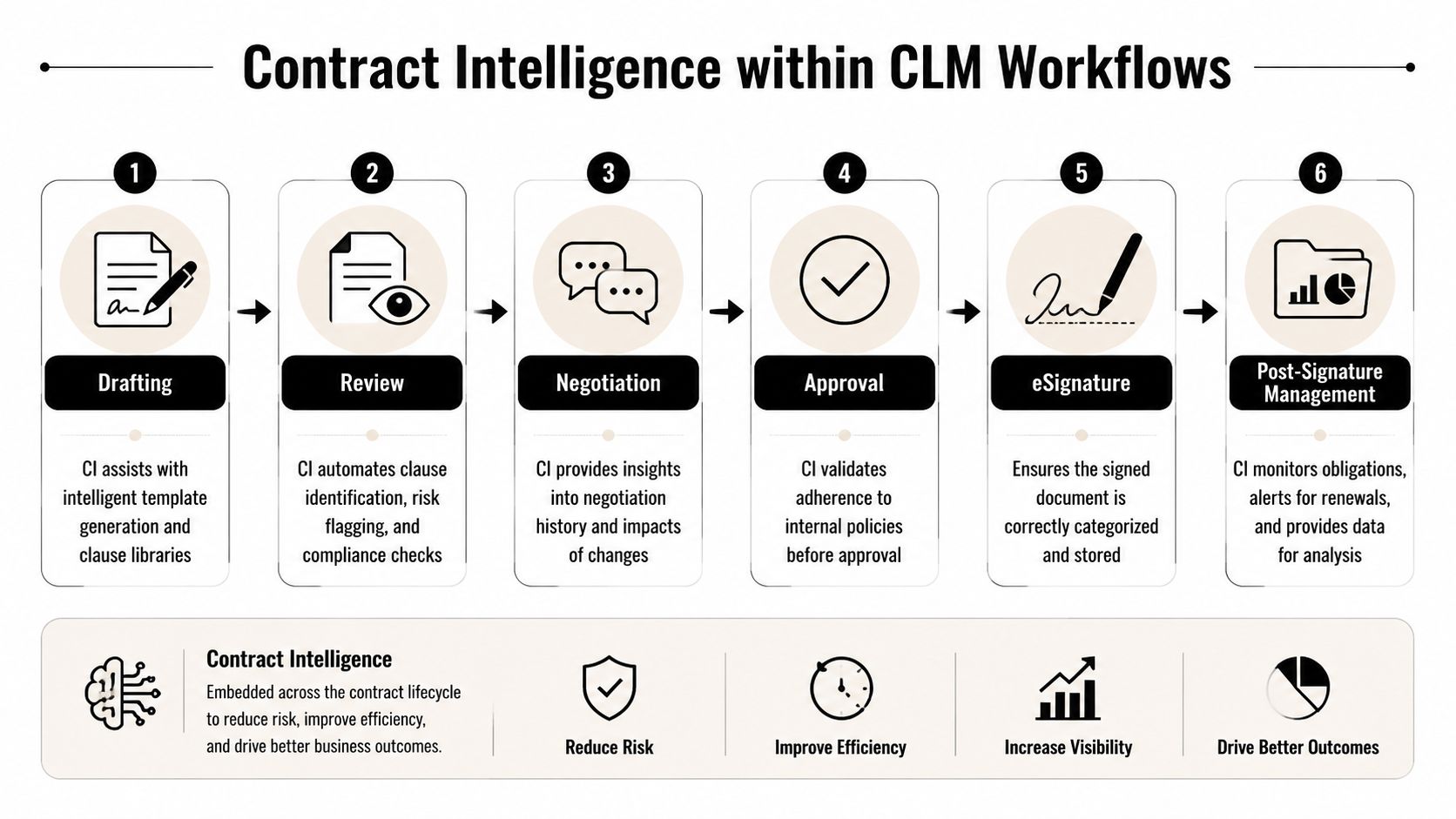
Contract intelligence becomes more valuable when it's embedded across the lifecycle, not bolted onto the repository after signature. In a well-designed contract lifecycle management process, AI supports drafting, review, negotiation, approval, execution, and post-signature management.
How the workflow changes
A traditional workflow often looks like this: someone starts from an old agreement, emails a draft, legal reviews manually, approvers respond in fragments, the final version gets signed, and the executed copy disappears into a folder.
An AI-enabled CLM workflow is more structured:
- Drafting: teams start from approved templates and clause libraries
- Review: AI identifies key terms and flags deviations
- Negotiation: redlines are assessed against policy and fallback positions
- Approval: routing follows deal size, clause risk, or business unit rules
- eSignature: the final document is executed and stored in the right record
- Post-signature management: obligations, renewals, and milestones are tracked
Where the speed comes from
The biggest gains usually appear in review intake. Stealth Agents' summary of Gartner's 2025 procurement technology trends states that AI contract management tools reduce the time to extract and structure key terms from a vendor contract by 80 to 90%, shrinking the process from 45 to 60 minutes of attorney or paralegal review to 5 to 7 minutes of AI-assisted extraction with human confirmation.
That doesn't mean lawyers disappear from the process. It means lawyers spend more time deciding and less time hunting.
A practical CLM example
Consider a third-party vendor agreement arriving in procurement:
| Stage | Traditional process | Contract intelligence workflow |
|---|---|---|
| Intake | Email attachment sent to legal | Contract uploaded into CLM intake |
| Review | Manual read-through | Clauses extracted and risk flags generated |
| Negotiation | Legal compares redlines manually | Deviations compared to playbook |
| Approval | Email chain and follow-ups | Policy-based routing inside workflow |
| Signature | Final PDF sent around | eSignature with status tracking |
| Renewal | Tracked in spreadsheet or missed | Automated alert and obligation monitoring |
For teams evaluating how AI fits across the full contract lifecycle, this guide to AI in contract lifecycle management is a useful companion read.
Benefits and ROI by department
Contract intelligence gets approved when leaders can connect it to revenue protection, cycle time, compliance, and workload reduction. The ROI case isn't only about legal efficiency. It touches every team that creates, negotiates, approves, or relies on contract data.
One of the clearest business risks is leakage. Stealth Agents' research on AI contract lifecycle management statistics cites World Commerce and Contracting's finding that organizations lose an average of 9.2% of annual revenue due to poor contract management.
That number matters because poor contract handling rarely shows up as one dramatic event. It shows up as missed notice windows, unenforced entitlements, late approvals, expired contracts, inconsistent fallback terms, and billing terms that never make it into downstream systems.
How to think about ROI without overcomplicating it
A practical ROI model starts with four questions:
- Time saved: How much review and admin time can legal, procurement, and sales recover?
- Revenue protected: Which negotiated terms are currently missed after signature?
- Risk reduced: How many high-friction reviews come from policy deviations discovered too late?
- Operational visibility: How quickly can finance or operations answer contract questions today?
You don't need a perfect finance model on day one. You need a baseline and a measurable pilot.
Start with one contract family, one business process, and one set of metrics. Broad transformation usually begins with a narrow win.
Benefits and ROI by Department
| Department | Key Benefits | ROI Metrics |
|---|---|---|
| Legal | Faster issue spotting, more consistent AI contract review, less manual triage | Review turnaround time, number of escalations, percentage of contracts handled through standard workflow |
| Procurement | Better visibility into vendor terms, renewal control, deviation handling | Renewal capture rate, vendor intake speed, number of contracts reviewed before deadline |
| Sales | Quicker draft generation, smoother approvals, cleaner negotiation workflows | Time from request to first draft, approval cycle length, signed-contract turnaround |
| Finance | Better access to payment terms, rebates, notice dates, and obligations | Recovery of negotiated value, fewer billing disputes, improved forecasting inputs |
| Operations | Centralized repository management and searchable agreement data | Time to answer contract questions, obligation completion tracking, audit readiness |
A good legal operations team will also track adoption metrics. If users still work in email and side spreadsheets, the system may be live but the workflow isn't.
For legal departments building a case internally, this article on how AI can help legal teams manage contracts more efficiently can help frame the conversation.
Implementation checklist and common pitfalls
Buying software is easy compared with changing contract behavior. Most rollout problems come from process design, data quality, and ownership confusion, not from the AI model alone.
That's why implementation should start with disciplined scoping, not a giant migration project.
Implementation checklist
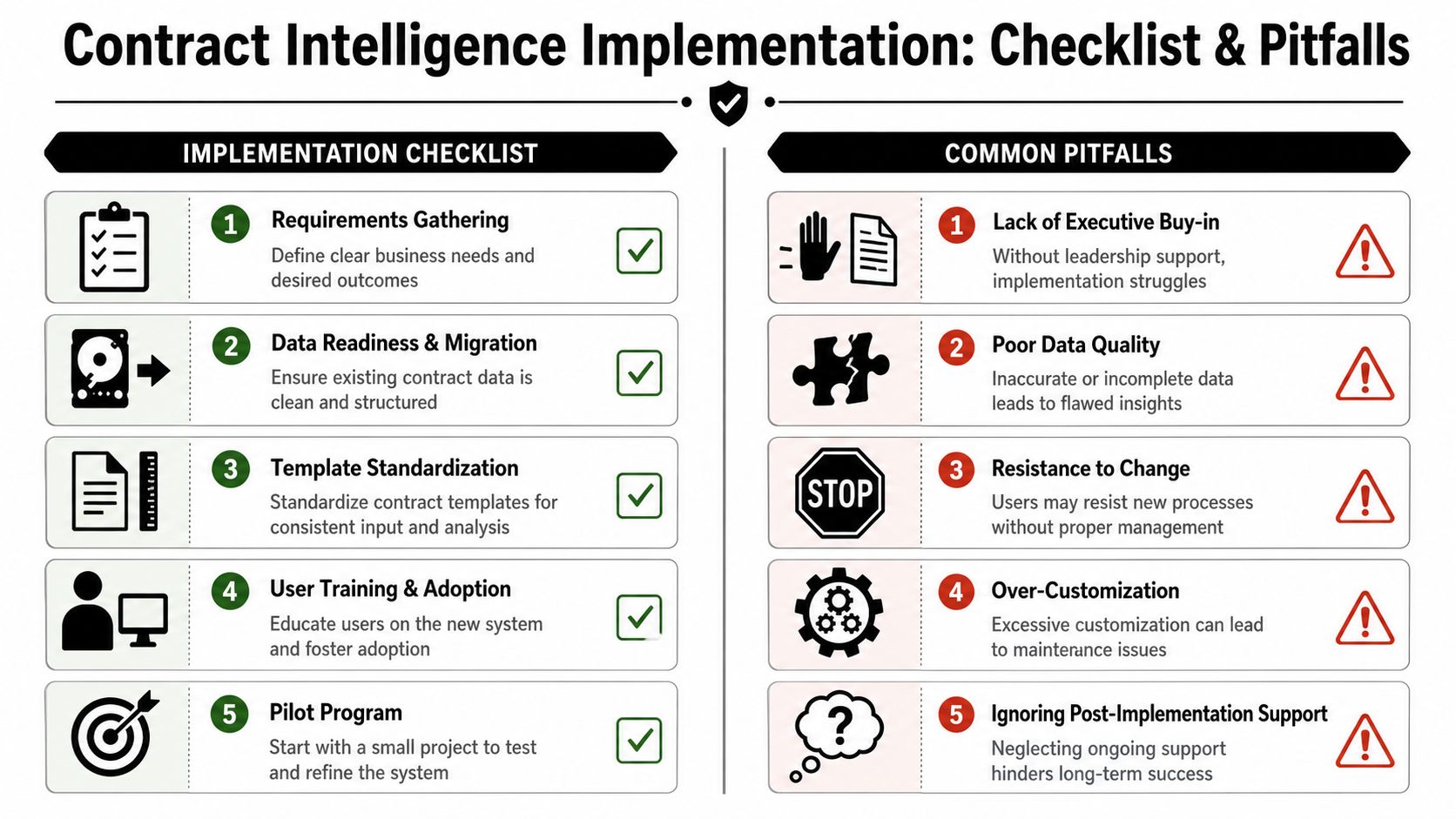
Define the business problem first
Don't begin with “we need AI.” Begin with a concrete use case. For example: third-party paper review, sales agreement approvals, renewal visibility, or legacy contract digitization.Choose the first contract set carefully
Pick a contract type with repeat volume and visible pain. NDAs, MSAs, vendor agreements, and order forms usually work better for early rollout than highly bespoke transactions.Clean up source documents
AI contract analytics depend on readable inputs. Scan quality, inconsistent naming, missing signature pages, and duplicate files can all weaken results.Standardize templates and fallback clauses
If your organization has five “standard” templates and none are consistently standardized, the system will reflect that inconsistency. Clause libraries and approval rules need governance before automation delivers its full value.Map integrations early
Decide how the platform will connect with CRM, document tools, eSignature, storage, and downstream systems. Otherwise teams end up rekeying data and bypassing the workflow.Train users by role
Sales needs drafting and approval guidance. Legal needs review and playbook controls. Procurement needs renewal and obligation visibility. Generic training often fails because each group uses the system differently.
Common pitfalls
A recurring mistake is trying to automate broken processes. If intake is inconsistent and approvals are unclear, AI will move confusion faster, not fix it.
Another issue is weak post-signature ownership. Contract intelligence often starts as a legal project, but renewal alerts, service obligations, and commercial commitments usually require finance, procurement, sales, or operations to take action.
A contract platform works best when each obligation has an owner, not just a storage location.
A third problem is resistance to change. Lawyers may distrust automated extraction. Business users may avoid structured intake because email feels easier. That's normal. Adoption usually improves when the team sees that the tool removes low-value work instead of adding clicks.
Why post-signature design matters
Ironclad's contract intelligence article notes that implementing contract intelligence directly addresses the estimated 11% of contract value organizations lose post-signature due to inefficient processes by tracking financial terms, scheduling renewal alerts, and surfacing unclaimed entitlements.
That point is important. Many organizations focus heavily on drafting and signature, then neglect the period when the actual economic value of the contract has to be enforced.
If your rollout is hitting cultural friction, this discussion of overcoming resistance to AI adoption in contract review offers practical ideas for change management.
Vendor selection criteria
Choosing a contract intelligence or CLM platform isn't just a feature comparison. It's a fit question. The right system for a fast-moving SaaS sales team may not be the right one for a procurement-heavy enterprise with complex supplier risk review.
A scorecard helps because it forces buyers to separate “nice demo” features from operational requirements.
What to evaluate
| Criteria | What to look for | Tradeoff to consider |
|---|---|---|
| AI extraction quality | Accurate clause, date, obligation, and metadata extraction | Strong demos may still vary by contract type and document quality |
| Review controls | Deviation analysis, clause playbooks, explainable risk flags | Too much automation without legal oversight can reduce trust |
| Drafting support | Template generation, clause libraries, version control | Broad template support matters less if your governance is weak |
| Approval workflows | Rule-based routing by value, risk, or contract type | Overly complex routing can slow the process |
| eSignature | Native signing or reliable integration with eSignature tools | Separate tools may create handoff friction |
| Repository and search | Searchable executed contracts, amendments, and versions | Storage alone isn't enough without structured data |
| Integrations | CRM, ERP, document tools, email, APIs | Integration breadth matters only if implementation is realistic |
| Security and access controls | SSO, MFA, RBAC, auditability, encryption, compliance posture | More control can require more setup effort |
| Usability | Simple intake, clean review interface, easy redline collaboration | Powerful systems often fail if business users avoid them |
| Pricing model | User-based, volume-based, workflow-based, or modular pricing | Lower entry cost can hide future expansion costs |
Questions buyers should ask vendors
- Can the platform review third-party paper, not just your own templates
- How does it show the source text behind an extracted term or risk flag
- How are clause libraries and fallback rules managed
- What happens after signature, especially for renewals and obligations
- How hard is it to connect CRM, Word, storage, and approval tools
One option in this category is Legitt AI, an AI-native CLM platform that supports drafting, negotiation, eSignature, repository management, clause extraction, deviation analysis, and obligation tracking in one workflow. If you're comparing platforms more broadly, this roundup of CLM platforms can help structure your shortlist.
Example AI prompts and workflows
The easiest way to understand contract intelligence is to see how someone would use it. Good prompts are plain, specific, and tied to a business outcome.
Drafting prompts
For AI-powered contract drafting, avoid vague requests like “write me an NDA.” Give the system business context.
Examples:
Mutual NDA prompt
“Draft a mutual NDA for a software evaluation between a customer and vendor. Include confidentiality obligations, permitted disclosures, return or deletion of information, and governing law placeholders.”MSA prompt
“Create a services MSA for a consulting engagement with sections for scope changes, payment terms, IP ownership, confidentiality, limitation of liability, and termination.”Sales order prompt
“Generate a SaaS order form that references a master agreement, includes subscription term, fees, billing frequency, and renewal language.”
Review and negotiation prompts
These prompts help with AI contract review and contract analytics:
Clause extraction prompt
“Extract the parties, effective date, term, renewal provisions, payment terms, limitation of liability, termination rights, and governing law from this vendor contract.”Deviation analysis prompt
“Compare this third-party MSA against our standard procurement playbook and flag non-standard indemnity, liability cap, data processing, and auto-renewal clauses.”Approval summary prompt
“Summarize the key legal and commercial issues in this redline for finance, procurement, and legal approvers in plain language.”
Ask the system for both the answer and the source clause. That makes review faster and trust higher.
Post-signature prompts
Many teams often underuse contract intelligence.
Try prompts like:
Renewal prompt
“List all contracts with renewal or notice dates coming up and identify the owner for each agreement.”Obligation prompt
“Show all signed customer contracts with service-level reporting obligations or rebate commitments.”Portfolio insight prompt
“Find agreements that contain assignment restrictions or audit rights and group them by counterparty.”
A practical workflow inside a modern platform is simple: upload or generate the document, run extraction, review flagged clauses, approve through workflow, send for eSignature, and then activate renewal and obligation tracking. Tools with assistant-style interfaces make that easier because users can ask plain-English questions instead of navigating only through filters and forms.
Moving forward with contract intelligence
Contract intelligence matters because contracts aren't just legal records. They're operating instructions for revenue, spend, compliance, service delivery, and risk.
When leaders ask what contract intelligence is, the shortest accurate answer is this: it turns agreement text into structured, usable business data. That changes how teams draft, review, negotiate, sign, store, and manage contracts across the lifecycle.
The strongest rollouts usually share a few traits:
- They start with one workflow instead of trying to transform every agreement at once
- They define ownership clearly for approvals, renewals, and obligations
- They measure outcomes early using turnaround time, visibility, and value recovery
- They refine templates and playbooks as real usage data comes in
For legal teams, that often means less repetitive review. For procurement, fewer surprise renewals. For sales, faster movement from request to signature. For finance and operations, better visibility into the commitments the business has already made.
The technology matters, but the operating model matters more. A useful contract intelligence program combines AI contract review, contract automation, eSignature, repository management, legal operations discipline, and practical workflow design.
Teams that treat it as a strategic business system usually get more value than teams that treat it as a document archive with a few AI features layered on top.
If your team wants to see how an AI-native CLM can support drafting, review, approvals, eSignature, repository search, renewals, and obligation tracking in one workspace, explore Legitt AI.