Contract management software, often called CLM, is the system that turns scattered Word docs, email threads, and PDFs into a single searchable workspace where agreements are drafted, negotiated, signed, tracked, and renewed. In 2026, the category is estimated at USD 3.77 billion and is projected to reach USD 5.64 billion by 2031, which shows how quickly it has moved from a legal back-office tool into core business infrastructure (Mordor Intelligence market estimate).
Many teams encounter the problem before they know the name for it. An MSA starts in Word, redlines move by email, the signed PDF ends up in a shared drive, and the renewal date slips past because nobody owns the calendar. That's where people start looking for a quick guide to contract software or a deeper internal playbook like this overview of contract management, because the core issue isn't storage, it's control.
What Contract Management Software Really Means
A contract lasts well beyond the signature. It starts as a request, becomes a draft, moves through negotiation and approval, gets signed, and then continues creating obligations, deadlines, and renewals after the deal is done. Contract management software gives that full lifecycle one governed home instead of leaving it spread across inboxes and folders.
The most common failure point is the handoff between teams. Legal may assume procurement is watching the vendor renewal, procurement may assume finance has the dates, sales may assume the account owner is tracking the customer term, and the signed version may sit buried in a shared drive with no clear owner. The core issue is an operating-model gap, not a document problem.
Repository, eSignature, and CLM are not the same thing
A contract repository stores executed agreements and makes them searchable. An eSignature tool helps people sign faster. Full CLM software connects the full process, from drafting and review to approval, signature, obligation tracking, and renewal management.
Practical rule: if your biggest pain is finding signed contracts, a repository may help. If your pain is delays, missed obligations, and no visibility across teams, you need CLM.
That difference matters because buyers often begin with one symptom and end up needing a wider operating layer. A company may adopt CLM for workflow discipline, then find that the bigger payoff comes from financial visibility, tighter renewal control, and clearer risk reporting. A quick guide to contract software can help small teams separate those needs, and a clear overview of contract management can help larger teams map the same idea to legal operations, procurement, sales, or finance.
How Contract Management Software Works End to End
A contract usually follows the same path, even when different teams use different names for each step. A vendor request enters the system, a template is selected, legal reviews the language, the business negotiates redlines, approvers sign off, the document is executed, and the platform keeps tracking post-signature dates and duties.
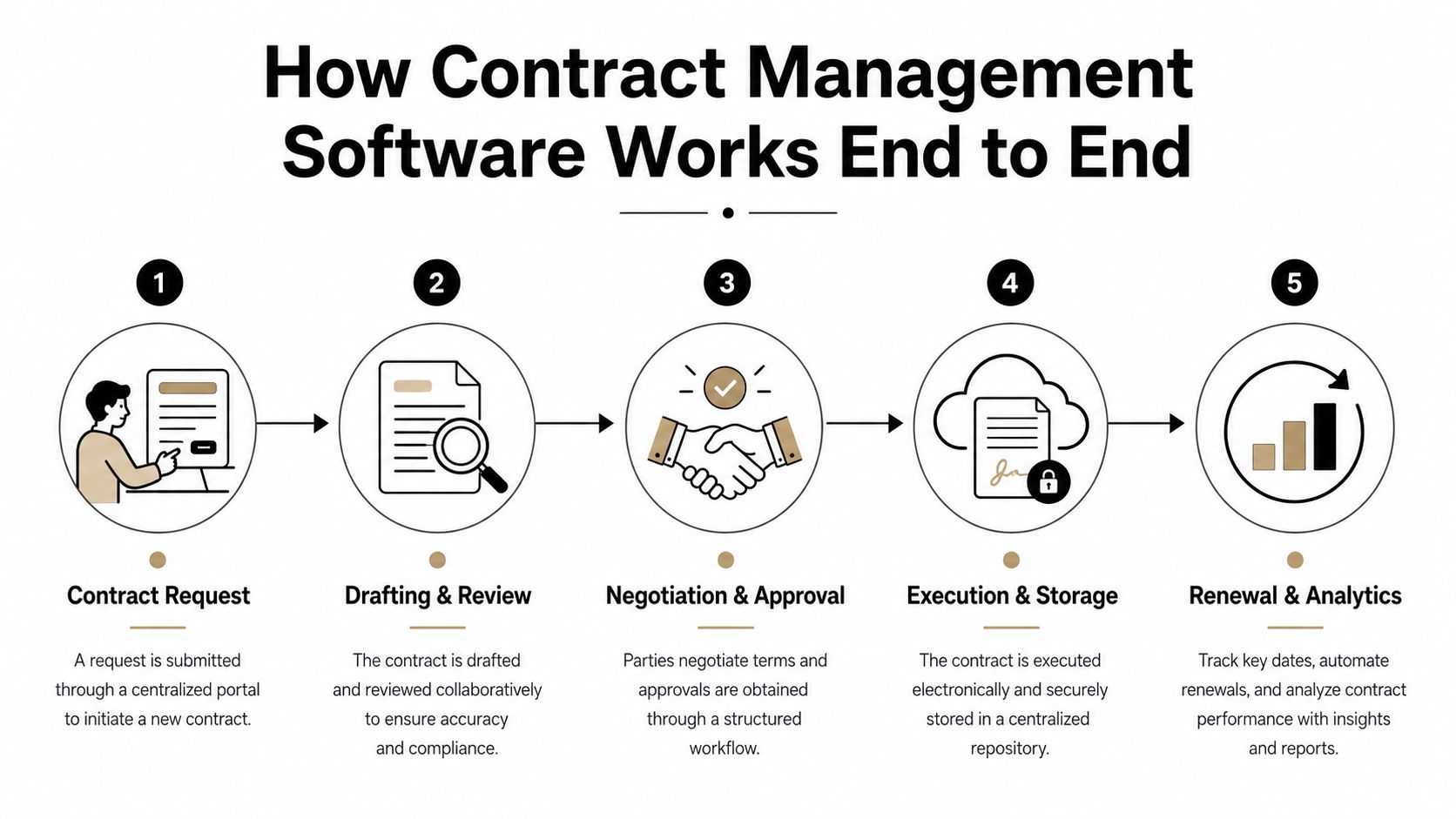
Request through approval
The process starts when someone submits a contract request instead of emailing legal from scratch. The system can send that request to the right template, assign the right owner, and keep the draft on a controlled path. That matters because it reduces the “who has the latest version” problem that usually appears as soon as several people start editing the same file.
Request routing also helps separate workflow from financial control. Workflow decides who reviews, approves, and signs, while financial control decides whether the deal terms fit the budget, pricing model, or renewal exposure. For teams comparing how approvals and controls work across systems, a treasury management system guide shows a similar pattern, where routing and oversight matter as much as the record itself.
Signature through storage
Once the draft is ready, the platform routes approvals, collects eSignature, and stores the executed file in one repository. A mature workflow also keeps version history, audit trails, and role-based access in place so the latest executable version is easy to find and the wrong person cannot open confidential terms. The same logic is described in this full guide to CLM.
Storage is useful, but storage alone does not explain contract value. The file matters because it becomes a system of record for later decisions, including who approved what, when terms changed, and which version went live.
Post-signature monitoring
The contract is not finished when signatures land. The system should track milestones, renewals, extensions, amendments, and terminations so missed obligations surface early. That is what turns CLM from a document tool into operating infrastructure.
Post-signature monitoring is also where the revenue and risk layer appears. A missed renewal can affect revenue timing, a forgotten obligation can create compliance exposure, and a stored agreement without dates or alerts leaves teams guessing instead of acting. Legal, sales, procurement, and finance each use that visibility differently, but they all depend on the same underlying signals.
Centralized storage improves searchability. Role-based access keeps confidential terms limited to the right people. Audit logs give legal and compliance teams a record they can actually defend.
The mechanics are simple, but the business effect is powerful. Email and spreadsheets get replaced by event-driven workflows, and people stop relying on memory to manage commitments.
Core Features of Modern CLM Platforms
Modern CLM platforms usually cluster into three practical groups, create, execute, and manage. That structure is easier to evaluate than a long feature list because it maps directly to the way contracts move through a business.
Create features
Teams start with templates, a clause library, and AI-assisted drafting or review. Approved language saves time because legal doesn't have to rewrite standard terms every time, and clause reuse helps non-legal teams stay within policy. Buyer guides increasingly treat AI clause extraction and structured review support as table stakes, but only when the underlying metadata is clean and the playbook is defined.
Execute features
This stage covers approval routing, redlining, counterparty comments, and eSignature. The point is not just speed, it's controlled speed, because the wrong approval path can create downstream risk that's hard to unwind later. If you're also comparing financial workflow tools, the logic feels similar to a treasury management system guide, where routing and control matter as much as the record itself.
Manage features
After signature, the platform should store the agreement in a searchable repository, tag metadata, trigger renewal alerts, and support obligation tracking and reporting. That's where the contract turns into a managed asset instead of a forgotten file. The best tools connect the dots between search, reporting, and downstream systems, which is why a contract platform should be evaluated alongside these 2026 CLM platform comparisons.
| Core CLM Features by Lifecycle Stage | Lifecycle Stage | Primary Owner |
|---|---|---|
| Template libraries | Create | Legal ops |
| Clause library | Create | Legal |
| AI review and extraction | Create | Legal ops |
| Approval routing | Execute | Legal and business approvers |
| eSignature | Execute | Signatories |
| Central repository | Manage | Legal ops |
| Renewal alerts | Manage | Procurement or contract owner |
| Obligation tracking | Manage | Finance, procurement, or legal |
Evaluation tip: if a platform has strong drafting but weak post-signature tracking, it solves only half the problem.
Why Contract Management Software Is Really a Revenue and Risk Layer
A contract platform often gets bought for speed. Teams keep using it because it gives them a clearer view of financial exposure, compliance gaps, and renewal pressure that were hard to see in email threads and shared drives. The shift is from document workflow to decision support.
The value appears after signature. Renewal dates, service obligations, auto-renew clauses, payment milestones, and performance commitments all live inside the agreement, but they only help if the system can surface them in time. A useful platform turns those terms into operational signals rather than static text, so the contract becomes part of day-to-day management.
Obligation tracking changes the business conversation
Obligation tracking is more than a reminder calendar. It watches SLA commitments, payment schedules, delivery milestones, compliance certifications, and performance checks so teams can act before a missed term becomes costly. That matters because analytics can then show spend concentration, renewal clusters, and recurring contract patterns across the portfolio, which is why teams increasingly care about the reporting layer as much as the drafting layer. The link between those signals and business outcomes is also why many teams study contract management and revenue realization alongside the operational side of CLM, because the same record that stores the contract also helps explain when revenue should be recognized and protected (obligation tracking and portfolio analytics).
A procurement team might catch an unfavorable auto-renewal term before it locks in. Finance might see a cluster of renewals that needs attention in the same quarter. Sales operations might notice a customer clause that could trigger an awkward pricing adjustment. Those are not abstract efficiencies, they are decisions that affect revenue and risk.
The reporting question is where many definitions stay too shallow. Basic explanations often focus on storing and tracking contracts, but buyers need a system that exposes value leakage after signature, not just a vault for PDFs. That is why a contract platform often matters more to finance, rev ops, and procurement than people expect at the start.
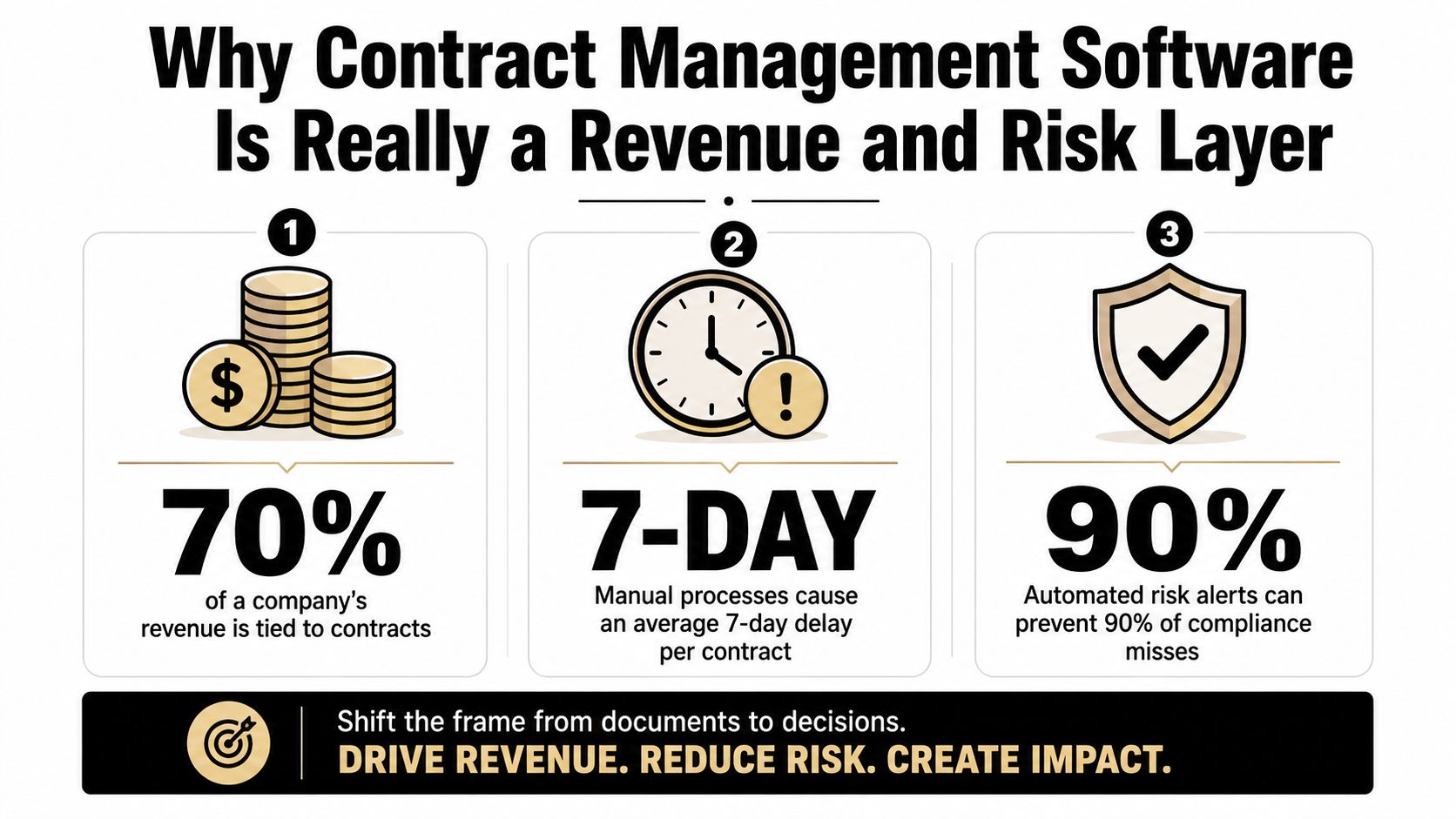
Stronger metadata leads to better insight. Without it, analytics turns noisy, and the platform becomes a nicer folder instead of a management layer.
Benefits by Role Across Legal Sales Procurement and Finance
Different teams buy into CLM for different reasons, and that's exactly why the value story has to be role-based. A legal department cares about defensible process. Sales cares about speed. Procurement cares about vendor control. Finance cares about commitment visibility and billing accuracy.
What each team gets
Legal teams get better control over review paths, version history, and auditability. That means fewer surprises, cleaner evidence in disputes, and a more consistent approval process.
Sales teams get fewer deal stalls because legal no longer lives in a separate email loop. They can see contract status, know where a deal is stuck, and keep momentum without guessing who owns the next step.
Procurement teams use CLM to standardize vendor governance, track renewals, and keep pressure on service terms. It's easier to challenge a vendor position when every agreement is stored, searchable, and tied to the right business owner.
Finance teams rely on contracts for billing triggers, commitments, and revenue assurance. When the contract record is clean, finance can align what was signed with what gets invoiced and what should be renewed.
I've seen teams adopt a platform like Legitt AI for exactly that reason, it gives legal, sales, procurement, and finance one shared contract workspace with drafting, review, signature, and tracking in the same system.
| Role | Main Outcome | Platform Capabilities That Matter |
|---|---|---|
| Legal | Lower risk and stronger audit trails | Version control, approvals, RBAC, audit logs |
| Sales | Shorter deal cycles | Template reuse, workflow routing, eSignature |
| Procurement | Vendor control and renewal discipline | Repository, alerts, obligation tracking |
| Finance | Better billing and revenue visibility | Metadata, reporting, system of record |
A good CLM platform doesn't just make each team faster. It makes them more aligned around the same contract facts.
Security Compliance and Integrations Buyers Should Verify
Enterprise buyers should treat CLM as part legal system, part business system, so security and integration checks matter as much as feature checks. The platform has to protect the contract record, fit into existing workflows, and prove that it won't create a new silo.
Security and compliance basics
Ask for SOC 2 Type II, ISO 27001, ISO 27701, GDPR support, HIPAA support where relevant, SSO, MFA, role-based access control, encryption at rest and in transit, and audit logs. If data residency matters in your region or industry, ask for that too.
A secure platform should also make retention and access controls easy to understand. That's especially important for legal teams managing cloud storage policies, and these cloud retention practices for lawyers are a useful companion reference when storage governance is part of the evaluation.
Integrations that actually matter
Contracts don't live in one place. They touch CRM, email, identity, finance, and collaboration tools, so the platform should connect cleanly to Salesforce, HubSpot, Microsoft Dynamics 365, Microsoft 365, Word, e-signature tools, SSO providers, Slack or Teams, APIs, Zapier, and ERP or finance systems. If the integrations are shallow, people end up copy-pasting data and the workflow breaks again.
Buying rule: shortlist platforms by integration depth before you compare feature count.
Here's a simple implementation checklist:
- Define the use case first. Start with renewal risk, sales cycle speed, vendor governance, or compliance.
- Map the current process. Identify who requests, reviews, approves, signs, and stores contracts today.
- Verify the plumbing. Confirm CRM, identity, document, and finance integrations before launch.
- Roll out in phases. Start with one contract type or one team, then expand.
- Assign a contract owner. Don't treat CLM as an IT project with no business sponsor.
For contract compliance controls, this overview of contract compliance is a useful companion when legal and operations need shared language.
ROI Common Pitfalls and Short FAQ
ROI comes from the places where contract work used to leak time and money. Template libraries and AI-assisted drafting reduce how often teams start from scratch. Native eSignature shortens execution. Obligation and renewal tracking help prevent missed commitments and bad auto-renewals. The business case gets stronger when the system also improves visibility into what's signed, what's due, and what's exposed.
The biggest mistake is over-customizing the workflow before anyone uses it. Teams spend months rebuilding every exception path, then the rollout stalls because the process is too complex for everyday users. The second mistake is ignoring metadata quality, which makes reporting unreliable and weakens the analytics layer. The third is under-investing in CRM and identity integrations, which leaves contracts disconnected from the systems that already hold customer and vendor context.
Short FAQ
What is the difference between CLM and eSignature software?
eSignature helps people sign. CLM manages the full lifecycle, from drafting and review to storage, obligations, and renewals.
How long does implementation usually take?
It depends on scope and integrations. A narrow rollout is easier than a full enterprise deployment, especially if the goal is to connect CRM, identity, and finance systems.
What should a small team prioritize first?
Start with templates, a central repository, and renewal alerts. That gives immediate structure without forcing a heavy rollout.
Do AI features pay off?
They can, if the platform has good metadata, clear playbooks, and strong human review. AI helps most when it reduces repetitive review work and improves contract visibility, not when it adds noise.
What matters most when evaluating a vendor?
Look for process fit, integration depth, and post-signature visibility, not just a polished demo.
Contract management software is most valuable when it acts like a governed analytics layer over the full lifecycle, not a fancier shared drive. That's the difference between storing contracts and using them to manage revenue, risk, and accountability.
If you're evaluating CLM for your team, Legitt AI brings drafting, review, eSignature, repository management, renewal alerts, and contract intelligence into one workspace. Visit Legitt AI to see how it fits contract workflows across legal, sales, procurement, and finance.