A contract is sitting in someone's inbox right now, and everyone thinks someone else owns the delay.
Sales believes legal is slowing the deal. Legal sees unclear business asks, risky third-party paper, and five versions of the same draft in email. Procurement is waiting on scope confirmation. Finance wants payment terms cleaned up before revenue or spend assumptions become real. Operations hasn't even been asked whether the service levels are deliverable.
That's the normal failure pattern. The contract negotiation itself isn't the actual bottleneck. The bottleneck is fragmented information, unclear authority, and a process that treats negotiation like a last-minute argument instead of a managed business workflow. That's why teams end up chasing redlines, debating old versions, and making concessions without understanding the operational or financial impact.
The better way to think about what contract negotiation is starts with one idea. It's not a battle of wills. It's the disciplined process of aligning risk, revenue, scope, timing, and accountability before those assumptions harden into obligations.
In practice, that means contract negotiation sits at the center of AI contract management, CLM, legal operations, contract review, eSignature workflows, and repository governance. It also means the old “send a Word file and wait” model no longer works well enough for enterprise contract workflows.
If your current process still depends on inboxes and tribal memory, the problem isn't just inefficiency. It's hidden commercial drag. The broader issue is what many teams are now confronting in the world of dumb contracts, where agreements get signed but remain hard to search, track, analyze, or enforce.
Introduction Beyond the Battle of Wills
Teams often learn contract negotiation the wrong way. They inherit a template, join a few calls, and assume negotiation means pushing back on whatever the other side asked for.
That approach creates noise, not advantage.
A strong negotiation process doesn't start with redlines. It starts with clarity. What are we buying or selling? What risk is acceptable? Which terms are true deal points, and which are merely habits carried over from old templates? Which stakeholders must approve trade-offs before the draft goes out? Until those questions are answered, negotiation is mostly improvisation.
What negotiation looks like in the real world
For a sales-led contract, speed matters. For procurement, price and supplier accountability matter. For legal, enforceability and risk allocation matter. For finance, billing triggers and liability exposure matter. Those goals aren't contradictory, but they do compete if nobody sets a clear negotiating position.
That's why mature teams treat contract negotiation as a business design exercise.
Practical rule: If the team can't explain the commercial purpose of a clause in one sentence, it probably shouldn't be the hill anyone dies on.
Modern contract management software and CLM platforms improve this because they reduce preventable friction. Shared playbooks, contract automation, AI contract review, approval routing, and contract intelligence let teams focus on judgment instead of administration. The point isn't to remove people from negotiation. It's to stop wasting expert time on avoidable process failures.
What good looks like
A healthy negotiation process usually has these traits:
- A defined fallback position: Teams know what they'll accept, what they'll escalate, and what they'll reject.
- A controlled drafting environment: One source of truth replaces scattered email attachments.
- Clear ownership: Legal advises on risk. The business decides which risk is worth taking.
- Post-signature discipline: Renewals, obligations, amendments, and performance terms don't disappear after eSignature.
When people ask what contract negotiation is, the useful answer isn't “a discussion over terms.” It's the mechanism that turns commercial intent into enforceable, executable, measurable reality.
What Is Contract Negotiation Really
At its simplest, contract negotiation is the process of agreeing on the terms that govern a business relationship. That sounds obvious. The part many teams miss is that a contract doesn't just record a deal. It allocates power, money, responsibility, timing, and remedies when things go wrong.
Think of it as the operating blueprint for a relationship.
If the blueprint is vague, the business pays later through delay, dispute, missed revenue, compliance issues, or strained customer and supplier relationships. If the blueprint is clear, negotiation becomes less emotional and more strategic. That's the core answer to what is contract negotiation in a business setting.
For a broader foundation on how contracts function in an AI-enabled workflow, this AI-powered guide to what a contract is is a useful companion.
Positions versus interests
A lot of negotiations stall because teams argue over positions instead of interests.
A position is what someone says they want. An interest is why they want it.
Here's the difference:
| Term | What it sounds like | What it usually means |
|---|---|---|
| Position | “We need net-30 payment terms.” | The party needs predictable cash flow or internal policy compliance |
| Position | “We won't accept uncapped indemnity.” | The party wants a defined ceiling on risk |
| Interest | “We need confidence this service won't create downstream liability.” | The party wants protection against a specific failure scenario |
When negotiators focus only on positions, they tend to trade demands. When they uncover interests, they can often redesign the clause.
BATNA and ZOPA in plain English
Two concepts matter in almost every negotiation.
BATNA means Best Alternative to a Negotiated Agreement. It answers one question. What will you do if this deal doesn't close on acceptable terms?
If you don't know your BATNA, you don't know your true advantage. Sales may think the company must sign this quarter. Procurement may have another supplier. Legal may know the requested clause creates a risk the business shouldn't carry. BATNA aligns those realities.
ZOPA means Zone of Possible Agreement. That's the practical range where both sides can still make a deal.
If your acceptable outcome and the other side's acceptable outcome overlap, there's a ZOPA. If they don't, no amount of wordsmithing will save the deal.
Negotiation gets easier when the team distinguishes what it prefers from what it requires.
What sophisticated teams do differently
They don't negotiate every issue with equal energy. They classify terms.
- Strategic terms: Liability, data use, IP, exclusivity, termination rights.
- Operational terms: Scope, service levels, implementation responsibilities, acceptance criteria.
- Commercial terms: Pricing mechanics, invoicing, renewals, credits, volume commitments.
- Governance terms: Approval rights, reporting, audit, notice, dispute escalation.
That classification matters because not every clause deserves executive attention. Good contract review and CLM software help route issues to the right owners instead of sending the whole agreement through the same slow path.
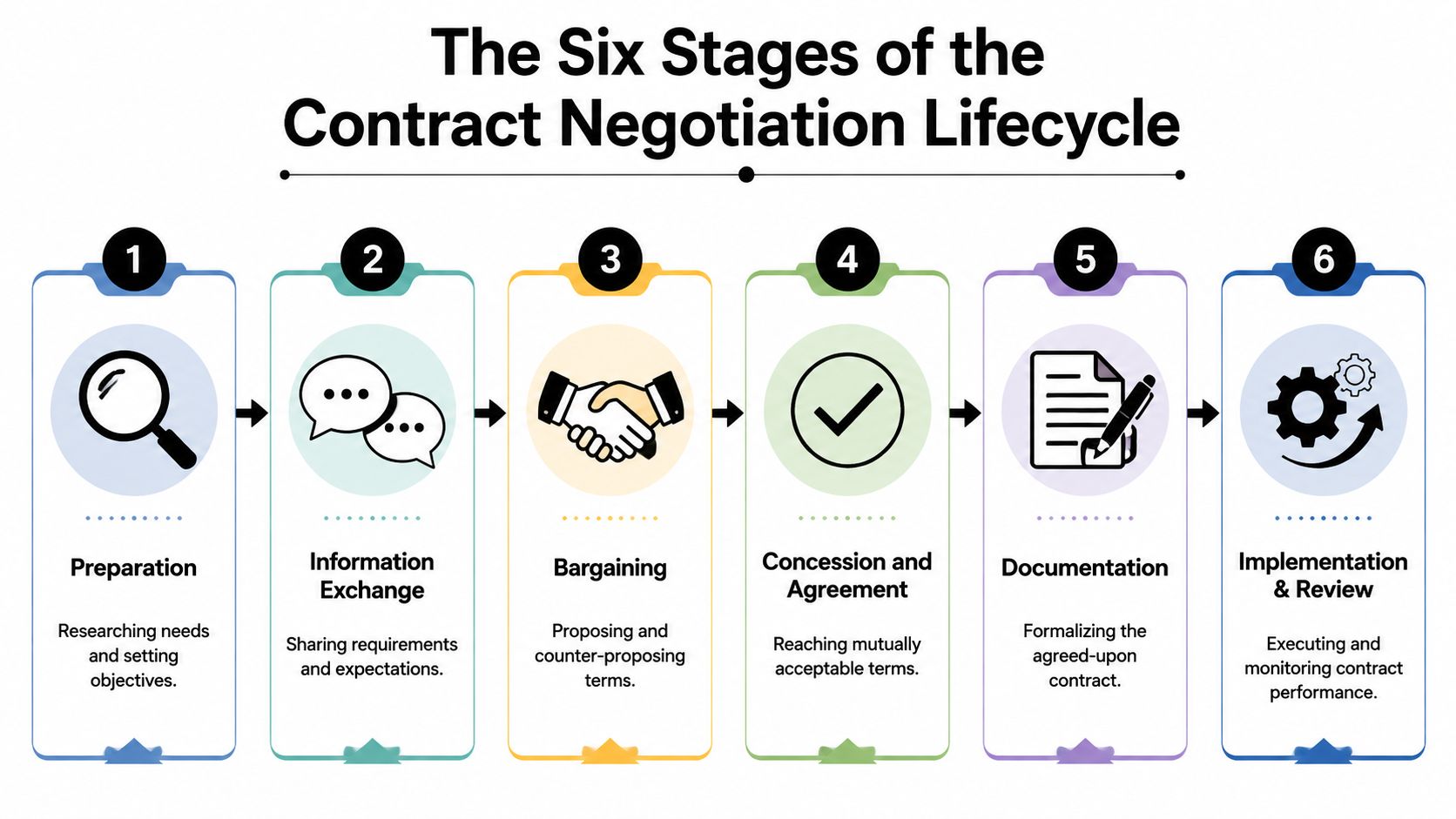
The Six Stages of the Contract Negotiation Lifecycle
Contract negotiation is easiest to manage when teams stop treating it as a single event. It's a lifecycle. Each stage affects the next, and mistakes made early become expensive later.
Critically, over 80% of contract negotiation outcomes are determined during pre-negotiation phases rather than the actual discussion period, which is why preparation matters more than performance in the meeting itself, according to the Negotiations Training Institute's 2026 negotiation trends analysis.
For a deeper operational view, this complete guide to contract lifecycle management connects negotiation to the broader CLM process.
Stage one through three
- Preparation
This stage largely determines outcomes. Teams define objectives, map stakeholders, identify fallback positions, gather business facts, and decide what can move.
Preparation should include:
- Scope definition: What is being sold or bought, and what is outside scope.
- Risk priorities: Which clauses are fixed, which are negotiable, and who decides.
- Authority lines: Who can approve concessions on pricing, liability, or timing.
Information exchange
The parties share templates, requirements, assumptions, and constraints. If this stage is rushed, the rest becomes expensive cleanup.In transactions involving acquisitions or business sales, the early framing document matters. Founders and deal teams often benefit from practical Bizbe insights on business sales LOI, because a letter of intent can narrow later negotiation fights if it states the right commercial points upfront.
Bargaining
This is the visible part. Redlines, calls, counterproposals, and commercial trade-offs happen here. But bargaining only works well when the team has already decided its logic.
Stage four through six
Concession and agreement
Discipline is particularly important. Teams should make deliberate concessions, not accidental ones. A concession should solve a business problem, not just end a call.Documentation
The final language must match the business deal. Many disputes start because side conversations never made it into the operative draft. Documentation also includes approval workflow discipline and version control.Implementation and review
Negotiation doesn't end at signature. Obligations tracking, renewal management, and contract analytics then become essential. If a contract repository can't surface critical dates, owners, and commitments, the organization loses value after the deal is signed.
What works and what fails
| Practice | Usually works | Usually fails |
|---|---|---|
| Early alignment | Clear deal priorities before first draft | Internal debate after the counterparty sends redlines |
| Draft control | Shared workspace and tracked versions | Email attachments named “final_v7_revised” |
| Concessions | Pre-approved give/get logic | Unplanned edits made to “keep things moving” |
| Post-signature management | Repository, alerts, obligations tracking | Signed PDF stored with no follow-up owner |
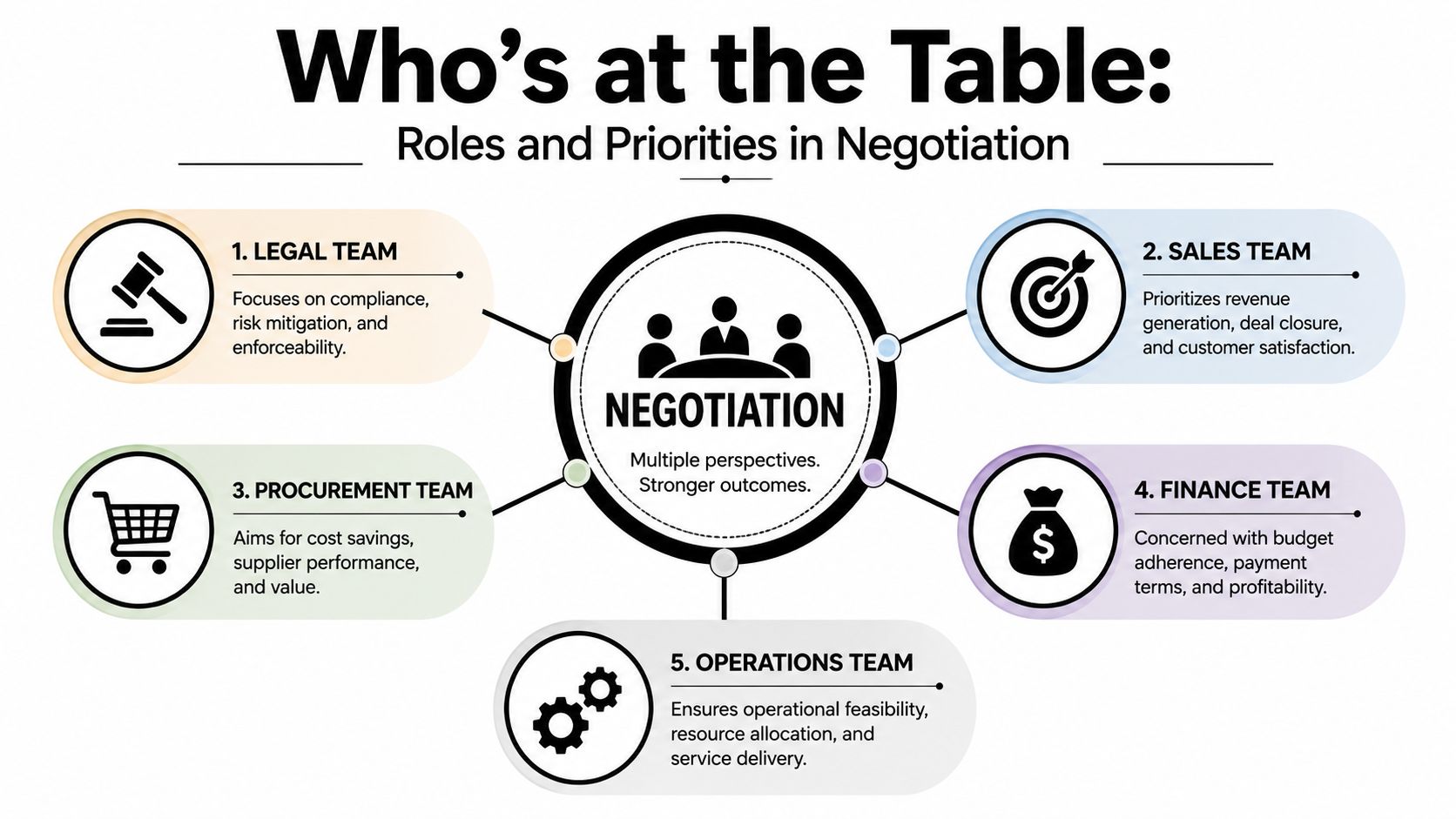
Whos at the Table Roles and Priorities in Negotiation
Most contract negotiations don't fail because the other side is unreasonable. They fail because your own team is misaligned.
Legal is reading risk. Sales is reading urgency. Procurement is reading bargaining power. Finance is reading exposure. Operations is reading deliverability. All of them are right, but none of them can run the negotiation alone.
How each function sees the same clause
Take a customer request for aggressive service credits.
Legal asks whether the credits amount to uncapped damages. Sales asks whether pushing back will slow the deal. Operations asks whether the service level is realistic. Finance asks how credits affect margin. The customer success team asks who definitively owns remediation if the metric is missed.
That's why negotiation is a leadership exercise, not just a legal task.
The internal priorities that shape outcomes
Legal team
Legal focuses on enforceability, regulatory compliance, data risk, liability allocation, and dispute posture. Legal should frame options and consequences, not operate as the sole commercial decision-maker.Sales team
Sales wants deal velocity, customer acceptance, and a path to signature. Good sales leaders understand that speed without guardrails creates future churn, write-offs, and escalations.Procurement team
Procurement looks for supplier performance, pricing discipline, service consistency, and remedies when delivery slips. In supplier contracts, procurement often spots key operational advantages legal would not prioritize alone.Finance team
Finance cares about payment triggers, billing mechanics, profitability, credits, and cash-flow timing. A badly negotiated payment schedule can damage a sound commercial deal.Operations team
Operations validates whether the company can do what the draft promises. During this validation, many avoidable commitments should be challenged.
A clause is “legal” only in form. In practice, almost every important clause is a business decision wearing legal language.
Anxiety is real, and it changes behavior
There's another issue leaders often underestimate. Inexperienced negotiators can freeze, avoid conflict, or concede too quickly. Research indexed on PubMed notes the significance of negotiation anxiety among early-career professionals, including lack of confidence and anxiety that can delay progress and contribute to poor outcomes.
That shows up in routine ways:
- Over-conceding on low-value points because the drafter wants to avoid another round.
- Escalating too late because no one wants to appear difficult.
- Confusing politeness with agreement in customer or supplier calls.
Structured workflows help. So do playbooks, fallback language, and visible approval rules. They reduce improvisation, which is usually where anxiety causes damage.
A practical leadership model
The best internal negotiations use a simple principle. Legal owns legal judgment. The business owns business risk. The negotiation lead makes sure those two things meet before a concession leaves the building.
Strategic Tactics and Critical Clauses to Master
Strong contract negotiation is not about winning more redlines. It is about deciding where the business should hold firm, where it should trade, and where speed is worth more than theoretical protection.
That sounds obvious. In practice, teams still lose time on low-impact wording while conceding on clauses that control margin, liability, cash flow, and exit options. The better approach is to rank issues by business consequence before the first markup goes out.
A useful working distinction is between value-creating negotiation and value-claiming negotiation.
Value-creating negotiation improves the deal structure for both sides. A customer may want tighter service levels, while the vendor wants a longer commitment, narrower assumptions, or a phased rollout. That is a commercial exchange, not a legal debate.
Value-claiming negotiation decides who bears more of a fixed burden, usually around price, liability, or termination economics.
Good negotiators know which mode they are in. Great negotiators switch between them on purpose.
For a practical reminder on avoiding self-inflicted negotiating mistakes, these business negotiation strategies from Lerner & Weiss APC are useful reading.
Clauses that deserve senior attention
The clauses below deserve executive visibility because they shape outcomes after signature, when the true cost of a bad compromise shows up. For a broader list of provisions that regularly drive business risk, review these top contract clauses in business contracts.
Limitation of liability
This clause sets the financial boundary of the deal.
Too many teams negotiate the cap amount first and the carve-outs later. That sequence creates bad outcomes. A cap that looks reasonable on paper can become nearly meaningless if it excludes confidentiality breaches, data incidents, IP claims, service credits, or payment obligations.
The right question is not "What cap sounds fair?" The right question is "What loss scenarios can the company absorb on this deal?" A low-value pilot, a strategic enterprise rollout, and a data-processing relationship should not land in the same liability bucket.
What tends to work:
- Tie the cap to deal economics and risk profile: Contract value matters, but so do data access, implementation scope, and operational dependency.
- Keep carve-outs narrow and deliberate: Every carve-out shifts the actual allocation of risk.
- Check remedy overlap: If indemnity, service credits, and direct damages all stack, exposure can exceed what the negotiators intended.
Indemnification
Indemnity is where abstract risk becomes cash, control, and litigation posture.
If your company may have to defend or pay a third-party claim, the clause needs clear rules on notice, defense counsel, settlement authority, admissions of fault, and the other party's cooperation obligations. Without that detail, a company can end up funding a defense it does not control or accepting a settlement that creates operational problems long after the claim closes.
This is also where commercial context matters. IP indemnity in a software agreement raises different issues than product liability indemnity in a supply contract or employment claims in a services arrangement. One template position will not fit all three.
Payment terms
Payment language drives working capital and negotiating power.
A contract can look profitable and still perform badly if invoicing depends on vague acceptance criteria, disputed milestones, or approval steps no one can measure. I have seen deals close on target pricing and miss forecast because the payment clause let the customer delay the first invoice for reasons that were never operationally tested.
Review three points closely:
- Invoice triggers: Signature, delivery, go-live, acceptance, and elapsed time produce very different cash outcomes.
- Dispute rights: The clause should limit withholding to the disputed amount, not the full invoice balance.
- Renewal and pricing mechanics: Annual uplifts, pass-through costs, and notice windows should be precise enough for finance and sales ops to administer.
A clause review lens that works
Useful clause review is less about spotting legal jargon and more about pressure-testing business consequences.
| Question | Why it matters |
|---|---|
| What business risk does this clause allocate? | Keeps the discussion focused on exposure, not wording preferences |
| Who has to operate this clause after signature? | Exposes obligations that sales, procurement, finance, or delivery teams cannot realistically administer |
| What happens if the clause is breached? | Distinguishes real remedies from language that looks protective but changes little in practice |
The strongest negotiators do not treat every issue with equal weight. They concentrate on the clauses that change revenue timing, cost of failure, control over disputes, and freedom to exit a bad deal. That discipline matters even more once AI enters the process, because the teams with better deviation data can choose their battlegrounds earlier and negotiate from evidence instead of instinct.
How AI Transforms Contract Negotiation into a Science
A sales leader wants the quarter closed. Procurement wants tighter service levels. Security wants stronger audit rights. Legal is asked to turn comments overnight on a supplier paper the company has never seen before.
In a manual process, the side with the better memory usually has the advantage. They know which fallback positions your team accepted in prior deals, where internal approvals tend to break down, and which clauses slip through because nobody has time to compare them properly. That is not just a workflow problem. It is a negotiation problem.
AI contract management and CLM software change that balance by turning past negotiations into usable intelligence.
For a focused look at the negotiating layer specifically, this guide on AI for contract negotiation shows how teams are applying these workflows in practice.
The important shift is power, not just speed
A lot of discussion about AI in contracts stays at automated redlines. That understates the business value.
The stronger use case is decision quality at scale. AI can compare incoming language against approved positions, identify where a counterparty is asking for a concession outside policy, and show whether similar deviations were approved before, by whom, and with what downstream effect. That gives legal and business teams a firmer basis for saying yes, no, or yes with conditions.
As discussed in Ironclad's overview of contract negotiation and AI, newer AI capabilities give teams repository-wide visibility into negotiation patterns and obligations before those issues become post-signature cleanup. That changes the conversation in the room. Teams stop arguing from instinct and start negotiating from precedent, data, and operational reality.
Information asymmetry has always shaped negotiation outcomes. AI reduces it for the team that implements it well.
What AI-native CLM changes
A modern AI-native CLM platform supports negotiation in four ways that matter to leadership:
It improves the starting position.
First drafts come from approved templates and clause libraries, not from the last contract someone found in email or a shared drive.It reviews third-party paper against policy.
The system flags deviations, highlights missing protections, and identifies terms that need legal, finance, security, or executive review.It routes decisions based on risk.
Low-risk paper can move quickly. Non-standard indemnity, liability, data use, pricing, or termination terms can be escalated to the right owner without waiting for someone to notice them manually.It preserves negotiating intelligence after signature.
Accepted positions, renewal dates, obligations, and amendment history remain searchable, which makes the next negotiation smarter than the last one.
One example is Legitt AI, which combines AI-powered drafting, review, negotiation workflows, eSignatures, repository management, obligation tracking, renewal alerts, and contract intelligence in one workspace. Used well, that kind of platform changes who sees risk early, who can approve exceptions, and how consistently the company trades legal terms for commercial value.
The operating advantage leaders should care about
The immediate gain is speed, but speed is only the visible part of the return.
The larger gain is consistency. Revenue teams can use cleaner paper. Finance sees pricing and billing terms earlier. Procurement can spot supplier positions that create avoidable cost exposure. Legal spends less time on repetitive comparison work and more time on the deals where judgment changes the outcome.
That shift matters because negotiation delays rarely come from typing. They come from uncertainty. Nobody knows whether language is standard, whether an exception has precedent, whether the fallback is acceptable, or who has authority to approve it. AI shortens the cycle by answering those questions faster and with more consistency.
It also provides a practical advantage. A team that knows its historical fallback positions, common redline patterns, and highest-risk deviations can choose where to push and where to concede. That leads to better economics, fewer accidental precedents, and less post-signature friction.
Where human judgment still decides the deal
AI can surface the issue. People still decide whether the issue matters enough to trade for price, scope, term, or strategic access.
| Human decision | Why AI cannot own it alone |
|---|---|
| Whether to accept a risk | Risk tolerance depends on deal size, customer importance, replacement options, and business strategy |
| Which concessions are worth making | A concession may be acceptable if it protects revenue, speeds launch, or secures a priority supplier |
| When to escalate | Some terms create precedent beyond a single contract and need leadership judgment |
Used properly, AI does not replace negotiation strategy. It makes strategy more disciplined. The team enters the discussion with evidence, not guesswork, and that changes both the pace of negotiation and the outcome.
Measuring What Matters Negotiation Metrics and Risk Management
Quarter-end closes. Sales reports a signed deal. Procurement has a signed supplier agreement. Legal should still ask a harder question. Did the company get the economics it expected, contain the risks it meant to contain, and set itself up to perform what it promised?
Those are different outcomes, and they rarely show up in a simple count of executed contracts.
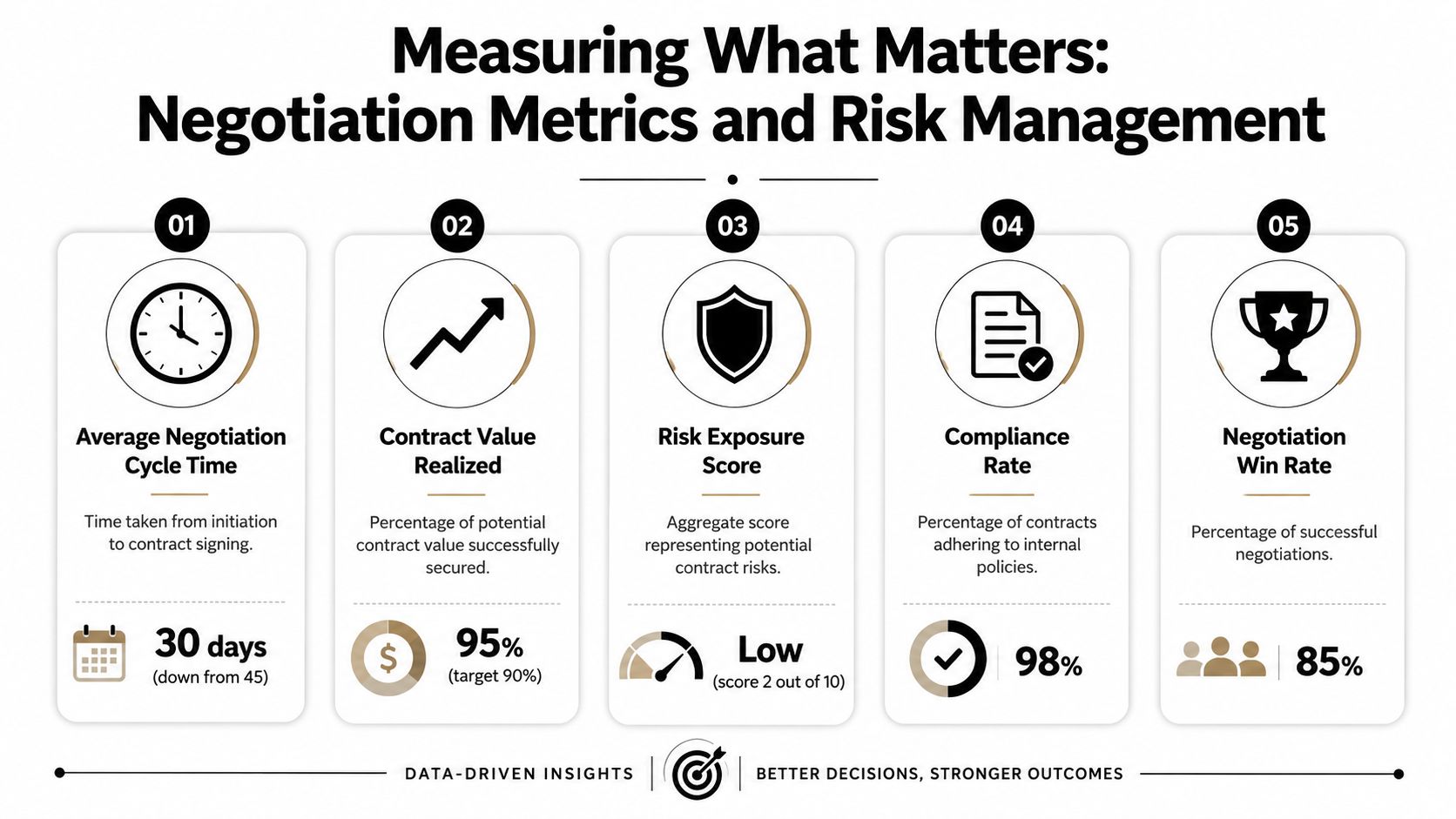
Leadership should review negotiation metrics that connect legal work to revenue, margin, and operational exposure. Vanity metrics create false comfort. The useful ones show where deals slow down, where teams give away more than intended, and where signed terms create downstream cost.
The metrics leadership should actually review
Start with a short set of measures that can drive decisions:
- Cycle time: Time from intake to signature, broken down by contract type, counterparty, and business owner
- Deviation rate: Frequency and type of non-standard terms accepted, especially on liability, payment, data use, service levels, and termination
- Approval friction: Where internal review stalls, who the repeat bottlenecks are, and which clauses trigger unnecessary escalation
- Renewal visibility: Whether notice dates, auto-renewals, and pricing reset points are visible early enough to act
- Obligation completion: Whether post-signature commitments, including reporting, implementation milestones, credits, audits, and security deliverables, are assigned and tracked
One metric on its own can mislead. Fast cycle time is not a win if the team got there by accepting uncapped liability. Low deviation rates are not a win if the approval process kills deals that should have closed. Good reporting shows the trade-off, not just the speed.
If a signed clause cannot be tied to an owner, a deadline, and a business consequence, the negotiation did not finish. It only moved into operations without controls.
What AI changes in measurement
The fundamental shift is not faster dashboards. AI changes what the company can measure and how quickly it can act on it.
Traditional reporting usually depends on manually tagged fields and a small sample of reviewed contracts. AI-powered CLM can examine the full text of negotiated agreements at scale, identify where language drifted from fallback positions, and connect those deviations to cycle time, dispute history, missed obligations, or margin erosion. That gives leadership a different kind of visibility. Instead of asking whether contracts are getting done, they can ask which concessions correlate with faster closes, which ones create approval churn, and which ones create avoidable exposure after signature.
That changes the power dynamic inside the company as much as across the table. Sales, procurement, finance, and legal stop arguing from anecdotes. They can work from actual contracting patterns.
Risk management after eSignature
Signature shifts risk from drafting to execution.
A disciplined CLM repository should let the business answer a few operational questions quickly:
- Which agreements renew automatically, and when notice must be sent
- Which customers or suppliers received non-standard concessions
- Which clauses create audit, reporting, security, or service obligations
- Which payment, implementation, or delivery deadlines are approaching
- Which negotiated exceptions have become repeat precedent and need policy review
Weak negotiation programs usually break down. The company spends time redlining indemnities and limitation of liability, then loses value because nobody tracked a rebate commitment, a usage cap, a pricing notice window, or a data deletion deadline.
Strong teams treat negotiation metrics as an operating system for future deals. If AI shows that one fallback position closes deals faster with no meaningful increase in claims, that position may belong in the new playbook. If a concession repeatedly creates disputes or revenue leakage, it should become harder to approve. That is how contract negotiation becomes more than a legal process. It becomes a feedback loop that improves speed, consistency, and commercial judgment.
Frequently Asked Questions About Contract Negotiation
Can a standard form contract actually be negotiated
Yes, in many cases.
A standard form is usually the other side's preferred paper, not a final answer. The key decision is where to spend negotiating time. Push on terms that change economic value or operational risk, such as payment timing, auto-renewal, termination rights, data use, service levels, and liability allocation. Let lower-impact wording go if it does not change the business result.
That discipline matters. Teams lose time when they redline every sentence instead of protecting the few clauses that affect margin, cash flow, implementation burden, or dispute exposure.
When should legal get involved
Legal should step in before the business gives away position without realizing it.
For low-risk, repeatable deals, that may mean legal sets the playbook, fallback clauses, and approval thresholds, then stays out of the first round. For higher-risk deals, unusual data terms, large revenue commitments, or material supplier dependencies, legal should be involved early enough to shape the structure, not just clean up language after commercial terms are already promised.
The trade-off is simple. Early legal input can slow a deal if the issue is routine. Late legal input gets much more expensive when the business has already conceded on price, scope, indemnity, exclusivity, or implementation terms.
Does eSignature reduce negotiation risk
eSignature reduces execution friction and improves the record of who signed what and when.
It does not improve the negotiated position on its own. If the contract contains vague obligations, missed approvals, or off-playbook concessions, eSignature helps the company finalize those problems faster. Risk is decided in drafting, review, and approval discipline before signature.
Where does AI help most in routine negotiations
AI has the biggest immediate effect in high-volume agreements with recurring issues, such as NDAs, vendor paper, MSAs, order forms, and standard procurement terms.
The value is not just speed. AI can flag deviations from approved positions, compare a draft against prior negotiated outcomes, identify which fallback language tends to close faster, and route exceptions to the right reviewer. That changes who has informational advantage inside the company. Sales, procurement, finance, and legal can make decisions from actual contract history instead of memory or the loudest opinion in the room.
In practice, that means routine negotiation becomes more consistent and more strategic. Legal spends less time on predictable edits and more time on the terms that affect revenue, cost, and risk.
If your team is still negotiating through email threads, scattered templates, and disconnected approval steps, it's worth seeing how Legitt AI handles drafting, review, negotiation workflows, eSignatures, repository management, renewals, obligations tracking, and contract intelligence in one system. The business case is straightforward. Better contract process improves control over risk, revenue, and execution across the full contract lifecycle.