
For most legal and commercial teams, the contract playbook is the backbone of consistent, controlled negotiations. It captures standard clauses, fallback language, redline rules, and approval thresholds across topics like liability, indemnity, data protection, pricing, and termination. The challenge is that in day to day practice, people often work outside the playbook. Under pressure to close deals, teams negotiate directly inside documents, and it becomes difficult to know whether a new contract still aligns with agreed positions.
AI is changing this dynamic. Instead of manually reading every clause and cross checking it against a PDF or spreadsheet playbook, AI can read both the contract and the playbook, compare them at scale, and flag where the draft deviates from approved positions. AI native platforms such as Legitt AI are built to bring the playbook to life inside drafting, review, and negotiation workflows so that policy becomes enforceable in real time, not just aspirational.
1. What is a contract playbook and why is it so important?
A contract playbook is a structured guide that defines how your organization wants to negotiate and finalize contracts. It usually includes standard clauses, acceptable variants, fallback language, and rules about when to escalate for legal or management approval. The playbook might also map risks into categories, define which positions are non negotiable, and specify what concessions are acceptable for particular deal sizes or customer types.
Without a playbook, every contract becomes a one off exercise and risk posture varies depending on who is negotiating. With a playbook, legal and commercial teams can drive consistency and predictability. The problem is that a static playbook is hard to apply at speed across a large contract volume. This is exactly where AI can play a pivotal role by embedding the playbook logic directly into document review and generation.
2. How do organizations compare contracts to the playbook today and what goes wrong?
In many companies, comparison to the playbook is largely manual. A lawyer or contract manager opens the draft, scans the key clauses, and cross checks them against their memory or a separate document. They highlight deviations, suggest alternative wording, and check whether the changes require approval. This approach works for a small number of contracts handled by a seasoned team, but it does not scale.
Common issues include:
- Inconsistent application of the playbook because different people interpret rules differently
- Missed deviations when teams are under time pressure
- Limited visibility into how often non standard positions are being accepted
- Difficulty updating the playbook and making sure everyone uses the latest version
As contract volume and complexity grow, relying on human comparison alone becomes a bottleneck and a risk. AI offers a way to keep the human judgment while delegating the repetitive comparison work to machines that can read every word, every time.
3. How can AI understand the company playbook in a structured way?
For AI to compare contracts against a playbook, it must first understand that playbook as structured rules rather than as a static PDF. This usually involves breaking the playbook into machine readable components. Each clause or rule is tagged with metadata such as clause type, risk category, preferred language, acceptable variants, and escalation requirements.
AI models then learn how to:
- Recognize which clause in a contract corresponds to which playbook category
- Distinguish standard language from non standard or risky language
- Map clauses to risk levels and recommended responses
- Interpret instructions about when to accept, modify, or escalate a deviation
In an AI native platform like Legitt AI, the playbook effectively becomes a rules engine combined with semantic understanding. The system does not just store text. It encodes the logic that a senior lawyer would apply, then uses AI to apply that logic across new drafts at scale.
4. In what ways can AI compare new contracts against the playbook in real time?
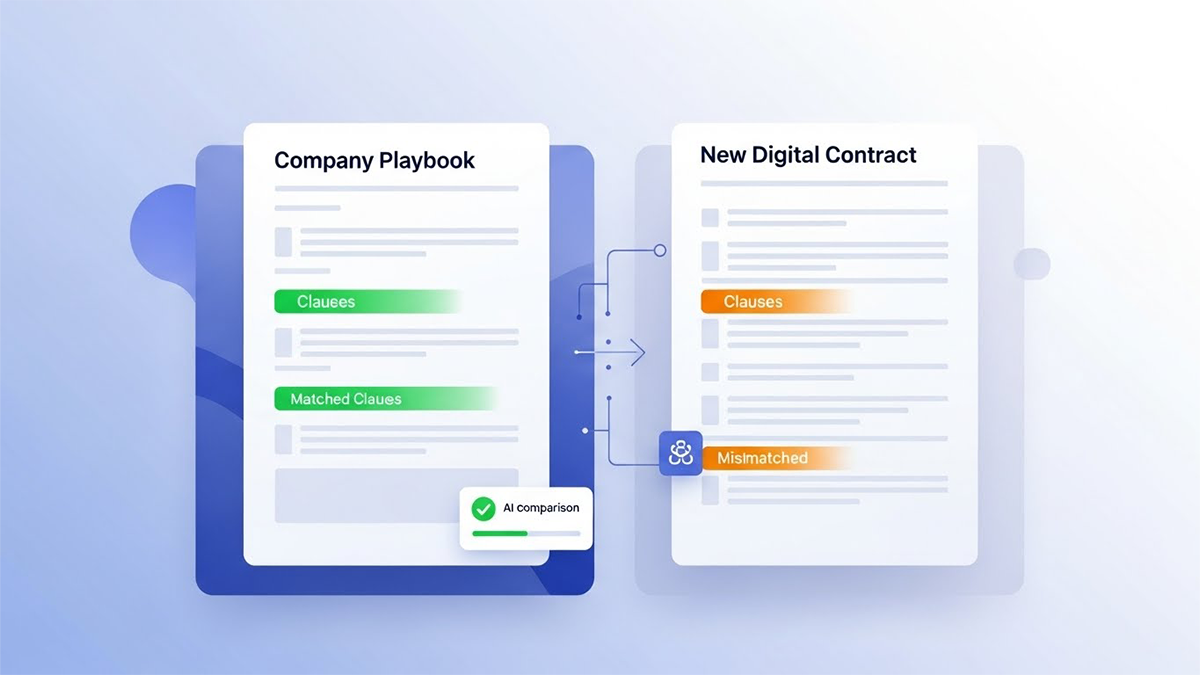
Once the playbook is digitized and understood, AI can act as a real time reviewer every time a new contract is created or received. When a user uploads a third party paper or generates a draft from a template, AI scans the document and aligns each clause with the matching playbook topic. It then highlights where the contract text matches the standard, where it uses an approved variant, and where it deviates.
Practical capabilities include:
- Clause by clause comparison that shows the standard language side by side with the current draft
- Automatic tagging of clauses as acceptable, negotiable, or high risk
- Detection of missing clauses that are required by policy but absent in the draft
- Inline comments suggesting edits to bring wording back in line with the playbook
Instead of starting from a blank review, legal teams see a structured map of the contract relative to policy. This reduces review time and ensures that no critical topic is overlooked.
5. How can AI help enforce negotiation guidelines and fallback positions?
A strong playbook does more than define ideal language. It captures how the organization is willing to move during negotiation. For example, a limitation of liability clause might have a preferred cap, a fallback cap for strategic deals, and a set of positions that are never acceptable. AI can encode these movement rules and help negotiators stay within them.
During redlining and back and forth exchanges:
- AI flags when the counterparty proposal is outside the approved band
- The system suggests alternative wording that fits an approved fallback
- Escalation logic is triggered when a deviation exceeds the usual risk threshold
- Negotiators can see at a glance what has been agreed in similar deals for consistency
By turning the playbook into a live assistant, AI helps sales and procurement teams negotiate faster while staying inside defined guardrails. It also gives legal teams confidence that even when they are not personally in every negotiation, the rules are applied consistently. Platforms such as Legitt AI are designed to deliver this kind of guided negotiation experience as part of their core workflows.
6. How does AI powered playbook comparison improve risk management and visibility?
When AI compares every contract against the playbook, risk information becomes measurable and reportable. Instead of relying on anecdotal feedback, legal and risk teams can see data on how often particular deviations occur, in which regions, and for which products or customer segments. This enables more informed decision making about where to tighten or relax policy.
Benefits include:
- Portfolio level risk heatmaps by clause type, geography, or business unit
- Insight into which playbook rules are frequently overridden and why
- Better alignment between risk appetite and real world contracting behavior
- Faster audit and compliance checks, because evidence of playbook alignment is captured automatically
This data is especially powerful when combined with a centralized AI native repository like the one offered by Legitt AI at www.legittai.com. Playbook compliance is no longer a manual box ticking exercise. It becomes a continuous, data driven process that is visible to both legal leadership and business stakeholders.
7. What does it take to implement AI based playbook comparison successfully?
Technology alone is not enough. Successful deployment requires coordinated effort across legal, commercial, and operations teams. First, the playbook itself must be clear, current, and agreed. AI will only enforce what is defined. If policies are outdated, ambiguous, or not aligned with current business practice, the system will produce friction rather than value.
Key steps usually include:
- Reviewing and refreshing the playbook with a focus on clarity and structure
- Tagging and organizing clauses and rules in a way that AI can use
- Deciding which contract types and risk areas to prioritize for the first rollout
- Integrating AI workflows into existing tools, such as CLM systems and document editors
- Training users to interpret AI outputs and provide feedback so the system improves over time
Vendors like Legitt AI can support this process with implementation services and pre built models that accelerate setup. The goal is to make AI feel like a natural extension of existing workflows rather than a separate parallel process.
8. How does this change the role of legal and commercial teams?
AI comparison against the playbook does not replace lawyers or negotiators. It changes where they spend their time. Instead of manually checking every clause against policy, they focus on the truly strategic exceptions and on improving the playbook itself. Legal teams can become designers of safe, efficient negotiation frameworks rather than line by line editors.
Commercial and procurement teams benefit from faster guidance during deals. They no longer need to wait for legal to review every minor deviation. They can see in the tool what is acceptable, what can be countered, and what must be escalated. Over time, this increases confidence and speeds up deal cycles while still protecting the company. AI native platforms like Legitt AI help make this shift from document centric work to system centric, policy led contracting.
Read our complete guide on Contract Lifecycle Management.
FAQs
Can AI really understand our specific playbook, or only generic legal rules?
AI does not rely on generic legal standards alone. It can be configured or trained on your specific playbook, templates, and historical contracts. The system learns how your organization defines acceptable positions, fallback options, and redline rules. While out of the box models provide a strong starting point, the real power comes from tuning them with your language and policies so that the AI reflects your unique risk posture.
How accurate is AI when flagging deviations from the playbook?
Accuracy is usually high for standard topics where the playbook is clear and well structured. AI is particularly strong at spotting missing clauses, changed numbers, and material wording differences. There will always be edge cases and nuanced scenarios where human judgment is needed. The best practice is to treat AI as a first pass reviewer that consistently applies the same rules, then have lawyers or senior contract managers review the high risk flags and adjust as needed.
What happens when the counterparty proposes something that is not in our playbook?
When AI encounters a clause or position that is outside the defined playbook, it can still classify and present it for review. The system may highlight it as non standard or unknown and request human input. Once legal decides whether to accept, reject, or modify the position, that decision and any new language can be added to the playbook as an approved variant or a prohibited pattern. Over time, the playbook and the AI both become richer and more complete.
Does AI work only with our templates, or can it handle third party contracts too?
AI is very effective on third party paper, which is often where playbook deviation is greatest. When a counterparty sends its own draft, AI can analyze it, map sections to your playbook, and show where their language diverges from your standard. It can also suggest redlines to bring terms closer to your preferred positions. This speeds up review of unfamiliar documents and reduces the risk of missing problematic provisions simply because they appear in unexpected sections or with different headings.
How does AI deal with multiple jurisdictions and different business lines?
You can maintain different playbooks or playbook segments for different jurisdictions, product lines, or business units. AI uses metadata such as governing law, contract type, and internal tagging to select the correct ruleset for each contract. For example, data protection clauses might follow stricter standards for EU customers compared to other regions. By encoding these distinctions in the playbook and feeding them into the AI, you ensure that comparison is context aware rather than one size fits all.
Will AI comparison slow down our process by generating too many warnings?
If configured poorly, any control mechanism can become noisy. The key is to tune the playbook and AI thresholds so that only material deviations trigger strong warnings or mandatory escalations. Minor wording differences that do not change risk can be marked as low priority or ignored. Over time, you can refine the system using feedback from users, reducing noise and focusing attention on the changes that truly matter. When tuned, AI based comparison usually speeds up work instead of slowing it.
How secure is it to feed our contracts and playbook into an AI platform?
Security and confidentiality are critical. Enterprise grade providers encrypt data in transit and at rest, implement strict access controls, and isolate each customer’s environment. Organizations should also ask about audit logs, compliance certifications, and data residency options. Platforms like Legitt AI at www.legittai.com are designed with these security requirements in mind so that you can safely leverage AI on sensitive contractual and policy data.
Do we need a fully mature playbook before we can start using AI?
A mature playbook helps, but it is not a strict prerequisite. AI can actually assist in building and refining your playbook by analyzing existing contracts, clustering similar clauses, and surfacing common patterns. You can start with a core set of policies for high impact clauses, then expand coverage as you learn from real usage. Many organizations follow an iterative approach where AI and the playbook evolve together rather than waiting for a perfect, final document.
What kind of internal team is needed to manage AI based playbook comparison?
You typically need a small cross functional team that includes legal, commercial operations or sales operations, and IT or legal operations. Legal defines the playbook rules and risk thresholds. Operations ensures the workflows fit real deal processes. IT or legal ops manages integrations and user access. Once the system is in place, day to day usage is handled by the people who already work on contracts. The core team periodically reviews metrics, adjusts rules, and oversees continuous improvement.
How does an AI native platform like Legitt AI differ from a traditional CLM with add on AI?
Traditional CLM systems may offer basic AI features as separate modules, such as simple clause extraction or text search. An AI native platform like Legitt AI is architected so that AI and playbook logic are central to every stage of the contract lifecycle. Contracts are treated as structured data objects, and comparison to policy happens automatically whenever a contract is created, edited, or reviewed. This level of integration makes it much easier to enforce the playbook consistently and to generate meaningful analytics about how contracts align with company strategy.