
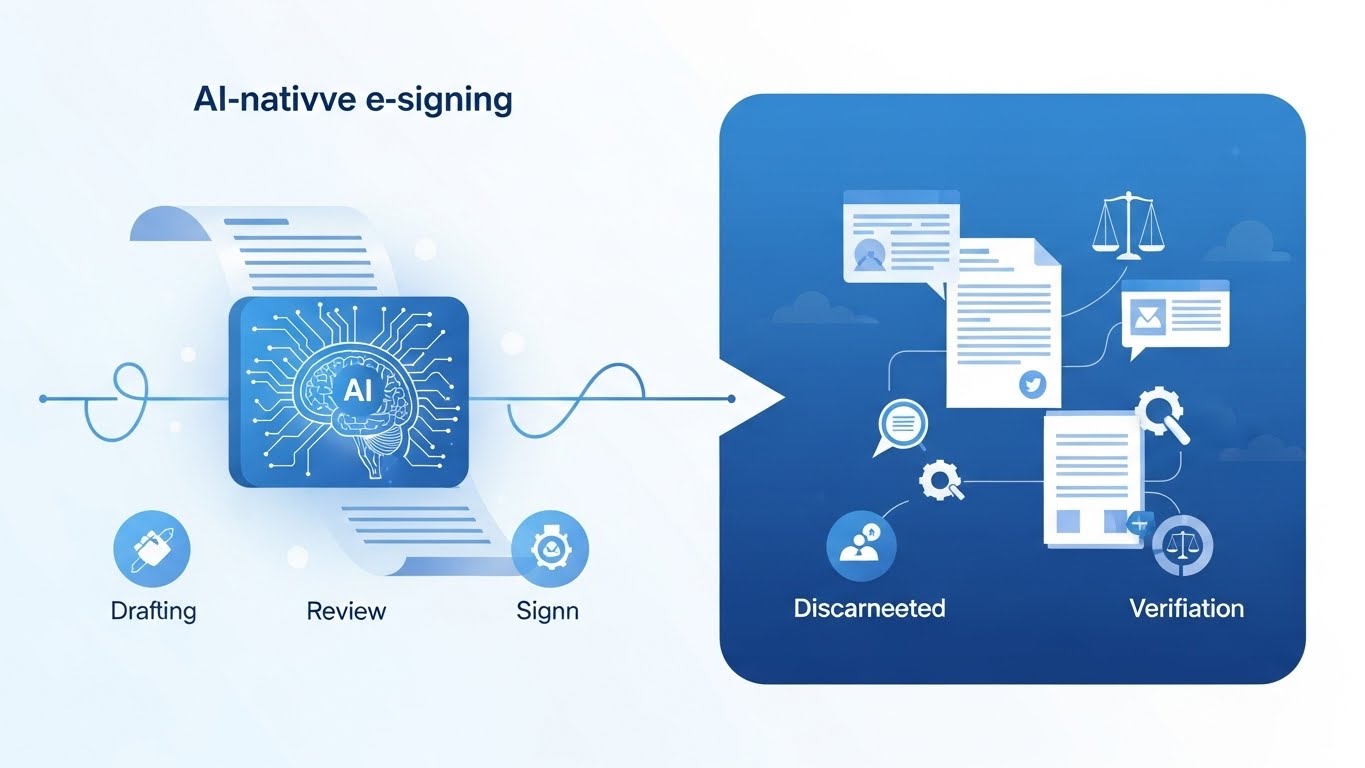
AI-native e-signing is not just “e-signature with a chatbot.” It is an architecture where AI drives how contracts are drafted, routed, signed, stored, and analyzed across their entire lifecycle. By contrast, most tools today are “AI-added”: the traditional PDF-upload and tag-placement experience with a few AI helpers bolted on.
An AI-native platform such as Legitt AI (www.legittai.com) is designed from the ground up around contracts as data, not just documents. It uses AI to generate agreements from clause libraries, orchestrate approvals, pick the right signing flow for each risk level, and feed executed contracts back into analytics, renewals, and revenue workflows. This article explains what AI-native e-signing really is, how it differs from AI-added workflows, the business benefits, and a practical roadmap for making the shift.
1. What Do We Mean by “AI-Native” E-Signing?
“AI-native” is about where AI sits in the system, not whether you have an AI button somewhere in the UI.
In an AI-native e-signing platform:
- AI is in the critical path.
Contracts are generated or assembled by AI from approved templates and clause libraries. AI proposes approval routes, sequences signers, and decides authentication strength based on risk. - Contracts are treated as structured data.
Key terms (caps, discounts, renewal dates, SLAs, obligations) are extracted, stored, and linked to business systems, not left buried in PDFs. - Workflows are policy-driven, not ad-hoc.
Legal, sales, procurement, and finance define guardrails and playbooks; AI executes within those boundaries.
By contrast, an “AI-added” e-signature tool still relies on humans to:
- Upload PDFs and place signature fields.
- Choose templates manually.
- Track approvals and reminders in email or spreadsheets.
- Interpret and re-key contract data after signing.
AI may help summarize documents or draft reminder emails, but it does not fundamentally change how contracts are created or how risk is controlled.
2. AI-Native vs AI-Added E-Sign: Key Differences
2.1 Role of AI in the architecture
AI-added e-signing
- Core product: a document-centric signing utility.
- AI is an overlay: “Summarize this contract” or “Explain this clause.”
- If you remove AI, the tool behaves more or less the same.
AI-native e-signing
- Core product: an AI-orchestrated contract engine.
- Templates, clauses, approvals, and signing flows are determined by AI using your policies.
- If you remove AI, the value proposition breaks: drafting slows down, errors increase, and workflows become manual.
2.2 Approach to contracts and data
AI-added
- Contracts are mostly PDFs and static files.
- Limited metadata: title, parties, status, dates.
- Little or no clause-level insight; repository analytics are shallow.
AI-native
- Contracts are data objects with structured fields: obligations, financials, risks, key dates, jurisdictions.
- AI extracts and normalizes these terms, then links them to CRM, ERP, HR, and revenue systems.
- E-sign events (views, delays, drop-offs) become feedback for improving templates and flows.
2.3 Process ownership
AI-added
- Users drive every step: pick template, upload file, decide signers, manually route approvals, chase signatures.
- AI helps only when explicitly called.
AI-native
- Leadership defines policy and guardrails:
- Which templates apply to which scenarios.
- When legal or finance must approve.
- Which signing flows are acceptable by risk and jurisdiction.
- AI executes: it chooses the template, assembles clauses, routes approvals, sends for signature, and escalates exceptions.
 Hi, What do you want to Draft?

Click to upload or drag & drop
pdf, docx up to 5 MB
Click to upload or drag & drop
pdf, docx up to 5 MB
3. Core Capabilities of an AI-Native E-Signing Platform
An AI-native platform like Legitt AI (www.legittai.com) spans much more than the signature moment itself.
3.1 Intelligent contract generation
Instead of starting from a blank Word file or a recycled PDF:
- Users describe the scenario (“US-law SaaS MSA for an enterprise customer, 3-year term, premium SLA”) or select a deal from CRM.
- AI chooses the correct master template and clause variants (liability, data protection, IP, SLAs, jurisdiction).
- Commercial terms (names, pricing, quantities, dates, discounts) are auto-filled from connected systems.
- The draft is policy-compliant by design, before legal or sales touches it.
3.2 Risk-aware signing flows
AI-native e-signing dynamically adjusts how signatures are captured:
- Low-risk documents (standard NDAs, internal approvals)
→ simple signing with basic authentication and standard audit trail. - Medium-risk documents (typical customer or vendor contracts)
→ stronger authentication (one-time passwords, SSO), explicit consent screens, rich logs. - High-risk or regulated documents (certain financial, public sector, or cross-border deals)
→ elevated assurance (advanced or certificate-backed signing where required by policy or law).
The same platform can offer multiple levels of assurance and automatically select the right one based on rules set by legal and compliance.
3.3 Guided experience for senders and signers
AI can dramatically improve usability:
- For senders
- Recommends the right contract type and template.
- Suggests the approval path based on deal value, jurisdiction, and risk.
- Warns if mandatory clauses or schedules are missing.
- For signers
- Highlights key terms (price, term, renewal, termination, SLAs).
- Offers a plain-language explanation of complex sections.
- Answers common questions inside the signing interface, reducing friction and drop-off.
3.4 Closed-loop analytics and continuous learning
Because contracts and signature events are captured as structured data, AI-native platforms can:
- Identify where deals consistently slow down (specific clauses, approvers, or signers).
- Spot clauses that generate frequent redlines and suggest simplified alternatives.
- Correlate contract patterns with outcomes (disputes, renewals, upsell success, revenue leakage).
Over time, your templates, playbooks, and signing flows improve based on real evidence, not anecdote.
4. Why “AI-Added” E-Sign Workflows Hit a Ceiling
There is nothing wrong with having AI helpers in a traditional e-sign product; they can be genuinely useful. But they rarely address the big structural problems:
- Templates scattered across teams and drives.
- Inconsistent clauses and one-off edits across the portfolio.
- Manual, email-driven approvals with no central visibility.
- Weak linkage between contracts and revenue, procurement, or HR systems.
- Limited ability to answer basic questions like “How many contracts have this risky clause?” or “Where are deals stuck?”
In an AI-added setup, e-signature is still the “last mile.” Most risk and friction are upstream (in drafting and approval) and downstream (in repository management and analytics). AI will feel incremental in that environment because the underlying architecture hasn’t changed.
AI-native e-signing, by contrast, assumes that drafting, approval, signing, storage, and analysis are all parts of one unified, AI-orchestrated lifecycle.
5. AI-Native E-Signing in Practice: A Typical Flow
Consider a standard B2B sales contract scenario using Legitt AI (www.legittai.com):
- Deal intake
- A salesperson selects an opportunity in CRM or provides structured inputs (deal size, region, term, products, special conditions).
- AI-generated draft
- The platform selects the correct contract type and template (NDA, MSA, SOW, order form).
- It assembles clauses from the controlled clause library, applies the right jurisdiction, and fills in commercial variables.
- Pre-flight checks
- AI verifies that all mandatory clauses and schedules are present.
- It checks for internal consistency (numbers, definitions, cross-references).
- It flags deviations from policy and suggests changes or required approvals.
- Approval orchestration
- Based on rules (value, risk, customer type), the system routes the draft to sales management, legal, finance, or security as needed.
- Approvers see a summarized risk view, not just a raw document.
- Signature flow selection
- Once approved, AI selects the appropriate signing flow: signer order, authentication level, reminder cadence, expiry conditions.
- The invitation goes out to signers with a guided, branded experience.
- Execution and evidence
- Every action is logged: views, consent, authentication steps, signatures, declines.
- A tamper-evident evidence package is generated for audit and dispute readiness.
- Post-signature integration
- Executed contracts are stored in a central repository with enriched metadata (renewal dates, SLAs, discounts).
- Key data syncs back to CRM, billing, revenue recognition, procurement, or HR, depending on the contract type.
- AI monitors milestones (renewals, price steps, notice periods) and drives reminders or workflows.
The result: users experience “click and send,” but the process behind that click is a deeply governed, AI-driven operation.
6. Benefits of AI-Native E-Signing Across the Organization
6.1 For legal and compliance
- Standardized risk posture
Clause libraries and playbooks are enforced in every draft, reducing clause drift and one-off exceptions. - Higher leverage
Legal teams spend less time drafting and checking routine documents and more time on strategy, complex negotiations, and regulatory updates. - Portfolio-level insight
Legal can see where the organization is consistently conceding on risk and address it structurally (template updates, negotiation training, policy changes).
6.2 For sales and customer-facing teams
- Shorter cycle times
Contracts and amendments can be generated and sent for signature in minutes, not days. - Less friction with legal
Standard deals adhere to policy by default; fewer escalations and fewer “back to the drawing board” moments. - Better signer experience
Customers see guided, transparent signing flows, leading to higher completion rates and improved perception of professionalism.
6.3 For procurement and vendor management
- Controlled vendor risk
Vendor NDAs, MSAs, DPAs, and SOWs follow consistent standards, making it easier to manage third-party risk. - Central visibility
All vendor contracts sit in one searchable repository with clear key terms, not scattered in email attachments. - Faster onboarding
AI-generated vendor agreements and streamlined e-sign flows accelerate onboarding and reduce operational bottlenecks.
6.4 For finance and leadership
- Cleaner linkage to revenue and costs
Contract data flows into billing, forecasting, and cost analysis. There is a clear connection between executed agreements and financial systems. - Improved governance and auditability
Approvals, deviations, and key decisions are traceable. This supports internal audits, investor due diligence, and regulatory inquiries. - Strategic decision support
Leadership can see patterns in contract terms and outcomes, such as which commercial models drive higher renewals or fewer disputes.
7. How to Move from AI-Added to AI-Native E-Signing
Transitioning to AI-native e-signing is a change in operating model, not just a tool swap. A realistic roadmap looks like this:
Step 1: Rationalize templates and clauses
- Inventory existing contract types (NDAs, sales MSAs, proposals, vendor MSAs, SOWs, HR letters).
- Consolidate them into a smaller number of standard templates.
- Build a clause library with approved variants for key topics (liability, indemnity, data protection, SLAs, termination, jurisdiction).
Step 2: Define policies and playbooks
- Agree on default positions, acceptable fallbacks, and absolute “no-go” clauses.
- Map which contract types and thresholds require which approvals (legal, finance, security, leadership).
- Document where different assurance levels of e-signature are acceptable or required.
Step 3: Implement an AI-native platform
- Deploy Legitt AI (www.legittai.com) or a similar AI-native system as the central orchestration layer.
- Configure templates, clause libraries, approval rules, and signing flows inside the platform.
- Integrate it with CRM, HRIS, procurement, and your contract repository.
Step 4: Pilot with a narrow, high-value use case
- Start with one or two contract families (for example, standard sales MSAs and NDAs in one region).
- Keep legal closely involved, reviewing AI-generated drafts and monitoring approvals and signing events.
- Iterate on templates, rules, and user experience based on practical feedback.
Step 5: Expand scope and mature governance
- Add more contract types (vendor contracts, SOWs, HR documents), more geographies, and more use cases.
- Move some standard, low-risk processes to lighter legal review, while maintaining strict control over exceptions.
- Establish a contract governance group to manage ongoing updates and ensure alignment with business strategy and regulatory changes.
8. Guardrails: Staying in Control While Embracing AI
The power of AI-native e-signing comes with responsibility. To stay in control:
- Lock legal content.
Core clauses and templates should be centrally owned, versioned, and change-controlled. AI generates from approved building blocks; it does not improvise new legal language for critical sections. - Maintain role-based access.
Only authorized users can modify templates, clause libraries, and approval rules. Business users can assemble and send contracts; they cannot alter the underlying legal framework. - Enforce approvals.
Deviations from standard terms, high-value deals, and high-risk sectors must always trigger human review. - Audit AI decisions and actions.
Every major AI-driven step (template selection, clause variant choice, risk classification) should be traceable and explainable to internal and external stakeholders. - Protect data.
Ensure contract data, clause libraries, and transaction logs are segregated, encrypted, and governed according to your security and privacy standards.
With these guardrails in place, AI-native e-signing becomes a safer, more reliable way to scale contracting than manual, fragmented processes.
Read our complete guide on Contract Lifecycle Management.
FAQs
How would you explain AI-native e-signing in one sentence?
AI-native e-signing is an e-signature capability built into an AI-driven contract lifecycle platform that drafts, routes, signs, and analyzes agreements based on templates, clause libraries, and policies—rather than a stand-alone tool that simply collects signatures on uploaded PDFs.
Do we need to rewrite all our contracts to adopt an AI-native platform?
Not necessarily, but you do need to standardize. The practical approach is to consolidate existing documents into a smaller set of master templates and extract reusable clauses into a central library. Platforms like Legitt AI (www.legittai.com) can help analyze your current portfolio and identify common patterns, making the standardization process faster and more structured.
Can AI-native e-signing handle different jurisdictions and regulatory requirements?
Yes, provided your templates and rules are configured accordingly. You can maintain separate or layered templates and clause variants for different jurisdictions, industries, and regulatory regimes. The AI engine then selects the correct combination based on contract context (e.g., governing law, data flows, sector) as defined by your legal and compliance teams.
How does AI-native e-signing improve security and auditability compared to traditional tools?
AI-native systems log every step in the contract lifecycle: who drafted, who edited what, which clauses were used, which approvals were obtained, and how signatures were captured. They also maintain consistent, tamper-evident records and can generate evidence packages on demand. This level of structured traceability is often superior to ad-hoc Word-and-email workflows plus a basic e-sign tool.
How does AI-native e-signing improve security and auditability compared to traditional tools?
AI-native systems log every step in the contract lifecycle: who drafted, who edited what, which clauses were used, which approvals were obtained, and how signatures were captured. They also maintain consistent, tamper-evident records and can generate evidence packages on demand. This level of structured traceability is often superior to ad-hoc Word-and-email workflows plus a basic e-sign tool.
Is an AI-native approach suitable for small and mid-sized businesses?
Yes. Smaller organizations often lack dedicated legal operations and contract management teams, so they benefit even more from automation and standardization. They can start with a limited set of critical contracts (NDAs, sales orders, vendor MSAs) and grow into more complex use cases as their business expands, using Legitt AI (www.legittai.com) as a force multiplier rather than hiring large back-office teams.
How does AI-native e-signing affect the experience for signers?
The signer experience becomes more guided and transparent. Rather than a bare PDF and a signature box, signers can see key terms highlighted, receive plain-language explanations of important clauses, and ask questions in context. Appropriate authentication steps are built into the flow without feeling intrusive. The result is higher trust, fewer misunderstandings, and faster completion.
Can AI-native systems integrate with our existing CRM, ERP, and HR platforms?
Yes. Integration is central to the AI-native model. Deal data from CRM, vendor and cost data from ERP, and employee data from HRIS all feed into contract generation. After signing, executed contract data flows back into these systems for billing, forecasting, reporting, and compliance. Legitt AI (www.legittai.com) is specifically designed to operate as this connective tissue.
What are the main risks of moving to AI-native e-signing, and how can we mitigate them?
The main risks involve poor governance: uncontrolled template changes, inadequate approval rules, or insufficient monitoring of AI-driven behavior. Mitigation involves strong ownership of templates and clause libraries by legal, clear change-management processes, role-based access, and regular audits of both system configurations and transaction logs. Choosing a vendor with robust security and governance capabilities is equally important.
How can we measure the success of an AI-native e-signing implementation?
Useful metrics include: average time from draft to signature, number of contracts using standard clauses versus bespoke ones, rate of legal escalations on standard deals, signer completion and drop-off rates, the volume of post-signature corrections, and overall contract visibility (e.g., percentage of contracts with complete metadata). As these indicators improve—and as internal teams report smoother collaboration—you will see clear evidence that the AI-native model is delivering value.