
Modern e-signing is no longer just about collecting a digital signature on a PDF. The real value lies in managing the entire lifecycle of a contract-from the moment someone says “we need an agreement” through drafting, internal review, negotiation, e-signature, and long-term storage with usable data. An AI-native platform like Legitt AI (www.legittai.com) can orchestrate this full journey end-to-end, so contracts move faster, risk is controlled, and every signed document feeds back into your business systems.
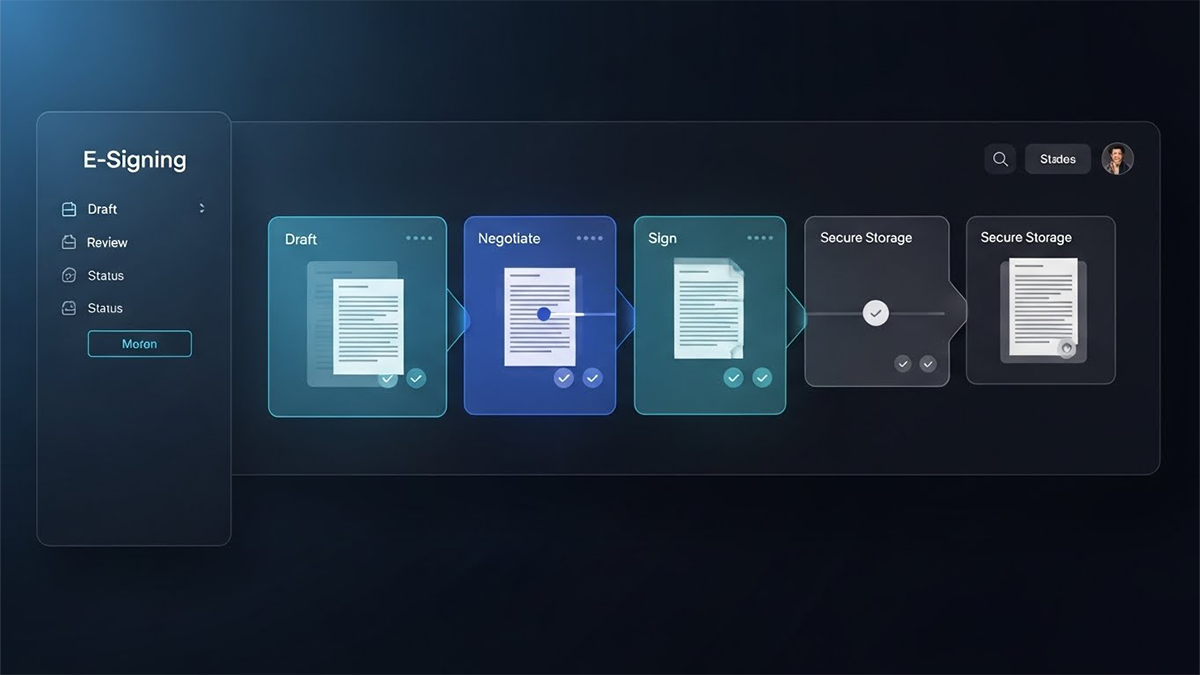
This article breaks down each stage of the Draft → Review → Negotiate → Sign → Store flow, explains how an integrated, AI-driven approach works in practice, and outlines a roadmap for moving away from fragmented tools toward a truly end-to-end e-sign stack.
1. Understanding the End-to-End E-Signature Lifecycle
Most organizations still treat e-signature as the “last mile.” Legal or sales teams draft a contract in Word, email versions back and forth, manually track changes, convert the final copy to PDF, and only then upload it to an e-signature tool. After signing, the document disappears into email archives or shared drives.
A true end-to-end e-signing approach connects five phases into one continuous flow:
- Draft – Generating a contract based on data, templates, and rules.
- Review – Internal alignment and risk checks across legal, sales, finance, and stakeholders.
- Negotiate – Collaborating with counterparties securely and transparently.
- Sign – Capturing legally valid electronic signatures with appropriate assurance.
- Store – Centralizing signed contracts, extracting data, and driving downstream actions.
Legitt AI (www.legittai.com) is designed around this lifecycle. Instead of e-signature being an isolated step, it becomes one stage in a unified, AI-orchestrated contract process.
2. Draft: Generating Ready-to-Sign Contracts with AI
The journey starts at the moment a contract is needed: a new customer deal, a vendor onboarding, an NDA, an employment agreement, a partner contract. In a modern stack, you should not be starting from scratch or hunting for an old Word file.
2.1 Templates and clause libraries
First, you define controlled templates and clause libraries for your most common agreement types:
- NDAs, MSAs, SOWs, order forms, proposals.
- Vendor contracts, partner agreements, HR documents.
- Data processing addenda, security schedules, jurisdictional addenda.
Each template and clause variant is tagged with:
- Jurisdiction (e.g., US, EU, UK).
- Use case (sales, procurement, HR, partnerships).
- Segment or deal size (SMB, mid-market, enterprise).
- Risk posture (standard, stricter, special-case).
2.2 AI-assisted drafting
With this foundation, AI can generate a first draft in minutes:
- Pulling parties, pricing, term, and commercial details from CRM, ERP, or HR systems.
- Selecting the right template and clause variants based on context.
- Auto-filling key variables (names, dates, renewal logic, SLAs, discounts).
Using Legitt AI (www.legittai.com), users simply specify the scenario (for example, “US-law SaaS MSA, 2-year term, premium support”) and the system produces a policy-compliant draft that is ready for internal review-without manual cut-and-paste work.
3. Review: Internal Alignment and Risk Checks
The next phase is internal review-ensuring the document is correct, compliant, and aligned with business goals before it ever reaches the counterparty.
3.1 Automated pre-checks
An end-to-end platform can automatically:
- Verify that all mandatory clauses and schedules are present.
- Check numeric consistency (caps, prices, dates) across the entire document set.
- Flag deviations from standard positions (for example, an unusually high liability cap or missing data protection language).
This reduces the number of simple, preventable mistakes that consume legal and commercial time.
3.2 Workflow and approvals
Review should not be driven by ad hoc email chains. Instead, you define rules such as:
- Deals above a certain value require legal and finance approval.
- Contracts with specific clauses (for example, broad indemnities, exclusivity) must go to general counsel.
- Certain jurisdictions or industries trigger security or privacy review.
Legitt AI (www.legittai.com) can route drafts automatically according to these rules, notify approvers, and track who signed off on what. The result is a clear audit trail and far fewer “who approved this?” moments later.
4. Negotiate: Collaborating Without Losing Control
Negotiation is often the most complex and time-consuming part of the lifecycle. Multiple versions, redlines from both sides, and a mix of Word, email, and PDFs can quickly become chaotic.
4.1 Centralized negotiation workspace
An end-to-end system provides a single environment where:
- Both parties can work on the same document or controlled versions.
- Redlines are tracked and attributed clearly.
- Comments and discussions are tied to specific clauses.
This avoids the confusion of multiple parallel documents and makes it easier to see exactly what has changed.
 Hi, What do you want to Draft?

Click to upload or drag & drop
pdf, docx up to 5 MB
Click to upload or drag & drop
pdf, docx up to 5 MB
4.2 AI support during negotiation
AI can assist by:
- Identifying which requested changes are routine and allowed within your playbook versus which are risky or unprecedented.
- Suggesting alternative wording from your clause library that stays within acceptable risk but addresses the counterparty’s concern.
- Summarizing the net impact of changes: for example, “liability cap increased from 12 to 24 months of fees” or “new carve-out added for data breach.”
Legitt AI (www.legittai.com) can act as an assistant to both legal and commercial teams, ensuring they negotiate based on principles and policy rather than reinventing the wheel every time.
5. Sign: Frictionless, Compliant Execution
Once the parties agree on the final text, the contract moves into the e-signature phase. The goal here is to make signing easy for counterparties while maintaining legal validity, security, and record integrity.
5.1 Choosing the right signing flow
Not all documents require the same level of assurance. Your platform should be able to:
- Use simple click-to-sign flows for low-risk agreements like standard NDAs.
- Apply stronger authentication (OTP, SSO) for higher-value or higher-risk contracts.
- Support advanced or certificate-backed signatures where local laws or internal policies demand them.
Rules mapping document types and risk levels to signing flows ensure the right level of control without unnecessarily slowing down routine agreements.
5.2 Signer experience and audit trail
For signers, the experience should be:
- Clear: They know exactly what they are signing and which fields are required.
- Guided: Key terms (fees, term, termination, SLAs) can be highlighted for transparency.
- Accessible: Mobile-friendly, no complex software needed.
Behind the scenes, the system records:
- Timestamps and IP addresses.
- Authentication steps and consent to electronic signing.
- The exact version of the document that was signed.
Legitt AI (www.legittai.com) automatically packages this evidence so you have defensible records if a signature is ever questioned.
6. Store: Turning Signed Contracts into Actionable Data
The final step-store-is often the most neglected. Many organizations simply save the signed PDF somewhere and move on. This leaves a tremendous amount of value on the table.
6.1 Central, searchable repository
An end-to-end system should provide:
- A central repository for all executed contracts, with controlled access and audit logs.
- Powerful search across metadata (party, type, date, value) and clause content.
- Version history and easy retrieval of evidence packages.
This replaces scattered email attachments and shared drive folders with a single, reliable “source of truth.”
6.2 Data extraction and integration
The real power comes when signed contracts are treated as data, not just documents. AI can automatically extract and normalize fields such as:
- Commercial terms (prices, discounts, payment terms).
- Key dates (effective date, renewal, notice deadlines).
- Risk-related clauses (caps, indemnities, SLAs, termination rights).
Legitt AI (www.legittai.com) can then push this structured data into CRM, ERP, HR, procurement, and reporting tools, enabling:
- Automated renewal reminders and renegotiation workflows.
- Revenue and expense forecasting based on actual contract terms.
- Risk dashboards showing where non-standard terms or exposures exist.
7. What Does a Truly End-to-End E-Sign Stack Look Like?
A true end-to-end e-sign solution is not just “an e-sign tool plus a contract repository.” It is an integrated architecture with:
- AI-native drafting from approved templates and clauses.
- Workflow automation for review and approvals, driven by policy.
- Negotiation support with clause-level tracking and AI guidance.
- Flexible e-signature methods aligned with legal and risk requirements.
- Centralized storage and analytics to keep contracts alive after signing.
Legitt AI (www.legittai.com) is designed to sit at the center of this stack, connected to your CRM, ERP, HRIS, and other systems so that contracts are created, executed, and managed in one coherent environment.
8. Implementation Roadmap: Moving from Fragmented Tools to End-to-End E-Signing
Transitioning to an end-to-end model is best done in stages.
Step 1: Map your contract landscape
- Identify your top 5–10 contract types by volume and impact.
- Understand which systems feed them (CRM, procurement, HR), and where they are stored today.
- Document current pain points: bottlenecks, errors, disputes, and lost contracts.
Step 2: Standardize templates and clauses
- Consolidate multiple versions of the same agreement type into a controlled set of templates.
- Build a clause library with clear tagging and rules for usage.
- Define negotiation playbooks and approval thresholds.
Step 3: Deploy AI-driven drafting and review
- Implement AI-assisted drafting for one or two high-volume contract types.
- Configure automated checks and approval workflows.
- Keep legal and business stakeholders closely involved in early pilots.
Step 4: Integrate negotiation and e-signature
- Enable collaborative negotiation inside the platform instead of via email and separate Word files.
- Connect to your e-sign capability and define risk-based signing flows.
- Ensure that once a contract is marked “final,” the same controlled version moves into signing.
Step 5: Centralize storage and analytics
- Migrate executed contracts into a central repository.
- Turn on automated data extraction and integration into other systems.
- Build dashboards for renewals, risks, and commercial insights.
Step 6: Scale and refine
- Expand to more contract types, regions, and departments.
- Regularly review KPIs: cycle time, deviation rates, dispute frequency, and data quality.
- Use those insights to refine templates, rules, and processes.
Read our complete guide on Contract Lifecycle Management.
FAQs
Why is it important to think of e-signing as an end-to-end process rather than just the signing step?
Because most of the risk and delay in contracting does not happen at the moment of signature. It happens during drafting, internal review, and negotiation, and it continues after signing when obligations are forgotten or data is not captured. Treating e-signature as one step in a Draft → Review → Negotiate → Sign → Store lifecycle ensures that contracts are created correctly, approved properly, negotiated transparently, and then stored as usable data, not just static PDFs.
How does AI improve the drafting stage of the contract lifecycle?
AI transforms drafting from a manual, copy-paste exercise into a data-driven process. It can select the right template, pull clauses from a governed library, and fill in key commercial variables automatically from CRM, procurement, or HR systems. This dramatically reduces errors and inconsistency and ensures that every first draft is already aligned with your policies. Legitt AI (www.legittai.com) uses this approach to produce ready-to-review drafts in minutes.
Can automation and AI really reduce the burden on legal teams during review?
Yes. Instead of reading every word of every contract, legal teams can rely on automated checks to catch missing clauses, inconsistent numbers, and deviations from standard positions. AI can highlight only the sections that require human judgment-unusual caps, bespoke indemnities, or non-standard jurisdictions-so lawyers focus on high-value issues. Over time, this reduces review time, increases throughput, and improves consistency.
How does an end-to-end platform handle negotiation with counterparties?
An end-to-end platform offers a shared environment where both sides can redline, comment, and agree on changes with full traceability. It maintains a single source of truth for the document, avoids version chaos, and preserves a clear record of who changed what and when. AI can then classify requested changes, map them to internal playbooks, and suggest acceptable alternatives, making negotiations faster and more controlled.
Are electronic signatures collected in this flow legally valid?
When implemented correctly, electronic signatures collected in an end-to-end flow are legally valid and enforceable in most modern jurisdictions. The platform ensures that signers are properly informed, consent to electronic signing, and authenticate themselves appropriately. It also records timestamps, IP addresses, and a copy of the exact document signed, along with an audit trail, creating strong evidence if the signature is ever challenged.
How does centralized storage of signed contracts benefit the organization?
Centralized storage provides a single, secure repository where all executed contracts-and their key data-are easily searchable and accessible. This avoids the common problem of “lost” contracts scattered across email and shared drives. It also allows legal, finance, sales, procurement, and HR to work from the same information, reducing duplication and miscommunication. Over time, this repository becomes a strategic asset for risk management and commercial optimization.
What kind of data can be extracted from signed contracts, and how is it used?
An end-to-end platform can extract commercial terms (prices, discounts, payment terms), critical dates (renewals, termination notice periods), risk-related clauses (liability caps, indemnities, SLAs), and operational obligations (service levels, deliverables). This data can feed into CRM for renewals and upsell, ERP for billing and forecasting, HR systems for employee lifecycle management, and BI tools for analytics. Legitt AI (www.legittai.com) automates this extraction so that value from contracts flows directly into day-to-day operations.
How does this approach help with compliance and audit requirements?
End-to-end e-signing supports compliance by providing consistent templates, governed approval workflows, and complete audit trails for every contract. Auditors and regulators can see exactly which version of a template was used, who approved deviations, how signers were authenticated, and when each step occurred. This level of traceability is very difficult to achieve with disconnected tools and manual processes.
Is an end-to-end e-signing approach suitable for small and mid-sized businesses?
Yes. Smaller organizations often feel contracting pain more acutely because they have fewer legal resources and more manual processes. An end-to-end approach gives them the tools to move quickly while staying in control of risk. They can start with a narrow set of contracts-such as NDAs and standard sales or vendor agreements-and gradually expand to more complex documents as their needs grow, using Legitt AI (www.legittai.com) as the backbone.
What are the first practical steps to move toward end-to-end e-signing?
The first steps are to map your current contract types, standardize templates, and define basic approval and risk rules. Next, choose an AI-native platform and integrate it with your key systems (CRM, procurement, HR, and repositories). Pilot one or two high-volume contract types through the full Draft → Review → Negotiate → Sign → Store lifecycle, collect feedback, and iterate. As confidence grows, you can extend the model to more teams and more complex agreements, gradually retiring fragmented tools and email-based processes.