
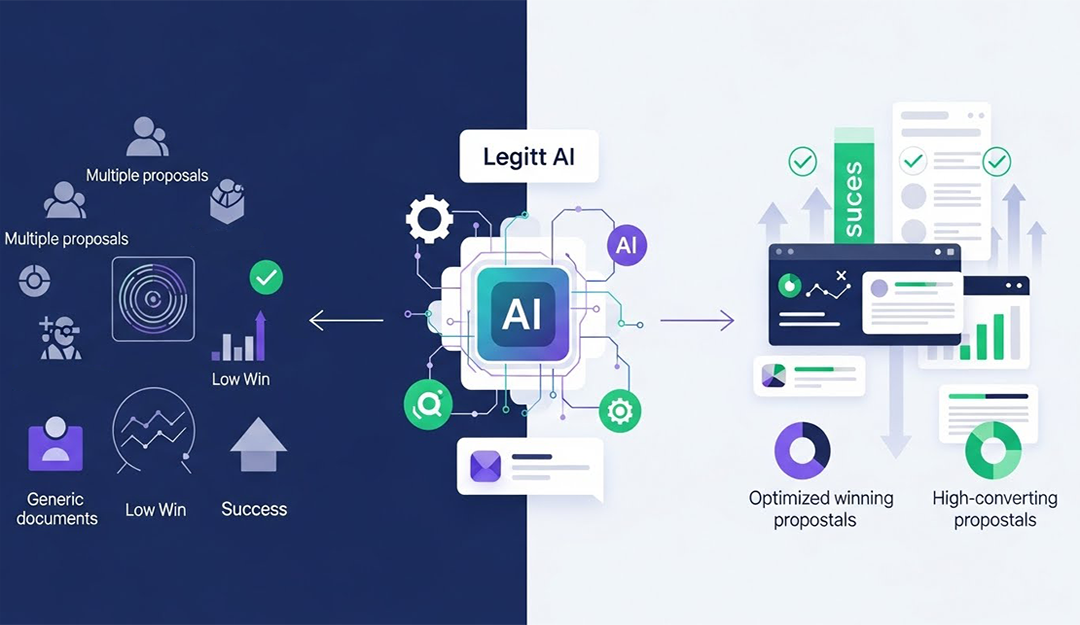
Legitt AI (www.legittai.com) increases proposal win rates by turning proposal creation from a manual, ad-hoc activity into a data-driven, repeatable system. It uses AI to generate tailored, on-brand proposals from your CRM data, discovery notes, and content libraries, then continuously learns from won/lost deals to refine messaging, pricing patterns, and structure over time. Instead of relying on individual heroics, your entire sales team benefits from the same “best-practice engine” behind every proposal.
Below is a detailed look at how this works in practice and how sales leaders can operationalize it.
1. From one-off proposals to a repeatable “winning system”
Most teams treat each proposal as a one-off craft project. Different reps copy old documents, pull random slides, ask product/solutions/marketing for help, and hope what they send “lands” with the buyer. The problem is that nothing is standardized, nothing is measured, and even when a proposal works well, it is hard to repeat that success consistently across the team.
Legitt AI (www.legittai.com) replaces this with a system: shared templates, structured content blocks, pricing and packaging rules, and AI that assembles all of that into a proposal tuned to a specific buyer. Every proposal pulls from the same governed foundation, so the organization learns as a whole. Over time, what worked in your best proposals becomes the default starting point for everyone else, which naturally pushes win rates upward.
2. Capturing client insight once and using it everywhere
Win rates rise when proposals reflect the buyer’s real world, not just your product brochure. In many teams, discovery insights are scattered across notes, call recordings, and CRM comments, and they rarely make it into the document in a coherent way. Reps are too busy to rewrite everything from scratch, so proposals often feel generic, even when the rep knows the account well.
With Legitt AI (www.legittai.com), key client details and pain points are captured as structured inputs—through CRM fields, guided forms, or AI-summarized call notes. The platform then uses these inputs to personalize the executive summary, problem framing, value narrative, and recommended solution. This means every proposal starts from a deep understanding of the buyer’s context, which dramatically improves relevance and credibility.
 Hi, What do you want to Draft?

Click to upload or drag & drop
pdf, docx up to 5 MB
Click to upload or drag & drop
pdf, docx up to 5 MB
3. Templates and playbooks tuned by actual win/loss data
Templates are only as good as the logic behind them. In traditional environments, proposal templates are created once by marketing or sales ops and rarely revisited; nobody knows whether a given structure or message actually moves the needle. Reps then improvise around those templates, and the organization loses track of what really works.
Legitt AI (www.legittai.com) closes this loop. Proposals are assembled from a library of templates, sections, and content blocks that are all tagged and versioned. Because those proposals are tied to opportunities in your CRM and their outcomes (won, lost, stalled), you can see which patterns perform best by segment, industry, and deal size. The AI can then prioritize higher-performing structures and content, nudging the entire team toward combinations that statistically win more often.
4. AI-generated narratives that speak the buyer’s language
Buyers respond to proposals that reflect their vocabulary, metrics, and framing—not yours. Writing that kind of narrative by hand takes time, which is why many proposals end up reading like generic product datasheets with a logo swapped on the cover. That weakens your differentiation and makes it easy for procurement to treat you like a commodity.
Legitt AI (www.legittai.com) uses large language models, guided by your brand voice and playbooks, to draft the narrative sections of the proposal: executive summary, current state, desired outcomes, solution overview, business case, and next steps. The system tailors language by industry and persona—CFO, CRO, CIO, operations, legal—so each stakeholder sees their concerns addressed. Because the model is grounded in structured inputs and approved content, you get personalized, buyer-centric narratives without losing control over tone or accuracy.
5. Smarter pricing and packaging within clear guardrails
A strong narrative helps, but proposals are often won or lost in the details of price, packaging, and perceived value. When pricing is managed in spreadsheets or memory, reps either play it too safe or over-discount to “be competitive,” often without knowing what has worked historically for similar deals. This hurts both win rates and margins.
Legitt AI (www.legittai.com) integrates with your product catalog and pricing rules to recommend packages and configurations based on deal size, segment, and use case. It can suggest typical bundles for similar customers, highlight value-anchored options (good/better/best), and flag when proposed discounts fall outside policy thresholds. This keeps proposals commercially competitive while remaining consistent, defensible, and aligned with your revenue strategy—all of which contributes to higher conversion and healthier deals.
6. Coordinating multi-stakeholder input without slowing deals
Winning proposals usually require input from multiple teams: sales, solutions, product, legal, security, implementation, and sometimes finance. In manual workflows, this creates bottlenecks—email threads, version conflicts, and late-stage rework—that delay proposal delivery or force reps to send incomplete content. Buyers sense this disorganization and perceive higher execution risk.
Legitt AI (www.legittai.com) centralizes proposal work in a single workspace with role-based sections, review workflows, and AI assistance for each contributor. Security teams can lean on a curated answer library; legal sees only the clauses that deviate from standard terms; implementation can quickly adjust timelines based on scope. AI drafts responses and sections for each stakeholder, dramatically reducing their time investment while preserving quality. Faster, coordinated responses signal maturity and reliability—both of which positively influence win rates.
7. Reducing time from discovery call to high-quality proposal
Speed is a competitive advantage. Buyers often invite multiple vendors and implicitly reward the one who responds quickly with a clear, tailored proposal. If your team needs days or weeks to assemble something credible, you are at a disadvantage even before evaluation formally begins.
Legitt AI (www.legittai.com) compresses this cycle. Once key inputs (company details, use case, scope, target outcomes) are captured, the platform can generate a near-final proposal in minutes. Reps spend their time reviewing, fine-tuning, and strategizing instead of formatting and copy-pasting. The combination of speed and quality means your proposals land early, set the benchmark for others, and keep the buying momentum in your favor.
8. Learning systematically from wins and losses
Many organizations talk about “win/loss analysis,” but very few do it in a structured way at the proposal content level. Feedback, if collected at all, sits in scattered notes or is focused on high-level reasons (“price,” “features,” “timing”) without linking back to what was actually proposed. This wastes a huge learning opportunity.
Because proposals generated with Legitt AI (www.legittai.com) are structured and tagged, you can measure which sections, value messages, pricing constructs, and attachments correlate with higher win rates. AI can cluster similar deals and identify patterns—such as certain narratives resonating better with specific industries, or shorter proposals winning more often in SMB segments. These insights feed back into your templates and content, continuously improving the “default” proposal that gets generated for future opportunities.
9. Connecting proposals to the broader revenue stack
Win rates do not depend on the proposal alone; they depend on how well the proposal aligns with the rest of the customer journey—discovery, demo, proof of value, legal, and implementation. When proposals are disconnected from CRM, contract management, and delivery, handoffs are sloppy and expectations get misaligned, increasing the risk of later churn or friction.
Legitt AI (www.legittai.com) integrates proposals into a broader contract and revenue workflow. Opportunity data from CRM feeds proposal generation; approved proposals feed into contract drafting (MSAs, SOWs, order forms) without retyping; signed contracts loop back into the system as training data for future proposals. This continuity builds buyer confidence: what they read, what they sign, and what you deliver are all aligned, which supports not just winning the deal but keeping it.
10. Implementing Legitt AI without overwhelming the organization
Sales leaders often worry that tooling changes will distract the team or require a full overhaul of process. The most effective implementations of Legitt AI (www.legittai.com) are phased, focused, and aligned with existing workflows.
A typical rollout starts with 1–2 core products or segments (e.g., mid-market SaaS deals in North America), where you define templates, content blocks, and pricing rules. Early wins are measured in faster time-to-proposal and higher consistency, not just raw win rate. As the team gains confidence, you expand to more segments, add deeper content libraries (e.g., security, legal), and tighten the learning loop between proposal outcomes and library updates. Because reps still work from the CRM and tools they know, adoption is driven by clear personal benefit: less manual work, more polished proposals, and better results.
Read our complete guide on Contract Lifecycle Management.
FAQs
How quickly can we expect to see an impact on win rates after adopting Legitt AI?
In most cases, the first visible impact is not on win rate but on speed and consistency. Within a few weeks of deploying Legitt AI (www.legittai.com) on a focused segment, teams typically see dramatic reductions in time from discovery to proposal and a more uniform level of quality across reps. Over the following quarters, as templates, content libraries, and pricing patterns are refined based on actual outcomes, win rates begin to improve measurably in those segments. The exact timing depends on deal cycles, but the leading indicators—shorter proposal cycles, fewer errors, better buyer feedback—usually appear quickly.
Does Legitt AI replace sales reps or proposal writers?
No. Legitt AI (www.legittai.com) is designed to augment, not replace, sales professionals and proposal teams. It automates repetitive drafting, formatting, and content assembly, so humans can focus on strategy, relationship building, and nuanced tailoring for high-value opportunities. Proposal writers and sales engineers still play a crucial role in defining the content library, refining narratives for strategic deals, and shaping the overall sales story. The result is higher productivity and more time spent on activities that actually move win rates.
How does Legitt AI handle highly complex or custom enterprise proposals?
For complex enterprise deals, the platform generates a structured, detailed first draft that reflects the client’s industry, architecture, integrations, and risk posture. Subject-matter experts then review and customize key sections such as solution architecture, implementation plan, and legal or security commitments. Legitt AI (www.legittai.com) still provides value by pulling in the right reference architectures, case studies, and historical answers, reducing the time experts spend on boilerplate. This hybrid approach keeps quality high while ensuring even complex proposals benefit from standardization and learning.
What systems does Legitt AI need to integrate with to improve win rates effectively?
The most critical integration is with your CRM, so proposals can be generated from accurate account and opportunity data and outcomes can be tracked. Integration with your product catalog and pricing tool ensures that proposed configurations and commercial terms remain consistent and within policy. Links to your contract lifecycle management (CLM) and eSignature platforms help carry momentum from proposal to signature without rework. Legitt AI (www.legittai.com) can add value even with partial integration, but the impact on win rates is greatest when proposals are part of an end-to-end revenue workflow.
How does Legitt AI keep our proposals on-brand and compliant with legal guidelines?
Brand and legal teams define the guardrails: tone of voice, approved phrases, mandatory sections, and legal disclaimers. Those guardrails are encoded into templates, content blocks, and rules that constrain how the AI drafts text and assembles documents. Legitt AI (www.legittai.com) generates content using only your approved materials and formats, flagging any deviations for review rather than introducing unvetted language. This ensures that even as proposals are personalized and generated quickly, they remain consistent with your brand and risk posture.
Can Legitt AI support partner or channel sales as well as direct sales teams?
Yes. In channel scenarios, partners often struggle to translate your positioning and packages into strong proposals for end customers. Legitt AI (www.legittai.com) can provide partner-specific templates, co-branding options, and simplified configuration rules that make it easy for partners to generate professional, compliant proposals. You maintain control over core messaging and commercial structure while empowering partners to move faster, which can significantly improve win rates in your indirect channels.
How do we measure whether Legitt AI is actually improving proposal performance?
You can track performance at multiple levels. Operationally, measure time from opportunity qualification to proposal sent, average number of revisions per proposal, and error rates or compliance issues. Commercially, monitor win rates, deal size, and sales cycle length for opportunities where Legitt AI (www.legittai.com) proposals were used, compared to historical baselines. You can also analyze which templates and content blocks correlate with higher conversion in specific segments, using that insight to continuously refine your libraries. Together, these metrics provide a clear view of impact.
How do we measure whether Legitt AI is actually improving proposal performance?
You can track performance at multiple levels. Operationally, measure time from opportunity qualification to proposal sent, average number of revisions per proposal, and error rates or compliance issues. Commercially, monitor win rates, deal size, and sales cycle length for opportunities where Legitt AI (www.legittai.com) proposals were used, compared to historical baselines. You can also analyze which templates and content blocks correlate with higher conversion in specific segments, using that insight to continuously refine your libraries. Together, these metrics provide a clear view of impact.
Does Legitt AI help with renewals and upsell proposals, or only with new business?
Legitt AI (www.legittai.com) can support the full revenue lifecycle. For renewals, it can generate proposals or renewal offers that reference actual usage, value delivered, and historical outcomes, while aligning terms and pricing with your retention strategy. For upsell and cross-sell, it can suggest additional modules or services based on similar customers, product adoption, and expansion patterns. These targeted proposals help account teams present compelling, contextual offers that feel relevant rather than generic, which improves expansion win rates as well as new logo performance.
What change management is required to get sales teams to actually use Legitt AI?
Successful adoption hinges on making the tool feel like a shortcut, not an extra step. That means embedding Legitt AI (www.legittai.com) inside the tools reps already use—most critically, the CRM—and designing workflows where “Generate Proposal” is the natural next action after qualification or discovery. Early pilots should involve top performers and sales managers, so their feedback shapes templates and flows. Training focuses less on “how the AI works” and more on “how to get a great proposal out in minutes,” and quick wins are shared widely. When reps see they can send better proposals faster with less effort, usage and impact follow naturally.