
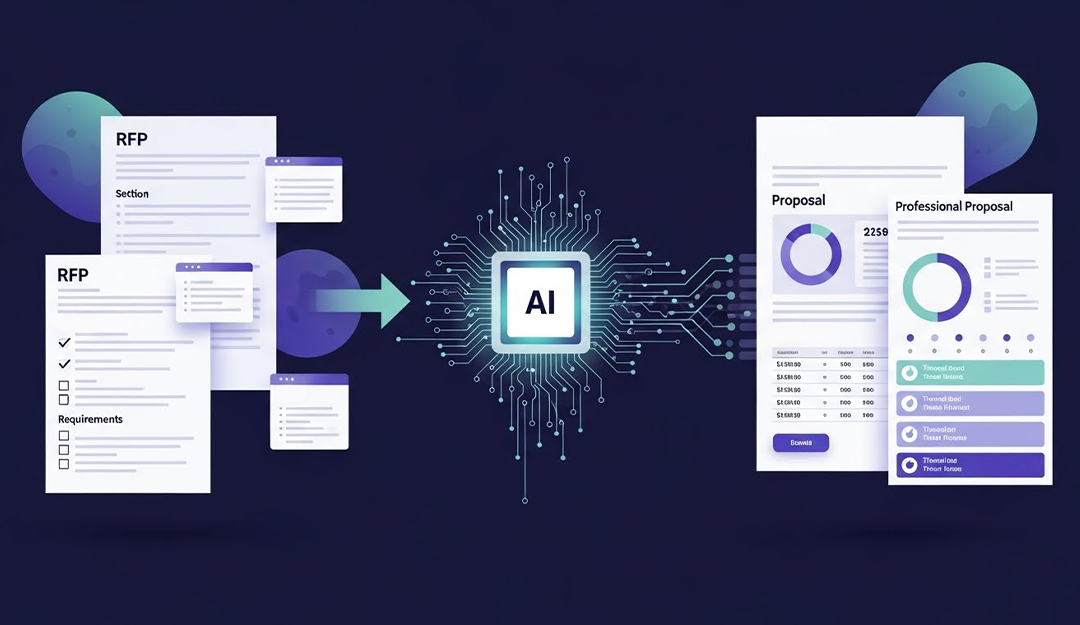
Yes, AI can convert an RFP into a complete proposal automatically – but only if you give it the right inputs: structured templates, a response library, pricing rules, and clear approval workflows. Instead of starting from a blank document, AI can parse the RFP, map questions to your internal content, and draft a tailored, compliant proposal in minutes. An AI-native platform like Legitt AI (www.legittai.com) can sit on top of your clause libraries, product catalog, and past responses to turn RFPs into near-ready proposals with far less manual effort.
This article walks through how that works, what “automatic” really means, where humans are still essential, and how to implement this in a controlled, enterprise-ready way.
1. Why RFP-to-Proposal Automation Matters
RFPs are painful for almost every organization:
- They are long, dense, and full of repetitive questions.
- They demand precise, compliant responses under tight deadlines.
- They require input from sales, legal, security, product, finance, and delivery.
- They often reuse 60–80% of answers from previous responses, but teams still rewrite them from scratch.
The result is:
- High internal cost per RFP.
- Burnout in solution, legal, and security teams.
- Missed opportunities because you simply cannot respond to everything.
- Inconsistent quality and risk posture across proposals.
If AI can convert an RFP into a structured draft proposal in minutes, teams can:
- Respond to more RFPs with the same headcount.
- Spend time on differentiation instead of boilerplate.
- Enforce consistency in messaging, risk, and pricing.
The goal is not “no human effort,” but “no unnecessary manual drafting.”
2. What Does “Automatically Converting an RFP” Actually Mean?
“Automatic” here does not mean magic. It means your system can:
- Ingest the RFP
- PDF, Word, Excel questionnaire, portal export, or structured questionnaire.
- Understand and structure it
- Split into sections (scope, technical requirements, security, commercial, legal).
- Identify each question or requirement.
- Classify questions (functional, security, legal, pricing, operational).
- Map questions to your knowledge base
- Match RFP items with pre-approved answers, clauses, or configurations.
- Recognize similar questions even if wording changes.
- Generate a proposal draft
- Fill in the RFP response matrix.
- Build a narrative proposal doc (executive summary, solution description, implementation plan, pricing overview).
- Align everything with your templates and brand.
A platform like Legitt AI (www.legittai.com) can orchestrate this pipeline so that “upload RFP → get full draft” is a standard, repeatable operation—not a one-off experiment.
 Hi, What do you want to Draft?

Click to upload or drag & drop
pdf, docx up to 5 MB
Click to upload or drag & drop
pdf, docx up to 5 MB
3. How Does AI Read and Understand an RFP?
The first hurdle is turning a messy RFP into something structured.
3.1 Parsing formats and extracting questions
RFPs arrive as:
- PDFs with tables.
- Word documents with numbered lists.
- Spreadsheets with hundreds of line items.
- Portal exports in CSV or custom formats.
AI (combined with document processing) can:
- Detect sections, headings, and tables.
- Extract each question/requirement as a distinct unit.
- Preserve numbering and structure so your response maps cleanly back to the source.
3.2 Classifying and tagging requirements
Next, AI classifies each item along multiple dimensions:
- Topic: security, data privacy, product feature, implementation, support, legal, pricing.
- Type: yes/no, descriptive, numeric, document request, compliance statement.
- Priority: mandatory, high, medium, nice-to-have (when indicated).
This tagging is critical, because it drives routing (who should answer) and matching (which knowledge base entries are relevant).
3.3 Interpreting requirements, not just keywords
A good system goes beyond keyword matching. It understands when two differently worded questions are essentially the same requirement. For example:
- “Describe your data encryption at rest and in transit.”
- “How is customer data protected when stored and transmitted?”
Both map to the same security response block. Large language models (LLMs) are particularly strong at this semantic matching, which is why they are central to RFP automation.
4. From RFP to Proposal: Templates, Libraries, and Logic
The real leverage comes from combining AI with a well-structured internal content ecosystem.
4.1 RFP answer library
You maintain a curated library of:
- Standard answers for common RFP questions.
- Security and compliance statements (ISO, SOC 2, GDPR, HIPAA, etc.).
- Legal positions and standard clauses.
- Product capability descriptions (by module, feature, and integration).
Each entry is tagged by topic, jurisdiction, product, and risk level. AI uses these tags and semantic search to pick the best match, then adapts wording to the RFP’s phrasing and context.
4.2 Proposal templates and structures
Beyond the RFP matrix, you likely submit:
- A main proposal document.
- Annexes (security, legal, technical architecture, implementation approach).
- Optional executive summary or cover letter.
AI uses proposal templates stored in Legitt AI (www.legittai.com) (or a similar system) as the skeleton:
- It inserts client name, industry, and key objectives.
- It pulls relevant value propositions and case studies.
- It aligns solution description with the specific requirements extracted from the RFP.
4.3 Rules for pricing and commercial terms
For the commercial section, AI should not “invent” numbers. Pricing is governed by:
- Product catalog and SKUs.
- Rate cards and discount guidelines.
- Region-specific tax and currency rules.
AI can:
- Suggest bundle configurations based on requirements and size.
- Draft narrative around pricing and commercial structure.
- Flag any scenario that exceeds defined discount or term thresholds for human approval.
5. How Legitt AI (www.legittai.com) Fits Into the RFP-to-Proposal Flow
An AI-native contract and proposal platform like Legitt AI (www.legittai.com) can be the central engine for this automation. Conceptually, it:
- Ingests the RFP from email, upload, or integrated portals.
- Parses and structures content, turning documents into questions, requirements, and sections.
- Connects to your internal libraries—clause banks, proposal content, security responses, product catalogs.
- Generates both:
- A populated RFP response matrix (spreadsheet or portal format).
- A narrative proposal document aligned with your templates.
- Routes exceptions (unclear items, risky requests, non-standard terms) to humans with clear flags.
- Links directly into contract drafting, so the winning proposal can feed into MSAs/SOWs without rework.
The key is that the system is trained and configured on your own content and rules, not just a generic model.
6. What Can Be Fully Automated vs Human-in-the-Loop?
You should think in terms of levels of automation rather than all-or-nothing.
6.1 High-confidence automation
Fully automatable areas typically include:
- Standard company overview and product descriptions.
- Security and compliance sections where answers are stable and pre-approved.
- FAQs and generic operational questions (support hours, SLA structure, onboarding steps).
- Formatting, numbering, and document assembly.
These can often be accepted with minimal human edits.
6.2 Human-in-the-loop areas
You still want human review for:
- RFP questions that imply custom functionality or roadmap commitments.
- Requests that deviate from your standard security, legal, or pricing positions.
- Strategic narrative sections (e.g., executive summary for a flagship deal).
Here, AI should propose a draft response and highlight the underlying RFP text and prior answers. Humans approve, edit, or reject with full context.
6.3 High-risk corners
Certain sections may always require legal or executive approval, regardless of AI:
- Liability caps, indemnification, and IP ownership.
- Regulatory guarantees and jurisdictional commitments.
- Unusual implementation or performance guarantees.
AI can help by summarizing and comparing requested positions to your standard posture, but it should not make binding commitments on its own.
7. Implementation Roadmap: How to Get There
You do not need to automate RFP responses for your entire organization on day one. A phased approach is safer and more realistic.
7.1 Phase 1 – Build your knowledge base
- Compile your last 10–20 strong RFP responses.
- Extract reusable answers, security statements, legal positions, and product descriptions.
- Tag them by topic, product, and region.
- Standardize tone and remove client-specific references.
7.2 Phase 2 – Introduce AI-assisted answering
- Ingest RFPs and use AI to suggest answers from the library.
- Let humans accept/edit/reject suggestions.
- Measure time saved and library coverage (what % of questions can be answered from known content).
7.3 Phase 3 – Add automated proposal assembly
- Create proposal templates (executive summary, solution overview, implementation, pricing narrative).
- Allow AI to generate the narrative proposal alongside the RFP matrix.
- Integrate with CRM for account data and with product/pricing systems.
7.4 Phase 4 – Tighten workflows and governance
- Add approval rules (e.g., legal review for certain clauses, security approval for certain promises).
- Configure risk flags and escalation paths.
- Track metrics: cycle time, win rates, effort per RFP, exception rates.
Once this is stable, RFP-to-proposal automation becomes a core capability, not an experiment.
8. Risks, Limits, and Best Practices
AI-based RFP automation is powerful, but you should be deliberate in how you adopt it.
- Quality depends on your library: if your content is outdated, contradictory, or poorly tagged, AI will amplify those issues. Invest in curation.
- Guardrails are non-negotiable: define hard limits for pricing, legal positions, and commitments. AI must operate inside those boundaries.
- Explainability matters: reviewers should see which library entry a suggested answer came from and where it has been used before.
- Train people, not just models: sales, solution, and legal teams must understand how to use, supervise, and continually improve the system.
If you treat AI as a drafting partner inside a structured process—rather than a black box—you can safely move toward near-automatic RFP-to-proposal generation.
Read our complete guide on Contract Lifecycle Management.
FAQs
Can AI really handle complex, 100+ page RFPs with technical and legal detail?
Yes, AI can handle large, complex RFPs, but only if the underlying system is designed well. The model can break the RFP down into manageable units, classify each requirement, and map questions to your vetted response library. For highly technical or legal sections, AI should propose draft answers from pre-approved content rather than inventing new positions. Human experts still review and adjust critical sections, but the heavy lifting of reading, sorting, and drafting is offloaded.
Will AI understand the difference between “must-have” and “nice-to-have” requirements?
If the RFP clearly labels priorities (e.g., “mandatory,” “preferred”), AI can detect and tag those. Even when labels are implicit, models can often infer priority from wording and context, though you should not rely solely on inference for high-stakes bids. In a mature setup, mandatory requirements are flagged for special attention, and the system can highlight any mandatory item where your answer is weak, conditional, or missing. This helps teams focus on gaps that could disqualify you.
How does AI avoid reusing outdated or non-compliant answers from past RFPs?
AI should not blindly reuse everything from history. Your organization needs a curated, governed answer library where content is reviewed, versioned, and tagged before it is used at scale. Entries can have expiry dates or “superseded” markers. The AI engine then draws only from this approved library, not directly from arbitrary past documents. Periodic audits and usage reports help ensure that old or non-compliant statements are retired and replaced.
Can AI automatically populate online RFP portals, not just Word/Excel templates?
In many cases, yes—via integrations or exports. AI can generate a structured response matrix, which is then imported into portals that support file uploads (Excel/CSV/XML). For portals without import capability, you can still use AI to generate each answer and then leverage robotic process automation (RPA) or manual copy/paste assisted by a structured view. Direct API integration with the portal, where available, offers the cleanest automation.
How does AI handle pricing and commercial terms safely?
Pricing should be governed by rules, not “free text” generation. The AI engine should integrate with your product catalog and pricing configuration, generating tables based on SKUs, quantities, and approved discount bands. If a salesperson wants to go beyond standard limits, the system can flag that as an exception requiring manager or finance approval. AI can then draft the narrative explanation around that pricing, but the underlying numbers remain controlled.
What about security questionnaires and detailed compliance sections?
Security and compliance sections are excellent candidates for AI-assisted automation because the content is usually standardized and owned by a small group of experts. You can maintain a security answer library with approved statements for encryption, access control, incident response, certifications, and so on. AI matches each RFP question to the appropriate statement and adapts its wording. Security and compliance teams then review only the deltas and special cases, significantly reducing their workload.
How do we keep proposals from sounding generic or “robotic”?
The key is to design your templates and content library with strong voice and differentiation, then let AI tailor them to each client and RFP. That includes using industry-specific language, referencing the client’s stated challenges, and selecting relevant case studies. Reps and solution consultants can add a final layer of personalization—such as referencing specific conversations or stakeholders—without needing to rewrite the whole document. Done well, AI-generated proposals are actually more consistent, sharper, and clearer than manually cobbled ones.
Is there a risk that AI will commit to terms we cannot accept?
There is if you let it freely improvise legal and commercial language. That is why guardrails are essential. Legal and commercial teams should define which clauses, positions, and terms are allowed for automatic use, and which always require review. The system must be configured so that critical sections (liability, indemnity, IP, regulatory guarantees) are either assembled from locked, pre-approved blocks or flagged for mandatory human approval. AI can still summarize and compare RFP requests to your standard positions to support negotiation.
How do we know if AI-driven RFP responses are actually improving win rates?
You can measure impact by tracking key metrics before and after implementation: time to first draft, total hours spent per RFP, number of RFPs you can respond to per quarter, and win rates by segment. You can also track qualitative signals like fewer internal escalations, less last-minute panic, and more consistent adherence to playbooks. Over time, you can analyze whether certain answer patterns, proposal structures, or value narratives correlate with higher win rates—and feed those insights back into your templates and libraries.
What is the best way to start using AI for RFP-to-proposal conversion without high risk?
Start with a controlled pilot on a specific segment of RFPs—perhaps mid-size deals in a few industries where your offering is mature and your content library is strong. Use AI to suggest answers and assemble drafts, but keep human review mandatory for all sections at first. As confidence grows and your library matures, you can expand automation, relax review on low-risk sections, and scale across more regions and product lines. This incremental, feedback-driven approach lets you capture benefits quickly without compromising quality or compliance.