Poor contract management is not a paperwork problem. It's a revenue problem. Poor contract management globally erodes 9.2% of annual revenue each year, according to CLM statistics summarized here. If your company still treats contract compliance certification as an annual legal fire drill, you're leaving money, bargaining power, and audit readiness to chance.
That approach doesn't survive 2026.
Contract compliance certification now sits at the intersection of legal operations, procurement controls, sales execution, vendor governance, and enterprise risk. The companies that handle it well don't rely on inboxes, scattered folders, and human memory. They build repeatable systems. They standardize drafting, centralize records, automate approvals, track obligations, and make every contract decision traceable.
That's the fundamental point. Contract compliance certification isn't a document you chase once. It's a discipline you operationalize every day.
Why Contract Compliance Is a Boardroom Issue
Leaders often push contract compliance certification down into legal or procurement. That's a mistake. The financial impact reaches the boardroom long before an auditor asks for evidence.
When contracts are poorly managed, teams miss renewal windows, fail to enforce pricing terms, overlook supplier obligations, and lose control over approvals. Revenue leaks out. Risk accumulates. Internal trust drops because no one can prove which version is current, who approved what, or whether the business followed its own process.
Compliance failures usually start as workflow failures
Most compliance problems don't begin with misconduct. They begin with operational sloppiness.
A sales team signs from an old template. Procurement stores a vendor amendment in email. Finance doesn't see a pricing exception. Legal reviews a clause but can't confirm whether the final executed version matches the approved draft. By the time someone asks for certification evidence, the organization is reconstructing history instead of producing records.
That's expensive and avoidable.
Practical rule: If your company can't produce the full contract history on demand, you don't have a compliance program. You have document storage with hope attached.
Certification protects more than audits
A strong compliance program does three things at once:
- Protects revenue: It reduces leakage caused by missed terms, inconsistent language, and unmanaged obligations.
- Protects trust: Customers, regulators, and counterparties take your controls more seriously when you can document them.
- Protects execution: Teams move faster when approved language, workflows, and signatures live in one governed system.
This is why legal operations leaders increasingly sit closer to strategic planning. The modern general counsel isn't just interpreting law. They're shaping the systems that keep the business defensible and scalable. That broader operating role is captured well in this discussion of general counsel responsibilities.
Manual compliance is now a liability
Manual tracking had a long run. It no longer works at enterprise speed.
If your contracting process depends on spreadsheets, shared drives, and someone remembering to chase approvals, your compliance posture is fragile. Contract compliance certification demands consistency across drafting, negotiation, approval workflows, eSignatures, repository management, renewals, and obligation tracking. None of that stays reliable when each department runs a separate workflow.
Executives should treat compliance infrastructure the same way they treat finance controls or cybersecurity. It's core operating architecture.
Decoding Contract Compliance Certification
Too many companies talk about contract compliance certification as if it were one universal credential. It isn't. That assumption creates wasted effort, bad scoping, and compliance blind spots.
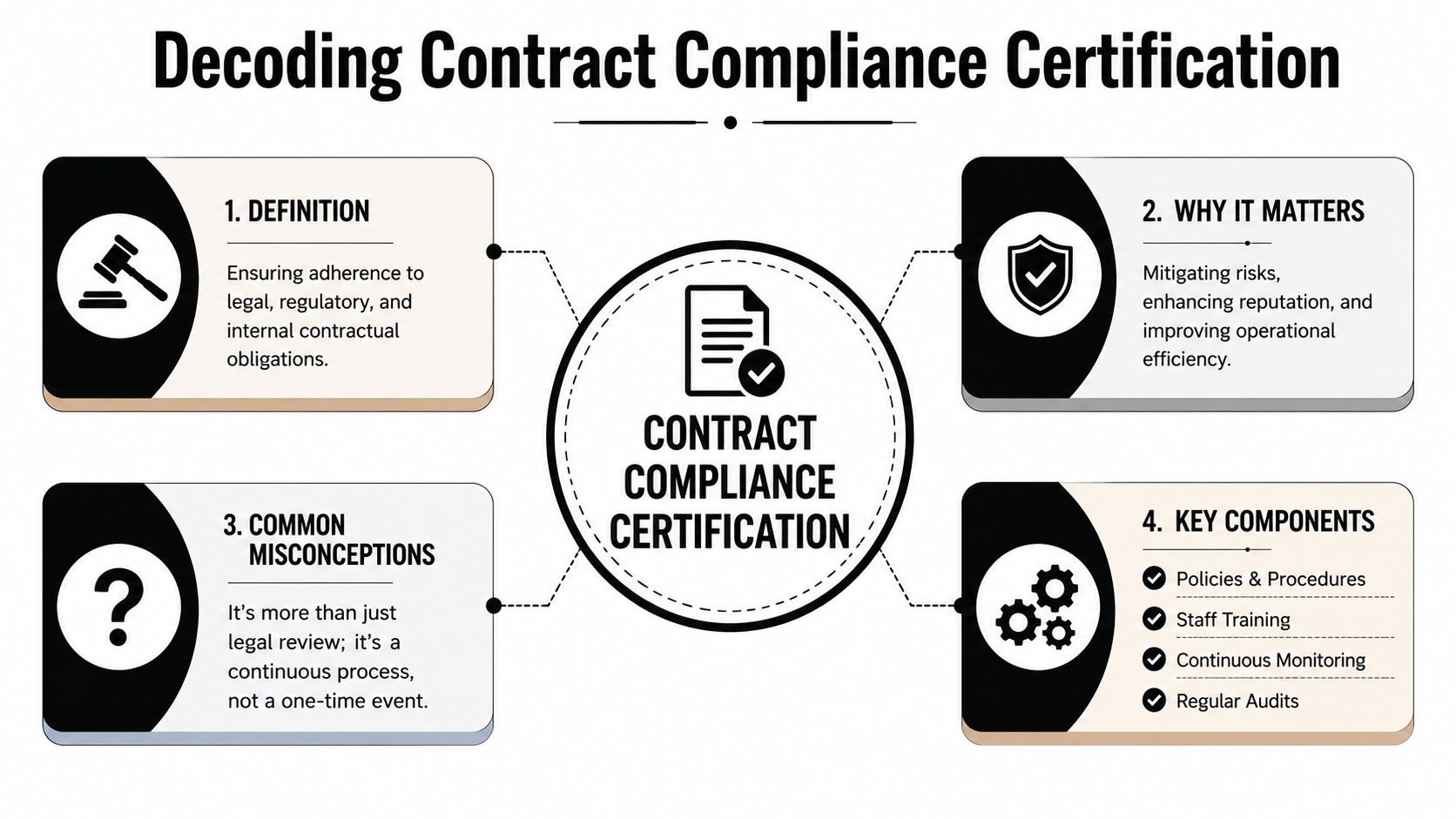
Contract compliance certification is better understood as proof that your organization can meet the contract-related requirements that apply to your industry, counterparties, and operating jurisdictions. Sometimes that means demonstrating control over supplier commitments. In other cases, it means proving adherence to sector-specific obligations, internal policies, or procurement standards.
There is no single certification standard
This is the first thing leadership teams need to accept. Contract compliance certification is frequently misunderstood as a universal credential, yet it is highly fragmented by industry and jurisdiction. In construction, for example, certification often ties to supplier diversity mandates like Minority Business Enterprise, and those requirements are region-specific rather than globally standardized, as outlined by Dane County's contract compliance guidance.
That fragmentation matters because companies often ask the wrong question. They ask, “Which certification do we need?” The better question is, “Which contract, regulatory, and buyer-specific obligations apply to this part of our business?”
What companies should map before they certify
A practical compliance map usually includes:
| Area | What to identify |
|---|---|
| Industry requirements | Sector rules that affect contract language, approvals, reporting, or supplier conditions |
| Geographic scope | Jurisdiction-specific obligations tied to where you operate or perform work |
| Customer and partner terms | Contractual standards imposed by enterprise buyers, public agencies, or prime contractors |
| Internal governance | Approval thresholds, fallback clauses, delegation rules, and retention requirements |
A legal team that skips this mapping step usually ends up over-controlling low-risk agreements and under-controlling high-risk ones.
Contract compliance certification isn't a badge. It's evidence that your contracts, workflows, and records align with the rules that actually govern your business.
What this means in practice
For legal operations, procurement, and sales leaders, the immediate takeaway is simple:
- Stop searching for a generic answer: Your certification path depends on your contracts and business model.
- Define the unit of analysis: Business unit, geography, contract type, and counterparty category all matter.
- Build controls around reality: Use standard templates, approval matrices, and repository rules that match actual obligations.
If you need a baseline definition before designing those controls, this overview of what contract compliance means in practice is a useful starting point.
The companies that get this right don't chase abstract compliance. They operationalize the exact requirements that govern their commercial relationships.
The Certification Journey and Documentation Trail
Most certification efforts fail for a simple reason. The company starts collecting evidence too late.
Auditors and reviewers don't just want the signed contract. They want the story of the contract. They want to see how the agreement was created, what changed, who approved deviations, what obligations were accepted, and how the business monitored performance after signature.
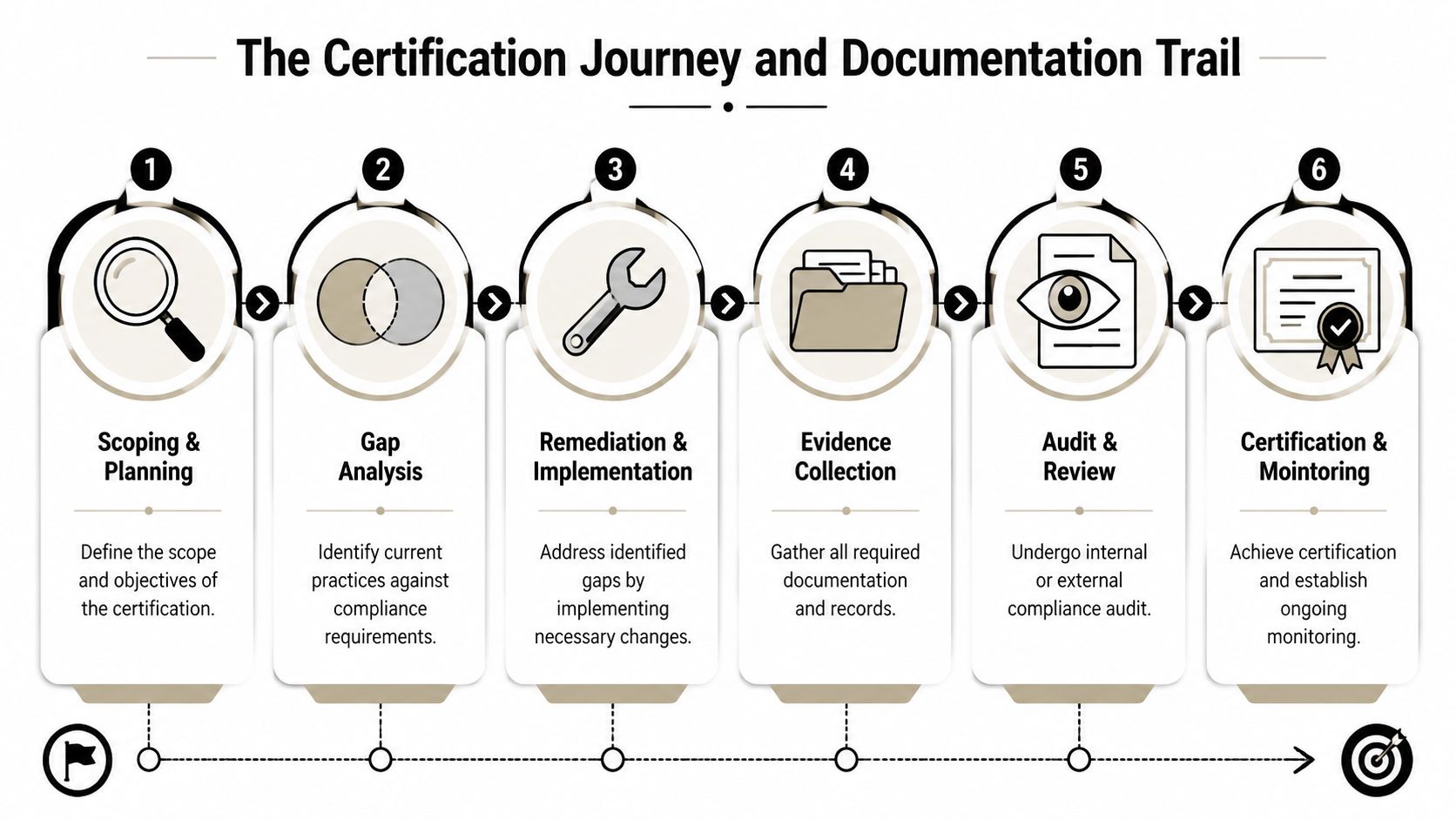
The journey follows a predictable pattern
The labels vary by industry, but the operating sequence is usually the same.
Scoping and planning
Decide which contracts, teams, jurisdictions, and obligations are in scope. If you skip this, your evidence set becomes inconsistent fast.Gap analysis
Compare your current contract lifecycle management process with the requirements you need to satisfy. This often exposes weak version control, missing approvals, and poor amendment tracking.Remediation and implementation
Fix the process before you fix the paperwork. Update templates, enforce clause playbooks, define approval logic, and assign ownership for obligation tracking.Evidence collection
Gather executed agreements, amendments, change records, approval logs, notices, correspondence, and supporting policy documents.Audit and review
Test whether the records prove compliance. Many teams discover at this point that their documents exist, but their chronology doesn't.Ongoing monitoring
Certification is maintained through continuous control, not one-time preparation.
Best-in-class companies digitize the trail
The documentation standard is clear. According to research by ISM and Aberdeen Group, 78% of best-in-class companies convert paper contracts into a digital format with pre-approved legal templates and maintain a central, searchable repository for all contracts and supporting documents to drive contract compliance certification, as reported by the Institute for Supply Management.
That number matters because it reflects what disciplined organizations do. They don't treat the repository as storage. They treat it as infrastructure.
What auditors expect to see
A defensible documentation trail typically includes the following records:
- Executed agreements: Final signed versions, with dates, parties, and effective terms clearly visible.
- Version history: Draft progression, redlines, and evidence of negotiated changes.
- Approvals: Who approved legal, commercial, procurement, and financial deviations.
- Amendments and renewals: Addenda, extensions, change orders, and notice records.
- Operational evidence: Proof that obligations were assigned, tracked, and acted on.
A missing signature page is bad. A missing approval trail is often worse. It suggests the company can't prove how decisions were made.
Audit reality: If your team has to ask five people where an amendment lives, your certification process isn't mature enough.
Why manual evidence collection collapses
Email threads break. Shared drives get renamed. Sales uploads one version, legal stores another, and procurement keeps a third copy in a vendor folder. Then someone leaves the company.
That's why audit trail discipline has to be built into the process itself, not reconstructed at the end. This explanation of the significance of maintaining an audit trail for contracts captures the point well. Traceability has to be automatic.
When companies understand that, contract compliance certification becomes much more manageable. The problem shifts from “How do we prepare for the audit?” to “How do we make every contract audit-ready by default?”
Your Audit Preparation Checklist
Audit readiness should never depend on heroic cleanup work. It should depend on operating discipline. In 2026, that means one controlled system for contract records, approvals, obligations, and evidence.
Centralized compliance platforms are mission-critical in 2026, replacing fragmented spreadsheets with an intelligent hub that serves as the authoritative source for all contract-related activities. Their audit trail functionality automatically documents every action and creates the defensible record auditors expect, as described in this overview of contract compliance monitoring tools.
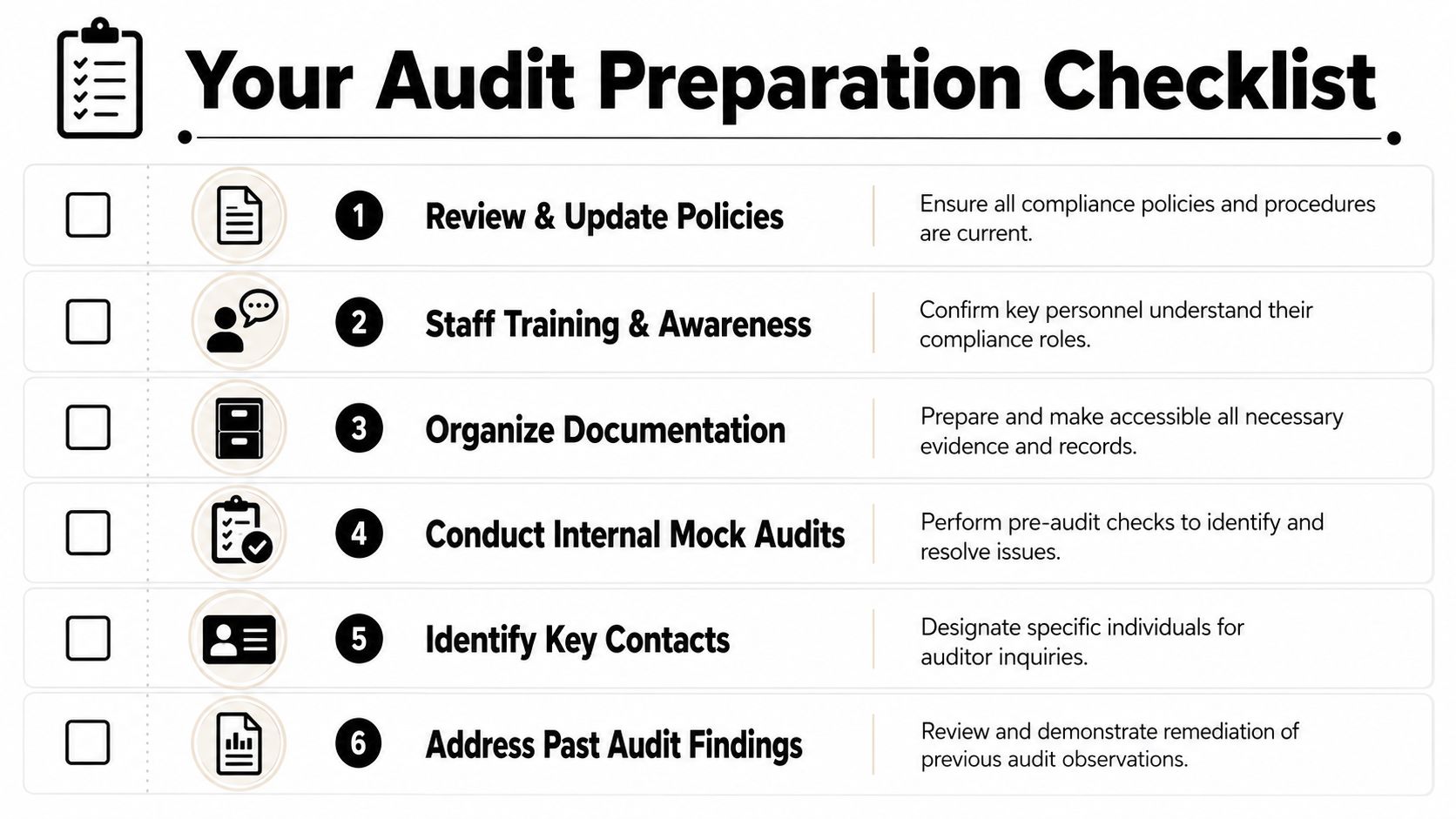
The minimum viable checklist
Use this as a working standard before any formal review.
- Centralize the contract repository: Store current agreements, prior versions, amendments, and executed copies in one searchable location.
- Lock down version control: Teams should know which draft is current and which clauses were approved as exceptions.
- Track obligations automatically: Renewal dates, notice periods, payment terms, reporting commitments, and milestone duties need assigned owners.
- Capture approval logic: Legal, procurement, finance, and business approvals should be time-stamped and attributable.
- Preserve eSignature history: Signature packets, audit logs, and execution evidence must stay connected to the final agreement.
- Test retrieval speed: If a reviewer asks for a contract file, your team should retrieve the full record without reconstructing it manually.
Where audits usually go sideways
Most failures come from process inconsistency, not from obscure legal interpretation.
| Common failure point | Why auditors care |
|---|---|
| Siloed records | No one can prove the complete contract lifecycle |
| Manual date tracking | Renewal and notice obligations are easy to miss |
| Unclear ownership | Critical obligations fall between legal, procurement, and operations |
| Inconsistent templates | The company can't show policy-based contracting discipline |
| Missing action logs | Approval and change decisions aren't defensible |
A good finance-oriented reference for broader controls thinking is this SaaS audit guide from Jumpstart Partners. It's useful because it reinforces the same operating truth. Audits reward documented systems, not informal habits.
What teams should do before the auditor arrives
Don't just organize files. Rehearse the process.
- Run a mock request exercise: Ask for a contract, its approvals, all amendments, and proof of obligation ownership.
- Review exception handling: Confirm that non-standard terms were flagged, approved, and retained with the contract record.
- Verify personnel readiness: The people likely to face auditor questions should know where records live and how controls work.
A calm audit response usually means the business has already operationalized compliance. Panic usually means the process was never under control.
That's the standard to aim for. Audit preparation isn't a separate project. It's the visible test of whether your contract lifecycle management system works.
Automating Compliance with CLM and AI Tools
Manual compliance breaks at scale because contract work is repetitive, high-volume, and detail-sensitive. That combination is exactly where AI contract management and contract automation belong.
A modern CLM platform changes the job from record-chasing to rule-enforcement. Instead of relying on people to remember the right template, route a contract to the right approver, save the final version in the right folder, and track the next obligation by hand, the system does it as part of the workflow.
Start with the repository, not the chatbot
Many companies get distracted by AI demos and miss the foundation. Contract intelligence only works if the underlying records are structured, complete, and searchable.
The first automation priority is a governed repository that ties together:
- draft versions
- redlines and comments
- approval workflows
- eSignatures
- amendments
- renewal terms
- obligation records
Without that, AI contract review has no trustworthy substrate. With it, you can extract obligations, flag deviations, route approvals, and surface risk patterns across the portfolio.
Where AI creates immediate operational value
The strongest use cases are concrete, not theoretical.
| CLM and AI capability | Compliance impact |
|---|---|
| AI contract drafting | Keeps teams inside approved clause libraries and templates |
| Contract review automation | Spots deviations and escalates non-standard terms faster |
| Approval workflow automation | Enforces policy-based routing and records every decision |
| eSignature tracking | Preserves execution evidence inside the contract file |
| Renewal and obligation alerts | Reduces missed dates and unmanaged commitments |
| Repository-wide contract analytics | Surfaces contracts that need remediation or follow-up |
Platforms such as Legitt AI fit naturally into an enterprise workflow. The value isn't that AI “does legal work.” The value is that it can extract clauses from third-party paper, identify deviations from approved playbooks, route exceptions to the right reviewers, and keep the resulting record connected to the full contract lifecycle.
Speed matters because backlog creates risk
One reason AI is becoming necessary is simple throughput. AI-powered contract review tools can analyze a standard NDA in 26 seconds, compared to the 92 minutes required by a human lawyer, while achieving a 94% accuracy rate, a 212x speed improvement, according to this contract management statistics summary.
That doesn't mean legal teams should hand everything to automation. It means routine paper should stop consuming disproportionate human time. Lawyers should handle exceptions, negotiation strategy, and risk calls. Software should handle pattern recognition, clause extraction, reminders, routing, and evidence capture.
Operating advice: Use AI to compress low-risk review time, then spend the saved time tightening controls on high-risk contracts.
A practical automated workflow
A defensible AI-native contract workflow often looks like this:
- Draft from approved templates using guided inputs and fallback language.
- Review incoming paper with AI to extract clauses and compare them to your playbook.
- Trigger structured approvals when terms cross policy thresholds.
- Execute with embedded eSignature so the final record stays tied to the contract file.
- Store everything in a searchable repository with metadata, dates, and ownership.
- Track obligations and renewals automatically with alerts and task assignment.
- Use contract analytics to identify non-standard terms, expiry risk, and compliance gaps across the portfolio.
Teams exploring workflow automation more broadly may also find GPT for Work's AI automation guide useful. It gives a practical frame for deciding where automation should handle repetitive work and where human review should remain mandatory.
Technology is no longer optional
Organizations are already moving this direction. A July 2026 market report states that 44% of companies globally have deployed or are actively deploying AI systems to support contracting workflows in 2026, and values the AI in contract management market at USD 1.86 billion in 2026 with a projection to reach USD 4.25 billion by 2030 according to this GlobeNewswire release. Treat that as a projection signal, not a reason for hype.
The practical conclusion is sharper. If your contract compliance certification process still depends on manual intake, ad hoc review, disconnected eSignature tools, and spreadsheet reminders, your control environment won't scale.
For teams evaluating what AI should do inside enterprise CLM, this breakdown of AI in contract lifecycle management is worth reading. The key question isn't whether AI belongs in contracting. It's where it should enforce consistency, reduce review lag, and improve audit defensibility.
Building a Future-Proof Compliance Strategy
A future-proof compliance program doesn't start with certification paperwork. It starts with governance. You need clear ownership, approved language, routing rules, escalation criteria, and a system that records what happened without asking people to document everything manually.
That's why contract compliance certification should be treated as a continuous operating capability. Your contracts change. Regulations change. counterparties change. Internal teams change. A static process won't keep up.
The right strategy has four traits
- It is centralized: One source of truth for contracts, approvals, signatures, and post-signature obligations.
- It is policy-driven: Templates, fallback clauses, and approval thresholds reflect business risk, not personal preference.
- It is observable: Leaders can see where contracts sit, which obligations are pending, and where exceptions are accumulating.
- It is trainable: Teams know their role in the process and can follow it consistently.
Training matters more than many companies admit. If you're refreshing internal enablement, Learniverse's compliance training guide is a practical resource for building a program people can follow.
What leadership should do next
If you want a scalable compliance posture, take these actions now:
- Map your certification scope: Identify which obligations apply by contract type, region, and business unit.
- Standardize intake through execution: Drafting, negotiation, approvals, and eSignatures should follow one governed workflow.
- Make post-signature work visible: Renewals, reporting duties, and performance commitments need active ownership.
- Adopt contract intelligence: Use AI and contract analytics to surface deviations, exceptions, and hidden risk.
- Strengthen governance design: This guide to effective contract governance frameworks is a useful reference for structuring controls that last.
The payoff is bigger than audit readiness. A disciplined contract lifecycle management program gives legal, procurement, sales, and operations a shared system for moving faster without losing control.
That's the shift that matters. Companies that modernize contract workflows turn compliance into an operational advantage. Companies that don't keep paying for the same disorder through missed obligations, slower deals, and weaker audit defensibility.
If your team is ready to replace fragmented contract processes with one AI-native system, Legitt AI is built for exactly that job. It brings AI contract drafting, review, negotiation workflows, eSignatures, repository management, obligation tracking, renewals, and contract intelligence into one workspace so legal, procurement, sales, and operations can run a scalable, defensible compliance program without stitching together separate tools.