A lot of SMBs are living with the same contract problem, even if they don’t call it that. A sales agreement gets signed and dropped into a shared drive. A vendor contract sits in someone’s inbox. Nobody sets a proper renewal alert, a pricing commitment gets missed, and the team only notices the contract again when there’s a dispute, an unexpected auto-renewal, or cash flow starts slipping.
That’s usually where the confusion starts. The business thinks it is “managing contracts” because someone is storing PDFs, chasing signatures, and checking whether work got delivered. In reality, that’s often just administration. It keeps the lights on, but it doesn’t help the business extract value, reduce leakage, or make better decisions at renewal time.
For SMBs, the distinction matters because resources are thin. The founder, ops lead, finance manager, and sales leader often share contract work without a legal operations function or dedicated counsel. If you want a practical view of the operational issues that create that mess, this breakdown of small business contract management challenges is a useful companion.
The Overlooked SMB Contract Challenge
Small businesses rarely fail at contracts because they don’t care. They fail because contract work gets fragmented across inboxes, Slack threads, CRM notes, and file folders. One person negotiates terms, another sends the document for signature, and someone else is supposed to remember milestones later. That handoff usually isn’t formal, and that’s where risk creeps in.
What gets missed in practice
Many organizations do a decent job on the visible tasks:
- Getting the deal signed: Sales or procurement pushes the agreement over the line.
- Saving the file somewhere: Usually a drive, email folder, or shared workspace.
- Handling immediate follow-up: Finance invoices, ops starts onboarding, and delivery begins.
What often doesn’t happen is the strategic layer:
- Checking whether the contract is producing expected value
- Reviewing whether obligations match business capacity
- Preparing for renewals before one’s position becomes weaker
- Comparing negotiated terms across customers or vendors
- Tracking which clauses create repeated risk
That’s the dividing line between contract administration and contract management.
Why founders should care
If your team only handles contracts after they become urgent, you’re operating reactively. That creates three predictable problems. Deadlines get missed. Revenue and margin opportunities stay buried in signed documents. Renewal conversations happen after the contract has already boxed you in.
For an SMB, contract work should do more than document the relationship. It should support revenue velocity, supplier control, compliance, and clean decision-making. Contracts aren’t just legal records. They’re operating instructions tied to cash flow, delivery, and risk.
SMBs don’t need a massive legal department to improve contract performance. They need a simpler operating model and a consistent way to see what matters before it becomes a problem.
Defining the Core Concepts for Business Teams
The terms sound close enough that teams often use them interchangeably. That’s part of the problem. If the business doesn’t know which function it’s performing, it can’t assign ownership, build workflows, or choose the right CLM software.
Contract administration in plain business language
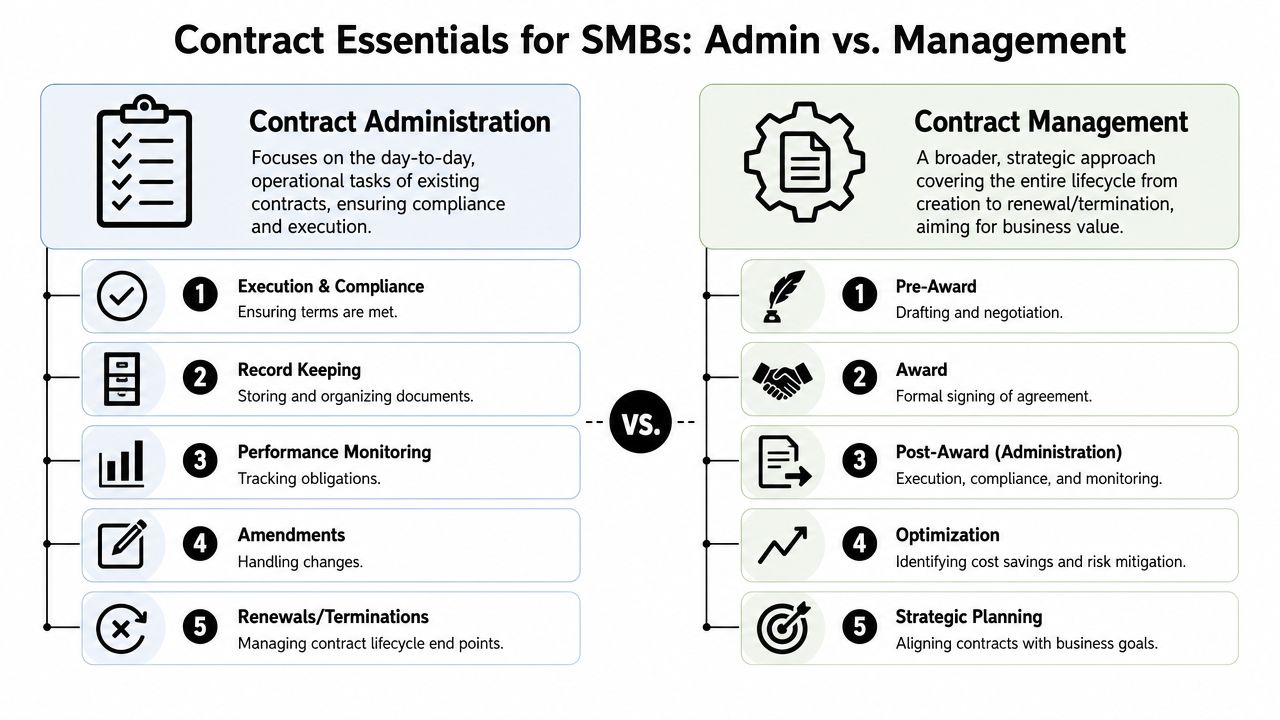
Contract administration is the operational side of the process. It focuses on execution after the agreement is in force. The work is practical and routine: tracking obligations, storing documents, coordinating amendments, watching deadlines, and making sure each party follows the agreed terms.
A helpful way to think about it is routine car maintenance. You’re making sure the vehicle is running properly, the scheduled work gets done, and nothing obvious is missed.
If you need a deeper operational breakdown, this guide on what contract administration covers in practice is useful for teams building basic ownership models.
Contract management in plain business language
Contract management is broader and more strategic. It covers the entire lifecycle from drafting through renewal, with a focus on business value and risk control. According to Roger’s explanation of contract management versus contract administration, contract management is the strategic process encompassing the entire lifecycle from drafting to renewal, focusing on value optimization and risk mitigation, whereas contract administration is the operational execution phase occurring post-signature, ensuring compliance with agreed terms and day-to-day deliverables.
The better analogy is a road trip plan. You’re not just checking whether the car works. You’re choosing the route, anticipating delays, deciding where to stop, and making sure the trip achieves the business outcome you wanted.
Administration asks, “Are we following the contract correctly?” Management asks, “Is this contract delivering the result the business needs?”
Why the distinction matters to non-legal teams
This isn’t only a legal issue. Sales teams touch negotiation strategy and approvals. Procurement teams shape supplier terms and renewal advantage. Operations teams own delivery and milestones. Finance teams care about payment timing, obligations, and margin.
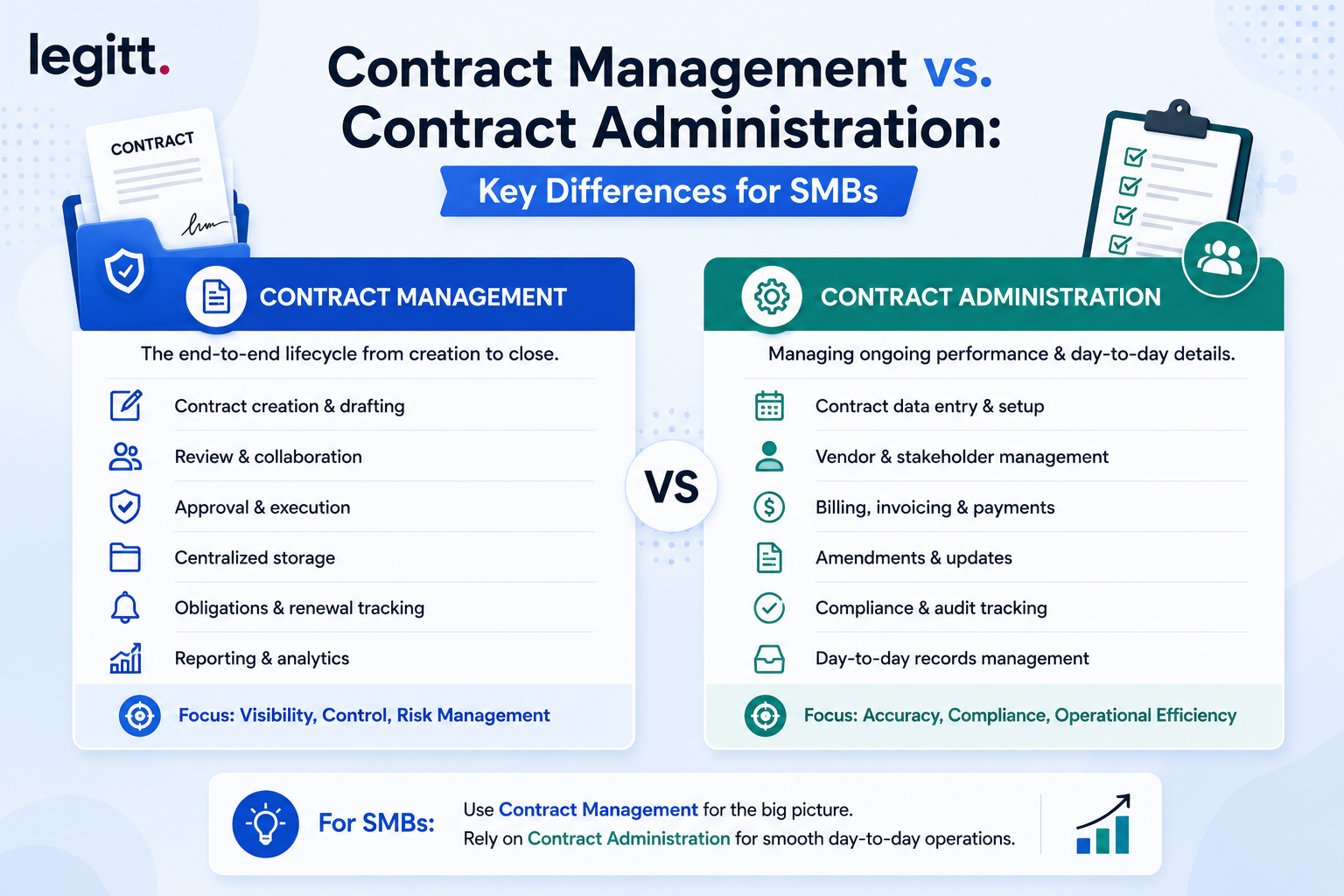
If those groups only perform administrative tasks, the business can still stay compliant while losing money over time. That’s why Contract Management vs Contract Administration: Key Differences for SMBs is more than a terminology debate. It’s a working model for how a small company controls risk without slowing deals down.
Management vs Administration A Detailed Comparison
The easiest way to separate the two is to compare what each function is trying to achieve, who usually owns it, and which metrics matter.
Contract Management vs Contract Administration at a Glance
| Criterion | Contract Management (Strategic) | Contract Administration (Operational) |
|---|---|---|
| Scope | Covers the full lifecycle from drafting to renewal or termination | Focuses on execution and control of active agreements |
| Primary goal | Maximize value, reduce risk, improve commercial outcomes | Ensure compliance, documentation, and day-to-day follow-through |
| Typical owners | Founders, sales leaders, procurement leads, finance, legal ops | Operations, finance, procurement coordinators, contract admins |
| Core activities | Template strategy, fallback positions, approval design, renewal planning, performance review | Signature routing, record keeping, obligation tracking, amendment handling, renewal notices |
| Main business question | Is this contract helping the business perform better? | Are we doing what the contract requires on time? |
| Decision horizon | Forward-looking and tied to business goals | Immediate and tied to current obligations |
| Risk focus | Commercial exposure, clause deviation, missed leverage, value leakage | Missed deadlines, incomplete records, process failures, compliance issues |
| KPI examples | Cycle times, approval delays, clause variance, missed milestones | Completed signatures, tracked obligations, timely reminders, document accuracy |
A lot of SMBs blur these roles because one person handles both. That’s normal. What matters is recognizing when the work changes from tactical execution to strategic oversight.
Scope changes how you staff the work
Management has a wider lens. It starts before signature, because choices made during drafting and negotiation determine margin, delivery flexibility, and renewal advantage later. Administration starts once the agreement has to be executed reliably.
That distinction becomes clearer when a founder reviews customer paper. If they’re deciding which clauses the company will accept and what fallback terms protect revenue, they’re doing management work. If they’re routing the final draft for eSignature and filing the executed PDF, they’re doing administration work.
Goals determine what “good” looks like
An administrative process can be efficient and still underperform commercially. A contract may be signed correctly, stored properly, and renewed on time, yet still lock the company into weak pricing, poor service levels, or vague obligations.
Strategic management asks tougher questions:
- Are approval delays slowing revenue recognition?
- Which clauses repeatedly trigger negotiation friction?
- Which vendors are underperforming against the business case?
- Are renewal terms still aligned with current priorities?
This is where the distinction also overlaps with governance. Teams comparing these models often find it helpful to understand how contract governance differs from contract management, especially when policy and execution start getting mixed together.
KPIs are where SMBs usually fall short
The most useful SMB benchmark isn’t a generic maturity score. It’s whether the team tracks a small set of contract KPIs consistently. The most practical measures are the ones tied directly to internal friction and missed value:
- Cycle times
- Approval delays
- Missed milestones
- Clause variance
Those are concrete enough for a lean team to monitor without building an enterprise legal ops function. If you don’t track them, you’re guessing where the process is breaking.
If your contract process measures signatures but not delays, deviations, or missed obligations, you’re monitoring paperwork, not performance.
The SMB Resource Gap Why This Matters for Growth
The most important issue for SMBs isn’t definitional. It’s operational. Smaller companies usually don’t have the people, time, or systems to run true contract management, so they default to administration and assume that’s enough.

What the resource gap looks like on the ground
According to Sirion’s discussion of the SMB resource gap in contract management, the “SMB Resource Gap” leads to SMBs confusing “administration” with “management”, resulting in revenue leakage because they only track compliance rather than performance value. While administration is operational, true management requires strategic thinking that SMBs often cannot execute without customized, simplified KPI templates.
That description matches what shows up in real companies all the time. The team pays the vendor on time, but nobody checks whether the vendor is meeting expected service levels. A customer agreement renews smoothly, but no one reviews whether discounting has drifted too far from standard terms. A founder negotiates every contract personally, but there’s no structured repository to compare what changed deal to deal.
Compliance alone won’t protect margin
Administration keeps the company organized. It makes sure documents are signed, accessible, and acted on. That’s necessary.
It isn’t sufficient.
A business that only tracks compliance tends to miss the higher-value questions:
- Is this customer contract profitable under actual delivery conditions?
- Did procurement accept terms that increase operational burden later?
- Are auto-renewals maintaining our advantage or diminishing it?
- Do contract amendments tell us where templates are failing?
Those are management questions. They influence pricing, staffing, vendor decisions, and renewal strategy.
Why this shows up most painfully at renewal
Renewal is where weak management habits become expensive. By the time a team notices a contract, notice periods may have narrowed, bargaining power may be gone, and the business may be stuck arguing from a weak position. That’s one reason CLM matters so much for growing teams. A structured small business contract lifecycle management process helps move the business from document storage toward active oversight.
A simple way to close the resource gap is to adopt a low-cost KPI framework. Start with only four things:
- Approval delays so you know where deals or purchases stall
- Missed milestones so delivery issues don’t hide in email
- Clause variance so repeated negotiation issues become visible
- Renewal readiness so you act before your negotiating power wanes
That doesn’t require a full legal department. It requires ownership, centralization, and discipline.
Small teams don’t need to copy enterprise process maps. They need a shorter list of signals that tells them which contracts need attention now and which patterns need fixing next quarter.
Practical Workflows for Sales and Operations Teams
The difference between management and administration becomes obvious when you follow the work through real business scenarios.
Workflow one for a sales contract
A sales rep closes a promising enterprise customer. The customer sends over third-party paper. The founder, sales lead, or commercial owner reviews the terms against the company’s preferred template and decides where to push back. That’s management work because the team is protecting revenue, limiting delivery risk, and deciding which deviations are acceptable.
Once the language is settled, the process shifts. The agreement needs internal approval, signature routing, repository storage, and reminders for key dates. That’s administration.
A clean workflow usually looks like this:
- Template and fallback review: Sales starts from approved paper or compares third-party paper to preferred positions.
- Business-risk review: Leadership checks pricing protections, obligations, renewal terms, and liability language.
- Approval workflow: Finance, operations, or legal reviewer signs off where needed.
- eSignature and storage: The contract is executed and stored in a searchable repository.
- Post-signature setup: Renewal dates, reporting duties, and delivery milestones are logged for follow-up.
If the team stops after signature, the deal is documented but not really managed.
Workflow two for a vendor agreement
An operations manager is onboarding a new software vendor. The company needs the tool, but it also needs clarity on service obligations, internal owner, notice periods, and how renewal will be handled.
In this workflow, administration carries more of the visible workload. The ops lead checks the final terms, routes the agreement for approval, confirms that the executed contract is filed correctly, and logs the notice period and renewal trigger. That’s solid administrative execution.
Management still matters, though. Someone should decide whether this vendor supports business goals, whether service commitments justify the spend, and what must be reviewed before renewal. Without that layer, the business ends up “organized” but not necessarily well protected.
Where teams usually break the chain
The failure point is rarely drafting alone. It’s the handoff between signed contract and business execution.
Common breakdowns include:
- No owner assigned after signature
- Renewal dates tracked on personal calendars
- Obligations stored in the document, not the workflow
- Redline lessons never fed back into templates
That’s why enterprise contract workflows matter even in small companies. The process doesn’t need to be heavy. It needs to be consistent.
How Modern CLM Platforms Bridge the Management Gap
SMBs don’t need bloated software. They need CLM tools that remove manual work, create visibility, and make one person capable of handling both operational administration and strategic management.
What to look for in a practical CLM stack
The most useful features for SMBs are the ones that tighten execution and improve decisions at the same time:
- AI contract review: Automated review can remove a lot of first-pass manual effort. Tracking Contracts’ CLM statistics roundup states that automated contract management shortens negotiation cycles by 50% and reduces payment errors by 75–90%, and that AI can review a standard NDA in 26 seconds compared to 92 minutes for a human lawyer, with 94% accuracy and a 212× speed improvement.
- Central repository and contract intelligence: Searchable storage matters because unmanaged files kill visibility. The repository should let teams find clauses, amendments, obligations, and renewal triggers quickly.
- Approval workflows with role-based access: Permission-based user roles help teams collaborate without creating approval bottlenecks. Access should match job responsibility, not force every change through one gatekeeper.
- Integrated eSignature: The best eSignature workflows move agreements from approval to execution in minutes, not days, while preserving auditability and version control.
- Obligation and renewal tracking: Alerts need to be tied to milestones and notice periods so teams act before deadlines become emergencies.
- Vendor risk visibility: If procurement and operations rely on third parties, contract review should be paired with broader vendor controls. This overview of third-party vendor risk management software from Formzz is a useful reference for teams connecting contractual obligations with operational risk.
Why the ROI case is strong
The reason CLM has become central to legal operations isn’t hype. It’s because the economics are practical. According to ZBrain’s analysis of AI in contract management, AI in contract management reduces administrative costs by 25–30%, accelerates contract cycle times by up to 80%, and boosts compliance by 55%, while also mitigating contract leakage that can erode up to 8.6% of a contract’s value.
That’s exactly the mix SMBs care about. Less admin load. Faster contracting. Better compliance. Lower leakage.
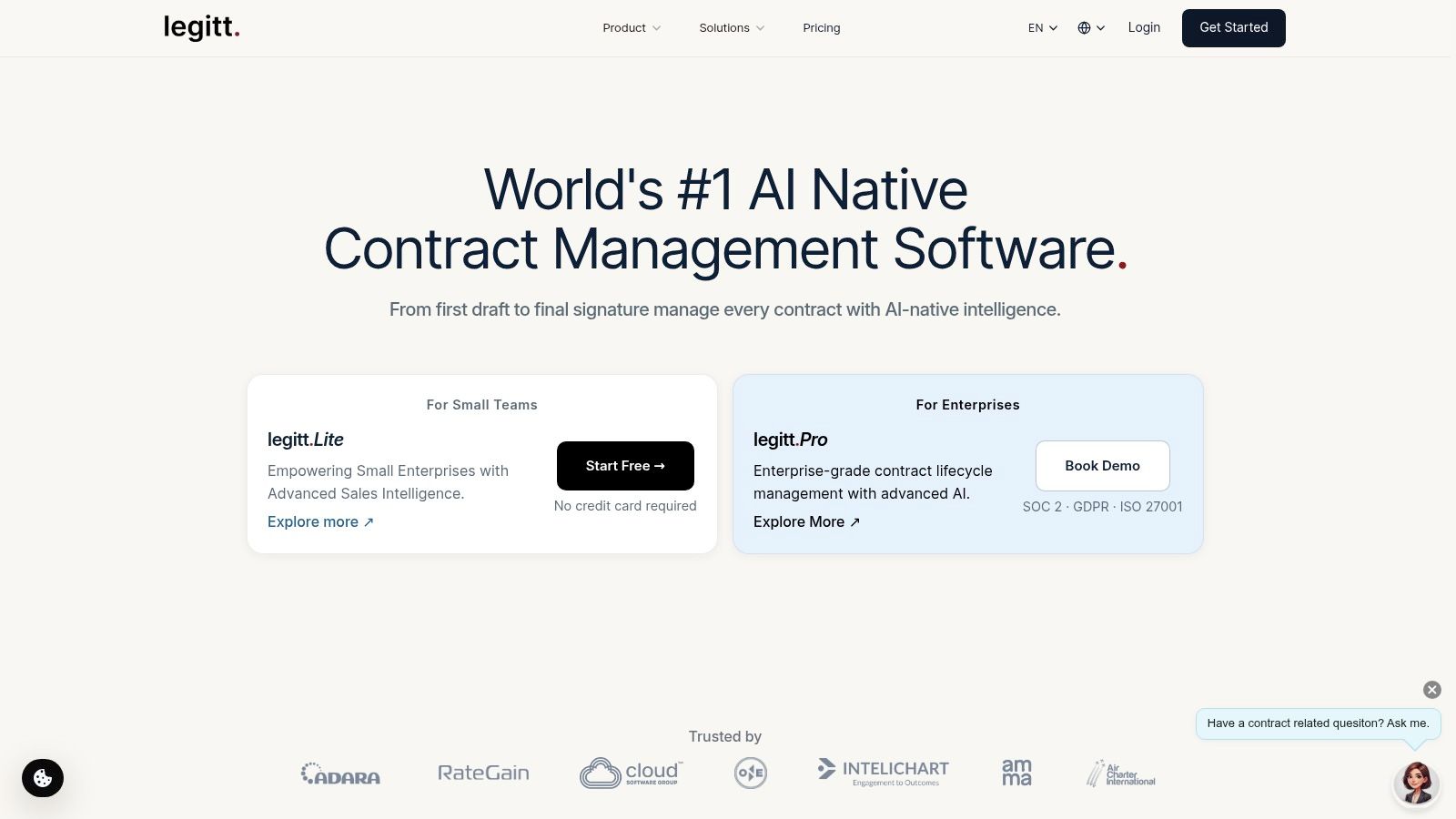
For teams evaluating AI contract lifecycle management, a platform should handle drafting, review, approvals, repository search, obligation tracking, and eSignatures in one workflow. One option in this category is Legitt AI, which combines AI-powered drafting, contract review, approval routing, eSignature, repository management, and contract intelligence, including clause extraction, risk analysis, and renewal alerts. If you’re comparing platforms and operating models, this guide to AI in contract lifecycle management helps frame what SMBs should prioritize.
Good CLM software doesn’t replace judgment. It removes repetitive work so the team can spend more time on term decisions, renewal planning, and risk review.
Frequently Asked Questions for SMBs
When does the handoff from administration to management actually happen
The handoff is one of the biggest sources of confusion. Leah’s summary of the issue for SMBs notes that some sources define contract administration as strictly pre-signature work while others define it as post-signature execution, and that this ambiguity creates an operational gap where SMBs lose visibility on performance tracking and renewals.
In practice, the cleanest rule is this: management starts as soon as the contract affects a business decision. If you’re deciding terms, evaluating risk, planning for renewal, or measuring value, that’s management. If you’re executing, tracking, filing, routing, or confirming compliance, that’s administration.
Can one person own both in a small company
Yes. In many SMBs, one person already does.
The problem isn’t shared ownership. The problem is doing both jobs without a system. One person can handle both roles if the business uses standard templates, clear approval rules, a central repository, and automated reminders. Without those, contract work becomes memory-based, and memory is a terrible control system.
What’s the first step to improve contract management
Start with a contract audit and centralization pass.
Pull active customer, vendor, partner, and employment-related agreements into one repository. Then identify four fields for each contract: owner, renewal date, key obligations, and unusual clauses. That single exercise usually reveals how much of your contract process is currently invisible.
What should SMBs measure first
Don’t start with an elaborate dashboard. Start with a short list:
- Approval delays
- Missed milestones
- Clause variance
- Renewal readiness
Those four signals tell you whether the team is just pushing paper or controlling contract outcomes.
If your team is still managing contracts through inboxes, shared drives, and manual reminders, it’s worth looking at Legitt AI as a practical CLM option. It gives SMBs and enterprise teams one workspace to draft, review, negotiate, e-sign, store, and monitor contracts with AI support, which makes it easier to close the gap between basic administration and real contract management.