Most SMB leaders don’t have a contract problem that starts at signature. They have a workflow problem that ends at signature.
A sales rep drafts in Word. Procurement marks up a vendor paper over email. Legal approves the final version in a Slack thread. Someone sends it through an e-signature tool. The executed PDF lands in a shared drive, and six months later nobody remembers the renewal date, indemnity language, or pricing exception that was negotiated under pressure.
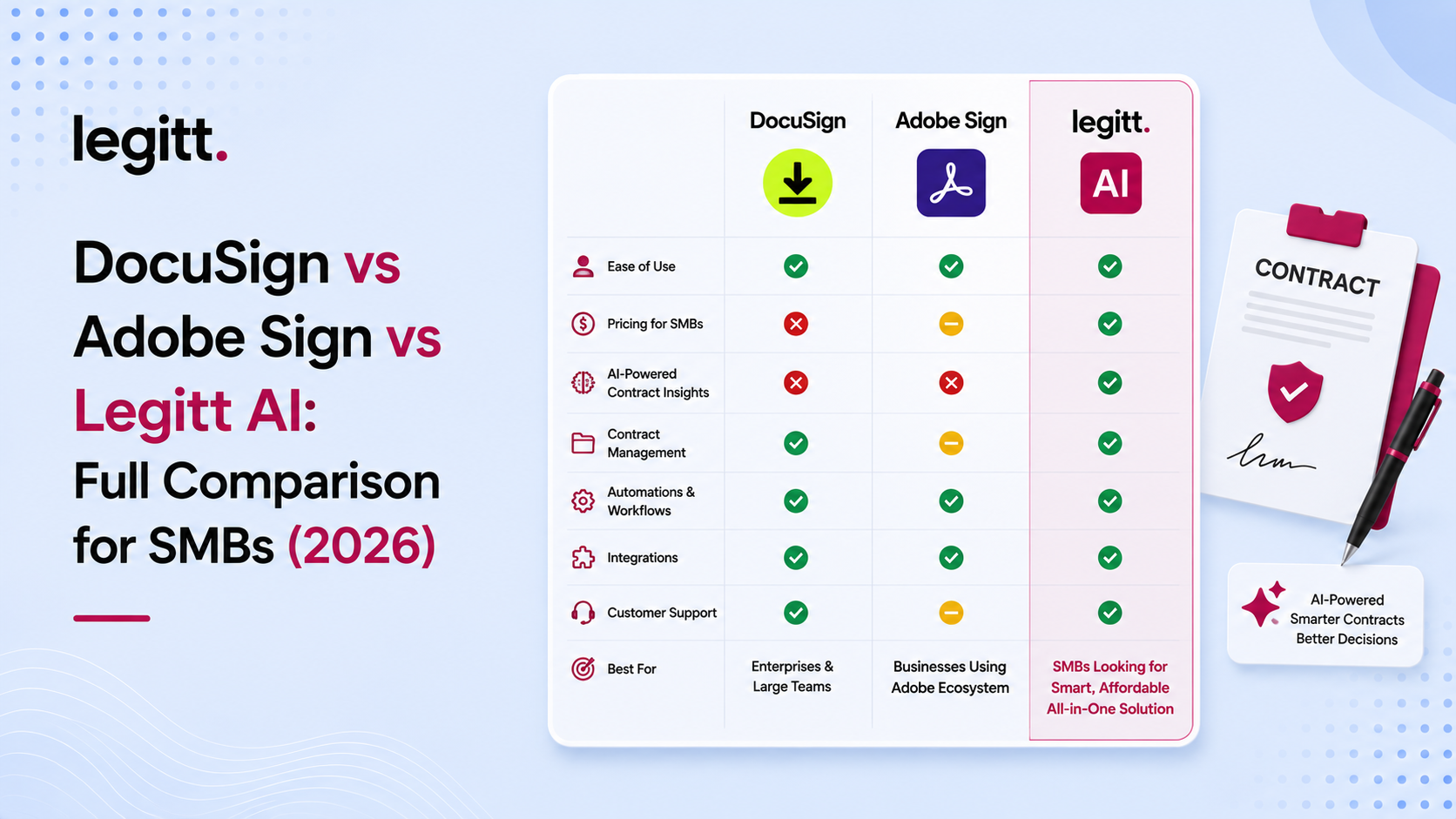
That’s why a simple feature checklist misses the actual decision in DocuSign vs Adobe Sign vs Legitt AI: Full Comparison for SMBs (2026). The fundamental choice is whether your company needs a signing tool, a document workflow tool, or a system for managing contract risk across the full lifecycle.
Beyond the Dotted Line Choosing Your 2026 Contract Platform
An SMB with a lean legal or operations team usually starts with the fastest fix. It buys an e-signature platform. That solves one visible bottleneck. Documents get signed faster, audit trails improve, and counterparties stop asking for scanned PDFs.
But the hidden work doesn’t disappear. Teams still copy terms from prior agreements, chase approvals manually, compare redlines by hand, and search inboxes when a customer disputes a clause. Those handoffs create delay, but they also create risk.
The strongest signal comes from legal teams themselves. The 2023 Association of Corporate Counsel General Counsel Metrics Survey found that 68% of in-house legal departments cite contract visibility and risk classification as top priorities, yet many market comparisons still focus on interface and signing speed rather than clause-level risk scoring or obligation tracking, as summarized in this analysis of contract visibility gaps.
Practical rule: If your team already signs documents efficiently but still loses time finding terms, tracking obligations, or policing deviations, your bottleneck isn’t e-signature anymore.
That’s the lens SMB leaders should use in 2026. Not “Which tool sends documents for signature?” but “Which operating model reduces manual work, improves contract intelligence, and keeps obligations visible after execution?”
For teams evaluating broader contract systems, this overview of top CLM platforms for 2026 is useful context. The market has split into point solutions for signing and integrated platforms for drafting, negotiation, approval, repository management, and post-signature control.
The 2026 eSignature and CLM Market for SMBs
A 40-person company closes deals quickly in Q1, then spends Q2 chasing contract terms across inboxes, PDFs, and shared drives when renewals, billing disputes, and approval questions start piling up. That pattern explains why SMB software evaluation in 2026 has shifted. Signing is usually the easy part. Cost control, visibility, and post-signature accountability are harder.
By 2025, electronic signature adoption across global enterprises exceeded 90% in key sectors, with DocuSign used in over 200 countries and Adobe Sign active in over 130 markets, according to this enterprise e-signature market comparison. For SMB buyers, that matters because it changes the buying question. E-signature is now baseline infrastructure. The more consequential decision is whether to buy a signing tool and assemble the rest of the process around it, or choose a contract system that includes signing inside a wider workflow.
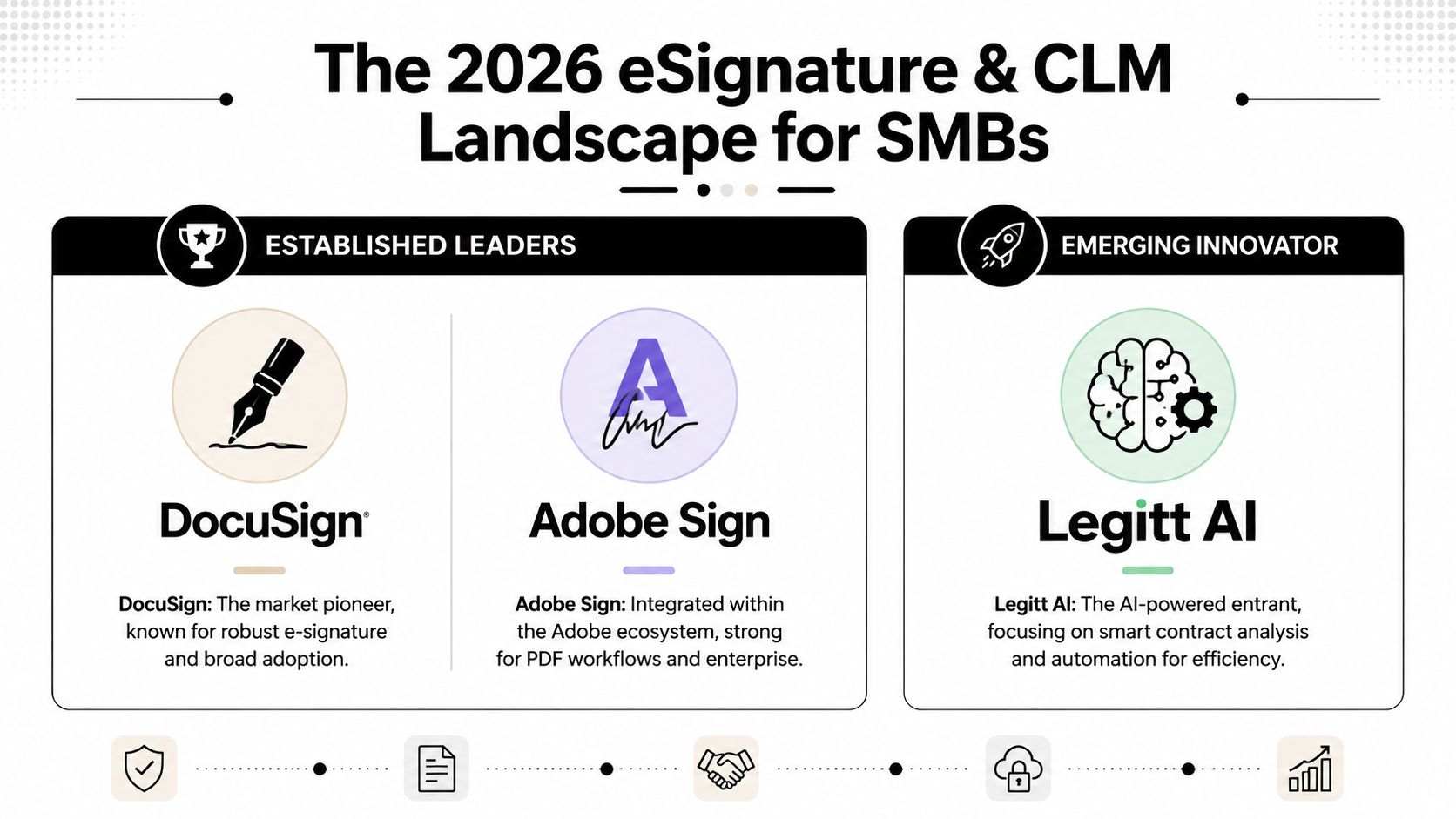
Three different product identities
| Platform | Core identity for SMBs | Strategic strength | Main limitation |
|---|---|---|---|
| DocuSign | Mature e-signature and workflow platform | Broad adoption, strong business process fit | Can become expensive as workflow needs expand |
| Adobe Sign | PDF-centric signing within Adobe workflows | Natural fit for Acrobat-heavy teams | Less compelling if your workflow lives outside Adobe |
| Legitt AI | AI-native CLM with embedded e-signature | End-to-end contract workflow in one workspace | Better suited to teams solving lifecycle problems, not just signature collection |
These products compete at different layers of the contract stack.
DocuSign is often the safest choice for organizations that want a proven signature product, broad acceptance, and minimal buyer education. Adobe Sign makes the most sense where contracts already sit inside Acrobat, PDF editing, and Microsoft or Adobe document routines. Legitt AI reflects a different operating model. It treats drafting, review, approval, execution, storage, and obligation tracking as one process rather than separate tool categories.
That distinction affects total cost of ownership. A lower entry price for a point solution can look efficient in procurement, but the savings narrow if sales, finance, and legal teams still spend hours routing approvals manually, searching for the latest version, or checking whether negotiated clauses made it into the final draft. An integrated CLM platform can cost more or require more change management upfront, yet reduce downstream labor and missed-obligation risk if contract volume is rising.
Why SMBs are reassessing contract software
SMBs are under pressure to reduce software sprawl and limit operational exposure. Each additional handoff between drafting, redlining, signature, storage, and reporting creates another place where data can go missing or a deadline can be overlooked. Teams trying to stop combatting contract management chaos are often responding to those process costs, not just shopping for a faster signature screen.
This is also why buyer segmentation is getting sharper. If your company sends standard sales agreements with light negotiation, DocuSign or Adobe Sign may still be financially rational. If contracts regularly involve custom terms, cross-functional approvals, renewal obligations, or supplier commitments, the cost of fragmented tools rises fast. In that situation, an AI-native CLM platform is less about feature breadth and more about reducing administrative load and keeping risk visible after signature.
International selling adds another layer. SMBs working across jurisdictions need to account for enforceability standards, signer authentication, and region-specific process requirements. This guide to cross-border e-signature compliance in 2026 is useful for teams that sign with customers, vendors, or partners outside their home market.
The market split in 2026 isn’t between two signature tools. It’s between point solutions and lifecycle platforms.
Core Capabilities Compared eSignature CLM and AI
A sales lead approves pricing in Slack. Legal redlines the paper in Word. The customer signs in an e-signature app. Then someone copies renewal dates into a spreadsheet and uploads the PDF to shared storage. On paper, the contract is complete. Operationally, the risky work has just started.
That is the right frame for comparing DocuSign, Adobe Sign, and Legitt AI. SMBs are not only choosing a signature interface. They are choosing how much contract data will stay trapped in PDFs, how many manual handoffs staff will own, and how much post-signature exposure the business will carry.
eSignature experience
DocuSign and Adobe Sign both solve the execution problem well. They support standard signing flows, templates, routing, audit trails, and status visibility. If your contract process is mostly standardized and the main bottleneck is getting documents signed on time, either product can be enough.
The practical distinction is less about whether a document can be signed and more about where each product fits in the broader process. DocuSign is usually the better fit for companies that expect heavier workflow configuration and broader system connectivity. Adobe Sign is often more natural for teams already centered on Acrobat, PDF editing, and Microsoft or Adobe document workflows.
That difference affects labor, not just convenience. A strong signing experience removes friction at the last mile, but it does not fix upstream drafting delays or downstream tracking gaps.
For teams that mostly need to sign a PDF on an individual device, a lightweight utility can still be useful. Something like File Studio Mac PDF signer fits that simple, occasional use case. But it doesn’t address approvals, repository management, or contract analytics.
CLM breadth
Here, point solutions and platforms separate.
DocuSign and Adobe Sign both extend beyond signature, but SMB buyers often encounter contract management features as add-ons, adjacent products, or capabilities that require more setup discipline to get full value. That can still be a rational choice if the business already has stable systems for drafting, review, storage, and reporting. In that case, e-signature remains one component in a process the company already controls elsewhere.
An AI-native CLM platform takes a different approach. Drafting, negotiation, approvals, repository management, and e-signature sit in one operating environment, which reduces the number of times contract data has to be exported, re-entered, or reconciled by hand. For SMB leadership teams, that changes the risk profile. Fewer handoffs usually mean fewer missed fields, fewer version-control disputes, and less dependence on one operations manager remembering where each agreement lives.
A contract lifecycle management platform tends to create more value when your current process includes:
- Repeated drafting work: Sales or procurement starts from old contracts and edits terms manually.
- Approval sprawl: Legal, finance, and executives review through email threads, chat messages, and disconnected file versions.
- Poor metadata capture: Executed agreements are stored, but key terms, notice periods, and obligations are not structured for search or reporting.
- Post-signature blind spots: Renewals, pricing changes, service levels, or supplier commitments are tracked outside the contract system.
Legitt AI is one example of that integrated model. It combines drafting, redlining, approval workflows, repository management, and e-signature in a single environment. For an SMB, the payoff is operational control. The business spends less time moving contract data between tools and has a better chance of keeping legal and commercial terms visible after execution.
If your team signs in one product, stores the PDF in another, and tracks obligations in a spreadsheet, the contract process is still manual in the places where errors are expensive.
AI and contract intelligence
AI is the category where SMB buyers can overpay for labels and underbuy for actual coverage.
Useful contract AI performs specific tasks. It reviews third-party paper for deviations from approved positions. It extracts obligations, dates, and key commercial terms into structured fields. It helps business users find contracts by clause or risk topic. It flags what changed, not just that something changed.
That capability is important because many SMBs don’t need another way to capture a signature. They need a system that can interpret contract content before signature and monitor obligations after signature. The value comes from lower review time, better consistency, and earlier visibility into risk.
A practical vendor test is straightforward:
- Can the platform analyze third-party paper, not only documents generated from its own templates?
- Can it identify clause deviations, obligation dates, and renewal terms in a structured format?
- Can sales, procurement, or finance use the output without reading every page themselves?
- Can the analysis continue after signing through alerts, search, and repository-level reporting?
If those answers are weak, the product may still be a good e-signature tool. It is just less likely to reduce the downstream contract workload that drives hidden cost for SMBs.
Unpacking the Real Cost Pricing Licensing and ROI
SMB buyers often begin with seat price because it’s easy to compare. That’s necessary, but not sufficient.
Market data from 2024 to 2025 shows that stand-alone e-signature solutions typically range from $25 to $45 per seat, while acquisition costs for pure e-signature tools are often 30% to 50% lower than full-featured CLM platforms. At the same time, 35% to 40% of SMBs projected a move toward integrated CLM-with-e-signature suites to reduce manual handoffs and gain end-to-end workflow control, based on this market pricing and migration analysis.
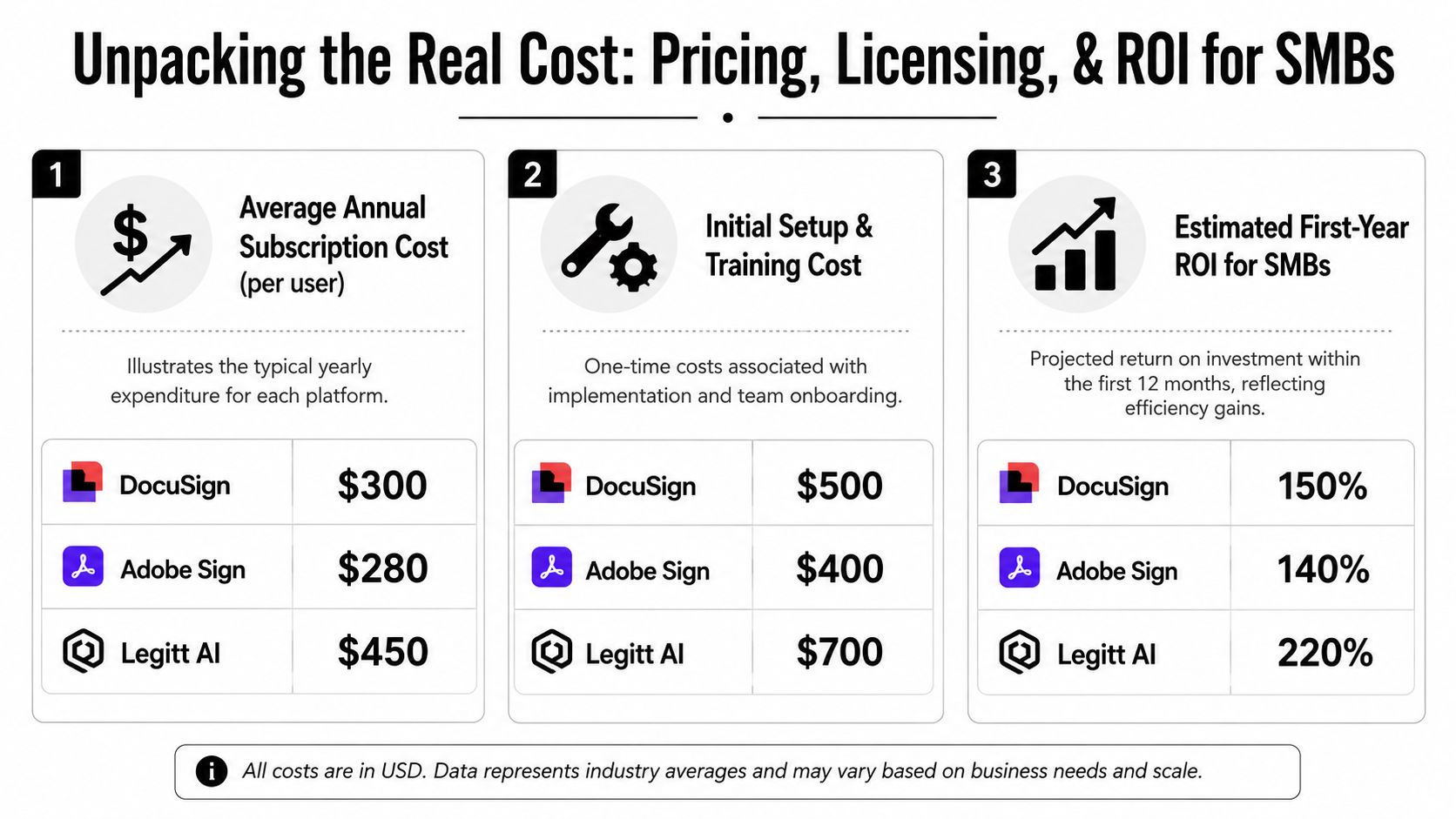
What the sticker price tells you
Entry-level and mid-tier e-signature products usually look financially attractive because the buying unit is simple. You pay per user, deploy quickly, and solve a visible execution problem.
That model works best when your needs are narrow:
- You only need signature collection
- You don’t require structured approvals
- You already manage drafting and storage elsewhere
- Legal review volume is modest
In that scenario, lower acquisition cost is real value. A lean startup or founder-led company shouldn’t overbuy a CLM platform just because AI is fashionable.
What the sticker price hides
The trouble starts when buyers confuse software cost with total cost of ownership.
A standalone signing platform can create downstream costs that never appear on the invoice:
| Hidden cost area | What happens in practice |
|---|---|
| Manual drafting time | Teams recreate standard language from old contracts |
| Approval friction | Sales, legal, and finance chase sign-off outside the system |
| Data re-entry | Key terms are copied into CRM, spreadsheets, or renewal trackers |
| Repository gaps | Executed documents are stored, but obligations aren’t structured |
| Risk review | Staff manually compare deviations and renewal terms |
Those costs land in legal operations, sales operations, finance, and procurement. They also create delay that buyers often tolerate because it’s spread across teams rather than billed as one platform fee.
How to think about ROI
For SMB leadership, the right ROI question isn’t “Which tool is cheaper per seat?” It’s “Which tool reduces enough friction and risk to justify its operating cost?”
A point solution often makes financial sense when signature is the main bottleneck.
An integrated CLM starts to make sense when your team is paying hidden labor costs in several places at once. Drafting takes too long. Reviews are inconsistent. Obligations go untracked. Revenue terms live in PDFs instead of usable data.
A useful buying exercise is to map your current contract workflow and mark every point where someone leaves the system. Each exit usually means another manual handoff, another potential version-control issue, and another place where contract intelligence is lost.
For teams trying to frame software spend around process efficiency rather than procurement line items, this guide to CLM integration for better ROI is a practical next step.
Integrations and Workflow Automation
Integration strategy shapes contract cost more than feature counts do. For an SMB, the real question is whether the contract process stays inside one controlled workflow or keeps bouncing across CRM, email, PDF tools, shared drives, and spreadsheets. Each handoff adds admin time, weakens auditability, and increases the chance that approved terms never make it into the system of record.
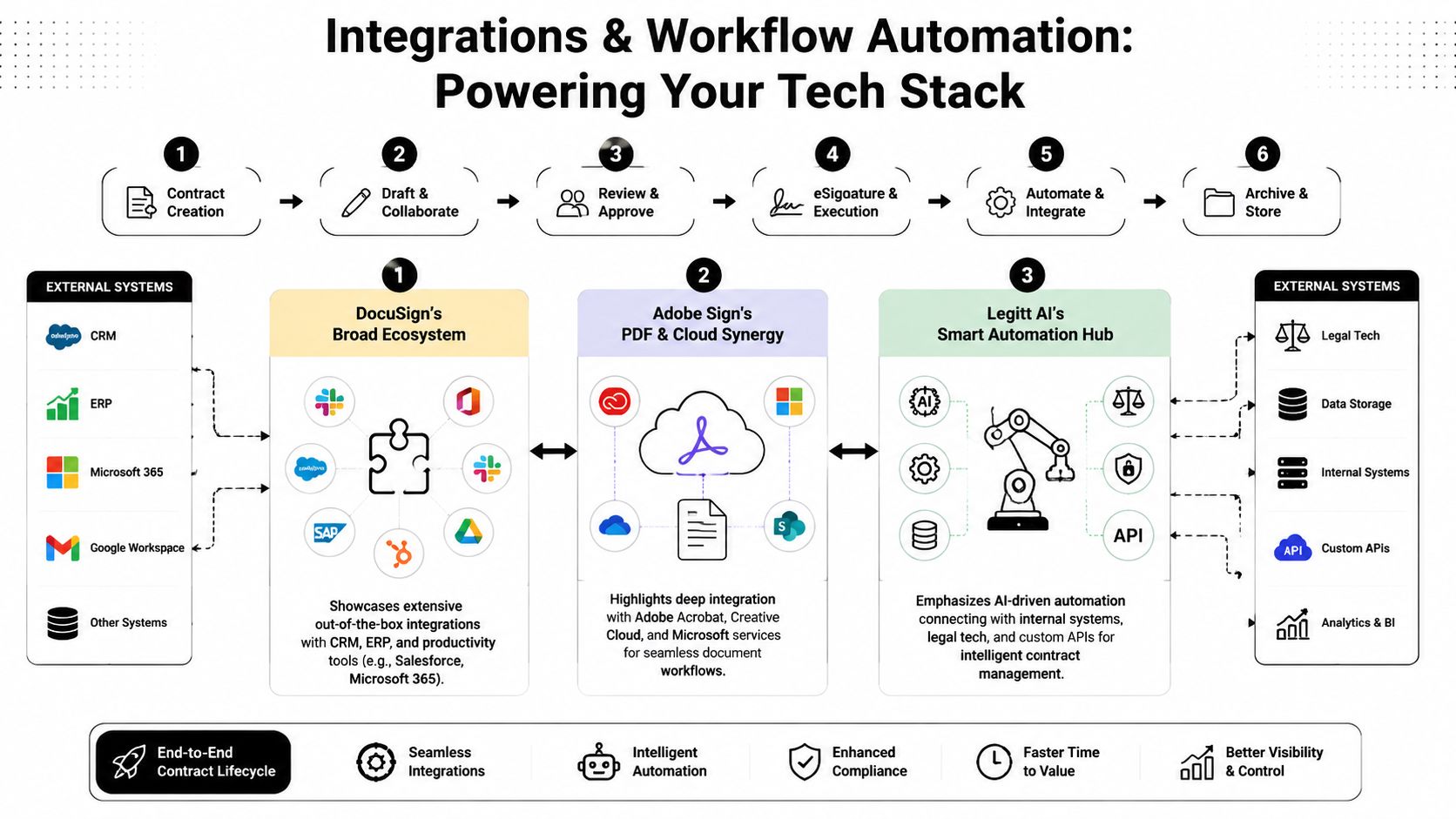
Where DocuSign stands out
DocuSign is usually the strongest fit when an SMB already runs approvals across several business systems and needs mature routing, status sync, and audit trails. Its value is less about marketplace size alone and more about process control. A typical setup starts in the CRM, routes documents by deal type or geography, pushes signature status back into the business system, and preserves a defensible record for compliance or finance review.
That model works well for companies with growing operational discipline. It can also raise total cost of ownership if the business still needs separate tools for drafting, redlining, repository management, and obligation tracking after signature.
Where Adobe Sign fits
Adobe Sign makes the most sense when document preparation and PDF handling sit at the center of the workflow. Teams that already work heavily in Acrobat often adopt it faster because the document experience feels familiar and the stack stays relatively simple.
The trade-off appears later. As approval logic, security controls, and downstream automation become more complex, SMBs can end up layering extra products or moving to higher-tier plans. The entry point may look efficient, but the operating model can stay document-centric rather than process-centric.
What SMBs should evaluate instead of logo counts
A stronger test is the round-trip workflow. Can the platform carry contract data from creation to approval to signature to storage to reporting without forcing staff to re-enter terms?
- From CRM to draft: Can customer, pricing, and term data populate the first version automatically?
- From review to approval: Can internal stakeholders work from the current version with controlled routing and clear ownership?
- From signature to repository: Does the executed contract, plus key metadata, land in a searchable system automatically?
- From repository to action: Can the system trigger renewals, obligations, and alerts without a spreadsheet sitting in the middle?
A useful integration closes the loop. A long app directory does not.
This is the point where an integrated platform changes the economics. If Legitt AI is connected to the systems your team already uses, the platform can keep drafting, review, execution, and post-signature tracking in one operating flow instead of spreading responsibility across disconnected tools. Teams evaluating that model can review this guide on integrating Legitt AI with existing contract management systems.
Some SMBs also use an external AI automation agency to connect contract workflows with CRM, ERP, or procurement systems when internal technical capacity is limited. That can be a rational choice if integration speed affects revenue recognition or purchasing controls. The key is to compare service cost against the labor and risk cost of keeping contract operations fragmented.
Buyer Scenarios Which Platform Is Right for Your SMB
There isn’t one winner for every SMB. The right decision depends on what problem is costing you the most time and exposing the most risk.
The signature-first startup
A founder-led company or small commercial team often needs fast, reliable execution without process overhead. Contracts are relatively standard. Legal review is limited. The team values simplicity and predictable adoption more than deep workflow orchestration.
Adobe Sign often fits this profile well if the business already works heavily in Acrobat and PDF-based document processes. The buying logic is straightforward. Keep the stack simple and avoid paying for lifecycle capability you won’t use.
The process-driven scale-up
Some SMBs are no longer small in operational terms. They have multiple approvers, regional sales motions, procurement controls, and contract workflows tied to CRM or finance systems. Signature is still central, but routing logic, integrations, and audit depth matter more.
That’s where DocuSign typically makes the strongest case. Its workflow maturity and connector breadth support organizations that are formalizing approvals and need a platform that can sit inside broader enterprise processes.
The efficiency-focused SMB
This is the most overlooked buyer. The company may not be large, but its contract workload is chaotic. Sales wants faster turnaround. Procurement needs policy consistency. Legal is spending too much time reviewing repeat deviations. Operations can’t reliably track obligations after execution.
This buyer shouldn’t ask which product signs fastest. It should ask which product reduces total manual work across drafting, review, approval, signature, storage, and renewal follow-up.
An AI-native CLM is often the better fit here because it addresses the full operational chain instead of one event in that chain. Teams in this stage sometimes also bring in outside workflow specialists, such as an AI automation agency, to map process bottlenecks before selecting software. That’s often a smart move when the bigger issue is fragmented operations rather than missing functionality.
Buy the tool that solves your next two years of process pain, not just this quarter’s signing bottleneck.
Frequently Asked Questions
Can an SMB move from DocuSign or Adobe Sign into an AI-native CLM without starting over
Yes. In practice, the key requirement is whether the platform can ingest legacy contracts, store prior versions, and analyze executed documents that originated elsewhere. A capable CLM should centralize old and new agreements in one repository so the team can search, review, and monitor obligations consistently.
Is a standalone e-signature tool enough for most small businesses
Sometimes, yes. If your contracts are simple, your approval chain is short, and you don’t need structured obligation tracking or clause analytics, a point solution can be the right financial choice. The problem appears when contract work spreads across teams and the signed PDF becomes a dead end.
What should legal and procurement leaders ask in a demo
Ask the vendor to walk through a real workflow. Start with draft creation. Then move to redlines, approvals, signature routing, repository storage, renewal alerts, and reporting. If the demo stops at signature, you’re evaluating an e-signature product, not a full contract lifecycle management system.
Does AI contract review only work on contracts created inside the platform
It shouldn’t. A useful AI contract review tool needs to analyze third-party paper, imported agreements, and legacy documents as well as system-generated templates. Otherwise, it won’t help with the backlog most SMBs already have.
How should an SMB decide between lower upfront cost and broader lifecycle capability
Use a simple test. If most of your contract cost sits in signing, buy signing software. If your cost sits in drafting delays, review effort, approval friction, missed obligations, and weak visibility, consider an integrated platform.
If your team is outgrowing point e-signature tools and needs one system for drafting, negotiation, e-signatures, repository management, obligation tracking, and contract intelligence, Legitt AI is worth evaluating alongside DocuSign and Adobe Sign. The strongest buying decision is the one that matches your current workflow maturity, risk exposure, and total cost of ownership.