
You’re usually not looking at a clean contract system when this work becomes urgent. You’re looking at a renewal that slipped, a redline nobody can find, or a finance team trying to reconcile obligations from three different inboxes. At that point, how to organize contracts stops being a filing question and becomes a revenue protection problem.
Why Organizing Contracts Is a Revenue Problem, Not a Filing Problem
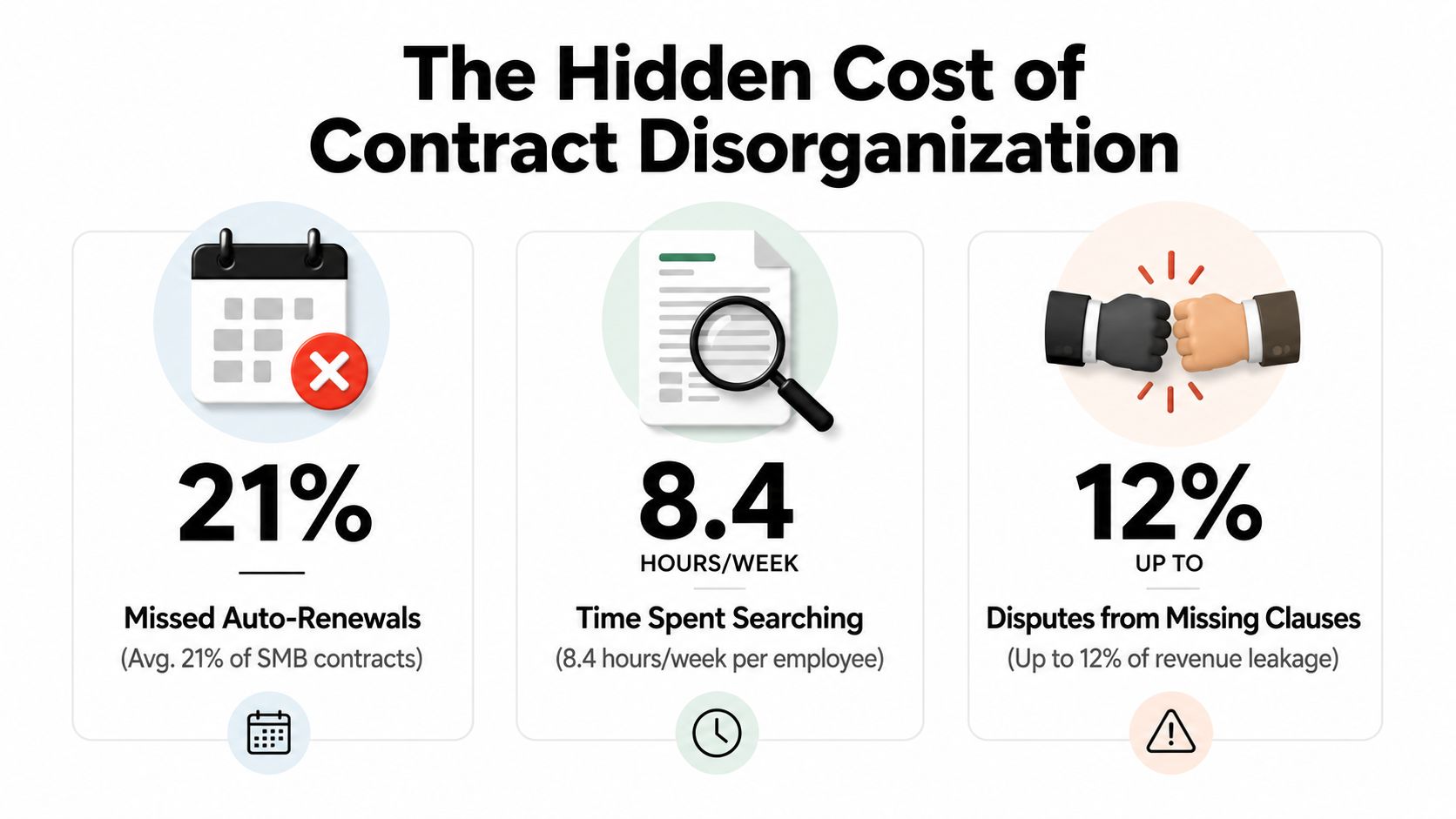
Disorganized contracts don’t just create clutter. They create leakage, missed deadlines, and weak visibility into the terms that determine what gets paid, renewed, enforced, or challenged. One 2026 industry roundup says inefficient processes can destroy up to 40% of a contract’s value, WorldCC estimates leakage can reach 9% of annual turnover, and a separate 2026 market summary puts average erosion at 8.6% Juro’s contract management statistics roundup. That’s why a contract repository has to be built for search, control, and action, not just storage.
Practical rule: if a contract can’t be found in seconds, it’s not organized enough to protect value.
The practical standard is a four-part operating model. First, run a full audit and build a complete inventory. Second, define a metadata schema that captures the fields people search for. Third, centralize the repository with a usable hierarchy, tags, and permissions. Fourth, turn the repository into a workflow engine with alerts, approvals, signatures, and review cadence.
That’s the difference between archiving and managing. A searchable contract system gives legal, sales, procurement, and finance one place to see the signed PDF, the key dates, the obligations, and the exception history. If you want the business case in one place, see contract management and revenue realization, then pair it with essential compliance contract language so the repository also reflects what matters in the paper.
Run a Contract Audit Before You Touch the Folder Structure
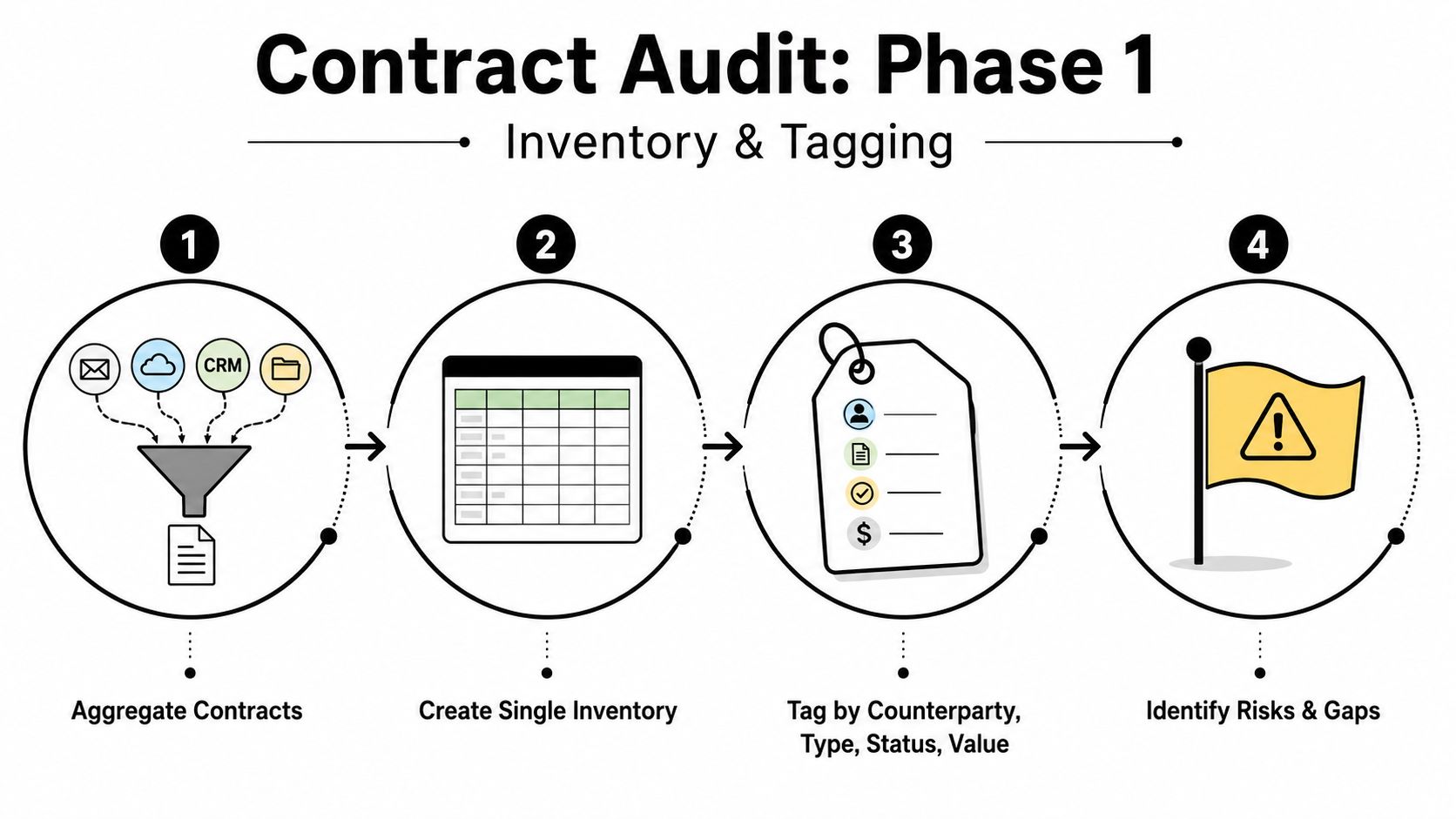
Start with every contract you can find, not with a new folder tree. Pull agreements from email, shared drives, CRM records, procurement systems, and the legal team’s local folders into one temporary inventory. The point is to create a single working list before anyone debates naming conventions or software.
The audit lead should be one accountable owner, usually legal ops or a contract manager, with input from legal, sales ops, procurement, and finance. The output is a spreadsheet or CLM intake list with one row per agreement and at least the basics already tagged: counterparty, contract type, owner, and likely status. For a portfolio analysis lens, that same inventory supports how to analyze your entire contract portfolio in one go without reopening every file later.
What to capture during the audit
Capture the signed agreement, any amendments, invoices, receipts, terms and conditions, and related communications. For dispute readiness, keep emails, text messages, and written correspondence because they can show context that never made it into the final document, and maintain a detailed communication log with the date, time, person spoken to, and a brief summary YouTube guidance on contract dispute evidence.
The audit is finished only when you can answer three questions quickly, what do we have, who owns it, and what could go wrong if nobody touches it for six months?
The rollout timeline should be realistic. Sirion recommends a 6-week pace, with week 1 for the audit, weeks 2-3 for defining the 5-8 most important metadata fields, weeks 4-6 for storage and naming controls, then continuous tagging and quarterly optimization to prevent organizational debt Sirion’s contract organization guide. That cadence matters because contract cleanup always takes longer than a single weekend and works better when the business sees it as a managed project, not a side task.
Define a Minimum Viable Metadata Schema and Naming Convention
The core of contract organization is metadata. Without it, the repository becomes a file dump with better branding. With it, legal and business users can search by the fields that matter, rather than guessing filenames or opening PDFs one by one.
Start with the fields people will use
ContractSafe recommends tracking at least counterparty, contract type, owner, status, start date, end date, renewal terms, and notice deadline ContractSafe’s contract management guidance. That is enough to prevent the most common failure mode, which is a contract that exists but can’t be monitored. I’d add the broader lifecycle dates used in modern contract operations, including execution and effective dates, performance milestones and deliverable deadlines, review and renewal dates, termination notice periods, payment and invoicing schedules, and compliance audit requirements Agrello’s contract tracking framework.
| Minimum Viable Metadata Schema | ||
|---|---|---|
| Field | Type | Why It Matters |
| Counterparty | Text | Makes the agreement searchable by vendor, customer, or partner |
| Contract Type | Dropdown | Separates NDAs, MSAs, vendor agreements, and other templates |
| Owner | Person or team | Assigns accountability for renewals and follow-up |
| Status | Dropdown | Shows whether the contract is draft, active, expired, or closed |
| Start Date | Date | Anchors the lifecycle and reporting window |
| End Date | Date | Supports renewal and closeout planning |
| Renewal Terms | Text | Surfaces auto-renewal and notice requirements |
| Notice Deadline | Date | Helps teams act before the cancellation window closes |
Give every contract a code and a hierarchy
A stronger structure uses explicit identifiers and file order. ContractHound recommends a unique code in the format contract type – unique number – revision, plus a hierarchy like contract type / year / company, and extracting key metadata such as start and end dates, amounts, and the contracting party ContractHound’s organizing tips. That makes it easier to tell related drafts apart and keeps the archive usable when the portfolio grows.
A practical filename might look like MSA-1042-R2_Acme_2026. Inside the repository, the folder path can stay broad, for example Customer Contracts / 2026 / Acme, while the metadata field set carries the exact dates, value, and renewal rules. That combination keeps the file system simple and the search layer precise.
For teams building the data model in a CLM, the underlying logic is what matters. Why metadata matters in AI-enhanced contract search is the right mental model, because AI can only search cleanly when the fields are standardized first.
Build the Repository with Folders, Tags, and Saved Searches
A usable repository has two layers, structure and retrieval. The folder tree gives humans a predictable place to file documents, while tags and saved searches prevent the system from turning into a maze of subfolders. If either layer is missing, users fall back to email or desktop storage.
Use a hierarchy that people can guess correctly
The most practical layout is top-level folders by contract type, then subfolders by year, then counterparty. That keeps broad categories visible without forcing every user to memorize a complex taxonomy. It also works well with centralized storage patterns, as covered in centralized contract storage.
For large estates, a storage design decision matters too. If your team is choosing between object storage and NAS SAN, Beyond Surplus has a useful explainer on object storage vs NAS SAN that helps frame how centralized repositories handle scale, access, and control.
Tags make the repository searchable
Folders organize where a file lives. Tags explain what the file means. The most useful tags are department, region, risk tier, governing law, data processing, and auto-renew. I also recommend status tags such as draft, active, expired, and under review because those are the filters users ask for in day-to-day work.
Saved searches turn that tagged repository into a working system. Instead of drilling through folders, a sales manager can pull all active agreements for a region, and legal can surface agreements with a specific governing law or renewal window. A procurement lead can scan vendor contracts with auto-renew turned on, then pull up the notice deadlines without opening each file.
Operational shortcut: if a question gets asked more than once, it should become a saved search, not a recurring manual hunt.
The key is to align tags with lifecycle dates. Payment milestones, audit triggers, and termination notice windows should sit beside expiration, not somewhere else in a separate spreadsheet. When users can see those items in one place, the repository becomes a live operations tool instead of a digital filing cabinet.
Add Workflow Automation, eSignature Routing, and Integrations
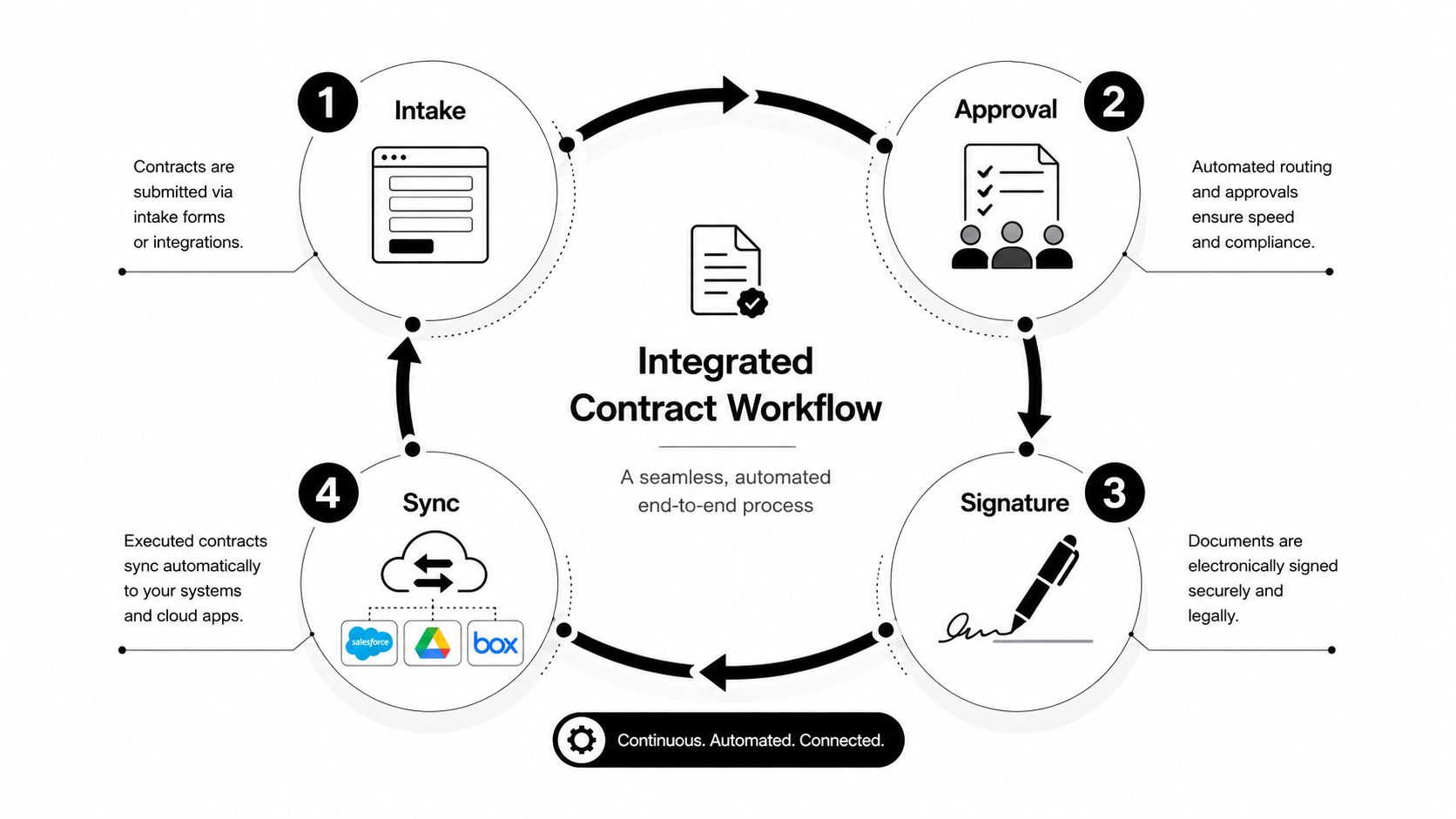
A clean repository is necessary, but it still won’t move a deal forward by itself. Contracts have to flow from intake to review to signature to storage without disappearing into inboxes, Slack threads, or side spreadsheets. That is where workflow automation matters.
Build the path from request to executed agreement
In a sales flow, the process should start in CRM, move into redlining and internal approval, route to counterparty eSignature, and then land back in the executed repository with the right tags and milestones attached. In a procurement flow, a vendor request should trigger intake, risk review, legal approval, signature, and obligation tracking. Both flows depend on the same thing, a repository that already knows who owns the contract and what fields must be captured.
A modern CLM can connect that flow to systems like Salesforce and the tools your team already uses. Legitt AI, for example, offers drafting, review, eSignature, repository management, and integrations in one workspace, so the contract record stays tied to the workflow rather than split across tools.
Use AI where structure already exists
AI works best when the repository is organized. It can extract clauses, compare third-party paper against approved language, and flag deviations faster when metadata, versions, and status are already consistent. That lines up with the market reality that 94% of companies believe generative AI will help analyze contract risk and compliance Icertis research on CLM trends.
Practical rule: automation should remove handoffs, not hide accountability. Every approval step still needs a named owner.
The reason this matters is simple. Contract automation without organization just moves chaos faster. Once the system knows the schema, the repository can support templates, approval routing, eSignature, obligation alerts, and contract intelligence without extra cleanup after every signature.
For more on the operational side of approvals and signatures, see integrate eSign workflows for sales and procurement. That’s the point where the repository becomes a workflow engine rather than a storage layer.
Govern Access, Retention, and Dispute-Ready Evidence
Once contracts are organized and moving, governance becomes the control layer that keeps the system defensible. If people can edit, export, or sign documents without clear permission boundaries, the repository may be searchable but it won’t be trustworthy. Legal ops has to define who can view, edit, approve, sign, and export, then pair that with SSO, MFA, and a defensible audit trail.
Set retention rules before the archive fills up
Retention should be treated as a lifecycle decision, not an afterthought. The practical tiers are active, expired, archived, legal hold, and deleted. The trigger for moving a contract between them should be tied to status changes, renewal outcomes, disputes, or statutory retention needs, not to whatever folder someone feels like using that week.
Audit trails matter here as well. A good system should show when a contract was accessed, by whom, and what modifications were made, because that history supports both internal accountability and external review. The same logic applies to disputes and investigations, which is why reliable investigation management is worth reviewing alongside contract governance if your team handles sensitive matters.
Store evidence the way disputes actually unfold
A dispute rarely turns on the signed agreement alone. It turns on the signed agreement, the amendments, invoices, receipts, terms and conditions, and the communications around who said what and when. Keep that evidence together, and keep a dated communication log so a future reviewer doesn’t have to reconstruct the story from scattered inboxes.
If a deal goes sideways, the winning file is the one that already has the signed document, the paper trail, and the timeline in the same place.
Governance and organization finally meet. Role-based access, retention rules, audit trails, and dispute-ready evidence are not separate policy topics. They’re the settings that make the repository reliable enough for legal operations, procurement, finance, and sales to trust it.
KPIs, Quick Wins, and a 90-Day Plan You Can Actually Ship
A contract system only matters if it changes behavior. The cleanest dashboard tracks time to find a contract, on-time renewal rate, cycle time from intake to signature, obligation compliance rate, and value leakage recovered. Those metrics tell you whether the repository is reducing friction or just looking polished.
A realistic 90-day plan is simple. Use the first 6 weeks to finish the audit, define the schema, and centralize storage. Use the remaining time to launch one automated workflow, usually sales or procurement, then review the data quarterly so missed renewals and obligations surface early.
Quick wins for Monday
- Centralize first: get all active agreements into one repository.
- Standardize second: lock the metadata fields and folder hierarchy.
- Automate third: route one high-volume contract flow.
- Measure fourth: report on renewals, search time, and cycle time.
The fastest teams don’t try to perfect every edge case on day one. They build a usable system, force consistency, and then improve it with quarterly review. That’s how organized contracts start protecting revenue instead of consuming admin time.
If you want a contract system that ties drafting, review, approvals, eSignature, and repository management into one workflow, Legitt AI can give your team a practical starting point. It helps legal, procurement, and sales keep contracts searchable, trackable, and tied to the right milestones. Visit Legitt AI to see how that operating model can fit your team.