You usually spot the problem on a busy morning. The crew rolls up, the gate is locked, the dog is loose, and the client says they never agreed to weekly service. By the time the office starts calling, you've already burned time, fuel, and labor on a job that should've been routine.
That's why lawn care contracts matter more than a signature on a form. In a fragmented industry with 556,000 landscaping businesses in 2026 and a U.S. landscaping-services value of $176.7 billion in 2026 (Landscaping industry statistics), written terms are what keep recurring service profitable and professional. A good contract turns a casual promise into a repeatable operating system.
Why Lawn Care Contracts Protect Your Business
A handshake works until the first dispute. I've seen arguments start over access, missed visits, payment timing, and whether a service was supposed to happen every week or only “when needed.” Once the customer remembers the agreement differently than you do, the crew ends up in the middle.
Lawn care contracts protect you because they define the work before the truck leaves the yard. They also help you separate the genuine service relationship from the small talk that happens during a quote. That matters in a market where maintenance services make up over 92% of the U.S. lawn care market in 2024 and the average household spends about $616 annually on lawn and garden services, according to industry data from Amra & Elma.
What written terms prevent
A contract cuts off the most common arguments before they get expensive:
- Scope creep, when a customer starts asking for extra edging, bed cleanup, or bagging without paying for it.
- Payment confusion, when the client thinks the bill is per visit but you priced it as a seasonal plan.
- Liability disputes, when a customer says your crew damaged property that was already in bad shape.
- Service timing fights, when weather or access issues force a reschedule.
Practical rule: If the client can't read the agreement and tell what happens on a wet week, a locked-gate day, or a termination notice, the contract isn't finished yet.
The best contracts do more than defend a claim. They also improve how your office schedules, bills, and renews work. That's where contract management software starts to matter, because a clean agreement is easier to store, find, and renew than a stack of PDFs buried in email. For a deeper lens on why that matters operationally, see why contract management is important.
Types of Lawn Care Contracts and When to Use Each
The right structure depends on the work. A residential mowing agreement doesn't need the same depth as a commercial property plan, and an installation project shouldn't be written like recurring maintenance. If you use one generic template for everything, you'll either overcomplicate small jobs or underwrite the bigger ones.
Match the contract to the service model
Use a recurring maintenance contract when the job is route-based, seasonal, and tied to ongoing visits. That fits weekly mowing, trimming, edging, fertilization, and similar service relationships. Use a project contract when the work has a clear start and end, like outdoor area installation or a one-time renovation.
A seasonal agreement works well when service frequency changes during the year. That's common for lawn care businesses that slow down during weather swings or shift from mowing to cleanup and aeration. A year-round contract works better when you're locking in route density and predictable billing across all seasons.
Commercial accounts usually need tighter definitions than residential ones. A property manager wants service standards, insurance language, and renewal timing. A homeowner usually cares more about price, visit cadence, and what's included.
Choose pricing structure with the contract
Fixed-price contracts work when the scope is stable and the property is easy to service. Time-and-materials works when the work is variable, access is uncertain, or the client keeps changing the job. For many lawn care businesses, the best fit is a recurring fixed-price arrangement with clearly stated exclusions and change-order language.
A simple way to decide is to ask three questions:
- Does the work repeat on a route? If yes, use a recurring agreement.
- Can the scope be measured easily? If yes, use fixed pricing.
- Will weather or site conditions change the job? If yes, add specific rescheduling and access clauses.
For a broader template approach, service contracts guidance helps you standardize clauses across client types without forcing every account into the same format.
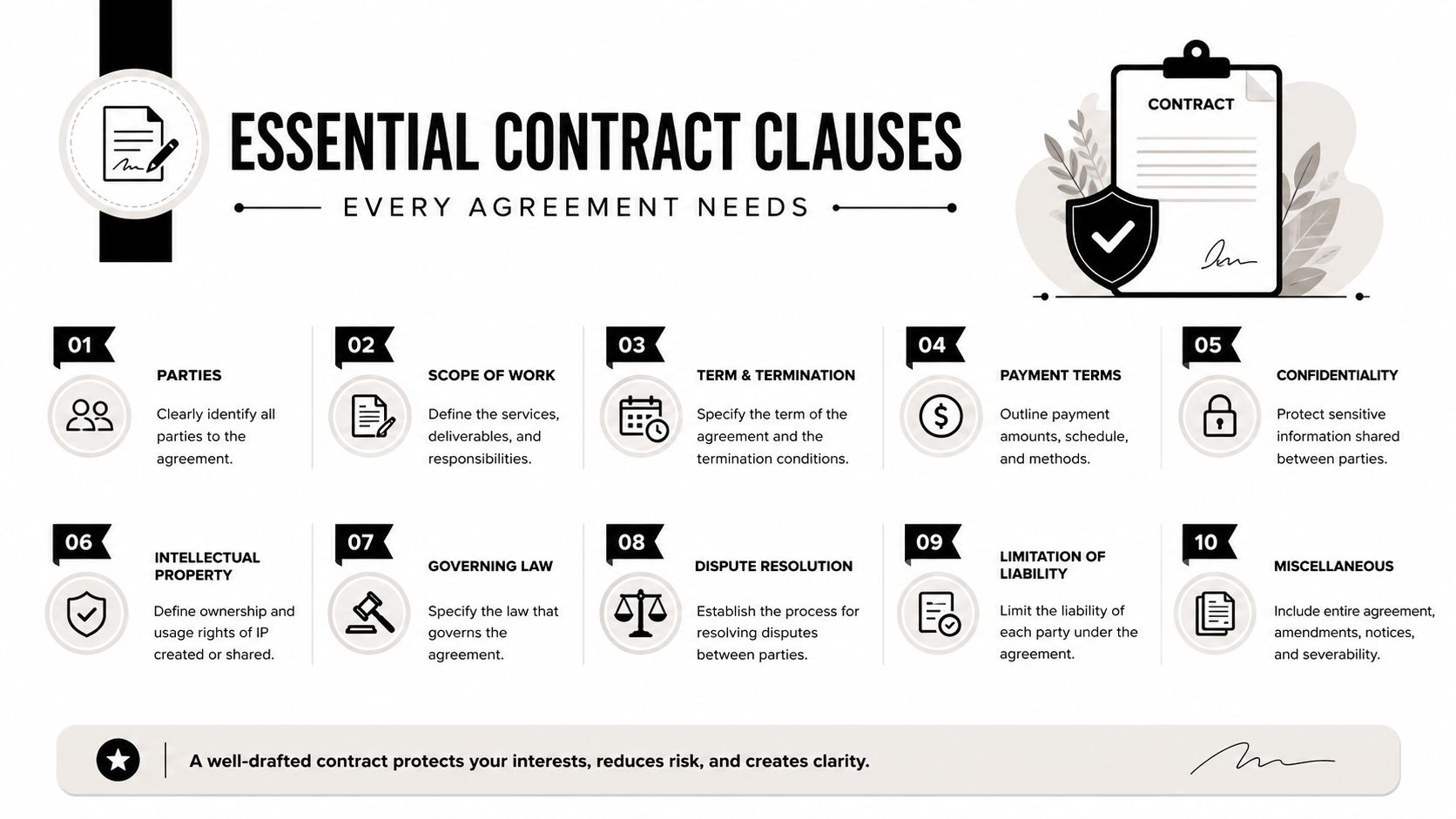
Essential Contract Clauses Every Agreement Needs
Generic wording causes the most expensive mistakes. “Mowing” sounds simple until the client says the strip by the fence wasn't included, or “maintenance” turns into an argument about fertilization, cleanup, and mowing height. North Carolina State University recommends listing the site areas first, then the tasks under each area, then the critical factors that determine whether the work was done properly, which makes performance measurable instead of vague NC State turf contract guidance.
Scope, pricing, and termination language
A strong scope clause says what happens, where it happens, and how often it happens. Weak language says “basic mowing and maintenance.” Strong language says the contractor will mow specified turf areas, edge specified borders, and exclude named areas, with performance judged by observable standards.
Pricing needs the same discipline. A contract should state the rate, billing schedule, accepted payment methods, and any late-payment consequences. If you want predictable revenue, spell out renewal timing and notice periods so a customer can't continue service running after they intended to stop.
Risk allocation clauses that save disputes
A good lawn care contract also needs liability and insurance language, plus a clear statement on pre-existing damage, obstacles, and property left on the lawn. Indemnity provisions matter when a third-party claim lands on your desk. Warranty limits matter because you can't promise turf results that depend on irrigation, weather, or the customer's own maintenance.
Keep the warranty narrow. Promise the service you control, not a lawn outcome you don't.
For clause design, top contract clause guidance for business contracts is a useful reference point when you're standardizing templates across residential, commercial, and seasonal work. The business value is consistency. When sales, operations, and legal all use the same clause set, redlines get shorter and renewals get cleaner.
Pricing Strategies That Protect Your Margins
Underpricing usually happens. The quote looks fine until you add setup, drive time, cleanup, fuel, equipment wear, insurance, and office work. Jobber's estimating guidance is useful here because it recommends pricing by hourly rate while explicitly adding setup, travel, cleanup, equipment maintenance, fuel, insurance, and administrative costs, and then adjusting for bigger or more complex properties Jobber lawn care contracts.
Compare the pricing models
A per-cut rate is easy to sell, but it can fail on properties that take longer than expected. A route-based contract is better when service frequency is predictable and the account fits your crew's existing path. Seasonal billing is better when the work changes across the year and the customer wants a more even cash flow.
| Lawn Care Pricing by Property Size and Service Frequency | |||
|---|---|---|---|
| Property Size | Service Type | Price Range | Monthly Cost |
| 1/8 acre | Monthly service | $100 to $200 | $100 to $200 |
| 2 acres | Monthly service | $1,600 to $3,200 | $1,600 to $3,200 |
| General mowing | Per visit | $50 to $205 | Varies |
| General mowing | Per square foot | $0.01 to $0.06 per square foot | Varies |
Those figures from Angi's lawn care cost guide show why size and frequency matter more than a simple mowing sticker price. If you're quoting a one-time annual contract, the old forum example that uses 32 cuts per year, $35 per cut, and a total of $1,120 shows how contractors often convert a seasonal total into monthly billing by dividing by 12 for predictable invoices (Lawnsite example).
Build the quote so it doesn't leak profit
Complexity should change the number. Hilly terrain, extensive trimming, and irrigation features all add time, and that time should be priced. That's why estimating tools are useful, especially when your office wants a cleaner quote-to-contract workflow. A platform like Exayard landscaping estimating software can help teams standardize the estimating side before terms are pushed into a contract.
For a cleaner pricing framework across estimates and proposals, standardizing pricing for estimates, proposals, and quotations is the part that keeps sales from promising one thing and operations delivering another.
Critical Gaps Most Contract Templates Miss
Most templates do the easy part. They list services, ask for a signature, and stop before the messy parts that create disputes. That's why weather, access, and property-condition clauses matter so much. The gaps are operational, not theoretical.
Weather and seasonal variability
A contract needs to say what happens when mowing frequency drops because conditions change. If rain, drought, or turf stress makes standard service impossible, the client should know whether you'll reschedule, skip, or switch to an alternative task. Many guides mention weather, but they don't turn it into an operational rule that the office can follow consistently.
Seasonal work deserves the same treatment. If spring cleanup replaces mowing for a few weeks, the contract should say so plainly. That protects route planning and prevents the customer from arguing that “weekly service” should have continued unchanged.
Access, liability, and excluded services
Locked gates, loose pets, obstacles on the lawn, customer-owned objects, and pre-existing damage all need their own treatment. These are the disputes that show up in real life, not in the brochure version of the business. If the crew can't access the property, the contract should state whether the visit is billed, rescheduled, or cancelled.
A lot of contracts also blur included and excluded services. That's a mistake. If you trim shrubs, haul debris, or handle irrigation work only by separate authorization, say it that way. It keeps scope creep from becoming a habit and protects the relationship when expectations drift.
Separate the work you price from the work you might do later. That one habit prevents most “I thought it was included” arguments.
Automating Contract Management With AI-Powered CLM
Manual contract handling slows every stage of the job. Sales retypes the same customer data, the office misses renewal dates, and nobody knows which version was last sent. AI-powered contract lifecycle management fixes that by turning drafting, review, approval, signing, and storage into one controlled flow.
Where automation pays off
A system like Legitt AI can generate jurisdiction-aware agreements from plain-English prompts, route them through redlines and approvals, and send them to eSignature with role-based tracking. It can also extract clauses from incoming paper, flag deviations, and surface obligations or renewals before they get lost in email. That matters when you're managing recurring service agreements, seasonal renewals, and account-specific exceptions across a growing portfolio.
The operational win is simple. Quote data moves into the contract once, then the agreement flows through review, signature, and repository storage without copy-paste errors. When the CRM is connected, sales doesn't have to rekey customer names, addresses, or service terms just to get a contract out the door.

What the workflow should look like
- Draft: Start from approved templates so the scope, payment, and termination clauses stay consistent.
- Review: Use redlines and clause checks to catch risky edits on customer paper.
- Approve: Route exceptions to the right manager, legal reviewer, or owner.
- Sign: Send the final version through eSignature with role-based routing.
- Store: Keep the executed copy in a searchable repository with renewal alerts.
For a deeper operational view, AI in contract lifecycle management is where the case for automation becomes obvious. The payoff isn't hype, it's fewer missed renewals, cleaner compliance, and less time spent hunting for old agreements.
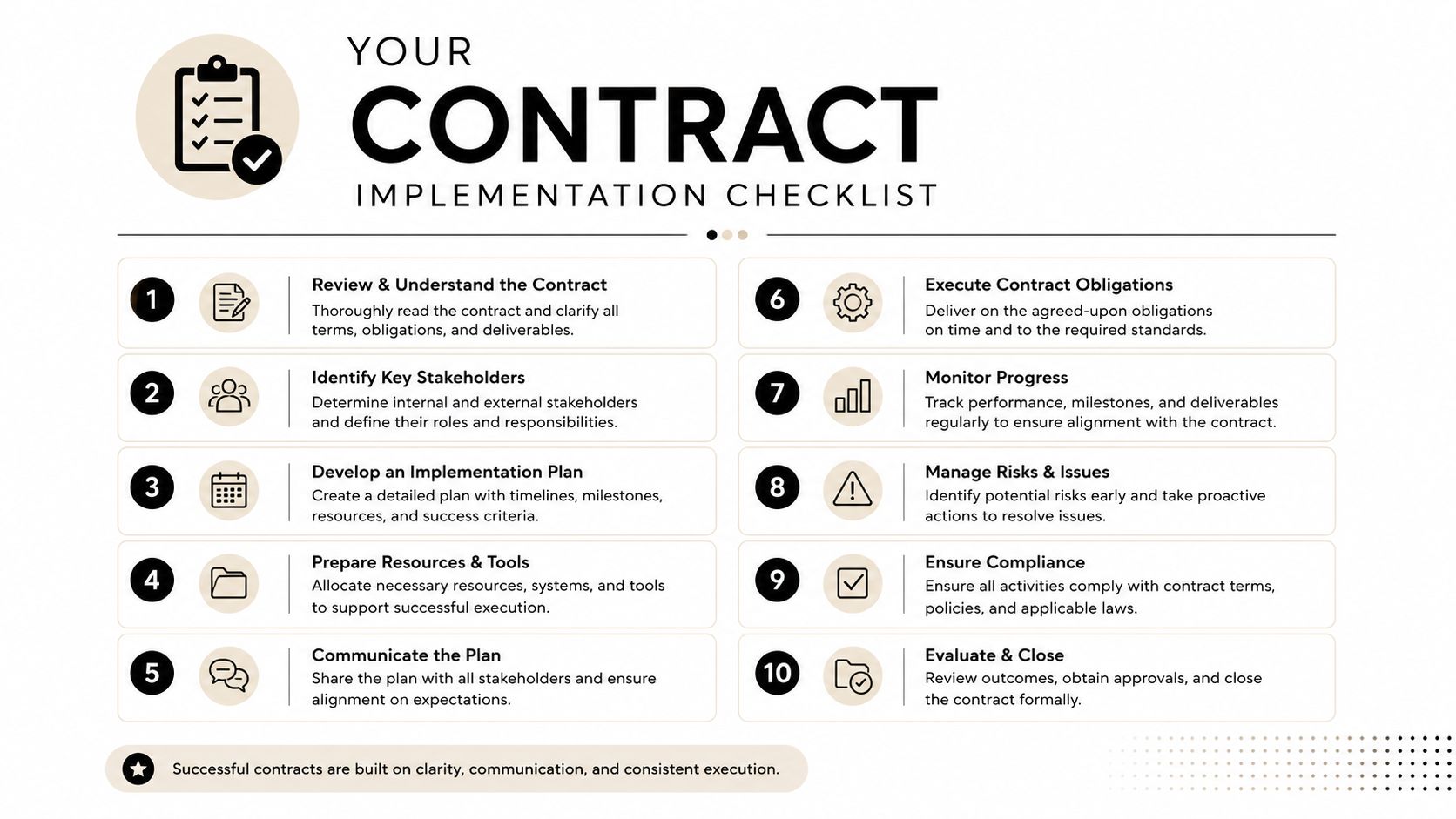
Your Contract Implementation Checklist
A usable contract process is built, not assumed. Start by pulling every template your team currently uses, then compare them against the disputes you've had in the field. If your last three problems came from access, weather, or mid-season cancellation, those clauses deserve immediate attention.
Put the process on rails
- Audit old agreements. Find missing scope, payment, and termination language.
- Standardize your clause set. Keep one approved version for the office to use.
- Train the team. Sales, dispatch, and account managers should know when a clause needs escalation.
- Add renewal tracking. Every recurring account should have a clear notice date.
- Use redlines deliberately. Don't accept contract edits by phone only.
- Confirm state-specific requirements. Insurance, cancellation, and business rules can vary.
- Store executed copies centrally. A searchable repository saves time when disputes start.
- Measure exceptions. Track which clauses keep getting negotiated and fix the template.
- Automate signatures. Faster execution means fewer dropped deals.
- Review after season changes. Weather and service mix shift, and contracts should reflect that.
If you want a simple way to keep signatures moving, sign documents easily with PDFKing can handle the execution step while your team focuses on the terms that protect margin and reduce risk.
Legitt AI helps teams draft, review, approve, e-sign, and store contract files in one workflow, which is useful when your lawn care contracts need clearer scope, cleaner renewals, and less manual follow-up. If you're ready to move from scattered templates to a controlled contract process, visit Legitt AI and see how it supports drafting, review, automation, and contract intelligence for recurring service businesses.