A contract lands in legal at 4:47 p.m. Sales wants it out the door, procurement says the paper is “basically standard,” and someone has already promised the customer it can be signed tonight. Two months later, the team discovers an auto-renewal they didn't expect, a liability cap that never got escalated, or a data-transfer clause that creates a cross-border problem no one flagged in time.
That's the difference between a glance and a real legal review of documents. A real review is an operational control, not a courtesy sign-off, and it matters just as much in commercial contracting as it does in litigation or diligence. The cost pressure behind that reality is easy to miss until the workload piles up, but the economics are clear, review has been the dominant cost center in large-volume discovery, accounting for 73% of total document-production costs, while processing made up 19% in the RAND brief on e-discovery economics (RAND brief).
This playbook looks at document review through three lenses that teams face: litigation review, contract review, and cross-border review. That matters because the failure modes differ, even if the discipline is the same. A structured workflow catches risk earlier, reduces rework later, and gives legal ops something better than “we looked at it” when leadership asks how the process is controlled. If your team also wants the business case for disciplined contract review, this overview from Legitt AI on why contract review matters in business is a useful companion.
Why Legal Review Matters More Than Most Teams Realise
The most common failure isn't that someone forgot to read the document. It's that someone read it too quickly, in the wrong order, without a system that forces the important issues to surface before signature. A sales rep can skim a contract, see familiar commercial terms, and move on. Legal then finds the problem later, usually after the deal has already created an obligation that's harder to unwind than to prevent.
A structured review would have caught that before execution. It would have separated the “looks standard” layer from the clauses that drive future risk, like renewal mechanics, indemnity scope, data handling, and approval routing. In practice, that's why document review matters far beyond one contract or one lawsuit. It's the point where a business decides whether it understands what it's agreeing to.
Three review lenses that shape the workflow
Litigation review focuses on relevance, privilege, quality control, and production. The pressure comes from volume, deadlines, and defensibility.
Contract review focuses on commercial risk, deviation from playbook positions, and whether the paper can be signed safely.
Cross-border review adds privacy, residency, and transfer restrictions. The question isn't only what the clause says, but who can see the data and where it can move.
The RAND finding on review cost concentration is one reason AI-assisted methods became strategically important in major markets (RAND brief). When the biggest cost sits in one stage, even small gains matter. That's the operational lesson here, treat review like a pipeline with checkpoints, not a one-time read-through.
What Legal Review of Documents Actually Involves
Legal review of documents is a controlled pipeline. It's not one person opening a file and deciding whether it feels acceptable. The core stages are collection, processing, relevance review, privilege review, quality control, and production or finalisation, and each stage narrows risk while creating a defensible record of what was checked and why (Lexitas on document review people, processes, and technology).
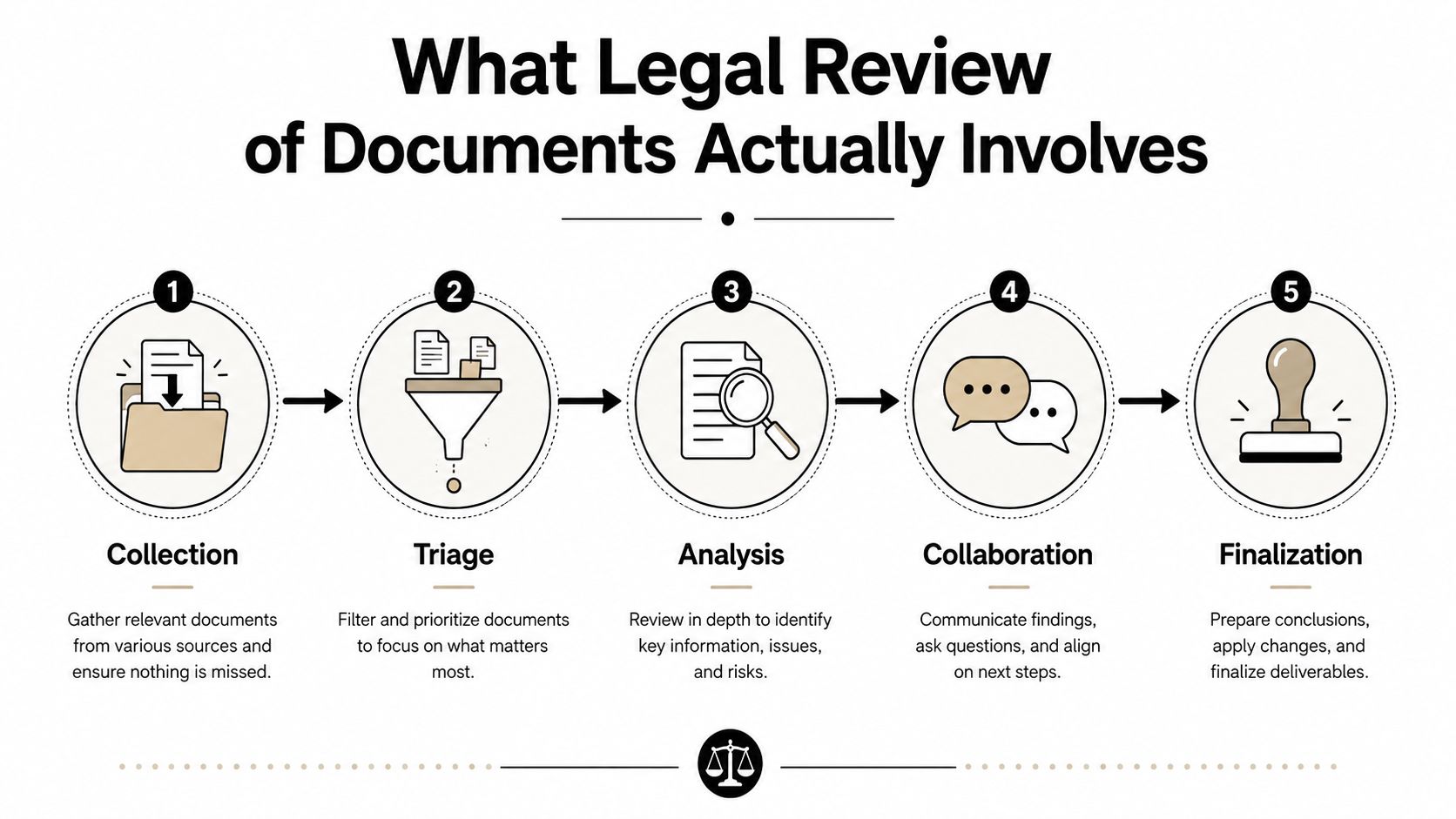
The pipeline that keeps errors from compounding
Collection gathers the source set. If the collection is incomplete, everything downstream is distorted.
Processing cleans and organizes the files, which is where mixed formats, duplicates, and unusable scans start to get separated from usable material.
Relevance review decides what belongs in the working set. In litigation, that means what's responsive or relevant. In contract review, it means what needs attention before approval.
Privilege review is the gate that protects confidential legal material before anything leaves the team.
Quality control and production finalise what gets disclosed or signed, and create the audit trail that shows the work was handled consistently.
The historical baseline for why this structure matters is the variability of human review. One foundational study found 43% inter-reviewer agreement for responsiveness, a spread from 23% to 54% across seven review groups, and one review decision set matched only 34% of the total document family count (Barnett study PDF). That isn't a knock on individual reviewers. It's proof that manual review without protocols produces uneven outcomes.
| Stage | Primary activity | Typical artefact | Common failure mode |
|---|---|---|---|
| Collection | Gather the source set | Custodian list, export set | Missing sources or duplicate pulls |
| Processing | Clean and normalize files | De-duplicated review batch | Unreadable files or bad OCR |
| Relevance review | Mark what needs attention | Coding decisions, tags | Inconsistent judgment across reviewers |
| Privilege review | Screen protected material | Privilege log, withheld set | Privilege misses or over-withholding |
| Production or finalisation | Release or sign off the final set | Production set, approved contract | Version drift or incomplete output |
The same logic appears in commercial work. A contract review should still move through a controlled sequence, even if the output is a redlined agreement rather than a production set. For a practical contract-review framing, Legitt AI's contract review guide is aligned with that workflow logic.
Practical rule: if a team can't name the stage where an error should be caught, that error will usually show up after the document is already out the door.
Step-by-Step Review Workflows for Contracts and Discovery
The two most common review paths look similar on paper and very different in practice. Contract review is built to get to execution. Discovery review is built to get to production with a defensible record. The roles, deadlines, and artefacts are not the same, so teams need different sequencing rules for each.
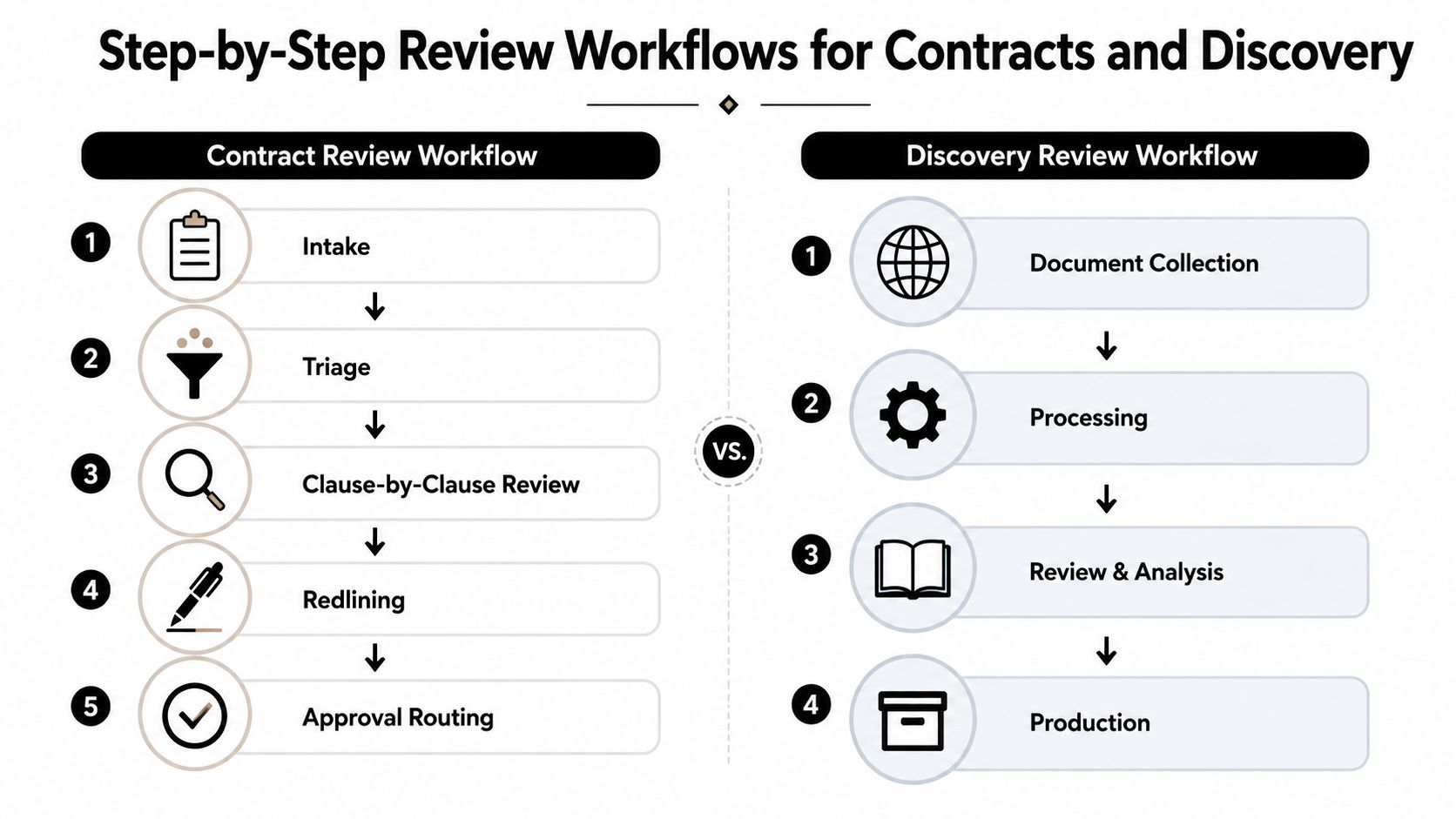
Contract review workflow
- Intake. The contract arrives with context, requester, counterparty, and business goal.
- Triage. Legal decides whether it's standard, needs playbook review, or needs escalation.
- Clause-by-clause review. Review defined terms, exhibits, renewal language, payment mechanics, indemnities, and data terms.
- Redlining. Mark changes directly in the document so the counterparty sees the proposed edits.
- Approval routing. Route exceptions through legal, finance, security, or leadership.
- Execution handoff. Send the final version into eSignature and repository storage.
That sequencing matters. Defined terms and exhibits often set the meaning for the operative clauses, so they're worth checking before people get lost in the body text. A good workflow also makes room for negotiation history, because a paper that looks clean in Word can still be risky if the final concession was never captured in the approval trail.
Discovery and diligence workflow
Collection comes first, followed by processing, first-level review, second-level review, privilege logging, and production. In this path, technology-assisted review can prioritise likely relevant documents earlier and reduce duplicate work, which is especially useful when the source set is large and mixed. For a litigation-facing example of how the discovery process in PI cases unfolds, Ares Legal's overview is a useful reference point.
The important sequencing choice in diligence sets is to reserve privilege review for last, after the team has identified the business-relevant material. That helps avoid wasting time on documents that won't matter to the transaction outcome. If your team is building this inside a CLM stack, Legitt AI's workflow customization guidance shows the kind of routing logic that makes the review path repeatable.
Review faster by reviewing less twice. Good sequencing removes rework before it starts.
Risk-Check Checklist Before You Sign Off
A review checklist should do two jobs at once. It should catch legal risk, and it should catch document-control mistakes that break execution, approval, or auditability. The mechanical side is straightforward, and a published checklist already points reviewers toward title, date, version number, party names and roles, reference numbers, headers, footers, signatures, and dates (Template.net document review checklist). The better version adds substance on top of that.
Pre-approval risk check
| Bucket | What to verify | Why it matters |
|---|---|---|
| Identification and versioning | Title, date, version number, party names, party roles, reference numbers | Prevents the wrong paper from being approved or signed |
| Structural consistency | Headers, footers, defined terms, signature blocks | Catches version drift and internal contradictions |
| Substantive flags | Indemnity scope, liability caps, auto-renewal, data protection, governing law | Surfaces commercial and legal exposure before signature |
A reviewer should run that gate before approval, not after counterparty pressure starts. The point isn't to make the checklist longer. It's to make the review repeatable enough that the team can move quickly without guessing which issues still need attention.
For teams doing broader contract risk work, Legitt AI's contract risk assessment guide fits naturally beside this checklist. The strongest version of the process is boring on purpose. It forces the same checks every time so people stop relying on memory.
A useful habit is to keep the checklist to one page and use it on every document type that reaches signature. That's where version-control errors, missing signature blocks, and unnoticed renewal terms usually get caught. If the checklist isn't short enough to use under deadline pressure, it won't survive real workflow conditions.
Who Owns What in the Review Process
Most review failures are handoff failures. Sales assumes legal already reviewed the paper. Procurement marks up a vendor form without flagging the commercial deviation. Finance doesn't see the revenue or payment trigger buried in the terms. Operations gets pulled in only after the contract is already circulating.
A simple ownership map prevents that confusion. It doesn't need to be elaborate, it needs to be clear.
| Activity | Legal | Procurement | Sales | Finance | Operations |
|---|---|---|---|---|---|
| Intake and triage | Owns legal review scope | Informed | Submits request | Informed | Informed |
| Clause deviations | Approves exceptions | Reviews vendor terms | Explains business need | Informed | Informed |
| Commercial concessions | Advises | Informed | Owns customer context | Informed | Informed |
| Payment and billing terms | Reviews risk | Informed | Informed | Owns approval | Informed |
| Approval routing | Owns legal sign-off | Participates | Participates | Participates | Participates |
| Repository and execution | Owns retention rules | Informed | Informed | Informed | Owns operational handoff |
A CLM platform helps most when it replaces email handoffs with structured approval routing and an auditable trail. That matters because the question isn't only who looked at the document, it's who had authority to approve each exception. In cross-functional workflows, that trail is often the difference between a controlled process and a scramble to reconstruct who said what.
If the approval path lives in email, accountability becomes a scavenger hunt.
Two Review Gaps Most Guides Miss
The first gap is AI-generated text inside legal documents. A lot of review guidance still assumes every clause was written by a human in a standard drafting flow. That's no longer a safe assumption when teams use AI to draft, redline, summarise, or negotiate language. Review now needs to ask where the clause came from, whether the language was machine-authored or human-edited, and whether the team can prove who approved the final text.
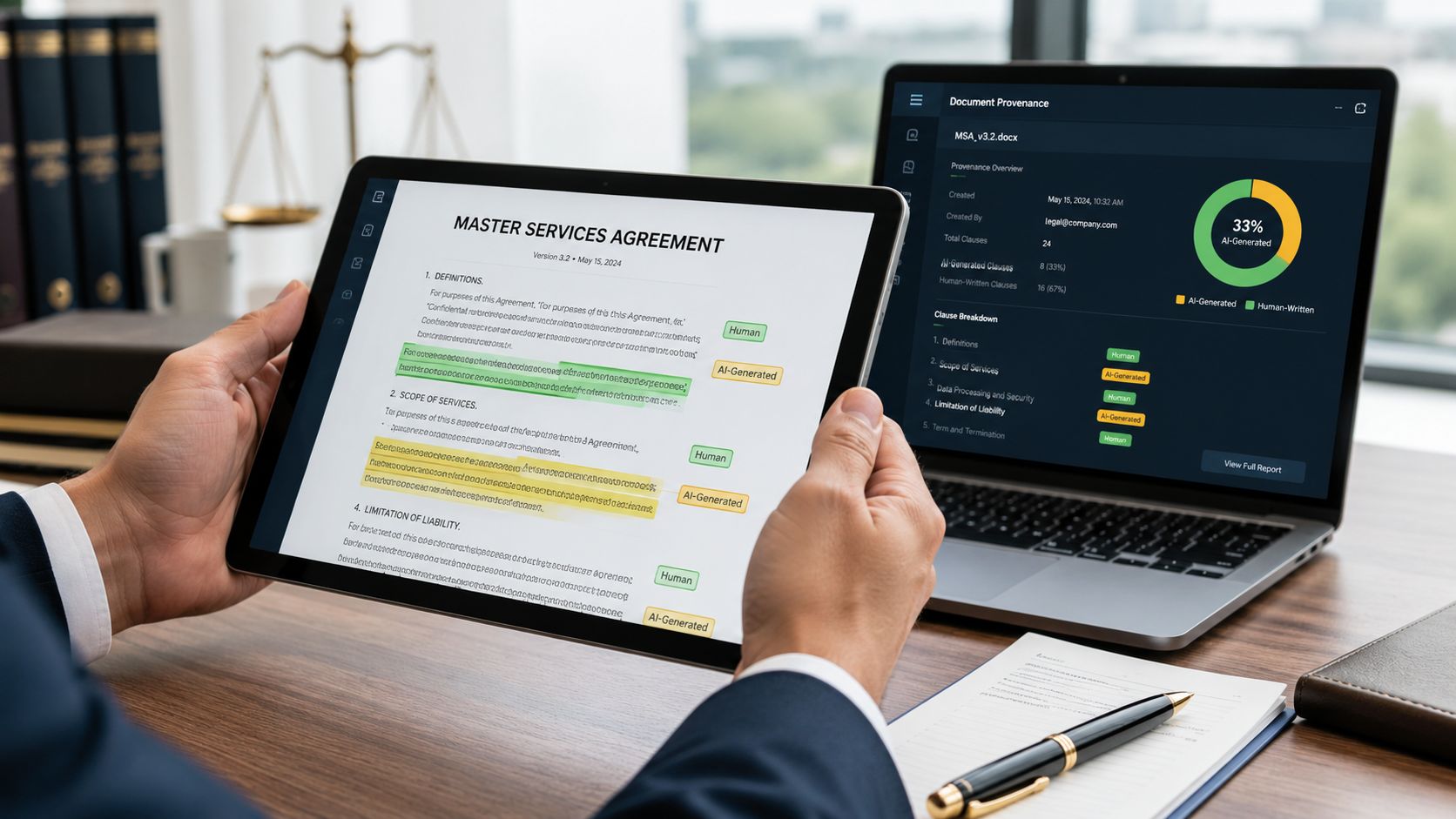
AI-generated clauses need provenance, not just proofreading
The legal issue isn't only whether a clause reads well. It's whether the team can explain its provenance, spot hallucinated obligations, and separate machine suggestions from the language that got adopted. A practical review should capture source metadata, note who edited the AI output, and treat AI-authored redlines as review inputs, not final authority.
The deeper point is accountability. A document can't be defended later if no one can say who reviewed the machine-generated language or why it was accepted. That concern is especially real now that courts are testing how generative AI interacts with privilege and confidentiality, as explored in the broader privilege debate in legal commentary on AI use.
Cross-border review needs data minimisation
The second gap is cross-border review under privacy and residency constraints. Most checklists tell reviewers to look for confidentiality, privilege, and red flags. They rarely explain how to do that without exposing more personal data than the business needs to move the deal or matter forward.
That question matters in contract operations, procurement, and diligence, where files move through CRM systems, eSignature tools, and collaboration platforms. The practical test is simple, review enough to protect the business, but not so much that personal or sensitive data gets spread across jurisdictions without a reason. For a broader view of those tensions, Lexology's discussion of cross-border review constraints is relevant context.
Guardrails that help:
- Capture provenance fields: Record whether the clause was drafted by a person, AI, or a hybrid workflow.
- Test for invented obligations: Compare AI language against the approved playbook and the deal brief.
- Limit review scope by need: Review only the data necessary for the legal issue at hand.
- Use localised access controls: Keep sensitive material within the right jurisdictional boundary where possible.
- Document the reason for transfer: If data crosses borders, tie the transfer to a business purpose.
Metrics and KPIs That Prove Review Is Working
A legal review process is only credible if the team can measure it. The right dashboard is small, not sprawling. It should track cycle time from intake to approval, first-pass yield, privilege-miss or material-miss rate, reviewer consistency, and obligation-extraction accuracy on a sample set. Those are the metrics that show whether the workflow is getting better, not just busier.
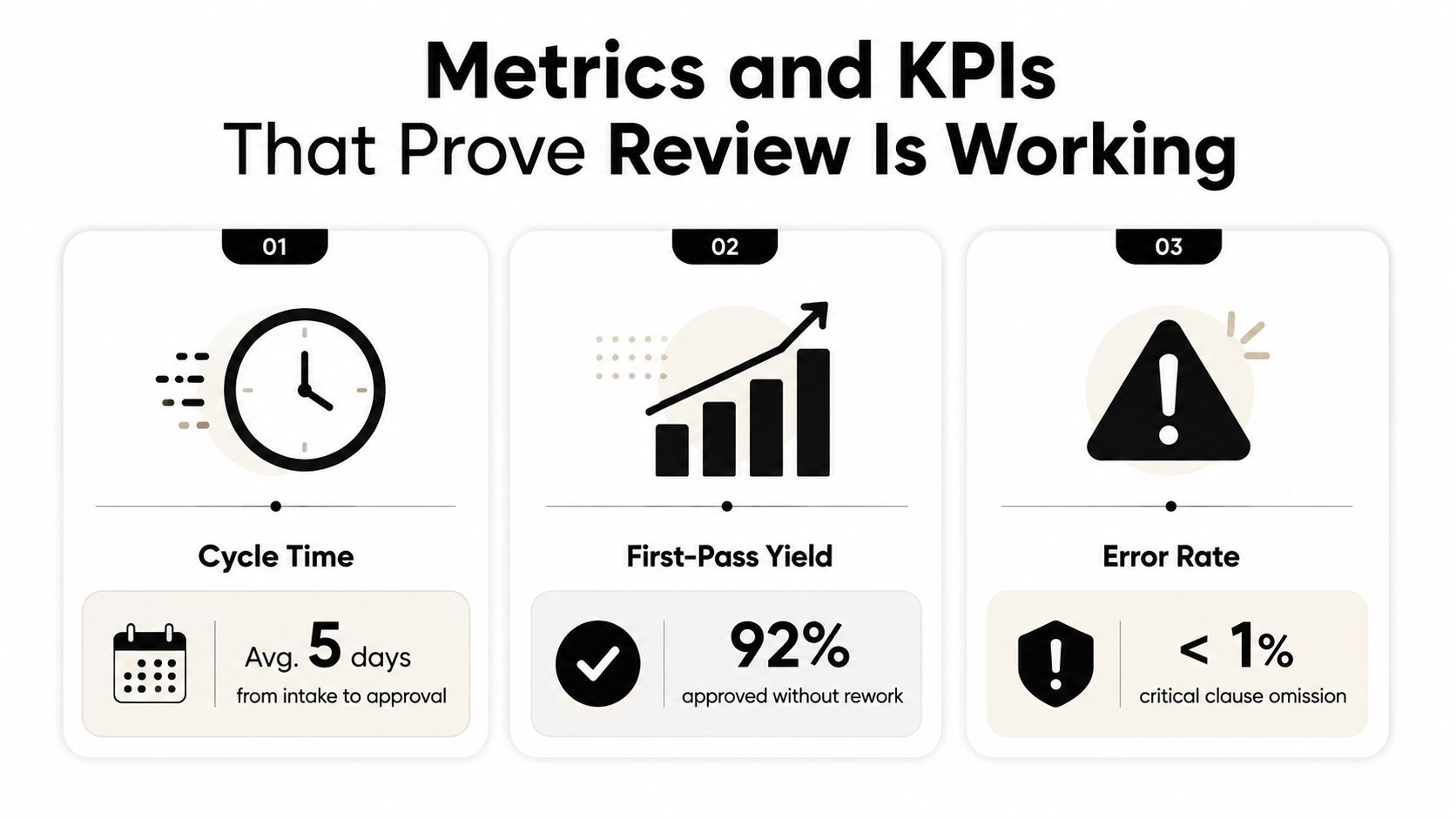
What leadership should see weekly and monthly
Weekly dashboards should show cycle time, first-pass yield, and critical misses. Monthly reviews should look at reviewer consistency and obligation-extraction accuracy, because those take a larger sample and a little more analysis.
A team moving from manual review to AI-assisted review should baseline before changing anything. That baseline matters because human-only review can be inconsistent, as the earlier 43% inter-reviewer agreement figure shows (Barnett study PDF). The goal isn't to promise perfection. It's to prove that the process is getting more stable, faster, and easier to defend.
Measure the process, not just the document. Leadership funds systems that show their work.
For contract teams, Legitt AI's legal document management overview can help frame repository, approval, and search discipline in operational terms. The point of the metrics is simple, if review quality improves, the numbers should show fewer reworks, fewer misses, and faster approvals without sacrificing control.
Choosing Automation and CLM Tools Without the Hype
Tool selection should start with workflow, not features. The first question is whether the platform integrates with the systems where work starts, like Salesforce, Microsoft 365, HubSpot, and Dynamics 365. The next is whether it supports structured approval routing, redlining, clause extraction, deviation analysis, and alerts for obligations and renewals. Security should be mandatory, with SOC 2 Type II, ISO 27001, GDPR, SSO, and encryption on the checklist.
For teams evaluating adoption strategy, Prometheus Agency's discussion of adopting AI in contract review is a helpful lens on rollout discipline rather than hype.
A practical selection checklist
- Source-system fit: Does it connect cleanly to CRM, email, and productivity tools?
- Review depth: Can it do clause extraction, deviation analysis, and risk flagging, not just search?
- Workflow control: Can legal route approvals and capture redlines in one place?
- Repository value: Does it store executed agreements, amendments, and obligations in a searchable system?
- Security posture: Are the core compliance and access controls documented?
- Rollout discipline: Can the team pilot one contract type, baseline cycle time, and run a parallel review before switching over?
Legitt AI is one option in this category. It combines drafting, review, eSignature, and repository management in one workspace, with integrations across major CRMs and productivity suites. For teams that want to standardise contract operations without rebuilding everything at once, the safest move is a limited rollout, then a 90-day hold on the old path until the new workflow proves its numbers.
If your team is ready to replace scattered review steps with a controlled contract workflow, visit Legitt AI and see how drafting, review, approvals, eSignature, and repository management can sit in one operational flow. A tighter review process starts with better structure, and the right platform should make that structure easier to run every day.