You've probably done it yourself. A request lands in Slack, someone needs a quick written commitment, and the fastest path seems to be a letter of agreement template pulled from the first search result. The problem is that generic template often arrives with gaps, outdated wording, or clauses that don't match the actual deal, which is exactly how a simple arrangement turns into a cleanup exercise for legal, procurement, or operations.
A good template still matters. It gives the team a fast, consistent way to capture the deal, but its full value shows up when that document becomes part of a CLM workflow instead of a standalone Word file. That's where drafting, redlines, approvals, eSignature, and repository storage start working as one process, not five separate chores. If you want a practical benchmark for what a business contract should cover, Coto & Waddington's contract guidance is a useful reference point, and for a deeper comparison of reusable vs. custom drafting, see this contract template analysis.
The shift is already visible in how people source these documents. Template libraries now offer agreement formats at scale, including TemplateLab's “41 Perfect Letter of Agreement Templates” and Jotform's “600+ Free and Editable Agreement Templates”, which shows how quickly drafting has moved from bespoke manual preparation toward reusable digital workflows. TemplateLab's letter of agreement collection is a good example of that market change. The catch is that a template alone doesn't manage approval, execution, or post-signature obligations.
A downloadable template is a sensible starting point. A managed agreement process is where the operational gain comes from.
Moving Beyond Risky Online Templates
A common first step is to search for a letter of agreement template and hope the document is “good enough.” That usually works until the deal gets specific, a stakeholder asks for changes, or the template leaves out something basic like date, scope, payment, or termination. A short agreement should be simple, but simple doesn't mean casual. It means the terms have to be clear enough that business users can execute them without a long negotiation cycle.
That's why the better approach is to treat the template as a starting point, not the final output. In practice, the template becomes the intake layer for a more controlled workflow, where legal, sales, procurement, or operations can generate the right version, route it for review, and keep the signed copy in one place. If you're mapping that to a broader process, this guide on contract templates versus custom contracts explains why standardization helps when the underlying business pattern repeats.
Why a basic template falls short
A static file can't tell you whether the contract is going to the right approver, whether the redlines changed the commercial intent, or whether the final signed PDF ever made it back to a searchable repository. That's where risk starts to build. The document may look complete, but the workflow around it is often fragmented.
Practical rule: if a template can't survive a real approval chain, it's not ready for business use.
A modern platform changes that by putting the template, review, signature, and storage steps in the same workspace. Legitt AI is one example of that model, because it lets teams draft from templates, manage redlines, route approvals, and store executed agreements without jumping between tools. That matters most for recurring service arrangements, short-term commercial deals, and simple partnerships where speed still has to coexist with control.
The strongest template is the one that can be reused without becoming risky. A good next step is to start with a clean template, then place it inside a workflow that preserves visibility from draft to signature.
Anatomy of a Rock-Solid Letter of Agreement
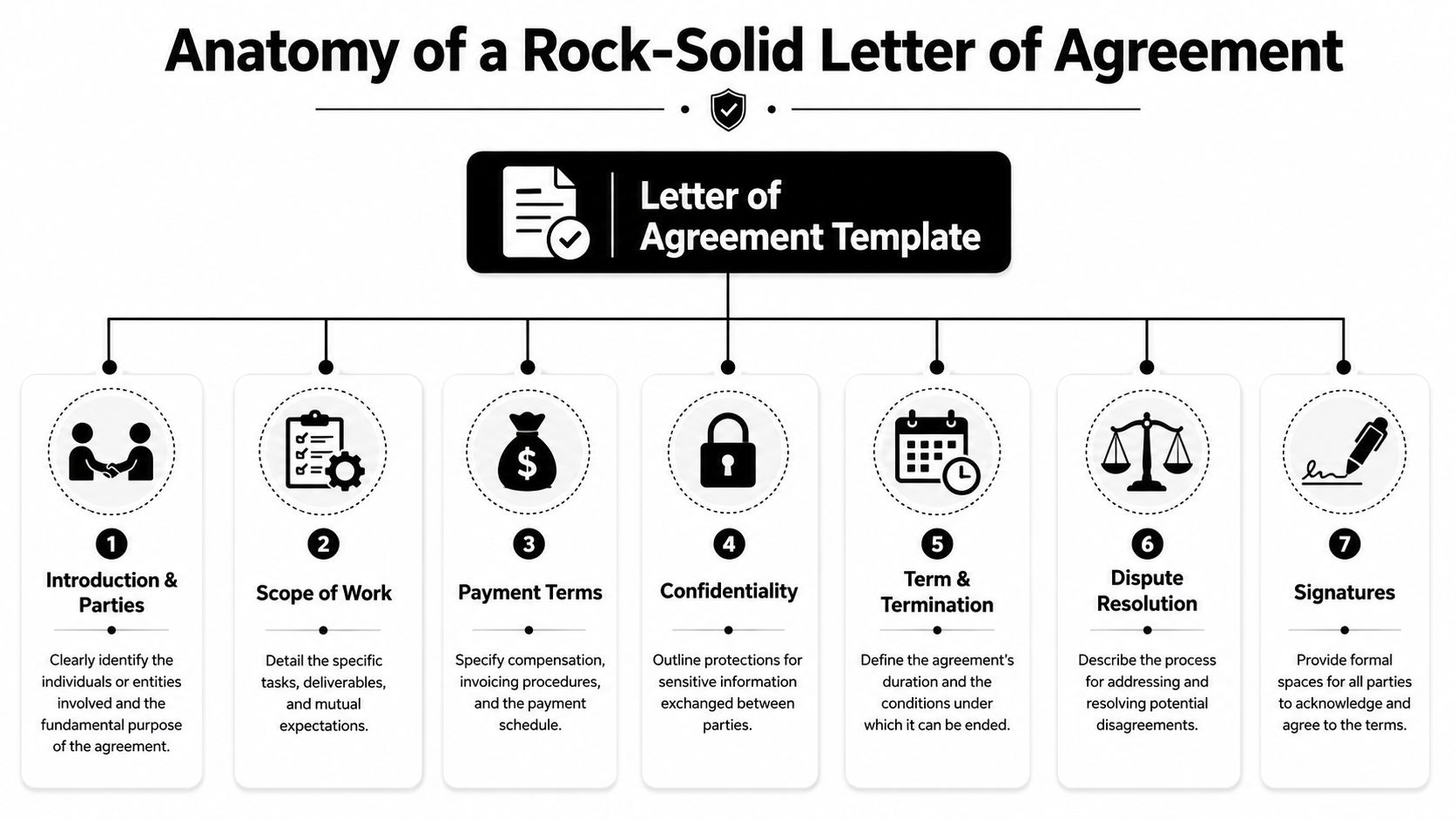
A letter of agreement template is usually short because it's designed for straightforward transactions. The core structure stays consistent across reputable guidance, with party names, date, scope, payment terms, duration, termination, dispute resolution, and signatures forming the backbone of the document, which is why it can move faster than a full long-form contract. Indeed's letter of agreement guidance reflects that core set of clauses, and LawDistrict's agreement structure emphasizes the same sequence.
The clauses that do the heavy lifting
Start with party identification. Use the full legal names and contact details, not nicknames, trading names, or informal references. If that part is fuzzy, the agreement can still look polished while creating avoidable enforcement and routing problems.
Then define the scope in plain, precise language. The best templates describe what is being delivered, what is excluded, and who owns the next step. Vague scope language is where disagreements usually begin, because both sides think they agreed to different things.
Payment terms should be clear enough that finance can process them without asking follow-up questions. If money is part of the deal, spell out the method and timing in the contract body rather than leaving it to an email thread. The more exact the wording, the less room there is for misinterpretation.
The terms that protect the relationship
A strong template also sets the duration of the arrangement and the termination trigger. That keeps everyone aligned on when obligations begin, when they end, and what happens if one side needs to exit early. Add dispute resolution language if the parties want a defined way to handle disagreements before they escalate.
Clear wording in a short agreement does more work than decorative legal language in a long one.
Finally, keep the signature blocks clean and obvious. If someone can't find where to sign, the execution process stalls, and the agreement ends up sitting in inboxes instead of becoming a binding record. For a deeper view of how contract components fit together, this contract elements guide is a useful companion.
A rock-solid template isn't complex. It's disciplined, readable, and ordered so a business reviewer can verify the deal in one pass.
Tailoring Your Template for Common Business Scenarios
A template becomes useful when it stops being generic. The same base form can work for a freelancer, a vendor, or a lightweight partnership, but each scenario needs different clauses pulled forward and different risks pushed out of the shadows. A contract manager knows the trick isn't adding more language everywhere, it's tightening the parts that matter for the specific deal.
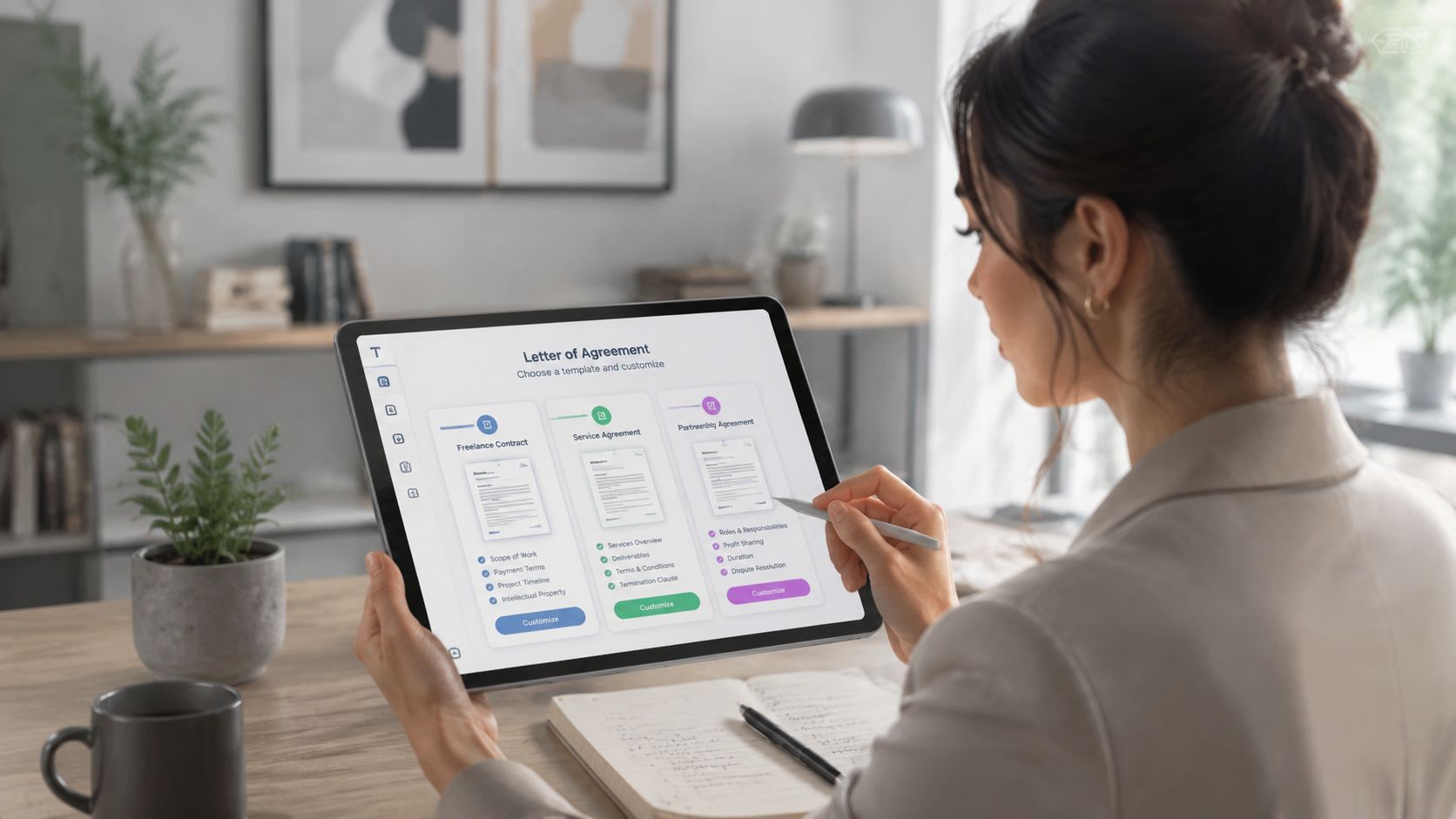
Freelancers and contractors
For contractor relationships, the agreement should specify full legal names, addresses, job title, responsibilities, start date, and whether the person is an employee or a self-employed contractor responsible for their own taxes. That reduces ambiguity about status, duties, and tax handling. Gloroots' sample letter of agreement guidance makes that contractor distinction explicit, and it's the part teams get wrong most often when they rely on a generic form.
A clean contractor clause might read like this in business language, not legalese. The provider performs the listed services as an independent contractor, starts on the agreed date, and is responsible for their own tax obligations. That one sentence does a lot of work because it narrows the status question before anyone can backfill assumptions.
Vendors and service providers
Vendor deals usually need tighter operational language than a simple personal services arrangement. The focus shifts to deliverables, service windows, and escalation paths. If the vendor handles sensitive information, confidentiality needs to be visible, not buried. If service quality matters, the template should say what “acceptable performance” means in business terms.
For these agreements, I'd keep the scope narrow and the handoff points visible. Procurement teams often want the same template across vendors, but that only works if the template leaves room for role-specific schedules and clear approval checkpoints.
Simple business partnerships
A short partnership arrangement usually needs more clarity around ownership, obligations, and exit timing than a standard service letter. The parties need to know who does what, what happens if the relationship changes, and how either side can step away. The template should stay concise, but the language has to protect against assumptions that never got written down.
A useful way to pressure-test any scenario is to ask three questions before signature.
- Who is doing the work? Spell out the legal entity or person responsible.
- What is being delivered? Describe the outcome, not just the activity.
- What happens if plans change? Add termination and dispute terms early.
The best templates adapt cleanly because they're modular. That makes them easier to review, easier to approve, and much easier to move into a contract automation workflow later.
From Draft to Deal with AI-Powered Workflows
The old process is familiar. Someone edits a Word file, sends it by email, receives comments in a separate thread, and loses track of which version is final. That approach slows execution and makes it harder to prove who approved what. A modern CLM platform replaces that with structured drafting, review, and approval in one system.
What structured workflow changes
When the template sits inside contract lifecycle management, the right people review the right fields in the right order. Sales can request a draft, legal can check the clause set, procurement can confirm commercial terms, and leadership can approve exceptions without circling the document through endless email replies. Legitt AI's drafting automation guide is a useful reference for how that shift works in practice.
AI-powered review adds another layer. Instead of reading every line manually, teams can flag deviations from standard language, spot risky clauses, and focus their time on the terms that matter. That doesn't replace legal judgment. It gives legal a faster way to spend that judgment where it counts.
Where the efficiency comes from
Operationally, tools like Legitt AI prove significant. Teams can generate a draft from a template, route it through approval workflows, exchange redlines in one workspace, and keep the version history tied to the final agreement. That reduces copy-paste work and cuts down on the version control problems that usually show up when multiple departments touch the same file.
For a broader business lens on AI in shared services, Benely's guide to AI in HR shows how process automation changes repetitive review work across teams, not just in legal. The same logic applies here. If the draft, review, and approval steps sit in separate tools, the delay is usually organizational, not legal.
Useful standard: the faster path is not fewer controls, it's better controls placed earlier in the workflow.
The practical payoff is simpler governance. Fewer loose files. Fewer missed comments. Less back-and-forth before signature. That's the difference between a template that sits on a desktop and a template that closes deals.
The Final Mile An eSignature and Execution Checklist
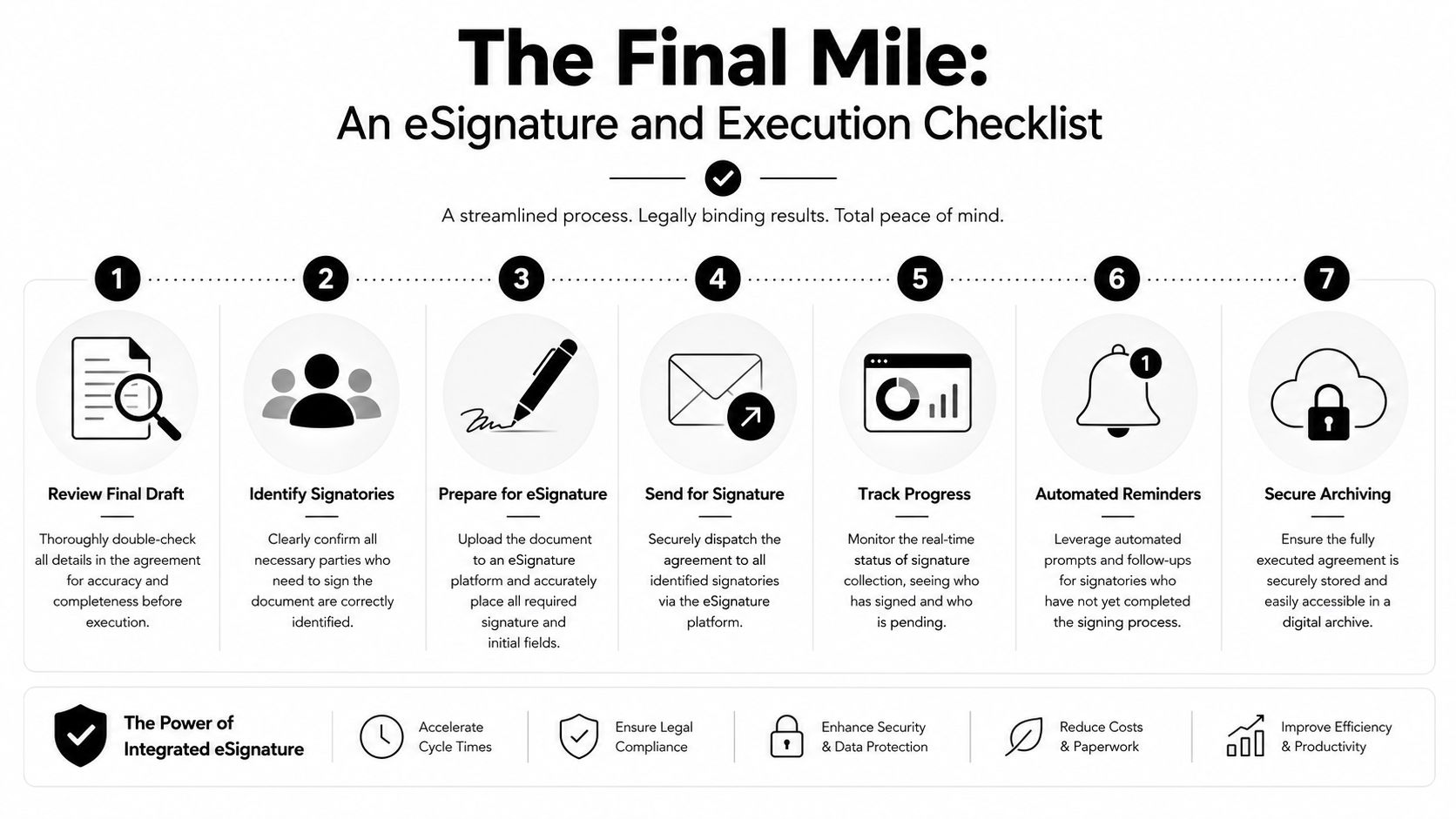
A signed agreement is only useful if the signature process doesn't introduce a new mistake. The last mile is where teams often send the wrong version, miss a signatory, or route the document to someone who shouldn't have signed in the first place. Integrated eSignature removes a lot of that friction because the agreement, signature fields, and audit trail stay in one flow.
Pre-flight checks before you send
Before execution, confirm the document is ready to sign.
- Review the final draft. Make sure the approved redlines are all reflected in the version going out.
- Check party details. Confirm names, addresses, and contact details are correct.
- Identify signatories. Verify the right individuals are assigned to the right signature blocks.
- Place signature fields carefully. Don't let an incomplete field map slow the deal down.
- Send only the authorized version. Avoid accidental circulation of a draft with unresolved comments.
Those steps sound basic, but they prevent the most common execution errors. A clean eSignature flow also makes it easier to track who signed, who is pending, and when the agreement moved through the process.
Why integration beats a standalone tool
Standalone signing tools can work, but they often leave the final signed file disconnected from the approval record and the contract repository. That creates avoidable friction later, especially when someone needs to prove what was signed or retrieve the executed version quickly. An integrated setup keeps the agreement tied to the workflow that produced it.
For legal teams that want a clearer view of enforceability and digital signing hygiene, this guide on electronic signature legal validity is worth reading before you standardize your signing process.
A good execution process is boring in the best way. The document moves, the signatures land, and the final record is easy to find.
Beyond Signature Storing and Managing Agreements in a CLM
The agreement doesn't stop mattering when the signatures are complete. That's when many teams lose visibility, because the signed PDF gets buried in a shared drive or forwarded around in email threads until nobody is sure which version is authoritative. A central repository changes that by making the executed agreement searchable, organized, and tied to the obligations that came out of it.
Why post-signature control matters
For regulated or cross-border transactions, the agreement needs more than a signature block. U.S. DDTC guidance treats the transaction summary, roles of each party, end-use context, and similar data points as required in agreement submissions, which shows how important specific information is after execution for compliance tracking. DDTC's agreement submission guidance makes that point plainly.
That same discipline applies in ordinary commercial contracts, even when the transaction isn't regulated. If the repository can extract the key dates, obligations, and renewal points, teams can respond before a deadline becomes a problem. If it can't, the contract becomes a file instead of an operational asset.
What a real repository should do
A useful CLM repository should let people search by counterparty, term, status, clause type, or obligation. It should also surface renewal dates, follow-up items, and the business owner responsible for each agreement. That's the difference between storing documents and managing them.
- Find agreements fast. A searchable repository saves teams from digging through folders.
- Track obligations. Someone needs to own each deliverable and compliance point.
- Watch renewals. Quiet rollovers are where missed revenue and missed notice periods show up.
- Keep the version history. Signed copies, amendments, and related records should stay linked.
For a broader operational view, this contract lifecycle management guide is a useful companion to the template itself. It shows why the post-signature stage deserves the same attention as drafting and execution.
Legitt AI fits that operating model because it combines drafting, approval, eSignature, repository management, obligation tracking, and contract intelligence in one workspace. That's the point of modern contract operations. The template is only the front door. The workflow behind it is what keeps the business moving, the risk visible, and the next renewal from slipping by unnoticed.
If your team is still relying on scattered Word files and email approvals, it's time to move the letter of agreement template into a real contract workflow. Start with a cleaner draft, then bring in Legitt AI to streamline review, signature, storage, and renewal tracking so your agreements are easier to control from day one.