Procurement teams are under pressure to digitize faster, but the actual bottleneck is not intake or sourcing. It is contract execution. Once requests move from vendor selection into drafting, review, approvals, signature, and post-signature tracking, manual work starts to compound across procurement, legal, finance, and operations.
That is why procurement best practices need a more operational definition now. Strong teams do not treat contracts as static documents stored after signature. They run contracts through a connected system that standardizes templates, routes approvals, flags risk, tracks obligations, and turns contract data into usable business intelligence.
AI-powered CLM platforms have changed what good looks like. Procurement can generate first drafts from approved language. Legal can review deviations against fallback positions. Finance can see payment terms earlier. Business owners can get renewal alerts before auto-renewal locks in another term. The result is shorter cycle time, fewer preventable exceptions, and better control over vendor commitments.
The practical shift is straightforward. Centralize the contract record, automate repeatable steps, and apply AI where experienced teams lose time on low-value review.
Teams building that model usually start with centralized contract storage for procurement and legal workflows. From there, the highest ROI comes from connecting repository, drafting, approvals, negotiation, signature, compliance, and analytics in one workflow instead of managing each task in a separate tool.
This article focuses on the ten practices that produce measurable gains in speed, compliance, and visibility, especially for teams using modern CLM software rather than patching process gaps with email and spreadsheets.
1. Centralized Contract Repository and Searchable Database
Most procurement dysfunction starts with one avoidable problem. The contract record is fragmented across shared drives, email attachments, local folders, and procurement systems that don't talk to legal.
A centralized repository fixes more than storage. It gives procurement, legal, finance, and operations one searchable source of truth for active agreements, amendments, commercial terms, and renewal dates. That's the foundation for nearly every other procurement best practice in this list.
Teams using CLM platforms like Legitt AI usually see the operational benefit first. A buyer can pull the latest MSA, check the payment terms, confirm whether the security addendum was signed, and see who approved the deviation without asking three departments for help.
What good repository design looks like
A useful repository isn't just a folder tree in the cloud. It needs structured metadata, full-text search, version control, and clear access rules.
- Standard naming conventions: Use one naming logic for vendor name, contract type, region, and execution status so people can find documents without guessing.
- Metadata that matches decisions: Tag contracts by vendor category, business owner, renewal date, governing law, and approval status.
- Role-based visibility: Procurement may need pricing visibility, while legal may need clause history and redline context.
- Date-based alerts: Renewal windows, notice periods, insurance expirations, and milestone dates should trigger alerts automatically.
Practical rule: If a contract can't be found in under a minute, it isn't operationally managed.
A searchable repository also enables contract intelligence later. Once agreements are centralized, teams can compare terms across vendors, find inconsistent liability language, and identify service commitments worth enforcing. For a practical look at repository structure, see centralized contract storage best practices.
2. AI-Powered Contract Drafting from Templates
Manual drafting still wastes a surprising amount of procurement time. The cost is not just slower contract turnaround. It is inconsistent language, preventable legal review, and higher approval friction later because basic terms were assembled incorrectly at the start.
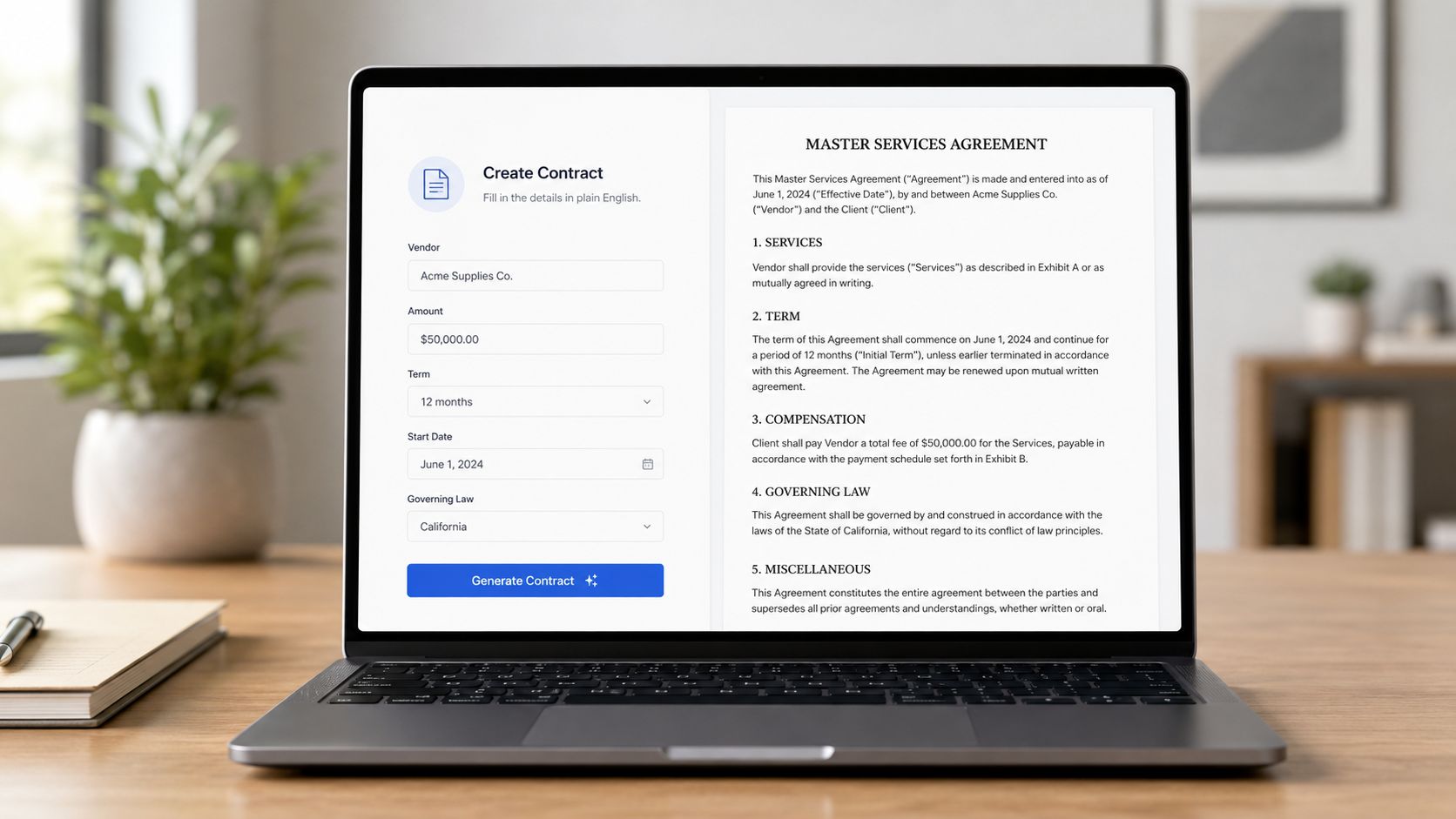
The fix is controlled drafting inside the CLM, using approved templates, clause libraries, and rule-based intake. AI improves the process by generating the first draft from structured business inputs, then routing only legitimate exceptions to legal. That is a better use of counsel time and a better control model for procurement.
Where AI drafting produces the best return
Start with high-volume, low-variance agreements. NDAs, standard services agreements, SOWs, order forms, and vendor onboarding documents are usually the right first wave because the business terms change more often than the legal structure.
A workable drafting flow is straightforward:
- Business user answers an intake form: Vendor name, scope, term, pricing model, jurisdiction, security requirements, and business owner.
- The CLM generates the draft: The system fills the right template, selects approved clause options, and inserts fallback language based on policy.
- Legal reviews deviations, not boilerplate: Counsel spends time on non-standard indemnity, data use, liability caps, or unusual commercial terms.
- The draft enters downstream workflow: The document moves into approval and signature with structured data already attached.
That shift matters in practice. Drafting stops being document assembly and becomes policy-driven document generation. Procurement gets faster first drafts. Legal gets fewer repetitive requests. The business gets fewer versioning mistakes and fewer side agreements created outside process.
The trade-off is governance work up front. Templates need owners. Clause libraries need maintenance. Business rules need clear thresholds for when AI can draft automatically and when counsel must step in. Teams that skip that discipline usually create a faster drafting process but a messier negotiation process.
Legal operations leaders often use platforms like Legitt AI to let business teams initiate low-risk contracts without bypassing controls. For a practical example of how drafting connects to downstream execution, see approval and signatory workflows in Legitt AI. For a deeper example, review AI-powered contract drafting automation.
Technology budget priorities support this direction. As noted earlier, procurement leaders are increasing investment in digital tools, automation, and AI. Template-based drafting earns that budget when it cuts cycle time, reduces clause inconsistency, and keeps standard agreements inside the CLM instead of scattered across email and shared drives.
3. Structured Approval Workflows and E-Signature Integration
Approval chaos usually isn't caused by too many controls. It's caused by inconsistent controls.
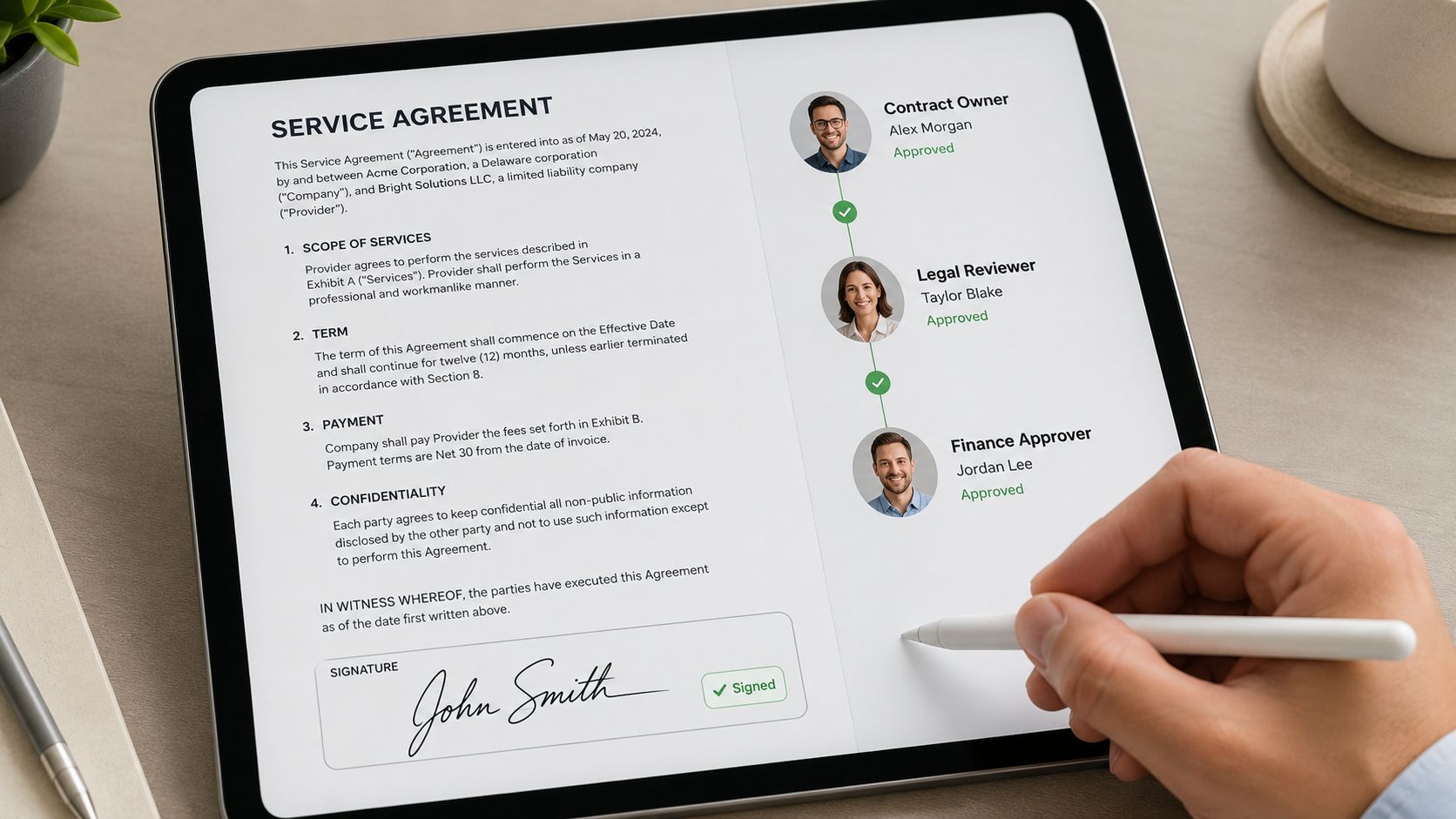
One team routes a services contract to legal and finance. Another sends the same kind of deal only to procurement. Someone signs from email. Someone else waits on a VP who didn't need to be involved. Structured approval workflows fix that by turning policy into routing logic.
Procurement leaders should define approval paths by contract type, risk level, spend level, and deviation from standard language. Then eSignature should sit inside the same flow, not at the end of a disconnected process.
What disciplined approval routing prevents
When approval logic is built into CLM software, teams stop debating process every time a document moves.
- Unauthorized commitments: Contracts don't reach signature without the right approvals.
- Serial delays: Independent stakeholders can approve in parallel instead of one after another.
- Missing audit history: The system records who approved, rejected, delegated, or edited the agreement.
- Signature bottlenecks: Counterparties sign electronically in the same workspace, with reminders and status tracking built in.
A strong eSignature workflow matters because execution is still where many deals stall. If procurement and legal have done the work, the last thing you want is a manual signature handoff that breaks visibility.
AI-enabled legal technology also supports cleaner collaboration before signature. If you're evaluating workflow design, approval and signatory workflows in Legitt AI shows how approval routing and execution can stay connected in one system.
4. AI-Powered Risk and Deviation Analysis for Third-Party Contracts
Third-party paper is where procurement best practices get tested. It's easy to say your organization has standard terms. It's harder to enforce them when a vendor sends a long agreement with edited indemnities, soft service levels, automatic renewal language, and data processing terms buried in attachments.
Manual review doesn't scale well here. AI contract review helps by comparing incoming language against your approved positions and surfacing deviations fast.
This isn't theoretical. In specific NDA risk-detection tasks, AI achieved an average accuracy of 94% in spotting risks, while experienced lawyers averaged 85%, according to Spellbook's AI contract management analysis. That doesn't mean counsel steps out. It means counsel starts from a structured risk summary instead of reading every clause cold.
How procurement should use AI review
The best use case is first-pass issue spotting on vendor paper. Procurement can get a deviation summary, legal can review escalated issues, and business stakeholders can understand the commercial impact in plain language.
Typical flags include:
- Payment risk: Extended payment terms, vague invoicing triggers, or one-sided late fee language.
- Liability imbalance: Broad indemnities, uncapped exposure, or weak vendor responsibility for its subcontractors.
- Operational ambiguity: Missing service levels, unclear acceptance criteria, or weak termination rights.
- Compliance concerns: Data handling terms, audit rights, insurance gaps, or conflicting security language.
Contracts don't become risky at signature. They become risky when teams miss what changed before signature.
Platforms like Legitt AI support this kind of contract intelligence by extracting clauses, identifying deviations, and helping teams route the right issues to the right reviewers. For a practical risk-review workflow, see how to flag vendor risk using AI-powered contract analysis.
Procurement teams dealing with hardware disposition, data-bearing assets, or regulated vendors should also pair contract analysis with operational controls like those described in Reworx Recycling's guide to ITAD risk management.
5. Obligation and Renewal Tracking with Automated Alerts
Miss one renewal notice, and a contract can roll over for another year before procurement has a chance to test the market.
That is why post-signature control matters as much as negotiation. The operational risk is rarely in the PDF itself. It sits in missed notice periods, expired insurance documents, untracked rebates, and service credits no one claims because the obligation never made it into a working system.
The post-signature workflow that actually works
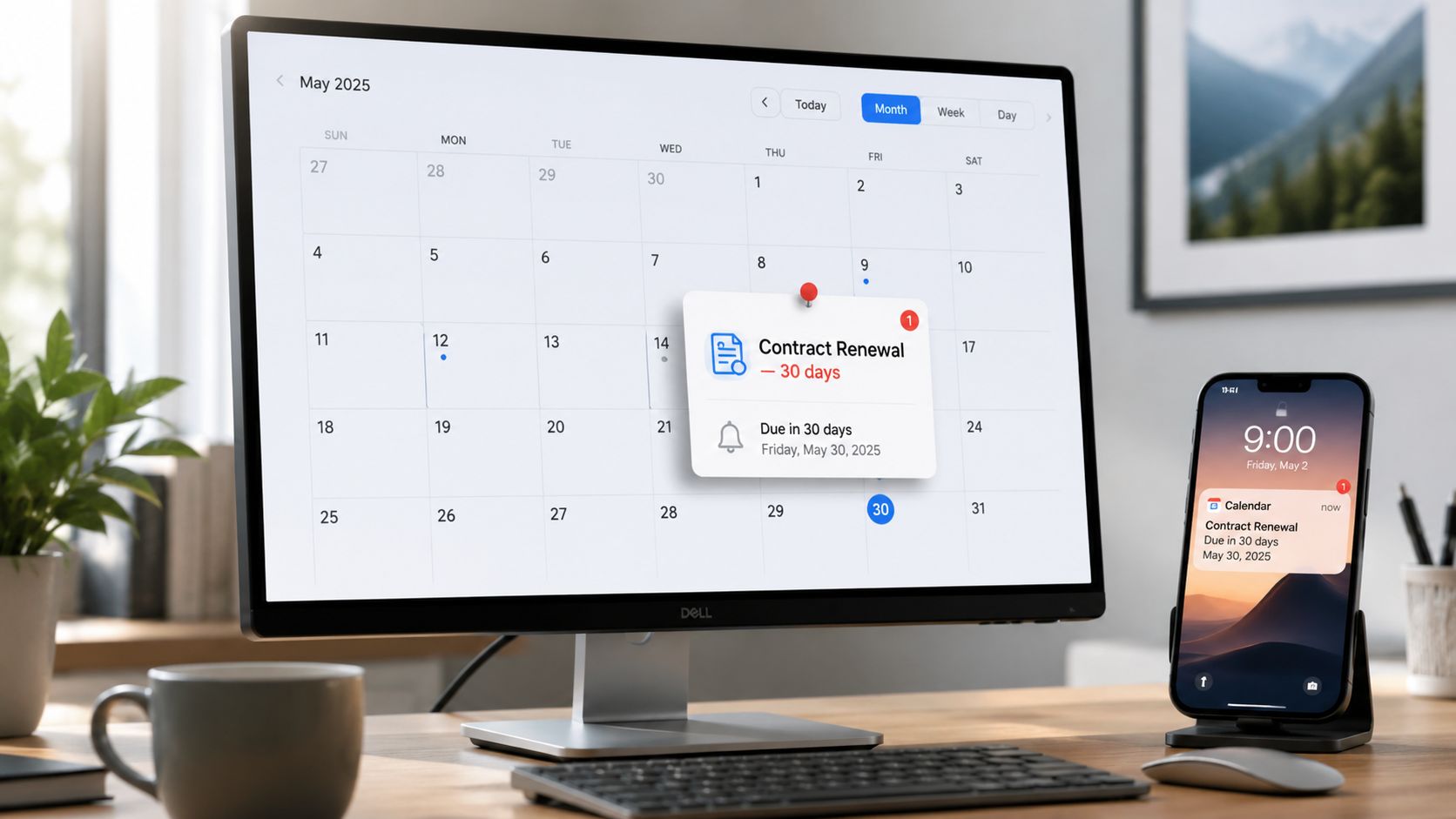
High-performing teams stop treating obligation management as calendar admin. They use CLM to extract renewal dates, notice windows, payment milestones, reporting duties, pricing review points, and SLA commitments from the signed agreement, then assign each item to an owner.
The routing needs to match how work gets done:
- Finance: payment milestones, rebates, service credits, and price increase review dates
- Procurement: renewal windows, termination notice deadlines, sourcing checkpoints, and benchmark triggers
- Legal: compliance certifications, data processing commitments, audit rights, and amendment controls
- Operations: implementation milestones, service levels, acceptance criteria, and vendor performance obligations
Timing is the trade-off. Alert too late, and the team can only react. Alert too early, and people ignore the reminder because no decision is ready. In practice, tiered alerts work better than a single deadline. A 120-day alert gives procurement time to assess spend, performance, and market alternatives. A 90-day alert starts stakeholder review. A 30-day alert forces a decision and notice check.
This is also where AI-powered CLM earns its keep. Instead of relying on one contract manager to read every clause and update a spreadsheet, the platform captures the obligations at intake, tracks them against dates and milestones, and pushes reminders to the people who can act. That reduces manual follow-up and improves recovery of value already negotiated into the contract.
For a practical example of that workflow, see AI-driven alerts for renewals and revenue tracking.
Teams that want better ROI from procurement digitization should start here. Renewal discipline protects margin, prevents unnecessary spend, and gives the business time to make an actual buy, renegotiate, or exit decision before the contract makes it for them.
6. Contract Intelligence and Analytics for Business Insights
Procurement teams sit on a large volume of commercial data, but many organizations still treat executed contracts as archived documents instead of a working source of margin, risk, and supplier performance insight.
A modern AI-powered CLM changes that operating model. It extracts structured data from signed agreements, normalizes terms across vendors, and gives procurement a way to compare what the business bought, what it approved, and what it can still claim. That matters because value often leaks after signature through inconsistent pricing, missed credits, weak fallback positions, and renewal terms that no one reviews until too late.
The first win usually comes from finding inconsistency at scale. Two business units may buy the same service under different rate cards. One supplier may have a 5% annual uplift, another 9%, with no commercial reason for the gap. Legal may also see different liability caps or security obligations for vendors with the same risk profile. Those differences are hard to spot in PDFs. They are much easier to act on when AI classifies the clauses and makes them searchable across the portfolio.
Start with spend categories where contract language drives measurable outcomes. Software, outsourced services, logistics, staffing, and data-processing agreements tend to produce the fastest returns.
Focus the analysis on a small set of fields first:
- Pricing terms: rate cards, indexation, uplifts, discount schedules, and rebate mechanics
- Commercial protections: service credits, benchmarking rights, audit rights, and termination assistance
- Renewal economics: notice periods, auto-renewal language, and price-change triggers
- Risk positions: liability caps, indemnities, data security terms, and insurance requirements
Procurement gets more value from this work when the team defines a clear data dictionary before loading contracts into the system. If "renewal date" means signature anniversary in one report and notice deadline in another, the dashboard will create confusion instead of action. Good CLM analytics depends on standard field definitions, controlled clause taxonomy, and ownership for exceptions. That operating discipline is the difference between a reporting tool and a decision tool.
For a practical framework on aligning sourcing decisions to structured procurement data, see Tradogram's discussion of data-driven sourcing and procurement strategy.
As noted earlier, procurement leaders are putting more weight on data in decision-making. Contract analytics turns that priority into a workflow the team can effectively use. Instead of relying on anecdotal supplier history or manual file review, procurement can enter a renewal or sourcing event with evidence: which vendors accepted stronger terms, where pricing drifted, which clauses correlate with service failure, and which business units are buying outside the approved commercial standard.
That is where ROI becomes visible. Better contract intelligence supports cleaner renegotiations, faster sourcing decisions, tighter policy enforcement, and fewer missed commercial rights. In practice, the strongest teams do not measure analytics by dashboard usage. They measure it by recovered savings, reduced cycle time, and improved consistency across the contract portfolio.
7. Vendor Management Integration and Compliance Automation
A contract system without vendor management integration leaves too much work unfinished. The agreement may be approved, but the supplier record, compliance documents, insurance certificates, and onboarding controls still sit elsewhere.
That gap creates friction fast. A vendor may be contractually approved but not operationally cleared. Or the business may onboard a supplier before the compliance package is complete. Strong procurement teams connect CLM with vendor onboarding and ongoing compliance checks so contract execution and supplier readiness move together.
Where integration matters most
Vendor management integration works best when procurement defines compliance by vendor tier. Not every supplier needs the same diligence, but every supplier should move through a controlled intake process.
A practical model includes:
- Tiered onboarding: Strategic, regulated, and data-sensitive vendors get deeper review than low-risk suppliers.
- Compliance gating: Insurance, certifications, tax forms, and security documentation must be complete before activation.
- Performance linkage: Vendor scorecards tie directly to contract obligations such as service levels or reporting duties.
- Expiration alerts: If a required document expires, the business owner and procurement team get notified before it becomes an audit problem.
If vendor onboarding lives in one system and contract terms live in another, people will eventually follow the easier workflow and ignore the safer one.
This is also where best value procurement becomes operational instead of rhetorical. Public sector and enterprise teams often say they want quality, resilience, and sustainability, not just lowest price. The harder part is measuring those factors consistently during evaluation. MGO's procurement best practices for state and local government highlights that gap. In practice, integrated vendor and contract data gives teams a better way to score total value, not just cost.
8. CRM and Sales Integration for Deal Pipeline Visibility
Revenue teams lose time and margin when contract data sits outside the systems they use to run deals.
A CLM that syncs with Salesforce, HubSpot, or Microsoft Dynamics 365 gives procurement, legal, sales, and customer success one operating picture without forcing everyone into the CLM every day. That matters because pipeline risk often starts as a contract visibility problem. A rep offers implementation timing that depends on an unsigned supplier commitment. A renewal enters its notice window before the account team sees it. Legal prioritizes work based on inbox volume instead of deal value.
The fix is not more status meetings. It is a clean system design.
The strongest CRM-CLM integrations push a small set of high-value fields into the CRM and pull commercial context back into the CLM. In practice, that usually includes:
- Contract stage on the opportunity or account: Requested, drafted, under review, approved, signed, or lapsed.
- Renewal and notice dates: Account teams can act early instead of treating renewals like fire drills.
- Commercial term summaries: Pricing model, term length, auto-renewal language, service commitments, and approved exceptions.
- Workflow triggers: A qualified opportunity can generate a contract request automatically, and a signed agreement can update the CRM record without manual entry.
- Delivery dependencies: Procurement can see whether a customer commitment relies on a third-party vendor, license, or data-processing term that is still pending.
That last point is where AI-powered CLM changes the value of the integration. Traditional CRM syncs expose status. AI-based CLM platforms add interpretation. They can classify non-standard clauses, flag missing approvals, summarize revenue-impacting terms, and route exceptions before they stall the quarter. Procurement gets earlier visibility into customer commitments that create supplier risk. Sales gets a realistic forecast instead of a hopeful one.
There is a trade-off. If you sync every field, the CRM becomes noisy and nobody trusts it. If you sync too little, teams go back to Slack messages and spreadsheet trackers. The right model is to publish decision-grade data to the CRM and keep document-heavy work inside the CLM.
Legitt AI is relevant here because it connects CLM with CRM and collaboration systems, which cuts the manual re-entry that usually breaks handoffs between revenue, legal, and procurement. The ROI is straightforward. Less copying, fewer status checks, faster routing, and better visibility into which deals are executable.
9. Redline and Negotiation Collaboration Tools
Contract negotiations slow down fast when every round lives in email, local files, and disconnected comments. McKinsey has estimated that contract negotiations can consume substantial legal and commercial time in large organizations. The operational problem is easy to spot. Teams spend too much effort finding the latest draft, rechecking old issues, and explaining why a clause changed.
AI-powered CLM platforms fix that by turning redlines into structured workflow data, not just marked-up documents. Procurement, legal, business owners, and counterparties work from one negotiation record with clause history, comments, approvals, and fallback positions in context. That creates speed, but the bigger gain is consistency. The next time a supplier pushes for the same liability carveout or payment term, the team can see what happened last time and decide faster.
Good negotiation tooling improves four parts of the process:
- Version control: One live draft reduces confusion over which markup is current.
- Clause-level history: Teams can see what changed, who changed it, and which issues are still open.
- Negotiation rationale: Comments and decision logs explain why a concession was approved, rejected, or escalated.
- Targeted review: Legal can focus on changed language and exceptions instead of rereading the full agreement every round.
That last point matters more than many teams expect.
In mature CLM environments, AI can compare each redline against approved playbooks, identify fallback language, and flag deviations that need business or legal review. That shortens cycle time because the system routes only the true exceptions. Standard edits move forward without turning every contract into a custom legal project.
There is a trade-off. Open collaboration speeds negotiation, but too many editors create noise, duplicate comments, and off-policy concessions. The fix is governance inside the workflow. Define who can accept fallback language, who can approve commercial givebacks, and which clause types trigger legal review automatically. Software helps, but decision rights make the difference.
Structured redline data also gives procurement leaders something rarely obtained from negotiation. Evidence. You can examine where deals stall, which clauses suppliers resist most, how often fallback language succeeds, and which business units create the most exception volume. That data improves templates, playbooks, and supplier strategy over time.
Legitt AI is relevant here because it combines collaborative redlining with AI clause analysis, workflow routing, and negotiation history in one CLM system. The ROI is practical. Fewer review loops, less manual comparison work, faster turnaround on standard positions, and better visibility into which concessions are becoming expensive habits.
10. Compliance and Security Governance with Role-Based Access Control
Every procurement system eventually reaches the same point. More value is being created inside the platform, so security and governance can no longer be treated as an IT afterthought.
Contracts contain pricing, intellectual property terms, data processing obligations, legal advice context, and commercial commitments that should not be visible to everyone. Role-based access control is how you centralize contract workflows without overexposing sensitive information.
The governance baseline modern teams need
A mature CLM environment should control who can view, edit, approve, sign, export, and administer documents. It should also record those actions in a defensible audit trail.
At minimum, strong governance includes:
- Role-based permissions: Procurement, legal, finance, sales, and operations each get the access they need, not a shared blanket permission set.
- Authentication controls: Single sign-on and multi-factor authentication reduce account risk.
- Audit logs: Teams can show who accessed a contract, changed a clause, or approved a deviation.
- Retention and deletion rules: Contract data stays available for business and regulatory needs, then is archived or removed according to policy.
The same logic applies to AI features. If your AI contract review assistant can analyze the full repository, you need confidence that repository permissions carry into the AI layer too.
Enterprise-grade CLM platforms distinguish themselves. Legitt AI's positioning around RBAC, SSO, MFA, encryption, and compliance frameworks matters because AI Contract Management only works at scale when legal, procurement, and business users trust the system enough to put sensitive agreements in it.
10-Point Procurement Best Practices Comparison
| Solution | Implementation Complexity 🔄 | Resource Requirements ⚡ | Expected Outcomes 📊 | Ideal Use Cases 💡 | Key Advantages ⭐ |
|---|---|---|---|---|---|
| Centralized Contract Repository and Searchable Database | Medium → high (data migration, RBAC setup) | Storage, indexing, CRM integrations, ongoing maintenance | Faster retrieval; single source of truth; improved compliance and versioning | Organizations with scattered contracts, audit-heavy teams, procurement scale | Reduces search time; audit trails; version control; centralized knowledge |
| AI-Powered Contract Drafting from Templates | Medium (template configuration, legal review) | Template library, AI engine, legal oversight and updates | Drafts in seconds; consistent, jurisdiction-aware documents; faster time-to-sign | High-volume routine agreements; sales/procurement self-serve | Rapid drafting; consistency; reduces legal bottlenecks and external fees |
| Structured Approval Workflows & E-Signature Integration | Medium (workflow design, approval logic) | Workflow engine, e-sign provider, CRM/email integration, training | Faster approvals and signatures; enforceable audit trails; visibility into bottlenecks | Multi-stakeholder approvals, high-volume contracting, revenue recognition needs | Enforced governance; reduced turnaround; mobile signing and traceability |
| AI-Powered Risk & Deviation Analysis for Third-Party Contracts | Medium → high (model training, calibration) | AI models, historical contract data, legal validation loops | Rapid risk identification; deviation alerts; prioritized negotiation items | Risk-sensitive industries and high-volume third-party intake | Consistent risk scoring; catches non-standard terms; speeds reviews |
| Obligation & Renewal Tracking with Automated Alerts | Low → medium (extraction rules, alerts config) | Extraction tooling, calendar/notification integrations, ERP sync | Fewer missed renewals; proactive negotiations; SLA compliance | Organizations with many subscriptions/renewals or auto-renew risk | Prevents auto-renewals; configurable alerts; centralized obligation view |
| Contract Intelligence & Analytics for Business Insights | High (data cleansing, analytics models) | Data engineering, BI tools, external benchmarks, integrations | Identifies revenue leakage, pricing anomalies, vendor insights | Enterprises seeking cost recovery, vendor consolidation, strategic sourcing | Uncovers hidden value; benchmarking; portfolio-level decisions |
| Vendor Management Integration & Compliance Automation | Medium → high (system integration, rules automation) | Vendor data sync, compliance engine, onboarding automation | Faster onboarding; consistent compliance verification; reduced duplicates | Large supplier bases, regulated sectors, organizations needing vendor controls | Automated compliance checks; vendor scorecards; centralized vendor records |
| CRM & Sales Integration for Deal Pipeline Visibility | Medium (field mapping, bi-directional sync) | CRM connectors, mapping, training for sales and ops | Real-time contract context in deals; better forecasting; surfaced renewals | SaaS/subscription businesses and sales-driven orgs needing visibility | Improves revenue visibility; upsell identification; aligns sales & legal |
| Redline & Negotiation Collaboration Tools | Low → medium (adoption, protocols) | Collaboration platform, training, counterpart onboarding | Shorter negotiation cycles; centralized redlines and comments; audit trail | Frequent negotiations, multi-party contracts, distributed teams | Eliminates version chaos; transparent rationale; faster consensus |
| Compliance & Security Governance with RBAC | High (governance design, certifications) | SSO/MFA, encryption, audit logging, compliance audits, admin overhead | Reduced breach risk; regulatory compliance; controlled data access | Healthcare, finance, multinational firms handling sensitive data | Strong access control; auditability; supports legal privilege and compliance |
From Practice to Performance: Implementing Your New Strategy
The shift in procurement isn't about adding one more tool. It's about changing the operating model behind third-party relationships and commercial commitments.
Traditional procurement best practices focused on policy, negotiation discipline, and cost control. Those still matter. But they don't solve the practical bottlenecks modern teams face every day. Contracts are the workflow spine of procurement now. They determine who can buy, what terms apply, when value can be enforced, where risk sits, and whether the business can move quickly without losing control.
That's why the most effective procurement functions are building around AI-native contract lifecycle management. Centralized repository management gives teams one reliable record. AI-powered contract drafting removes repetitive document assembly. AI contract review and deviation analysis shorten the path from third-party paper to informed negotiation. Approval workflows and eSignatures keep execution from breaking at the last mile. Obligation tracking and contract intelligence turn signed agreements into active business controls instead of archived files.
The operational payoff is straightforward. Teams spend less time searching, chasing, and rechecking. They spend more time negotiating from a position of visibility. Legal operations gets cleaner intake and fewer avoidable escalations. Procurement gains a stronger position because terms, renewals, and supplier performance are visible in one place. Sales and operations get faster answers because contract status doesn't disappear into email. Finance gets a clearer line of sight into commitments, notices, and commercial rights.
There are trade-offs, and it's better to acknowledge them early. Centralization requires cleanup. If your current templates are inconsistent, AI drafting will expose that inconsistency quickly. If your approval matrix is political or unclear, workflow automation will force decisions people have postponed. If your supplier records are fragmented, repository and analytics projects will surface duplication and ownership gaps. That's not a reason to avoid modernization. It's usually the first sign that the project is aimed at the right problems.
In practice, the strongest rollout strategy is phased.
Start with the bottleneck that causes the most daily friction. For some teams, that's repository centralization and searchable contract storage. For others, it's third-party paper review, renewals, or approval routing. Once one workflow is working reliably, add the adjacent layer. Drafting feeds review. Review feeds approvals. Approvals feed eSignature. Signature feeds repository. Repository feeds alerts, analytics, and contract intelligence.
Keep the implementation grounded in decisions people already make. Who approves payment-term deviations? Who owns notice windows? Which contract types should non-legal teams generate from templates? Which supplier tiers require legal review? AI and CLM software work best when they encode those decisions instead of trying to replace them with generic automation.
A modern procurement strategy should also reflect where the market is going. Procurement leaders are investing in technology, analytics, digitization, supplier monitoring, and sustainability because manual workflows can't support those priorities at scale. The teams that benefit most won't be the ones with the most software. They'll be the ones that connect procurement, legal operations, sales, finance, and vendor management into one contract-centered process.
If you're assessing maturity today, don't start with a broad transformation slogan. Start with one question: where does contract work currently slow the business down or hide risk? Fix that first. Then build the rest of the system around it.
Legitt AI helps procurement, legal, sales, and operations teams run the full contract lifecycle in one workspace, from AI-powered drafting and contract review to approvals, eSignature, repository management, renewals, obligation tracking, and contract intelligence. If you're modernizing procurement best practices and want a practical CLM platform that supports enterprise contract workflows without adding more fragmentation, explore Legitt AI.