
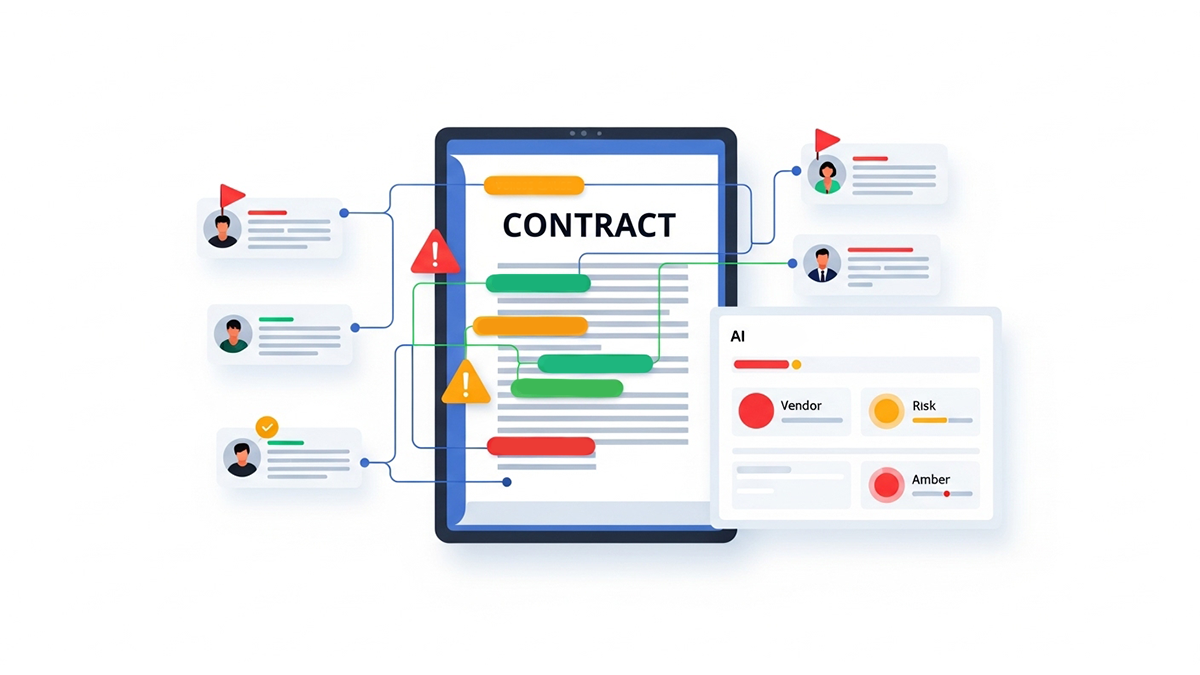
Vendor relationships are critical to modern enterprises, but they also represent one of the largest sources of operational, financial, legal, and reputational risk. Organizations today manage hundreds or thousands of vendor contracts across procurement, IT, logistics, professional services, and outsourcing. Each of these contracts contains clauses that can expose the business to risk if not properly identified, monitored, and enforced.
Traditionally, vendor risk has been assessed through manual contract reviews, questionnaires, periodic audits, and spreadsheet-based risk registers. While these methods may work at small scale, they break down rapidly as contract volume, regulatory complexity, and vendor dependency increase.
AI-powered contract analysis has emerged as a powerful solution-enabling organizations to automatically identify, assess, and continuously monitor vendor risk directly from contract language. Instead of relying on static reviews, AI transforms contracts into living risk intelligence systems.
This article explains how AI-powered contract analysis flags vendor risk, what types of risks it can identify, and how enterprises can operationalize AI-driven vendor risk management at scale.
Understanding Vendor Risk in Contracts
Vendor risk refers to the potential for financial loss, service disruption, compliance failure, or reputational damage arising from third-party relationships. A significant portion of this risk is embedded directly in vendor contracts.
Common sources of vendor risk include:
- Weak or missing service-level agreements (SLAs)
- Unfavorable liability and indemnity clauses
- Inadequate data protection or confidentiality provisions
- Overly broad termination restrictions
- Auto-renewals without exit protections
- Regulatory non-compliance obligations
- Ambiguous performance or delivery terms
- Unbalanced dispute resolution clauses
These risks are often hidden within dense legal language and may not be obvious without expert review. As vendor portfolios grow, manually identifying these risks becomes impractical.
Why Traditional Vendor Risk Assessment Falls Short
Traditional vendor risk management relies heavily on point-in-time reviews and self-reported data. Contracts are reviewed during onboarding or renewal, but rarely monitored continuously.
Key limitations include:
- Manual reviews do not scale with contract volume
- Risk registers become outdated quickly
- Amendments and renewals introduce unnoticed risk changes
- Risk severity is not consistently quantified
- There is no real-time visibility across the vendor portfolio
Most importantly, traditional methods are reactive. Risks are often discovered only after a breach, dispute, or regulatory issue occurs.
What AI-Powered Contract Analysis Means for Vendor Risk
AI-powered contract analysis uses natural language processing (NLP), machine learning, and legal intelligence models to read, interpret, and analyze vendor contracts at scale.
Rather than treating contracts as static documents, AI:
- Extracts risk-relevant clauses automatically
- Assesses clause strength and deviations
- Compares terms against internal standards and policies
- Flags risk severity and exposure
- Continuously monitors changes over time
Platforms such as Legitt AI (www.legittai.com) apply AI across vendor contracts to surface hidden risks early and maintain ongoing visibility throughout the vendor lifecycle.
Step 1: Automated Risk Clause Identification
The first step in AI-powered vendor risk analysis is identifying clauses that introduce risk.
AI models trained on legal contracts can automatically detect clauses related to:
- Liability and indemnification
- Limitation of liability caps
- Data privacy and security
- Confidentiality and IP ownership
- Termination and exit rights
- SLAs and service credits
- Compliance and regulatory obligations
- Subcontracting and assignment
Unlike keyword searches, AI understands legal context and intent, ensuring clauses are identified accurately even when written in non-standard language.
Step 2: Clause Strength and Deviation Analysis
Identifying a clause is not enough. The real value lies in understanding how risky it is.
AI evaluates clause strength by:
- Comparing vendor terms against approved templates
- Identifying missing protections
- Flagging unfavorable deviations
- Detecting ambiguous or one-sided language
For example, AI can flag:
- Unlimited liability imposed on your organization
- Weak data breach notification timelines
- SLAs without measurable performance metrics
- Termination clauses that restrict exit flexibility
This allows legal and procurement teams to focus on material risks instead of reviewing every clause manually.
 Hi, What do you want to Draft?

Click to upload or drag & drop
pdf, docx up to 5 MB
Click to upload or drag & drop
pdf, docx up to 5 MB
Step 3: Risk Scoring and Categorization
AI-powered systems assign risk scores to vendor contracts and individual clauses.
Risk scoring is typically based on:
- Financial exposure
- Regulatory impact
- Data sensitivity
- Vendor criticality
- Historical risk patterns
Contracts can then be categorized as low, medium, or high risk, enabling prioritization across large vendor portfolios. Platforms like Legitt AI (www.legittai.com) provide portfolio-level dashboards that show risk distribution across vendors, categories, and regions.
Step 4: Identifying Hidden and Indirect Risk
Some of the most dangerous vendor risks are indirect or conditional.
AI can detect:
- Auto-renewal clauses without notice protections
- Change-of-control provisions that weaken leverage
- Broad audit rights granted to vendors
- Jurisdiction clauses that increase litigation risk
- Subcontracting clauses that expose data to unknown parties
Because AI models understand contractual relationships holistically, they can surface risks that are often missed during manual review.
Step 5: Continuous Monitoring and Risk Drift Detection
Vendor risk does not remain static.
AI continuously monitors contracts for:
- Amendments and addenda
- Renewals and extensions
- Policy or regulatory changes
- Performance-linked obligations
When a contract is modified, AI automatically reassesses risk and updates scores. This ensures organizations are alerted when vendor risk increases over time, rather than discovering it after an incident.
Step 6: Linking Contract Risk to Operational Reality
Advanced AI platforms connect contract risk analysis with real-world performance.
For example:
- SLA breaches can increase vendor risk scores
- Missed compliance obligations can trigger escalations
- Data incidents can elevate security risk classification
This integration allows vendor risk management to move beyond static contract review into continuous, evidence-based oversight.
Step 7: Workflow Automation and Escalation
Flagging risk is only valuable if action follows.
AI-powered systems integrate risk insights into workflows by:
- Automatically notifying legal, procurement, or compliance teams
- Triggering remediation or renegotiation tasks
- Escalating high-risk vendors to leadership
- Creating audit-ready risk trails
Legitt AI (www.legittai.com) embeds these workflows directly into contract and vendor management processes, ensuring risk insights translate into timely action.
Organizational Benefits of AI-Based Vendor Risk Flagging
AI-powered vendor risk analysis delivers benefits across the enterprise.
Legal teams gain faster reviews and reduced exposure. Procurement teams negotiate stronger protections. Compliance teams maintain regulatory alignment. Leadership gains portfolio-level risk visibility and confidence.
Most importantly, organizations move from reactive risk response to proactive risk prevention.
Best Practices for Implementing AI Vendor Risk Analysis
To maximize impact:
- Centralize vendor contracts in a single repository
- Define internal risk standards and playbooks
- Use AI-native clause analysis rather than keyword search
- Integrate risk scoring with vendor workflows
- Monitor risk continuously, not just at onboarding
Treat vendor risk as a living process-not a one-time assessment.
The Future of Vendor Risk Management
The future of vendor risk management is predictive and autonomous. AI will increasingly anticipate risk before it materializes, recommend renegotiation strategies, and optimize vendor portfolios based on risk-adjusted value.
Enterprises that adopt AI-powered contract analysis today will be structurally better positioned to manage third-party risk in an increasingly complex regulatory and operational environment.
Read our complete guide on Contract Lifecycle Management.
FAQs
AI-powered contract analysis flags vendor risk early, uncovers hidden liabilities, and strengthens compliance across vendor agreements.
AI uses natural language processing to analyze contract clauses related to liability, compliance, data protection, SLAs, and termination rights. It understands legal context rather than relying on keywords. This allows it to accurately flag risk-relevant language across diverse contract formats.
Can AI detect unfavorable contract terms automatically?
Yes. AI compares vendor contract clauses against approved templates and internal standards. It flags deviations, missing protections, and one-sided language that increases risk. This significantly reduces manual review effort.
Does AI replace vendor risk questionnaires?
AI does not fully replace questionnaires but significantly reduces reliance on them. Contract analysis provides objective, verifiable risk data directly from legal agreements. Questionnaires can then be used selectively for non-contractual risk areas.
How does AI handle vendor contract amendments?
When a contract is amended, AI automatically re-analyzes the updated document. Risk scores and flagged clauses are updated in real time. This prevents risk changes from going unnoticed.
Can AI prioritize high-risk vendors?
Yes. AI assigns risk scores based on financial, regulatory, and operational impact. Vendors can be ranked and categorized, allowing teams to focus attention on the highest-risk relationships first.
Is AI-powered vendor risk analysis secure?
Enterprise AI platforms use encryption, access controls, audit logs, and compliance-ready architectures. Sensitive contract data is protected at rest and in transit. Many platforms also support private deployments.
Can AI integrate with procurement and GRC systems?
Yes. AI-powered contract analysis tools integrate with procurement, GRC, ERP, and vendor management systems. This ensures risk insights flow directly into operational workflows.
How accurate is AI in identifying legal risk?
AI accuracy is high for standardized risk categories and improves continuously with training. While AI does not replace legal judgment, it dramatically improves coverage and consistency across large contract volumes.
Can AI support multi-jurisdiction vendor contracts?
Yes. AI models can be trained to recognize jurisdiction-specific laws, regulatory clauses, and governing law risks. This enables consistent risk assessment across regions.
What ROI can organizations expect from AI vendor risk analysis?
ROI comes from avoided disputes, reduced compliance failures, stronger vendor negotiations, lower audit costs, and improved operational resilience. Many organizations see value within the first year of deployment.