

When something goes wrong with a contract, the question is rarely “Did we send it?”-it is “Can we prove who signed, when, how, and on what version?” Signature certificates, audit trails, and evidence packages are the backbone of that proof. A modern, AI-native platform like Legitt AI (www.legittai.com) builds this evidentiary record automatically, turning every e-signature event into defensible digital evidence.
This article breaks down what these artifacts are, how they differ, how they work together, and how AI-native e-sign workflows can give legal, sales, procurement, HR, and compliance teams a far stronger position in audits, disputes, and regulatory reviews.
1. Why Signature Certificates and Evidence Matter
E-signature laws and regulations generally accept that electronic signatures can be as binding as handwritten ones-provided you can demonstrate intent, identity, and integrity. That proof does not live in the PDF alone. It lives in:
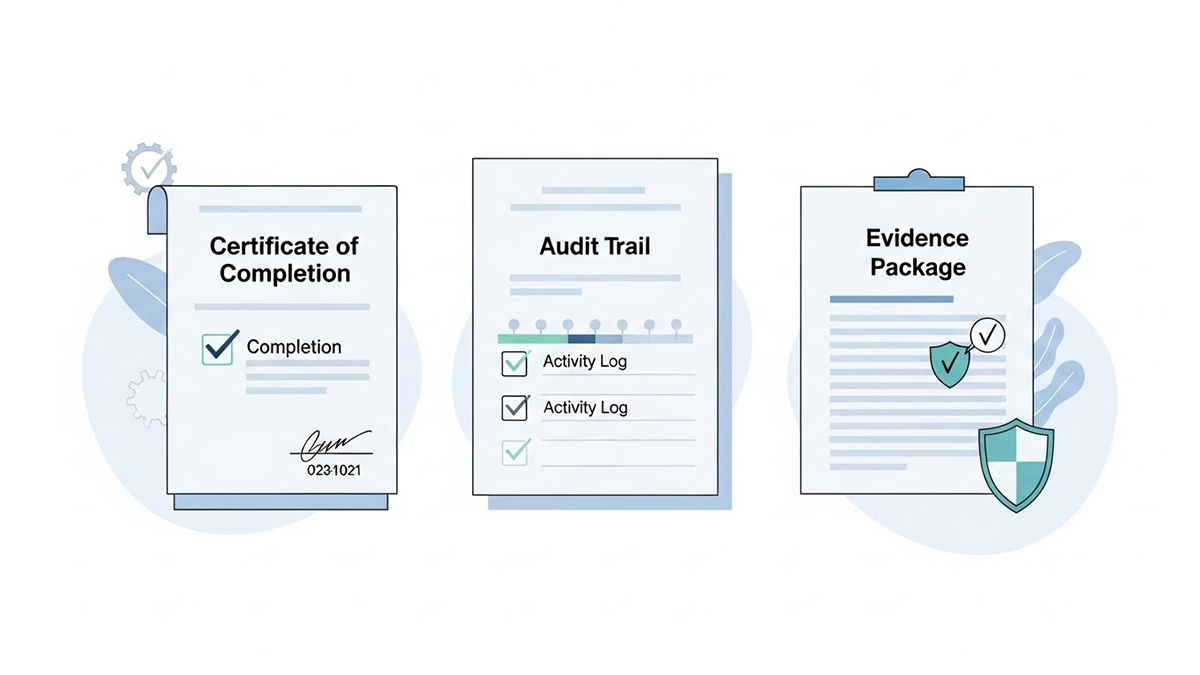
- The Certificate of Completion that summarizes the transaction.
- The Audit Trail that records each step and event.
- The Evidence Package that bundles the signed document, logs, and technical metadata.
Without these, you might still have a document with names on it-but limited ability to show how it was signed, by whom, under what conditions, and whether it has been altered since. For growing businesses and enterprises, this is not just a legal concern; it is a governance, compliance, and reputational issue.
An AI-native platform like Legitt AI (www.legittai.com) treats every signing process as an evidentiary workflow, not just a button-click.
2. What Is a Certificate of Completion?
The Certificate of Completion (sometimes called a “signature certificate” or “completion report”) is a human-readable summary of the signing transaction. Think of it as the front page of your evidence file.
2.1 Typical contents
A robust Certificate of Completion usually includes:
- Document details
- Title of the agreement.
- Internal document ID or envelope ID.
- Date and time of completion.
- Party and signer details
- Names and email addresses of all signers and, where relevant, approvers.
- Roles (signer, approver, witness, counter-signer).
- Sequence of participation (who signed first, second, etc.).
- Transaction metadata
- Time zone used for timestamps.
- Unique transaction identifiers.
- IP addresses used during signing.
- Outcome
- Status (completed, declined, voided, expired).
- Final completion time.
Some platforms also include an overview of authentication methods used (e.g., email, SMS OTP, SSO) and may show a high-level event log on the certificate itself.
2.2 Purpose in legal and compliance contexts
In practice, the Certificate of Completion is the first artifact a lawyer, regulator, or auditor will look at when something is challenged. It gives a concise, printable snapshot of the transaction that is easier to understand than raw log files.
It helps answer core questions:
- Was this a completed transaction?
- Who were the intended signers and in what order?
- When exactly did it complete?
While powerful, the certificate alone is not the full story-that is where the audit trail and evidence package come in.
3. What Is an Audit Trail in E-Signature?
The Audit Trail is the detailed, time-stamped log of everything that happened from the moment a document was created or sent to the moment it was completed, declined, voided, or expired.
3.1 Events typically captured
A well-designed audit trail commonly records:
- Document lifecycle events
- Creation of the envelope or transaction.
- Upload or generation of the document.
- Modifications before sending (if allowed and logged).
- Recipient lifecycle events
- Invitation sent to each signer/approver.
- Invitation delivered (where detectable).
- Document opened/viewed events.
- Authentication steps (e.g., OTP sent, OTP validated).
- Signature applied, initial fields completed, checkboxes ticked.
- Approval actions (approve, reject, delegate).
- Administrative actions
- Reminders sent (automatic or manual).
- Changes to routing or recipients (where policy allows).
- Voiding or cancelling the transaction.
Each entry will typically include date/time, IP address, user identity, and action taken.
 Hi, What do you want to Draft?

Click to upload or drag & drop
pdf, docx up to 5 MB
Click to upload or drag & drop
pdf, docx up to 5 MB
3.2 Why the audit trail is critical
In a dispute, the audit trail lets you show a narrative:
- The exact sequence of events.
- That the signer opened the document, had a chance to read it, and then signed.
- That no unauthorized actor changed the document mid-process.
- That required authentication and consent steps were performed.
From a compliance perspective, it supports internal policies, external regulations, and standards such as internal controls over financial reporting, data protection, and industry-specific frameworks.
In Legitt AI (www.legittai.com), the audit trail is not an afterthought; it is generated as a natural by-product of an orchestrated AI workflow, capturing both human actions and automated decisions.
4. What Is an Evidence Package?
The Evidence Package is the complete, exportable bundle of everything you may need to prove the validity of a transaction. It typically includes:
- The final, fully executed document (usually as a tamper-evident PDF).
- The Certificate of Completion.
- The full Audit Trail in a structured format (e.g., embedded in a PDF or provided as separate files).
- Technical metadata, such as document hashes, digital signature data, and sometimes server logs or signature verification manifests.
4.1 How it is used
The Evidence Package is what you produce when:
- A party disputes having signed or claims the document was altered.
- An auditor examines your control environment.
- A regulator investigates a complaint or incident.
- An internal investigation looks at who approved what and when.
It should be self-contained: someone outside your system (e.g., external counsel) can verify the integrity of the document and reconstruct the transaction without needing to log into your platform.
4.2 Evidence package vs. raw system logs
Some organizations mistakenly assume that server logs and database records are sufficient. Raw logs are useful, but they:
- Are often too technical and fragmented for practical legal use.
- May not be preserved in a defensible, immutable format.
- Are harder to share securely with external parties.
An evidence package is curated and structured for legal defensibility and practical use. It sits at the intersection of legal, technical, and operational domains.
5. How an AI-Native Platform Strengthens Certificates and Evidence
AI-native systems like Legitt AI (www.legittai.com) go beyond simply collecting logs. They use AI and structured data to make certificates and evidence richer, more reliable, and more actionable.
5.1 Context-aware certificates
Because AI generates and understands the contract content, the Certificate of Completion and evidence package can be enriched with:
- Contract category (NDA, MSA, SOW, DPA, HR document, vendor agreement, etc.).
- Risk classification or score at the time of signing.
- Key commercial terms (value, term, critical dates).
This makes it faster for legal and audit teams to understand not just that a transaction occurred, but what kind of transaction it was.
5.2 Intelligent anomaly detection
AI can analyze audit trails across many transactions to flag anomalies:
- Unusual signing times or locations.
- Rapid, improbable sequences of events (suggesting automation or misuse).
- Deviations from standard signing patterns for specific users or counterparties.
These signals can be encoded into the evidence package or used to trigger internal reviews.
5.3 Linking evidence to contract lifecycle
In a contract lifecycle environment, the evidence package is not isolated. It ties back to:
- The versions and redlines approved in the AI-native editor.
- The internal approval trail (legal, finance, security, etc.).
- Post-signature events such as amendments, renewals, or early terminations.
In Legitt AI (www.legittai.com), all of this sits in a unified contract record, giving you a complete view of how each agreement came into being.
6. Designing a Robust Signature Evidence Model
To get real value from certificates and evidence, you need a deliberate design-not just whatever your tools happen to provide.
Key design principles include:
- Completeness
- Capture the entire lifecycle: draft, approval, signature, and post-signature changes.
- Immutability
- Evidence packages should be locked once generated; any later changes must create a new, separately tracked version.
- Traceability
- Every event links back to specific users or services, with clear identifiers.
- Accessibility
- Evidence should be easy to export and share with internal and external stakeholders securely.
- Standardization
- Use consistent formats and fields so legal, audit, and compliance teams can work efficiently across many transactions.
When evaluating or configuring a platform, you should explicitly review what its certificates, audit trails, and evidence packages contain-and how configurable they are.
7. Common Pitfalls and How to Avoid Them
Despite good tools, organizations frequently weaken their own position by how they configure or use them. Typical pitfalls include:
- Not enabling or retaining full audit logs.
Some teams turn off logging to save storage or do not configure retention properly. This can seriously undermine defense in disputes. - Relying solely on email for approvals.
If approvals happen outside the system and are not captured, the evidence package may tell only half the story. - Allowing ad hoc edits after “final approval.”
If users can alter documents between approval and signing, you introduce gaps between what was approved and what was executed. - Lack of clear access controls.
If many users have rights to void, replace, or resend envelopes, evidentiary integrity can be questioned. - Poor archiving and discovery.
Evidence packages scattered across personal drives or email threads are hard to retrieve when needed.
A disciplined approach-using a central platform like Legitt AI (www.legittai.com) with strong configuration, governance, and training-helps avoid these traps.
8. Implementation Roadmap: Elevating Your Signature Evidence
If you want to improve how your organization handles signature certificates and evidence, a practical roadmap might look like this:
- Assess current state
- Review what your current tools generate for each signed document: certificates, logs, evidence bundles.
- Check retention, immutability, and accessibility.
- Define requirements
- Engage legal, compliance, audit, and security to define what they need: fields, formats, retention periods, and governance.
- Configure or select your platform
- If you already use an e-sign platform, configure certificates, audit trails, and exports according to your requirements.
- If you are transitioning to an AI-native stack like Legitt AI (www.legittai.com), align its configuration with your policy and regulatory needs.
- Standardize across contract types
- Ensure evidence quality is consistent irrespective of document type or department (sales, HR, procurement, etc.).
- Establish governance and training
- Define who can change configurations, who can access evidence, and how it is requested and shared.
- Train users on why these artifacts matter and how to avoid bypassing them (for example, using personal email for approvals).
- Review regularly
- Periodically sample evidence packages, test export and review, and refine configuration as your risk and regulatory landscape evolves.
Read our complete guide on Contract Lifecycle Management.
FAQs
What is the main difference between a Certificate of Completion and an Audit Trail?
A Certificate of Completion is a high-level summary of the signing transaction, usually designed for human consumption. It shows who signed, when, in what order, and the basic outcome. An Audit Trail is the detailed, time-stamped log of every action taken in the transaction-document creation, viewing, authentication steps, signatures, approvals, reminders, and administrative actions. You can think of the certificate as the “cover sheet” and the audit trail as the detailed “logbook” behind it.
Do I really need a Certificate of Completion if I already have the signed PDF?
The signed PDF shows the end result but not how you got there. If the signature is disputed-if someone claims they never received the document, never signed it, or that it was altered-the Certificate of Completion and underlying audit trail become essential. They help establish that invitations were sent, the document was opened, authentication was performed, and the signature event occurred at a specific time from a specific device. Relying solely on the signed PDF leaves you with limited evidence about the process.
What exactly goes into an Evidence Package?
An Evidence Package typically includes the executed document, the Certificate of Completion, the full audit trail, and supporting technical information such as document hashes and digital signature data. In some systems, it may also include configuration details relevant to the transaction (for example, policies applied, authentication methods enabled). The goal is to provide everything a third party-like external counsel or an auditor-would need to independently understand and assess the signing event without logging into your internal systems.
How long should we keep certificates, audit trails, and evidence packages?
Retention depends on your legal, regulatory, and business requirements. Many organizations align retention with the underlying contract’s retention period plus any applicable limitation periods for claims. For some industries or document types (such as financial services, healthcare, or long-term infrastructure contracts), retention periods can be quite long. It is important to define a formal policy and configure your platform-such as Legitt AI (www.legittai.com)-accordingly, rather than relying on default settings or ad hoc decisions.
Can evidence packages be used in court or regulatory investigations?
Yes, that is one of their primary purposes. Courts and regulators look for reliable, contemporaneous records that show who did what, when, and under what conditions. A well-structured evidence package, generated automatically by your e-sign platform, typically carries more weight than manual screenshots, email threads, or reconstructed logs. While local rules of evidence vary, having a consistent, system-generated package significantly improves your position compared with informal documentation.
How does an AI-native platform like Legitt AI improve the quality of evidence?
An AI-native platform like Legitt AI (www.legittai.com) understands the contract itself-its type, clauses, risk level, and lifecycle events-not just the fact that it was signed. This allows it to enrich certificates and audit trails with contextual data such as contract category, key commercial terms, and risk scores. It can also tie signing events back to drafting and approval history in the AI-native editor, giving you a complete narrative from first draft to final signature, all in one place.
Are there privacy or security concerns with storing detailed audit trails?
Yes, audit trails can contain sensitive information such as email addresses, IP addresses, and activity patterns. That is why it is crucial to protect them with appropriate access controls, encryption, and retention policies. Only authorized roles should be able to access full evidence packages, and access should be logged. Platforms like Legitt AI (www.legittai.com) typically provide fine-grained access controls and data segregation so you can balance evidentiary needs with privacy and security obligations.
Can we customize what appears on the Certificate of Completion?
In many platforms, yes. You may be able to add your branding, include or exclude certain fields, or adjust formatting for different use cases (for example, internal documents vs external customer agreements). However, customization should not compromise evidentiary integrity. Core fields-such as signer identities, timestamps, and transaction IDs-should remain consistent and mandatory. It is good practice to involve legal and compliance when deciding how certificates are formatted and which data they display.
How do we handle evidence when a contract is amended or renewed?
Each amendment or renewal should generate its own signing transaction, with its own Certificate of Completion, audit trail, and evidence package. In a contract lifecycle system, these artifacts are then linked to the original contract record so you can see the full history of the relationship. This avoids confusion about which version of the contract is current and provides a clear chain of evidence for each material change.
What are good first steps to improve our current signature evidence practices?
Start by taking a sample of recent signed contracts and pulling the associated certificates, audit trails, and evidence exports from your current tooling. Review them with legal, compliance, and audit teams: Are they complete? Clear? Easy to export and understand? From there, define a target standard-what you want every transaction to have-then configure your existing tools or transition to an AI-native platform like Legitt AI (www.legittai.com) to meet that standard. Finally, back it up with governance: defined retention policies, clear ownership, and user training to ensure the process is followed consistently across the organization.