You're in the middle of a deal, the redlines are finally cleaned up, and someone says, “Let's just get signatures.” That's usually when teams relax too early. The contract may look finished, but if the wrong person signs, the latest draft isn't the one routed, or the obligations never make it into the system of record, the deal can unravel after everyone thinks it's done.
That's why signing a contract isn't the finish line. It's the midpoint between negotiation and execution, the point where legal intent becomes an operational commitment, and the point where sales, procurement, HR, and finance either keep momentum or create avoidable rework. In practice, the best teams treat signature as a controlled handoff, not a clerical formality.
If you want a good primer on the drafting side of that handoff, Miles Hansford Law Firm has a useful piece on crafting legally sound agreements. The mechanics matter, but so does the timing, because the contract can already be binding before anyone signs.
The Moment a Deal Becomes a Commitment
A sales rep gets an MSA to legal after a fast-moving negotiation, the customer is eager, and the team wants to move. The signature request goes out on a draft that still has one unresolved exhibit and a signer who wasn't on the authority matrix. The contract comes back, everyone celebrates, and a week later procurement notices the wrong version was executed, finance can't match the payment schedule, and the customer starts pushing back on language nobody caught.
That kind of failure is why contract signing should be managed like a business control. People sign agreements all the time, 84% of respondents in a widely cited U.S. survey sign some kind of legal agreement multiple times a year, and 22% sign weekly, while only 16% sign once a year or less, according to the survey summarized here. The same source says just 1 in 6 Americans (16%) read every word before signing, which helps explain why execution discipline matters so much in everyday commerce.
Signing is recurring work, not a rare event
The practical lesson is simple. A contract signature is not a ceremonial endcap, it's a recurring operating step that affects sales velocity, procurement cycles, onboarding, and compliance. When teams handle it casually, they create hidden friction later, especially when the signed copy doesn't match the negotiated deal.
For that reason, practitioners should think in terms of throughput and control. A clean signature process keeps the deal moving without letting version drift or signer confusion sneak in.
Practical rule: if a contract can move through signature without a controlled version, confirmed authority, and storage plan, it isn't ready to sign.
The best teams also give stakeholders a straightforward path to understanding what binding looks like, what changes at execution, and what should already be true before anyone routes the document. That reduces the classic “signed but not really done” problem that shows up across sales, procurement, and HR.
What Legally Turns a Draft Into a Binding Contract
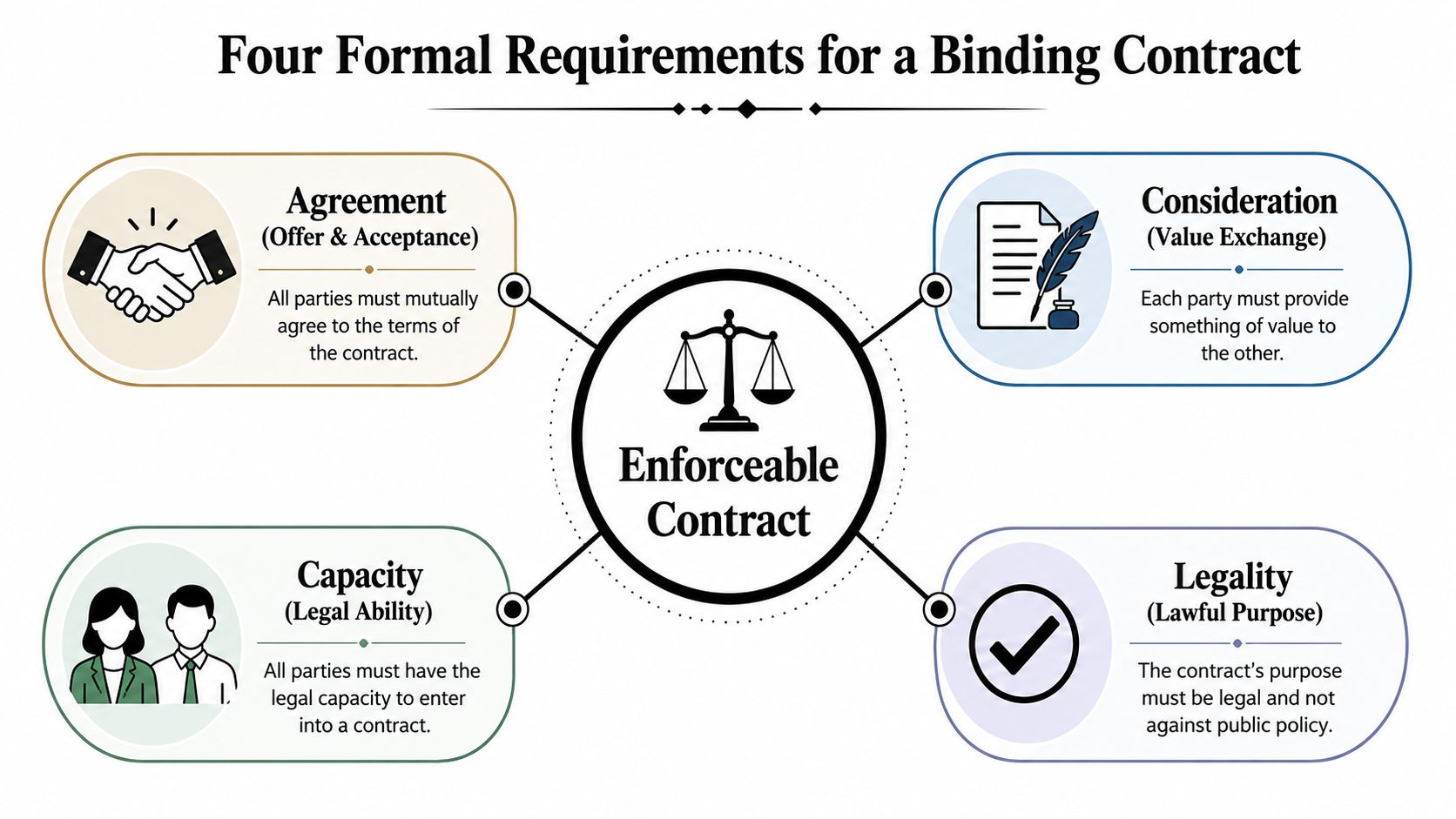
A contract isn't enforceable just because someone put their name on a page. Under standard contract principles, a draft becomes binding when there is agreement, consideration, intention to create legal relations, and certainty of essential terms. A practical CLM workflow should check each of those before routing for execution, because a signature on an incomplete draft doesn't magically cure missing substance.
The four checks that actually matter
Start with agreement. Did the parties reach offer and acceptance on the same terms? Then look at consideration. Did each side commit something of value, whether money, services, access, or another legal benefit? Intention matters too, because business documents are usually drafted to create legal relations, not informal promises. Finally, the terms have to be certain enough for a court to understand the subject matter, the parties, the timing, and the core obligations, as described in this contract primer.
The point for legal ops is practical. AI review tools and approval checklists shouldn't only ask whether a signature block exists, they should ask whether the draft still has all essential terms and no unresolved ambiguity. Hong Kong contract law guidance makes the same operational point in a different way, by treating intention, consideration, and completeness of essential terms as core requirements in a valid commercial contract, which is why clause extraction and contract intelligence matter in enterprise workflows for commercial contracting.
Unsigned doesn't always mean unbound
The biggest blind spot is assuming that an unsigned contract is safe. In practice, assent can be shown by conduct, performance, silence, or acceptance of benefits even when no signature exists, and Florida courts have repeatedly held that signatures are not always required for enforceability, as explained in this case-law overview. Sales, procurement, and finance teams need to understand that “not signed” and “not binding” are not the same thing.
A team can be bound before the ink dries, especially when emails, partial performance, or continued use of services show acceptance.
That's why the decision point is not just signature, it's whether the organization has already committed itself through behavior. Once you understand that, pre-sign review becomes less about paperwork and more about risk control. For a related conceptual foundation, Legitt AI has a useful explanation of offer and acceptance starting points of a legal agreement.
The Pre-Sign Checklist That Prevents Post-Sign Disasters
Most post-sign problems start before anyone signs. The fix is a short, enforced checklist that treats execution as a control point, not a courtesy review. If a team standardizes just this stage, it cuts down on the errors that force legal, sales, and operations to reopen a deal after the customer thinks it's done.
The checks that catch the common failures
- Latest controlled version: confirm the routed file is the final approved draft, not an old attachment. This prevents version mismatch and accidental execution of stale terms.
- Redlines resolved: make sure no unresolved comments, tracked changes, or side agreements are floating around. That stops “we thought this was already agreed” disputes.
- Authority verified: compare the signer against the delegation-of-authority matrix. This reduces the risk of an undersized signatory.
- Correct contract form selected: use the right template for the transaction, region, and department. That avoids missing provisions or incompatible clauses.
- All signers identified: list every required party before signature routing starts. This prevents unsigned counterparties from holding the deal hostage.
- Exhibits and attachments included: confirm schedules, addenda, and referenced documents are present. Missing exhibits usually surface here.
- Contract details recorded: capture key metadata before the system of record is updated. That makes search, reporting, and obligation tracking possible later.
| Pre-Sign Control | Failure Mode It Prevents |
|---|---|
| Controlled version check | Wrong version gets signed |
| Redline resolution | Unresolved business or legal terms survive execution |
| Authority matrix review | Wrong person signs |
| Required signer list | Counterparty or internal approver is omitted |
| Exhibit and attachment check | Unsigned or missing appendices create gaps |
| Metadata capture | The contract can't be found or tracked later |
A lot of teams also miss the items that don't stand out in a redline review. Employment agreements often need careful review of IP assignment, restrictive clauses, working hours, and termination terms, as noted in this employment checklist. Some transactions also require witnesses or notarization, and one unsigned copy can be only partially executed and not binding, which is why execution mechanics matter as much as the legal text itself.
A CLM makes those checks repeatable instead of personality-dependent. That's the difference between one careful reviewer and a standard process.
Wet Ink vs Electronic Signature and the Laws That Govern Them
Wet ink still has a place, but it's no longer the default for high-volume teams. In major markets, electronic execution has become routine. In the UK, 79% of office workers signed an agreement digitally in the previous 12 months, with 55% signing on a computer and 23% on a mobile device, while fewer than 18% signed on paper, according to DocuSign's contract-signing survey summary here. Another survey in the same source says 80% of respondents use electronic signatures, and 49% get a contract signed within one to three days.
The legal framework decides the method
In the U.S., e-signatures are generally governed by the ESIGN Act and UETA. In the EU, eIDAS creates different signature tiers, including AES, QES, and SES. UK and APAC rules follow similar principles, which is why the execution method should be chosen by jurisdiction and contract type, not by habit.
That means a compliant workflow needs to preserve signer identity, intent, record integrity, and a tamper-evident audit trail. Teams that use DocuSign, Adobe Sign, or CLM-native e-signature tools are usually trying to protect those mechanics while keeping the process fast. For a deeper legal overview, see Legitt AI's guide on whether electronic signatures are legal.
Operational takeaway: a valid e-signature process is really a chain of evidence, identity, and record control.
A few document types still call for paper or special formalities, including some wills, certain real estate documents, and notarized instruments. The point isn't that electronic signing replaces every paper workflow, it's that the right execution method depends on the governing law and the document type.
A useful extra lens comes from fintech and post-quantum security, because teams managing high-value agreements are starting to think harder about long-term record integrity and signature assurance. That's not an argument for overengineering the signing process, it's a reminder that the execution stack should stay aligned with the risk profile of the contract.
Routing Contracts Through the Right Approvers in the Right Order
Signing speed usually breaks in routing, not in signature capture. If a deal has to bounce between sales, legal, finance, and security by email, someone will miss a version, skip an approver, or wait too long for the wrong person to act. A modern CLM fixes that by encoding the approval path into the workflow itself.
How routing actually works in practice
Intake comes first, usually from CRM or a contract request form. The system creates the draft, sends it through redlines and comment resolution, then routes it based on role, risk, and contract value. When the delegation-of-authority matrix is embedded in routing rules, the right approver shows up at the right threshold without manual guessing.
That matters because handoffs are where work gets lost. If Salesforce or HubSpot creates the deal record, and Microsoft 365 or Slack carries the collaboration, the CLM should keep the contract moving without copy-paste between systems. Stamina has a useful discussion of automate lead routing and nurturing, and the same routing logic applies to contract approvals. The workflow needs rules, not memory.
A practical example is a mid-market MSA moving through review in Legitt AI. The platform can keep the draft in one workspace, surface risk flags, route approvals by role, and show status in real time, so the sales lead, finance reviewer, and legal approver each see their step without losing the history of the negotiation. That kind of structure is especially useful when the same deal touches multiple teams and every handoff needs a traceable owner.
For teams designing the approval stack, Legitt AI's overview of role-based contract approval controls is a good reference point.
If a contract's approval path lives in someone's inbox, it will eventually stall there.
Signing turnaround is also a business metric. It affects close timing, vendor onboarding, and employee start dates, so legal ops should track it like any other operational KPI instead of treating it as background admin work.
What Happens After the Last Signature Is Captured
The signature is not the end of the work. It's the point where obligations become real, which means the system of record has to be ready before the last signer clicks. If post-sign handling is weak, the contract can be fully executed and still become operationally invisible.
What has to happen immediately
The executed copy needs to go into a secure, searchable repository with the right metadata attached so legal, finance, and procurement can retrieve it later. Version history should stay intact for amendments and renewals, because a clean audit trail is what keeps future negotiations grounded in the actual agreement. Then the workflow should trigger obligation alerts and renewal reminders so nobody has to rely on memory.
Legitt AI's post-sign guidance on post-signing contract management aligns with the basic operating reality here, the repository only starts paying back once people can search, track, and act on the contract data. AI agents can surface key milestones, compliance gaps, and revenue leakage from that data, but only if the executed agreement is stored and tagged correctly first.
Where teams usually lose money or control
Missing a renewal reminder is the classic failure, because the contract renews on terms nobody revisited. Missing an obligation trigger is just as bad, because someone in procurement or RevOps assumes the follow-up task will happen automatically when it won't. And if the signed copy is stored outside the CLM, the organization loses the ability to answer basic questions quickly.
That's why the handoff to finance, procurement, and RevOps is the moment contract intelligence starts paying back the signing effort. The executed document becomes useful only when the repository can connect the legal text to dates, duties, and business owners.
Common Pitfalls, Quick Fixes, and a Starter Checklist for Teams
The fastest way to improve signing is to stop relying on memory. Most errors are predictable, and the fix is usually a short control, not a major project. A team that standardizes the basics can prevent the kind of rework that slows deals and creates avoidable risk.
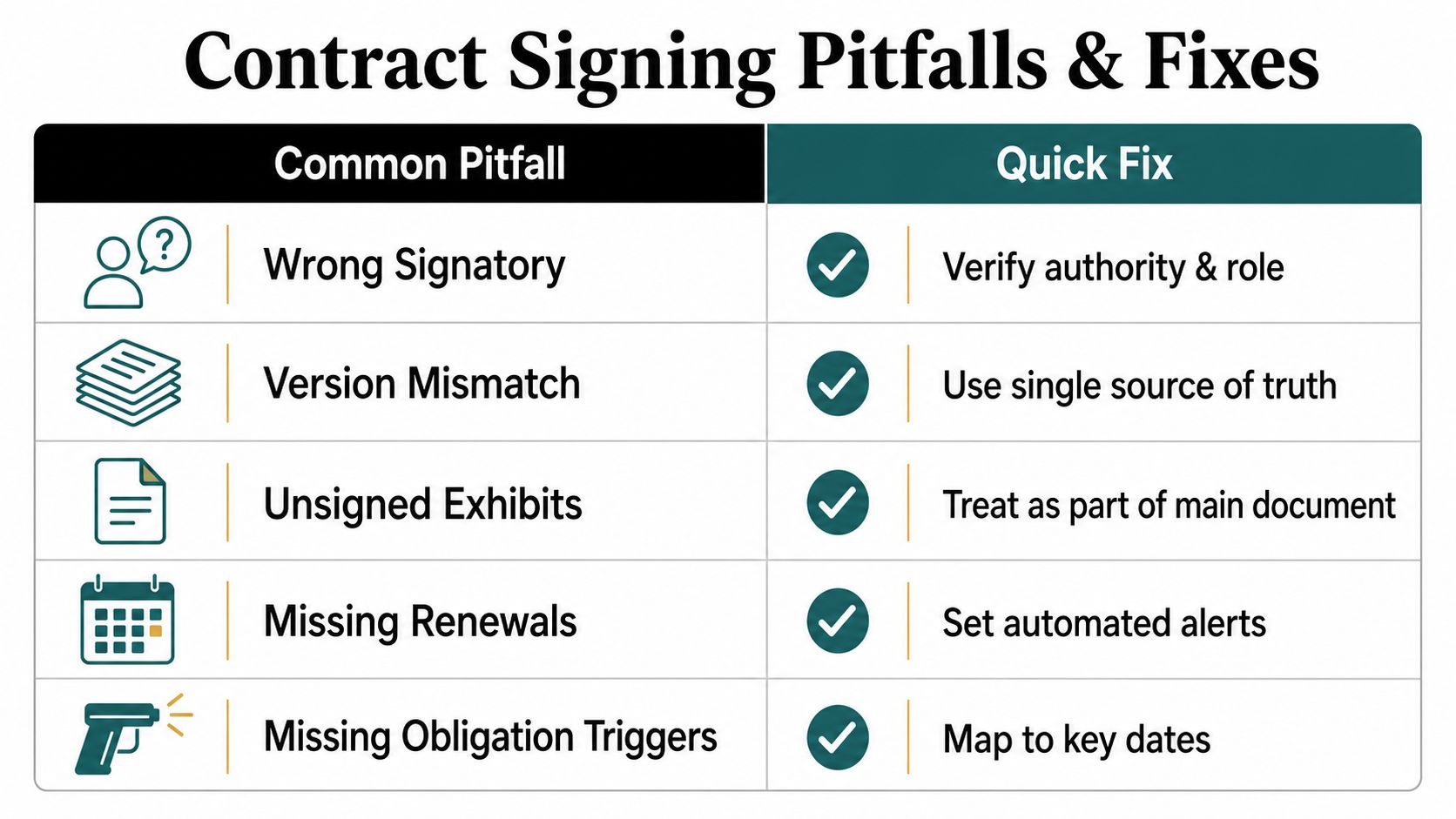
| Common Pitfall | Quick Fix |
|---|---|
| Wrong signatory | Verify authority and role before routing |
| Version mismatch | Keep one source of truth in the CLM |
| Unsigned exhibits | Treat attachments as part of execution, not afterthoughts |
| Missing renewals | Set automated alerts in the repository |
| Missing obligation triggers | Map duties to dates and owners |
The most common troubleshooting move is to slow down the handoff, not speed it up. If AI-drafted language is going into signature, it still needs legal review, especially if the workflow hasn't confirmed the final executable matches the negotiated terms. Legitt AI's overview of digital contract signing mistakes is useful for teams cleaning up that last mile.
Starter checklist for this week
- Pre-sign: confirm the final version, signer authority, and required exhibits.
- Sign: capture identity, timestamp, and completed signatures.
- Post-sign: store the executed copy, tag the metadata, and trigger alerts.
If a contract can bind through conduct, if the wrong person signs, or if the post-sign repository can't surface the next obligation, the process failed somewhere before execution. A short, enforced checklist fixes more than teams expect.
If your team wants to standardize signing across legal, sales, procurement, and HR, Legitt AI gives you one workspace to draft, route, e-sign, store, and track contracts with role-based approvals and obligation alerts. It's a practical fit for teams that need tighter contract control without slowing down the business.