
In modern enterprises, contract execution is no longer a simple handoff between sales and legal teams. Contracts today directly impact revenue recognition, financial exposure, regulatory compliance, data security, and long-term business risk. As deal velocity increases and organizations scale globally, the absence of structured controls before signature becomes a significant liability.
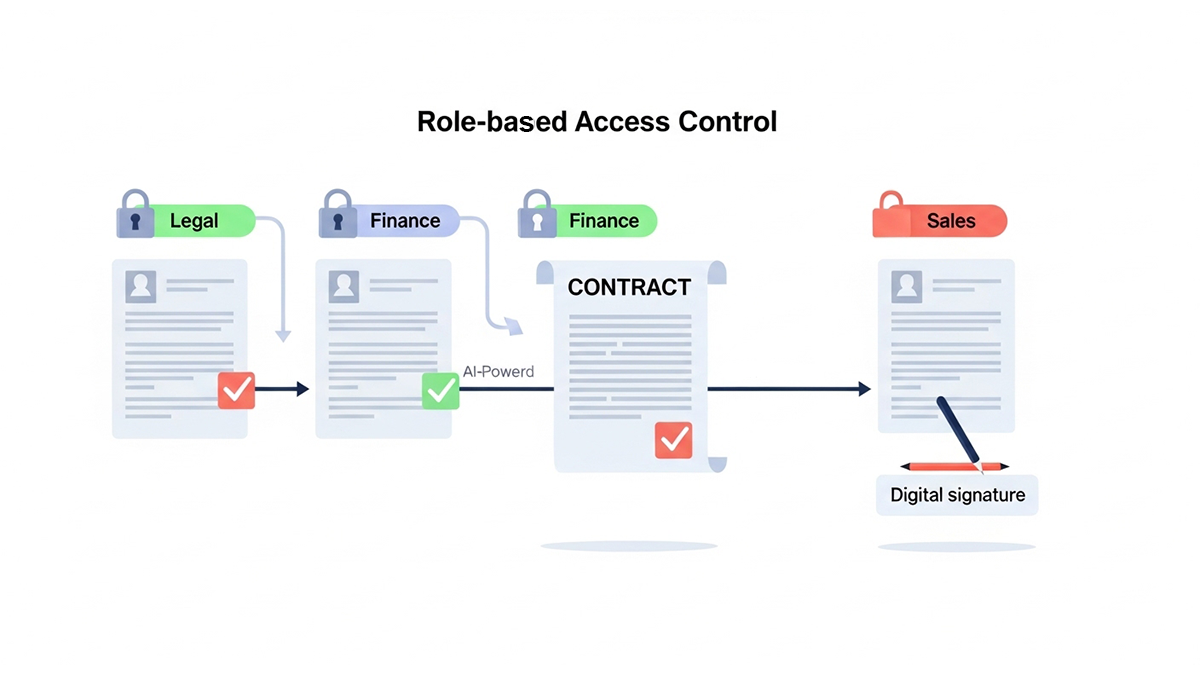
Role-based access control (RBAC) and approval gates are critical mechanisms that ensure contracts are reviewed, approved, and executed only by the right stakeholders, at the right time, and under the right conditions. Without these controls, organizations face risks such as unauthorized commitments, unfavorable commercial terms, compliance violations, and financial leakage.
AI-powered contract lifecycle platforms now make it possible to enforce RBAC and approval gates intelligently-based not just on workflow steps, but on contract content, risk levels, and business context. This article explains how role-based access and approval gates work, why they are essential before contract signature, and how AI enhances governance without slowing down deal execution.
 Hi, What do you want to Draft?

Click to upload or drag & drop
pdf, docx up to 5 MB
Click to upload or drag & drop
pdf, docx up to 5 MB
Why Pre-Signature Controls Matter More Than Ever
Before a contract is signed, it represents a point of maximum leverage and maximum risk. Once executed, correcting unfavorable terms often requires renegotiation, concessions, or litigation.
Pre-signature controls ensure that:
- Legal risk is identified and mitigated
- Financial exposure is reviewed and approved
- Commercial terms align with business policy
- Unauthorized users cannot bypass governance
As organizations handle higher contract volumes and faster sales cycles, manual enforcement of these controls becomes inconsistent and unreliable.
What Is Role-Based Access Control (RBAC) in Contract Management?
Role-based access control is a security and governance framework that restricts what users can see, edit, approve, or sign based on their role within the organization.
In a contract context, RBAC typically defines:
- Who can create or edit contracts
- Who can modify commercial or legal clauses
- Who can approve deviations from standards
- Who can send contracts for signature
- Who can view sensitive financial or legal data
RBAC ensures that access is aligned with responsibility, authority, and risk exposure.
Approval Gates: Structured Decision Points Before Signature
Approval gates are predefined checkpoints in the contract workflow where specific approvals are mandatory before the contract can progress toward execution.
Typical approval gates include:
- Legal approval for non-standard clauses
- Finance approval for pricing, payment terms, or discounts
- Sales leadership approval for commercial concessions
- Compliance approval for regulatory or data-related terms
- Executive approval for high-value or high-risk contracts
Approval gates prevent contracts from being signed without the necessary scrutiny.
Why Manual Approval Processes Fail
Many organizations rely on emails, spreadsheets, or informal approvals to manage pre-signature reviews. These methods fail for several reasons.
First, they lack visibility-there is no single source of truth for approval status. Second, they are inconsistent-approvals depend on individual judgment rather than standardized rules. Third, they are difficult to audit-there is often no clear record of who approved what and why.
As deal velocity increases, these weaknesses translate directly into risk.
How AI Enhances Role-Based Access and Approval Gates
AI fundamentally upgrades RBAC and approval gates by making them context-aware and risk-driven, rather than static and manual.
Instead of relying solely on predefined workflows, AI analyzes the contract itself to determine:
- Which roles must be involved
- Which approvals are mandatory
- Whether deviations from standards exist
- How much risk the contract introduces
Platforms such as Legitt AI (www.legittai.com) apply AI to contract content to dynamically enforce access controls and approval requirements before signature.
Legal Controls: Ensuring Contractual Risk Is Managed
Legal teams are responsible for safeguarding the organization against contractual risk. RBAC ensures that only authorized legal users can modify legal clauses, approve deviations, or waive protections.
AI-powered analysis flags:
- Non-standard liability or indemnity clauses
- Missing confidentiality or data protection provisions
- Unfavorable governing law or jurisdiction clauses
- Ambiguous termination or dispute resolution terms
When such risks are detected, AI automatically routes the contract through mandatory legal approval gates, preventing execution until risks are addressed.
Finance Controls: Protecting Revenue and Cash Flow
Finance approvals are essential for ensuring that contracts align with revenue policies, pricing standards, and cash flow requirements.
RBAC restricts who can:
- Modify pricing or discount structures
- Change payment terms or billing milestones
- Approve revenue-impacting concessions
AI evaluates financial terms in the contract and triggers finance approval gates when thresholds are exceeded. For example, extended payment terms, high discounts, or unusual billing structures can automatically require finance sign-off.
Sales Controls: Balancing Speed with Governance
Sales teams are incentivized to close deals quickly, but speed without governance leads to risk.
RBAC allows sales users to draft and negotiate within approved boundaries while preventing unauthorized changes to legal or financial terms. Approval gates ensure that when sales negotiates outside standard playbooks, leadership or cross-functional approvals are required.
AI enables this balance by detecting deviations in real time and enforcing approvals without disrupting standard, low-risk deals.
Dynamic Approval Routing Based on Risk
One of AI’s most powerful advantages is dynamic approval routing.
Instead of routing every contract through the same approval chain, AI determines:
- Contract value and risk level
- Clause deviations from standards
- Regulatory or data sensitivity
- Strategic importance of the counterparty
Low-risk contracts can move quickly, while high-risk or high-value contracts automatically trigger additional approvals. Legitt AI (www.legittai.com) supports this risk-based gating model, ensuring governance scales with complexity.
Auditability and Compliance Readiness
RBAC and approval gates are not only about prevention-they are also about accountability.
AI-powered systems maintain a complete audit trail showing:
- Who accessed the contract
- What changes were made
- Which approvals were granted or rejected
- When and why decisions occurred
This is critical for regulatory compliance, internal audits, and dispute resolution.
Implementation Best Practices
To implement effective RBAC and approval gates:
- Clearly define roles and approval authority
- Align approval thresholds with risk and value
- Use AI to detect deviations automatically
- Avoid over-approval that slows low-risk deals
- Ensure all actions are logged and auditable
RBAC and approval gates should enable speed with control-not create friction.
The Future of Pre-Signature Governance
The future of contract governance is intelligent and autonomous. AI will increasingly predict risk, recommend approvers, and even suggest remediation before humans intervene.
Organizations that adopt AI-driven RBAC and approval gates today will achieve faster deal cycles, stronger compliance, and greater confidence at the point of signature.
Read our complete guide on Contract Lifecycle Management.
FAQs
What is role-based access control in contract management?
Role-based access control restricts what users can view, edit, approve, or sign based on their role. It ensures responsibilities align with authority and risk exposure. This prevents unauthorized changes and improves governance before contract execution.
Why are approval gates important before contract signature?
Approval gates ensure that critical stakeholders review and approve contracts before they are signed. They prevent unauthorized commitments and reduce legal, financial, and compliance risk. Without gates, contracts can bypass essential scrutiny.
How does AI improve approval workflows?
AI analyzes contract content to detect risk, deviations, and thresholds automatically. It dynamically routes contracts for approval based on actual risk rather than static rules. This improves accuracy while reducing unnecessary approvals.
Can AI reduce approval bottlenecks?
Yes. AI allows low-risk, standard contracts to move forward quickly while routing only high-risk contracts for additional review. This prevents over-approval and accelerates deal cycles without compromising control.
How do legal teams benefit from RBAC and approval gates?
Legal teams gain assurance that risky clauses cannot be approved or modified without their involvement. AI flags non-standard terms automatically, reducing manual review effort and missed risks.
How do finance teams use approval gates?
Finance teams use approval gates to control pricing, discounts, and payment terms. AI triggers finance approvals when financial thresholds or policy deviations are detected, protecting revenue and cash flow.
Does RBAC slow down sales teams?
When implemented correctly, RBAC does not slow sales teams. Standard deals flow quickly, while only exceptional cases require additional approvals. AI ensures governance without unnecessary friction.
Are approval actions auditable?
Yes. AI-powered platforms maintain detailed audit logs of access, changes, and approvals. This supports compliance, audits, and internal accountability.
Can approval rules change dynamically?
Yes. AI-driven systems allow approval rules to adapt based on contract value, risk, and context. This flexibility is essential for scaling contract operations across regions and business units.
What is the business impact of strong pre-signature controls?
Strong controls reduce legal exposure, prevent revenue leakage, improve compliance, and increase confidence at execution. Over time, they lead to faster, safer, and more predictable contract outcomes.