A procurement lead has a shortlist of CLM vendors. Legal wants stronger controls around confidential agreements. Sales wants faster turnaround on contract review. IT security asks one question that changes the whole conversation: “Do they have a current SOC 2 Type II report?”
That's usually the moment when marketing language stops being useful. “SOC 2 compliant” is too vague to support vendor approval, especially when the platform will store executed agreements, negotiation history, pricing terms, customer data, and approval records. For AI contract management and enterprise contract workflows, the issue isn't whether a vendor has a security page. It's whether the vendor can prove its controls worked consistently over time.
For legal operations, procurement, and sales operations teams evaluating contract lifecycle management software, SOC 2 Type II is one of the most practical signals of operational discipline. It helps you assess whether a vendor can protect sensitive contract data, maintain reliable workflows, support auditability, and respond credibly during security review. That matters whether you're buying AI contract review, contract automation, eSignature, repository management, or full contract intelligence capabilities.
Why SOC 2 Type II Matters for Contract Management
A CLM platform doesn't just hold documents. It becomes the operating system for commercial commitments.
That means your vendor may process draft agreements, redlines, fallback clauses, indemnity positions, renewal dates, approval histories, pricing schedules, and sensitive attachments. If the platform includes AI contract drafting, AI contract review, or contract analytics, it may also process extracted obligations, metadata, and negotiation patterns that legal and procurement teams consider highly confidential.
The real buyer concern
For vendor due diligence, the central question isn't whether a provider says security matters. The question is whether the provider can produce credible evidence that security controls were designed well and operated consistently in production. That's what makes SOC 2 Type II useful in legal technology procurement.
A current Type II report gives buyers a much better basis to evaluate whether a provider's access controls, logging, change management, incident response, and system operations are part of day-to-day workflow rather than policy language sitting in a shared drive.
Practical rule: If a CLM vendor will host your contract repository, route approvals, manage eSignatures, or power AI review against third-party paper, security assurance should be treated as a buying criterion, not a post-selection formality.
Why this matters in AI contract workflows
Modern contract systems do more than store PDFs. They draft from templates, compare clauses, route approvals, trigger renewal reminders, and surface contract intelligence for legal operations and revenue teams. That creates efficiency, but it also concentrates risk.
When procurement teams review a vendor handling this level of data, they should expect evidence of operational maturity. A useful starting point is the vendor's own explanation of security and confidentiality considerations for contract workflows, then a deeper review of the actual audit report and scope.
From a business perspective, SOC 2 Type II matters because contract systems are embedded in execution. If access governance is weak, audit trails are incomplete, or changes aren't controlled, the problem doesn't stay in the security team. It reaches legal, procurement, finance, and sales.
What Is a SOC 2 Type II Report
A SOC 2 Type II report is an independent attestation report that evaluates whether a service organization's controls were not only designed appropriately, but also operated effectively over a defined period.
For buyers, the easiest way to think about SOC 2 is this: it's a structured way to test whether a vendor's security and operational controls can stand up to scrutiny when real customers, real data, and real workflows are involved.
The five Trust Services Criteria
Every SOC 2 engagement is built around the Trust Services Criteria. Legal and procurement teams don't need to memorize them, but they should know what each one tells them.
| Criterion | What it means in business terms | Why CLM buyers care |
|---|---|---|
| Security | Protection against unauthorized access | Core requirement for every platform handling contract data |
| Availability | Systems remain usable and reliable | Matters for approval workflows, repository access, and signing cycles |
| Processing Integrity | Systems process data accurately and as intended | Relevant for clause extraction, workflow routing, and contract automation |
| Confidentiality | Sensitive information is protected appropriately | Important for pricing terms, counterparty paper, and privileged materials |
| Privacy | Personal information is handled properly | Relevant where contract records include personal data |
Security is the foundation. The others depend on the service provided and what the vendor includes in scope.
How to read the report like a buyer
A SOC 2 Type II report is most useful when you treat it as an evaluation tool, not a badge.
Look for these elements:
- Scope of systems and services. Does the report cover the CLM platform, AI review workflow, repository, and eSignature environment you plan to use?
- Criteria in scope. Security is required, but buyers should check whether Availability, Confidentiality, Processing Integrity, or Privacy were also examined.
- Testing of operating effectiveness. This is the part that tells you whether controls worked in practice.
- Exceptions and management responses. A report with context is often more informative than a broad “everything is fine” claim.
Buyers often make one avoidable mistake. They ask whether a vendor has SOC 2, but they don't ask what exact service environment the report covered.
For AI contract management, that distinction matters. A vendor may have strong controls around one product and a different maturity level in another environment. The report helps you see whether the assurance maps to the workflow you're buying.
SOC 2 Type I vs Type II A Critical Distinction
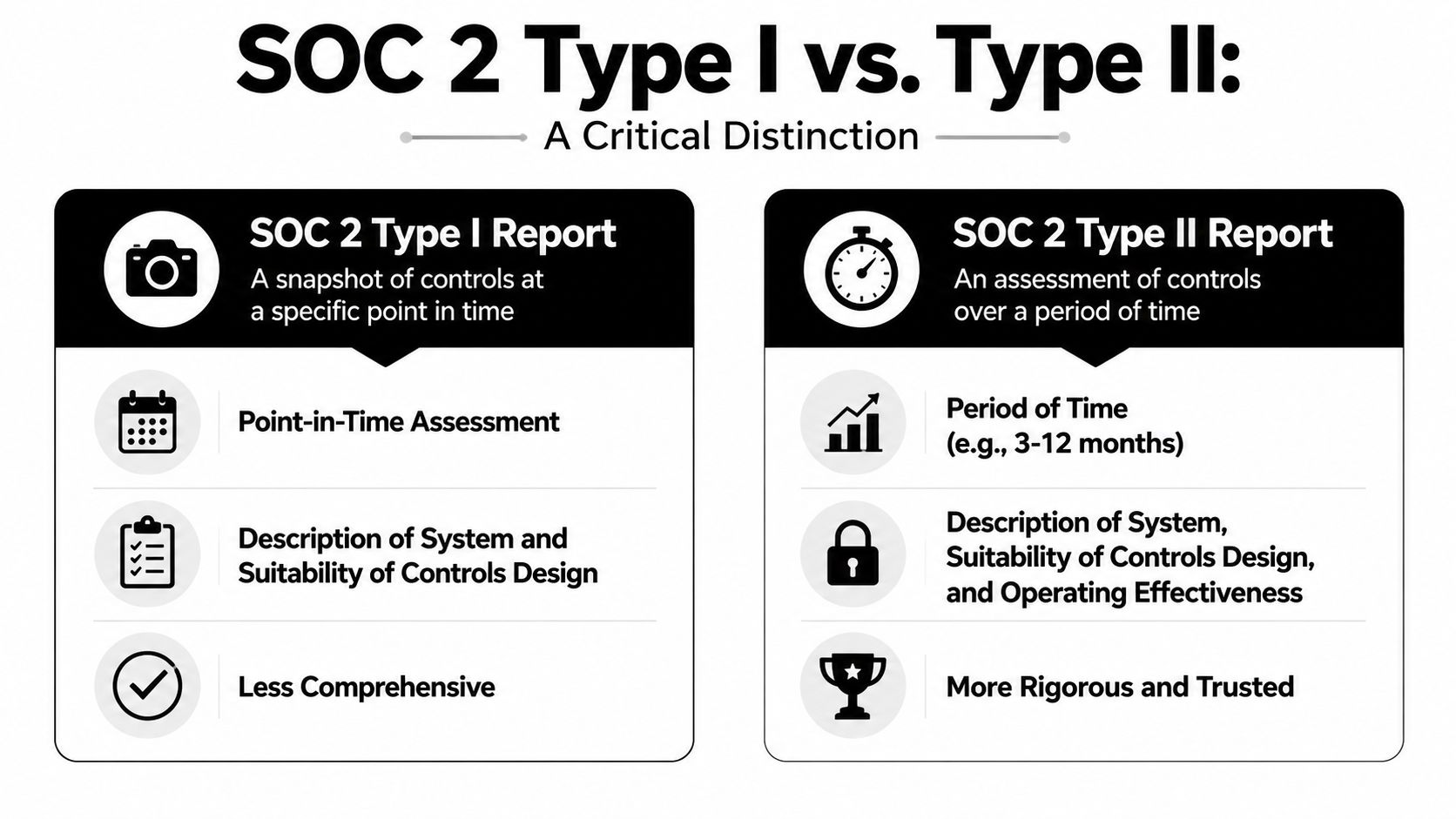
A Type I report is a photograph. A Type II report is a film.
That analogy works because the difference isn't cosmetic. It changes what you can rely on during vendor due diligence. A Type I report tells you controls existed and were suitably designed at a specific date. A Type II report tells you whether those controls kept working over time.
Why enterprise buyers push for Type II
For procurement and legal teams, consistency matters more than a one-day snapshot. A CLM vendor may have a well-written access control policy, but buyers need confidence that access reviews happened on schedule, changes were approved properly, logs were retained, and incidents were handled through a defined process.
That's the reason enterprise buyers usually prefer Type II. SOC 2 Type II compliance requires an independent CPA firm to observe and validate that internal security controls operate effectively over a continuous 6 to 12 month observation window, rather than merely confirming their existence at a single point in time as in Type I. This longitudinal evidence generation directly correlates with a 40-60% reduction in audit findings related to control inconsistency, according to Bemopro's explanation of SOC 2 Type II requirements.
A practical comparison for vendor review
| Question | Type I | Type II |
|---|---|---|
| Did the vendor design controls? | Yes, that's the focus | Yes |
| Did the controls keep working over time? | Not proven | Yes, that's the point |
| Useful for early-stage diligence? | Sometimes | More useful for enterprise diligence |
| Stronger basis for legal and procurement approval? | Usually no | Usually yes |
What works and what doesn't
What works is using Type I as an interim signal when a vendor is early in its maturity journey and your internal risk profile allows that decision.
What doesn't work is treating Type I and Type II as interchangeable.
A vendor with a Type I report is telling you, “We built the control.” A vendor with a Type II report is showing you, “We ran the control repeatedly, and an auditor tested that evidence.”
For software handling contract review, contract intelligence, renewals, obligations tracking, and approval routing, this distinction isn't academic. If workflows touch sensitive legal and commercial records daily, buyers should care about operational proof, not just control design.
The SOC 2 Type II Audit Process and Timeline
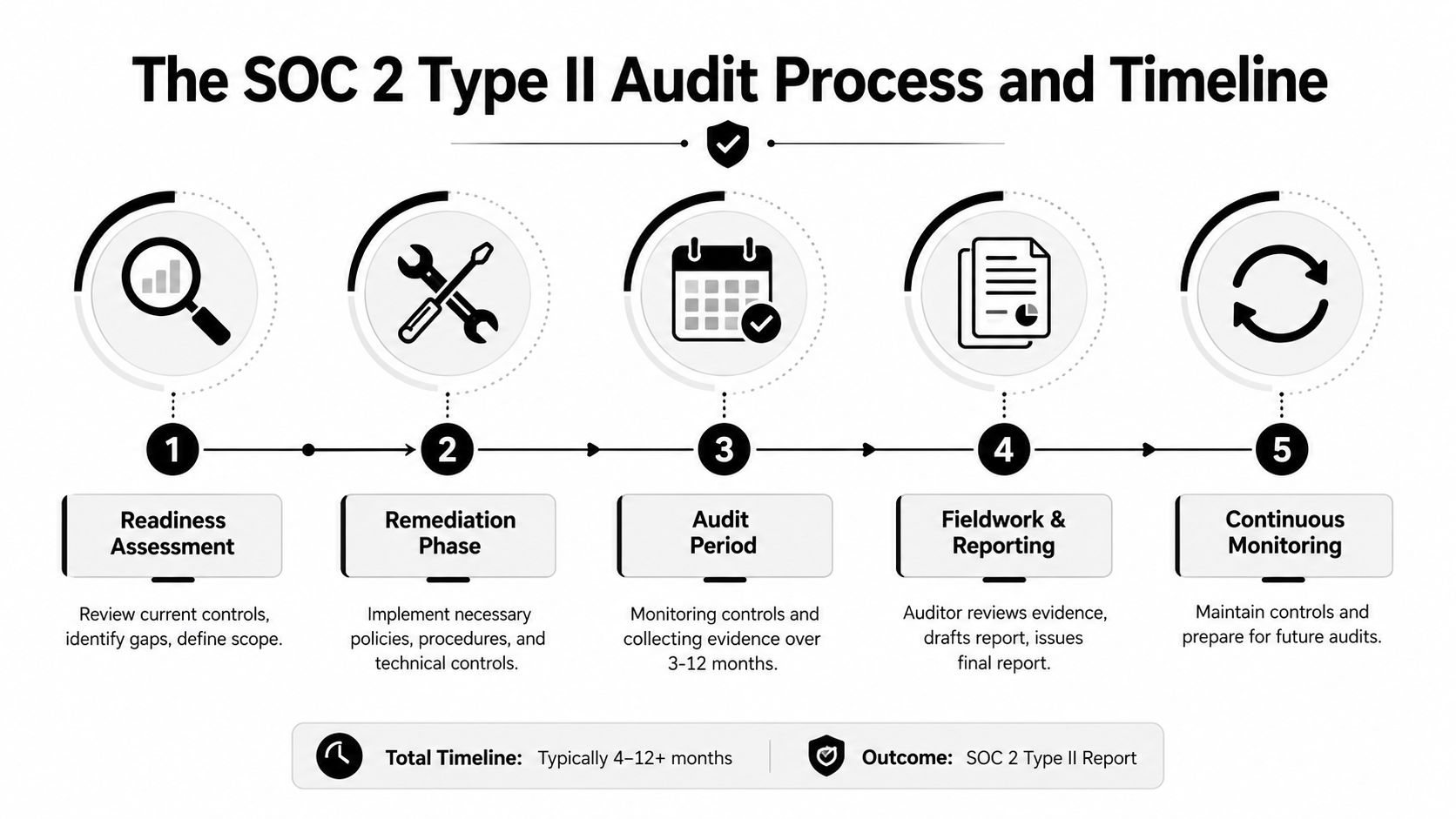
SOC 2 Type II isn't something a vendor “gets” quickly because a prospect asked for it. It's a long operational effort that starts well before the audit opinion appears in a report.
The timeline buyers should expect
SOC 2 Type II compliance requires an observation period of 6 to 12 months. The total elapsed time from kickoff to receiving a final Type II report typically ranges from 11 to 16 months, and the report is generally considered valid for only twelve months from its issuance date, as explained in Secure's guide to SOC 2 for SaaS.
That timeline matters during procurement. If a vendor says it's “in progress,” legal and procurement should ask where exactly it is in the process. There's a big difference between:
- Planning stage. Scope is still being defined.
- Remediation stage. Controls are being implemented or tightened.
- Observation stage. Evidence is actively being collected.
- Fieldwork stage. Auditor testing is underway.
- Issued report stage. Final report is available for review.
What happens during the process
Readiness and scoping
The vendor defines what systems, teams, and services are in scope. For a CLM provider, buyers should care whether the audit covers the actual contract platform, its repository, approval engine, eSignature flow, and any AI contract analytics features tied to customer data.
Remediation and control operation
The vendor closes gaps. This usually means tightening policy coverage, implementing workflow discipline, and ensuring technical controls generate usable evidence. A platform with strong product-level auditability, such as detailed workflow logs and role-based actions, is easier to defend during this phase. The importance of preserving those records is similar to why teams value maintaining an audit trail for contracts inside their own legal operations.
Observation and evidence collection
Weak programs often fail. A vendor can't wait until audit fieldwork to recreate months of proof. Controls must run normally and leave evidence behind as they operate.
If a vendor says “we have the policy” but struggles to show system records across the audit period, expect problems during diligence.
Fieldwork and issuance
The auditor samples evidence, tests control execution, and documents results. Buyers should then verify the report date. Even a strong report loses value once it's stale, which is why annual refresh matters in ongoing vendor management.
A Readiness Checklist with Common Controls and Evidence
When legal or procurement teams vet a CLM vendor, they shouldn't stop at “send the SOC 2 report.” They should understand what the report implies about the vendor's underlying control environment.
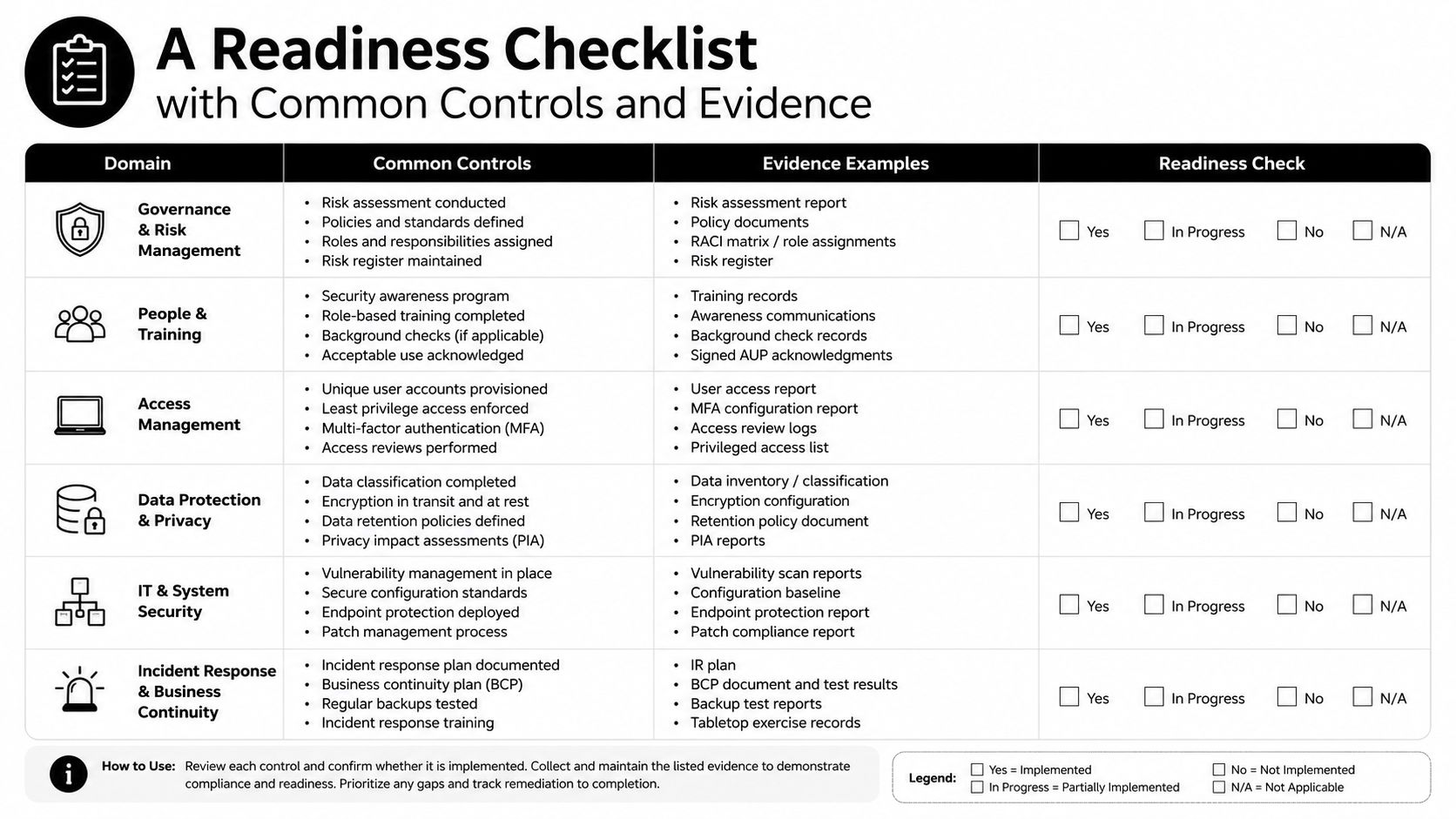
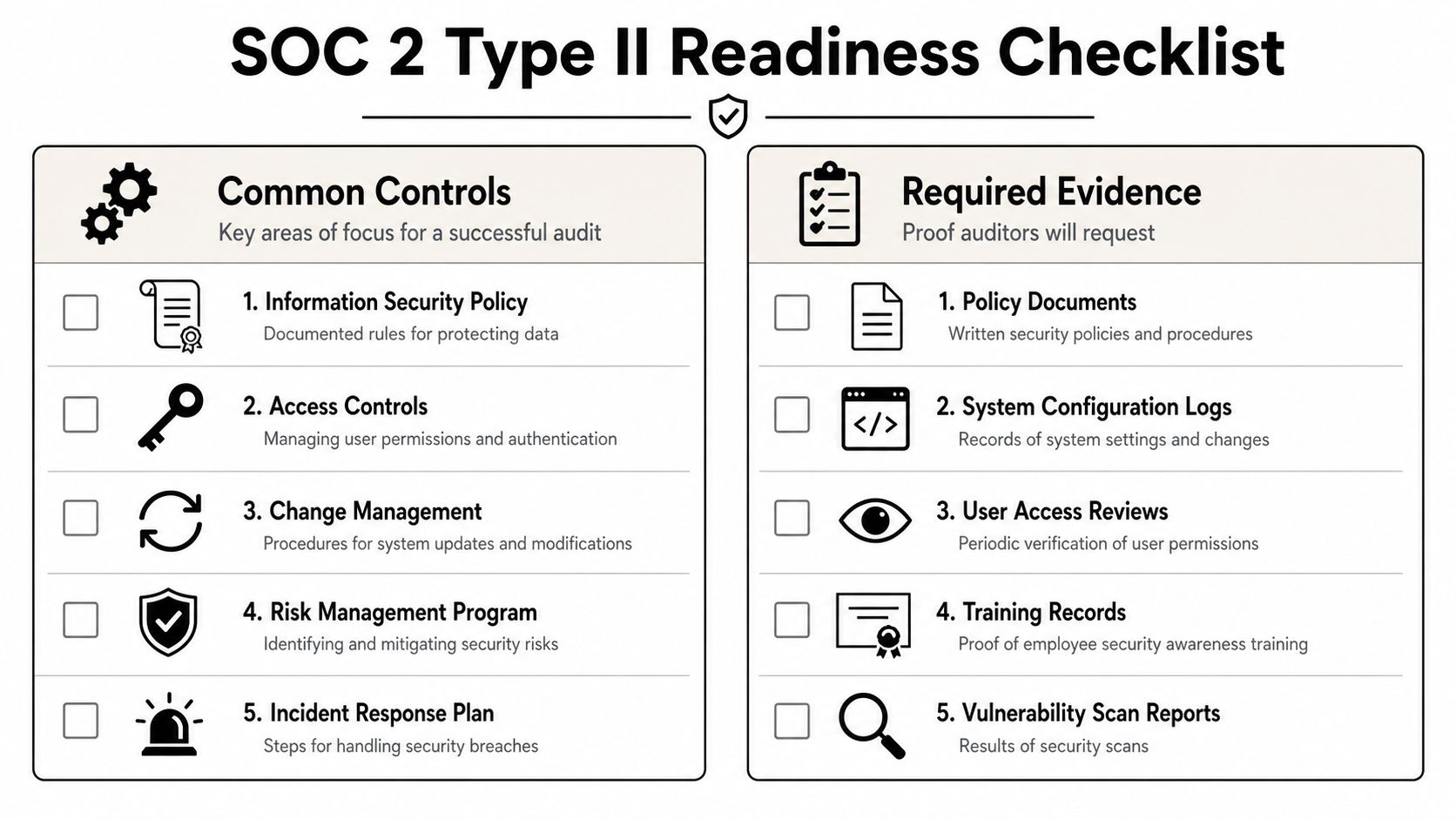
To achieve SOC 2 Type II, organizations must implement 12–15 core security policies and provide continuous evidence across 16+ technical control domains, including MFA enforcement, quarterly access reviews, AES-256 encryption, centralized logging, and annual penetration testing. Auditors reject point-in-time policy PDFs and demand system-generated logs spanning the full observation period, according to Policy Suite's breakdown of SOC 2 Type II policy requirements.
What buyers should expect to be true
A serious vendor should be able to support claims like these with operational evidence:
- Access governance. Users are provisioned intentionally, privileged access is limited, and reviews occur on a defined cadence.
- Authentication controls. MFA and centralized identity controls are enforced for relevant systems.
- Change management discipline. Product and infrastructure changes follow review and approval processes.
- Logging and monitoring. Security-relevant events are captured, retained, and reviewed.
- Encryption practices. Sensitive data is protected at rest and in transit.
- Incident response readiness. The vendor has a documented process and can show it has been exercised or maintained.
- Vendor management. Critical subprocessors and service providers are tracked and assessed.
Policy evidence versus system evidence
Here, many reviews go off track.
A procurement file full of policies may look organized, but auditors don't rely on policy PDFs alone. They look for evidence produced while the control was running. In practice, that means logs, access review records, tickets, backups, configuration exports, approval records, training logs, and testing artifacts.
| Evidence type | What it shows | Why it matters in CLM diligence |
|---|---|---|
| Policy document | Intent and governance | Useful, but not enough by itself |
| System-generated log | Actual operation of the control | Stronger proof for access, changes, and monitoring |
| Workflow audit trail | Who approved, changed, or signed what | Valuable for legal ops and internal accountability |
| Review record | Recurring control execution | Helps prove discipline over time |
Buyer check: Ask the vendor whether its platform naturally generates the records needed for access reviews, approval history, contract changes, and user actions. Mature systems usually can answer that quickly.
This distinction shows up outside software as well. If your organization is reviewing operational controls in broader projects such as facilities moves or regulated business changes, practical checklists like Ensuring UK office relocation compliance are useful because they focus on evidence, accountability, and execution rather than policy statements alone.
For legal operations teams, this same mindset improves internal governance. Platforms built around workflow history, repository controls, and action logs make it easier to support audits and investigations. That's one reason teams looking at contract automation also pay attention to how contract platforms improve compliance and risk management in day-to-day operations.
Understanding the Costs Pitfalls and ROI of Compliance
SOC 2 Type II is expensive because it forces an organization to build repeatable discipline across people, systems, and process. Buyers should see that cost as informative. It signals whether the vendor invested materially in risk reduction or just optimized for sales messaging.
The economics are substantial. The median first-year investment for SOC 2 Type II can be $300,000–$450,000. However, certified organizations win 3.4 times more enterprise contracts, and deals that include SOC 2 as a condition close 25–40% faster than those requiring compliance work during the sales cycle, based on Bemeir's SOC 2 Type II certification data.
What that means for buyers
A vendor that completed this process usually made choices that affect your risk posture positively:
- It funded control ownership instead of treating compliance as side work.
- It invested in evidence generation rather than relying on manual scramble.
- It aligned product, security, and operations teams around recurring auditability.
- It reduced friction in enterprise sales because fewer diligence questions go unanswered.
Common pitfalls during evaluation
Procurement teams still run into avoidable mistakes.
One is assuming cost automatically equals maturity. It doesn't. A vendor can spend heavily and still scope the audit poorly or fail to align controls with the actual product you're buying.
Another is ignoring the operational consequence of weak compliance. If the vendor has to retrofit controls in the middle of your security review, your deal slows down. Legal waits. Security asks for follow-ups. Sales loses momentum. The same dynamic appears inside organizations that improve workflow efficiency through reducing contract management costs with AI automation. Cleaner process lowers downstream friction.
Compliance ROI isn't abstract. Buyers feel it as fewer review cycles, fewer unanswered questionnaires, and fewer surprises after implementation.
For CLM, contract review, and legal technology buying, that translates into faster onboarding and a stronger basis for approving long-term use.
SOC 2 Due Diligence for CLM Vendors
Once the vendor sends the SOC 2 Type II report, the critical work begins. The report should shape your diligence questions, not end them.
A strong review is specific. It connects the report to the product, the workflow, and the data your business will use. For CLM software, that includes drafting, negotiation, AI contract review, approval routing, repository management, eSignatures, renewals, obligations tracking, and contract intelligence.
Questions worth asking
Scope and product coverage
Ask whether the audited environment includes the exact modules and services your team will use. If your business relies on AI review of third-party paper, contract analytics, or repository-wide search, those should be part of the diligence conversation.
Report freshness and bridge coverage
Check the report period and issuance date. If the report ended more than a few months ago, ask whether the vendor can provide a bridge letter explaining the current state of controls since the report period closed.
Exceptions and remediation
Experienced buyers separate mature vendors from polished decks at this stage. When responding to security RFPs, high-quality responses require explicitly disclosing exceptions alongside their remediation plans, as “honesty beats a vague clean claim” in vendor assessments. Failing to explain remediation rather than hiding deviations can derail deal velocity, according to guidance on SOC 2 responses in security questionnaires.
A well-explained exception with a remediation narrative is often more reassuring than a broad claim that avoids detail.
A practical review lens for legal and procurement
Use this checklist when reviewing a CLM vendor's materials:
- Does the scope match the product you're buying?
- Are the included criteria appropriate for the service?
- Is the report current enough for onboarding?
- Are exceptions disclosed clearly with remediation status?
- Can the vendor explain customer responsibilities versus vendor responsibilities?
- Will the full report be shared under NDA when needed?
Teams evaluating AI-assisted review tools often apply a similar lens to workflow-specific products such as AI contract review software, because the diligence standard should follow data sensitivity, not just software category.
Vendor oversight also shouldn't stop at onboarding. Mature procurement and legal operations teams treat this as part of broader vendor management best practices, with periodic review of report currency, scope changes, and control narratives over time.
SOC 2 Type II is most useful when buyers treat it as evidence of operational behavior. Not a checkbox. Not a slogan. A practical record of how a vendor runs.
If your team is evaluating AI contract management, contract automation, eSignature, or enterprise CLM software, Legitt AI is worth a close look. It combines AI-powered drafting, review, negotiation, approvals, repository management, obligation tracking, renewals, contract intelligence, and end-to-end workflow automation in one platform, with enterprise-grade security built for serious legal and procurement use.