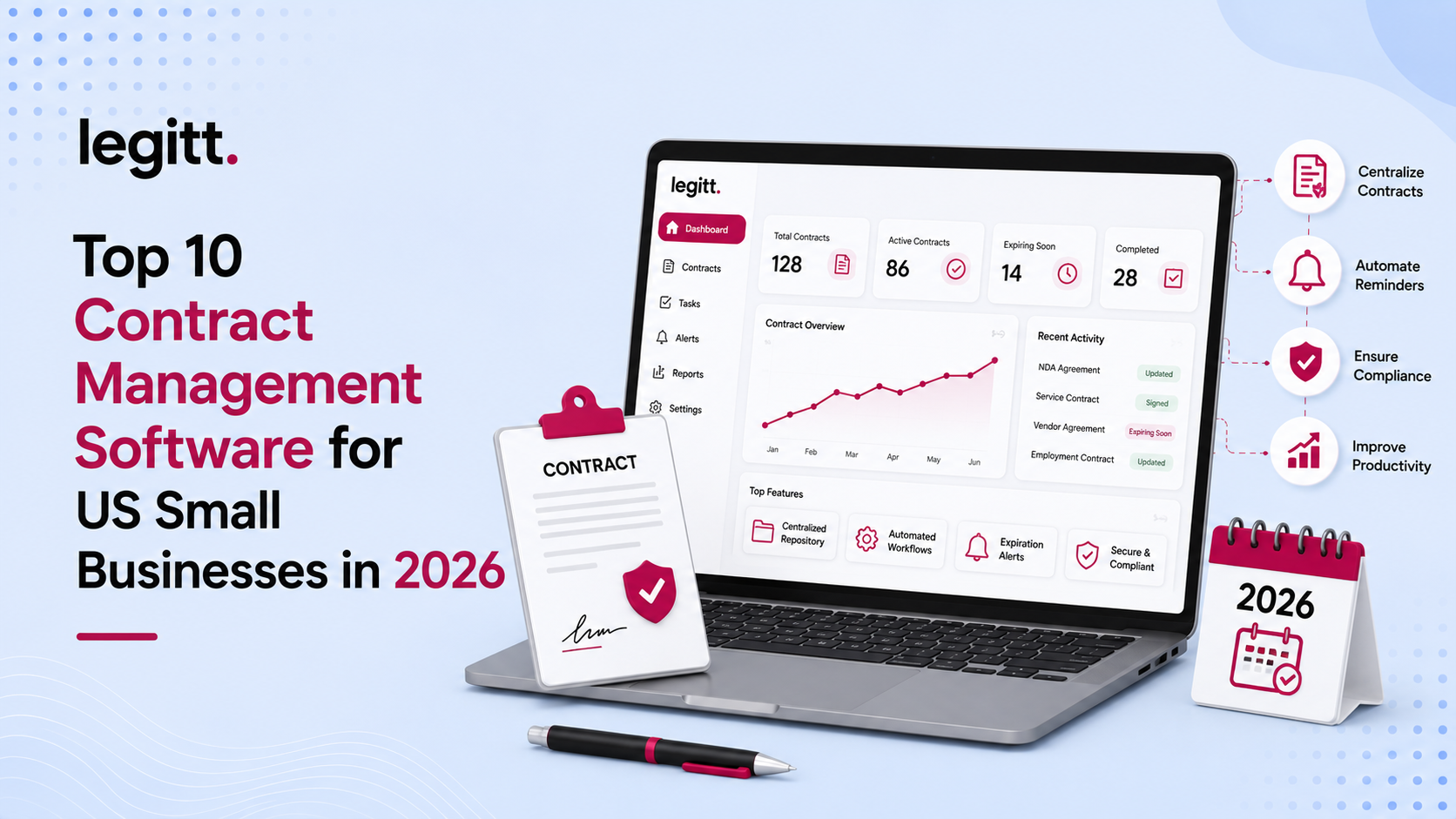
The contract lifecycle management market is no longer a niche legal category. For U.S. buyers, the market is projected to expand at a 12% CAGR from 2026 to 2035, rising from over USD 830 million in 2025 to around USD 2.57 billion by 2035. That matters for small businesses because CLM is becoming standard operating infrastructure, not a specialist add-on.
For SMBs, the primary risk isn’t just slow drafting. It’s scattered files, unclear approvals, missed notice dates, and contract data trapped in PDFs. Many teams first feel the pain after a renewal slips, a sales contract stalls in email, or finance can’t confirm what was signed. That’s why modern platforms now compete on end-to-end workflow, post-signature intelligence, and usability, not document storage alone.
This guide focuses on the Top 10 contract management software for US small businesses in 2026. It leans toward tools that help legal, sales, procurement, finance, and founders work in one contracting system instead of stitching together drives, inboxes, Word files, and e-sign apps. If you’re also evaluating upstream document capture, it’s worth understanding how choosing intelligent document processing affects contract intake quality.
The shortlist below gets to the point. Each platform is assessed through an SMB lens: how fast your team can adopt it, how much workflow depth you gain, where AI helps, and where complexity may outweigh the benefit.
1. Legitt AI
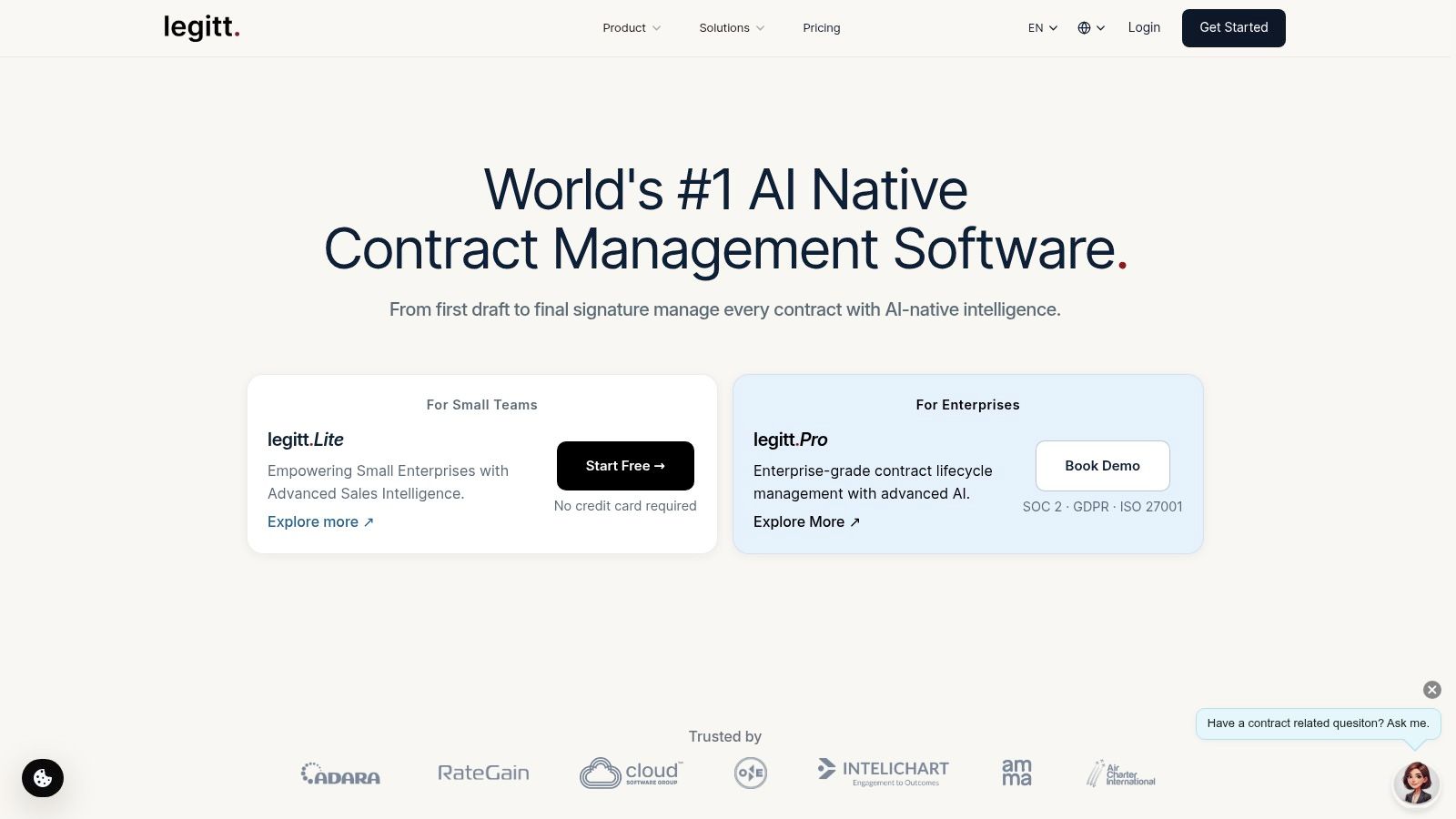
Contracting breaks down for small businesses when data has to be re-entered across Word files, email threads, CRM records, approval chains, and e-sign tools. Legitt AI addresses that operational problem with a single workflow for drafting, review, approvals, signature, storage, and post-signature tracking. For a 2026 SMB buyer, that matters because this category is shifting from document storage toward systems that can manage the full contract lifecycle and apply AI to the contracts already in the repository, as highlighted in this 2026 workflow-focused CLM buyer overview.
The product is a strong fit for companies where one agreement touches sales, legal, finance, and operations. A sales team can start from an approved template, legal can review redlines, finance can verify pricing or payment terms, and the signed contract stays in the same system for obligations and renewals. That reduces handoff risk, which is often where smaller teams start to feel the cost of fragmented process.
Why Legitt AI ranks first
Legitt AI scores well in this list because it covers the full lifecycle and applies AI in areas that produce measurable time savings. Its feature set includes plain-English drafting, third-party paper review, clause extraction, version comparison, obligation tracking, renewal alerts, semantic search, repository analysis, and built-in eSignature. The Microsoft Word add-in is a practical advantage for SMBs. It lowers change-management friction because teams can work inside a familiar interface while still following controlled workflows.
Integrations also carry real weight here. Legitt AI connects with Salesforce, HubSpot, Microsoft Dynamics 365, Microsoft 365, Slack, Zapier, QuickBooks, Zoho, Oracle, and APIs. For small businesses, that means contracts can feed downstream systems used by sales, finance, and operations instead of sitting as static PDFs in a folder.
Practical rule: If your CRM, communication tools, and contract repository are disconnected, staff spend time rekeying data, checking versions, and chasing approvals.
A few strengths stand out:
- AI drafting with governance: Teams can generate first drafts from approved templates and clause libraries, then review deviations against company standards.
- Useful post-signature intelligence: Lana AI and related agents review third-party paper, extract key terms, flag risks, and identify obligations and renewal dates.
- Security for larger counterparties: SOC 2 Type II, ISO 27001, ISO 27701, GDPR, HIPAA, SSO, MFA, RBAC, and AES-256 help smaller companies meet procurement and security review requirements.
- Range across company size: Legitt Lite gives smaller teams a lower-friction starting point, while Legitt Pro supports broader deployments.
Best fit and tradeoffs
Legitt AI is best for SMBs that want one contracting platform rather than a proposal tool plus e-signature app plus folder-based repository. It is also one of the better options for buyers who care about the practical use of AI, especially in drafting, redline review, and extracting obligations from signed agreements. If your team is building a shortlist for 2026, this is the kind of platform that aligns with a broader contract lifecycle management system for growing businesses rather than a narrow point solution.
The tradeoff is buying clarity. Pricing is not public, so evaluation requires a demo and a careful review of implementation scope, integrations, and AI configuration. As with any AI-driven CLM, results depend on how well your templates, fallback clauses, approval rules, and metadata structure are set up. This guide on improving contract management with AI is useful if you’re thinking through that rollout.
Legitt AI is the strongest fit in this ranking for SMBs that want AI-assisted contracting across creation, negotiation, execution, and ongoing contract operations.
2. PandaDoc
PandaDoc is often the easiest bridge from e-signature software to broader contract workflow. Many small businesses start with proposals, quotes, or sales documents, then expand into approvals, reusable templates, and CRM-linked contracting.
That origin matters. PandaDoc doesn’t force an SMB to think like an enterprise legal team on day one. It gives sales and operations users a fast path to standardization, especially when contracts are closely tied to deal flow.
Where PandaDoc works best
Its drag-and-drop builder, content library, audit trails, approval flows, and integrations with tools like Salesforce, HubSpot, Google Drive, and Zapier make it attractive for companies that need adoption quickly. If your contracting bottleneck lives in sales handoff, proposal-to-contract transition, or signature turnaround, PandaDoc is usually easier to operationalize than a heavier CLM.
PandaDoc is less compelling when legal needs deeper clause governance, complex fallback logic, or highly structured negotiation controls. Those capabilities tend to sit higher in the product stack.
PandaDoc is best viewed as a business workflow platform with contract capability, not just a repository with signatures attached.
A few practical notes:
- Best for founder-led and sales-led SMBs: It reduces friction for teams that need documents out the door quickly.
- Good pricing visibility: Public plans make it easier to compare without a long procurement cycle.
- Less ideal for complex legal review: If outside counsel or in-house legal needs playbook-based governance, you may outgrow the simpler setup.
For smaller teams still defining what a contract lifecycle management system should cover, PandaDoc can be a sensible starting point.
Explore PandaDoc.
3. Concord
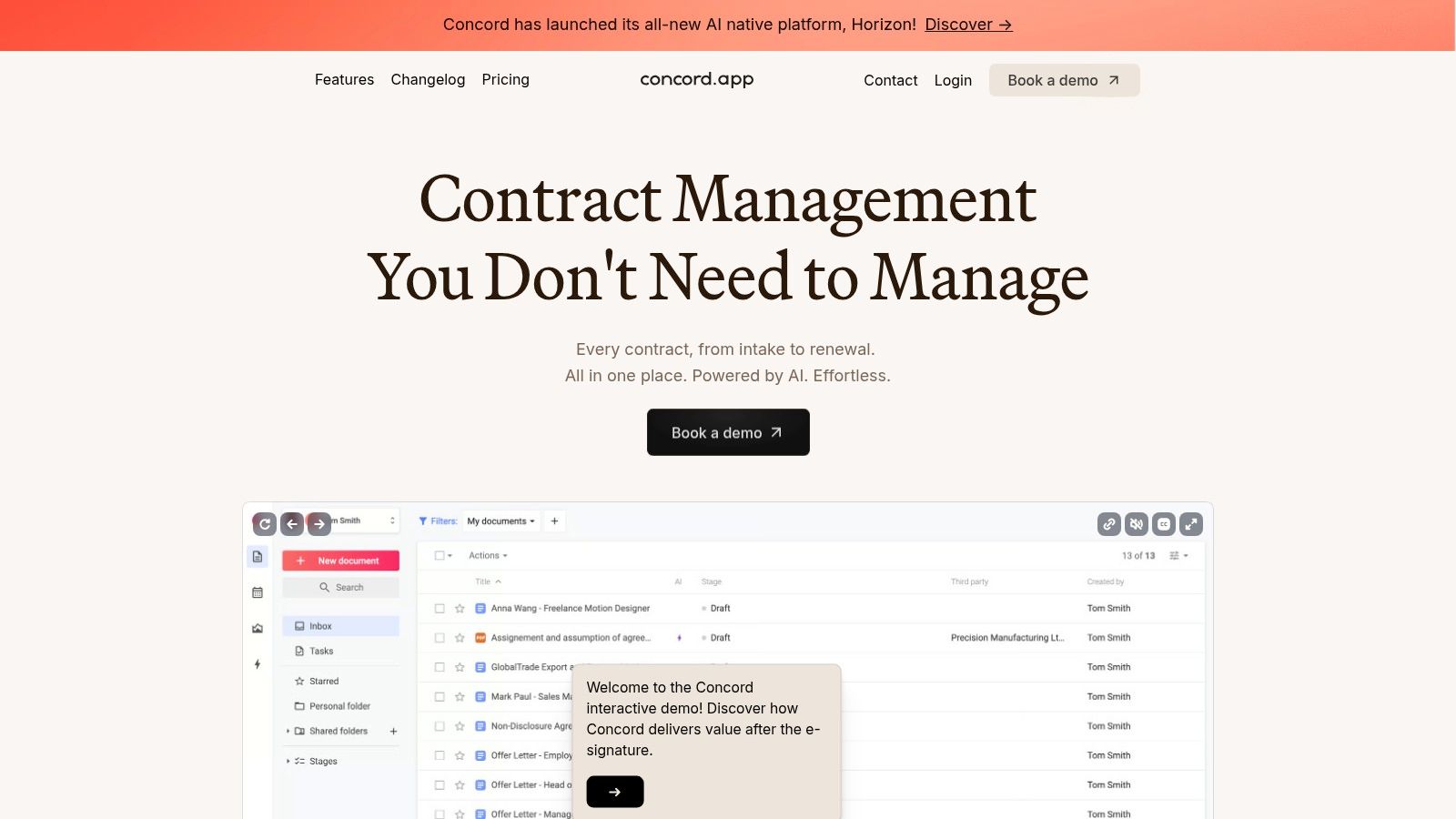
Concord sits in a useful middle ground. It offers a modern CLM experience with AI-assisted work, but it still feels oriented toward small teams that want to go live without a long implementation cycle.
That combination is hard to get right. Some CLMs become too simple to govern contracting well. Others become so configurable that an SMB never fully rolls them out. Concord stays closer to the usability side of that line.
Why SMB teams shortlist Concord
Concord includes templates, online redlining, version control, intake forms, approval workflows, AI extraction, and integrations with Salesforce, HubSpot, Box, Dropbox, Google Drive, and Zapier. Transparent packaging also helps buyers estimate total cost earlier than with quote-only vendors.
Its biggest appeal is that non-technical teams can usually understand the workflow quickly. Legal can retain control over templates and approvals, while business users can still initiate and move contracts forward.
- Strong collaboration model: Internal and external parties can work in one negotiation thread instead of passing versions over email.
- Reasonable path for growing teams: It has enough workflow structure for expansion beyond simple signature use cases.
- Watch seat economics: If you expect broad internal adoption, added-user costs can change the cost profile.
For companies moving away from drives and spreadsheets, Concord is often a cleaner first CLM than trying to implement a highly customized enterprise product. If you need a refresher on the basics, this overview of what contract management software is gives useful context.
Visit Concord.
4. ContractSafe
If your main problem is contract visibility, not complex drafting logic, ContractSafe is one of the simplest products to justify. It was built around repository-first contract management, which is still the right answer for many SMBs that need control before sophistication.
That sounds basic, but repository quality determines whether a business can act on renewals, obligations, and notice periods. A platform nobody uses won’t save you from a missed date.
The lightweight option with fewer surprises
ContractSafe focuses on secure storage, OCR-based search, reminders, reports, onboarding support, and optional redlining, approvals, and e-signature. Unlimited users are a practical advantage because it removes the seat-count friction that often blocks wider access.
This matches a key SMB buying question raised in 2026 market coverage: is the tool a lightweight contract tracker or a system that becomes a second software project? That distinction is central in this small-business contract software analysis.
A lightweight CLM is often the better financial decision when your biggest risk is disorganization, not the absence of advanced AI.
ContractSafe is a good fit when:
- You need one source of truth fast: Centralized storage and reminders solve immediate operational pain.
- You want low admin overhead: Onboarding and migration support matter for first-time CLM buyers.
- You don’t need deep pre-signature orchestration yet: Heavier workflow design is not its strongest angle.
For teams struggling with scattered contracts and manual reminders, these common contract management challenges for small businesses map closely to the use case ContractSafe solves.
See ContractSafe.
5. ContractWorks by Onit
ContractWorks is a strong option for teams that want just enough CLM to improve control without overengineering the process. That “just enough” positioning is more valuable than it sounds. Many small businesses don’t need a highly modeled enterprise workflow. They need searchable contracts, key-date tracking, template-based generation, approvals, and signatures in one place.
ContractWorks delivers that operational middle ground well.
Why it appeals to lean legal and operations teams
The product centers on a repository with OCR search, smart tagging, renewal alerts, templates, approval workflows, and built-in e-signature. Unlimited users also make internal access easier to justify, particularly for operations, finance, and procurement stakeholders who need occasional visibility.
Where it tends to win is speed. Teams can centralize contracts, assign metadata, and begin deadline tracking without designing a large governance framework first.
- Good for broad internal access: Unlimited-user licensing helps companies avoid hoarding access inside legal.
- Balanced feature set: It goes beyond storage but doesn’t push buyers into enterprise-level complexity.
- Narrower integration profile: If CRM and workflow integration are central to your ROI model, compare carefully.
This is often the better choice for companies that have outgrown spreadsheets but aren’t ready for a full legal ops buildout. If that stage sounds familiar, this overview of CLM for small business aligns closely with the use case.
Visit ContractWorks.
6. Juro
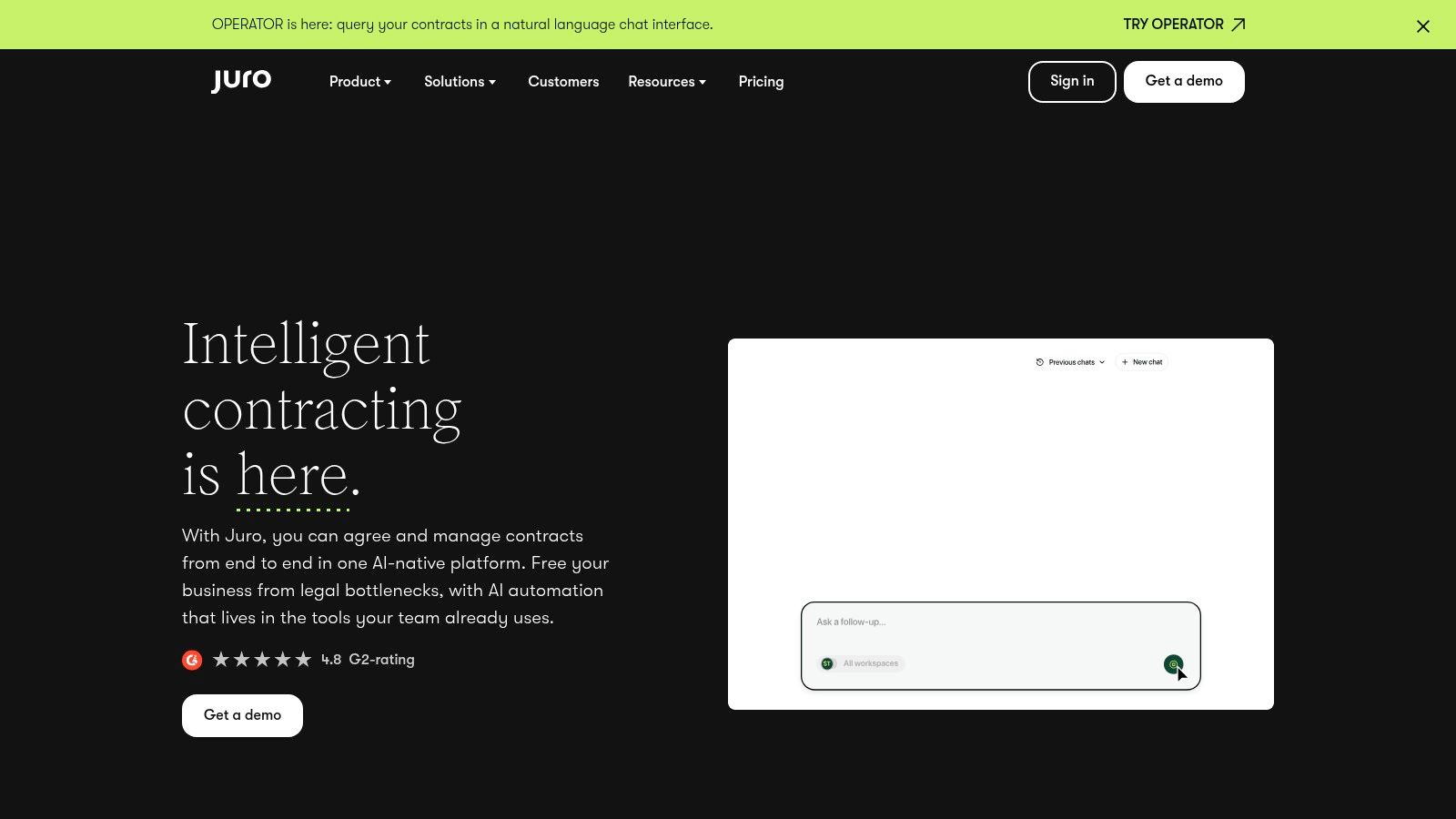
Juro is one of the clearest examples of browser-native contracting. If your team wants contracts to behave more like collaborative cloud documents than email attachments, Juro deserves a close look.
That design choice has business consequences. Adoption tends to improve when sales, HR, procurement, and legal can work in the same interface without bouncing between Word files, PDFs, and separate signing tools.
Best for high-collaboration SMBs
Juro combines in-browser creation, negotiation, AI-assisted drafting and review, searchable repository functionality, e-signature, and integrations with Salesforce, HubSpot, Slack, Word, and Zapier. The product is especially attractive to growth-stage teams where legal supports many business users but can’t become a bottleneck.
Its value shows up most clearly in repeated contract types. Employment agreements, NDAs, vendor contracts, and standard sales agreements move faster when everyone works from controlled templates inside one shared workflow.
If your business users resist legal tools, a browser-native editor often changes adoption more than another layer of automation does.
Juro is strongest when:
- Cross-functional contracting is frequent: It supports legal and non-legal collaboration well.
- Template discipline matters: Standardized agreements become easier to self-serve.
- You can handle quote-based buying: Pricing isn’t public, so budget validation takes longer.
Explore Juro.
7. SpotDraft
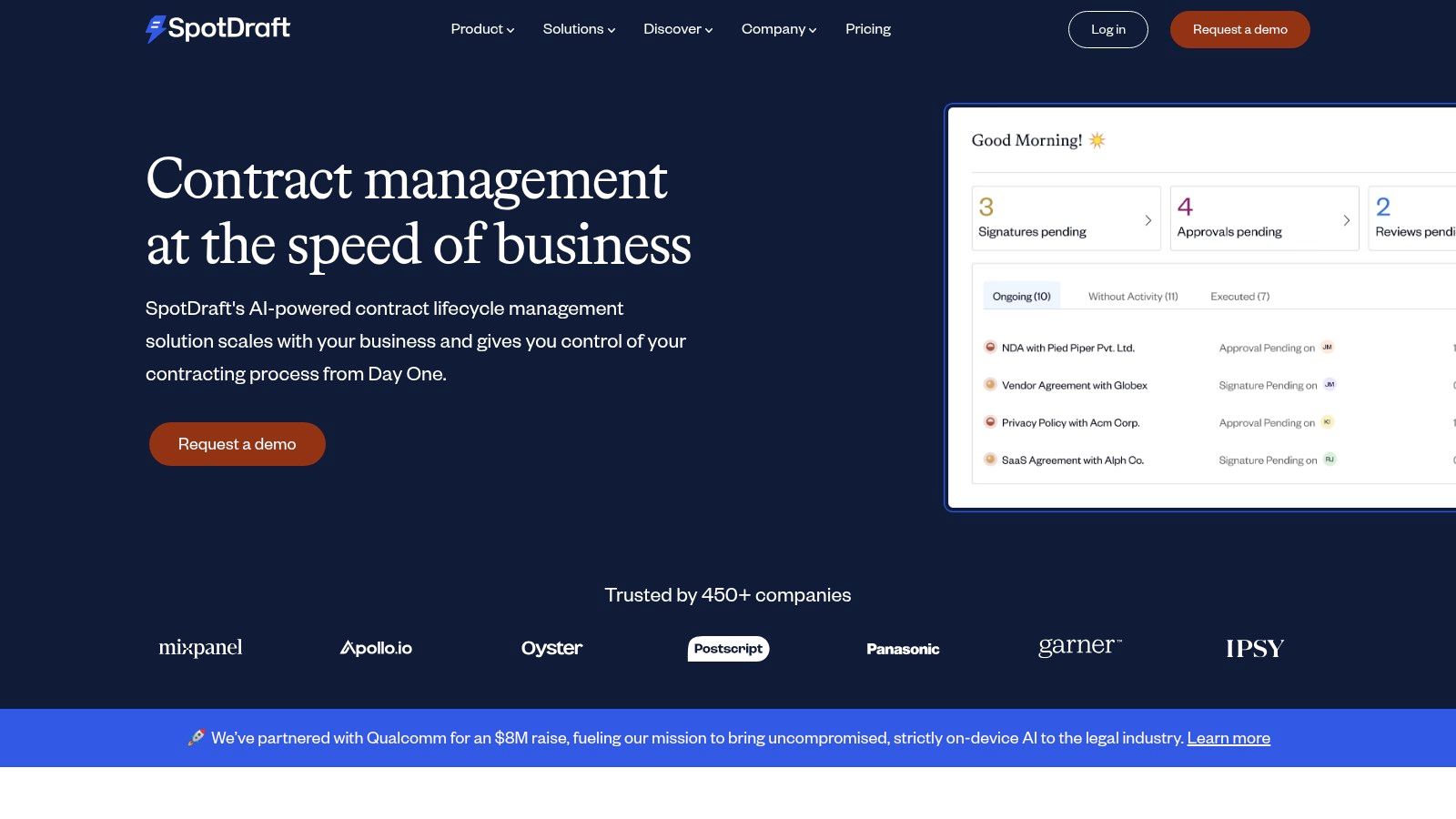
SpotDraft is a good fit for legal teams that want AI support but still prioritize process control. It tends to appeal to companies where contract intake is messy, approvals are inconsistent, and legal needs to standardize how requests enter the system.
That makes it more workflow-driven than some repository-first products.
Where SpotDraft makes sense
Its intake portal, structured approvals, AI-assisted drafting and review, clause and playbook management, bulk generation workflows, and Word-connected review options give it a practical legal ops flavor. For SMBs with growing contract volume, that can be a major advantage because it helps legal spend less time chasing context.
SpotDraft is particularly useful when the same team supports HR, procurement, and sales contracting. Bulk generation for repeated documents can reduce repetitive manual work, while approval routing prevents contracts from bypassing policy.
- Strong intake discipline: Better request quality often matters as much as faster review.
- Useful for growing internal legal teams: It supports standardization without immediately requiring a full enterprise stack.
- Expect quote-based evaluation: Buyers need a demo to understand packaging and advanced modules.
Use SpotDraft if your contracting challenge is less about storage and more about controlling the path from request to signature.
8. Contractbook
Contractbook is one of the more approachable CLM tools for small teams that want to start with templates and structured data. It works well when your goal is to turn repeatable contracts into governed workflows rather than manage highly negotiated legal paper.
That distinction matters. SMBs often get more value from consistency than from maximum configurability.
Why Contractbook is attractive for early CLM maturity
The platform combines templates, conditional logic, e-signature, AI import and extraction, searchable data fields, integrations, and packaged tiers aimed at smaller businesses. It also fits a broader 2026 market trend: contract value increasingly comes from searchable repositories, metadata capture, renewal workflows, and analytics, not just workflow automation. That trend is visible in Zylo’s description of a dataset spanning more than 40 million SaaS licenses and $75 billion in SaaS and cloud spend under management, which it uses for pricing benchmarks and renewal management.
For SMBs, the takeaway isn’t the scale itself. It’s the operating model behind it. Contract data becomes more valuable when extracted early, stored cleanly, and connected to renewal and usage decisions later.
- Good for repeatable business agreements: Templates and automation reduce drafting inconsistency.
- Clearer packaging than some quote-only vendors: That’s useful for buyers trying to control software spend.
- Watch tier limits: Entry plans may be too restrictive for a multi-user contracting process.
Visit Contractbook.
9. Oneflow
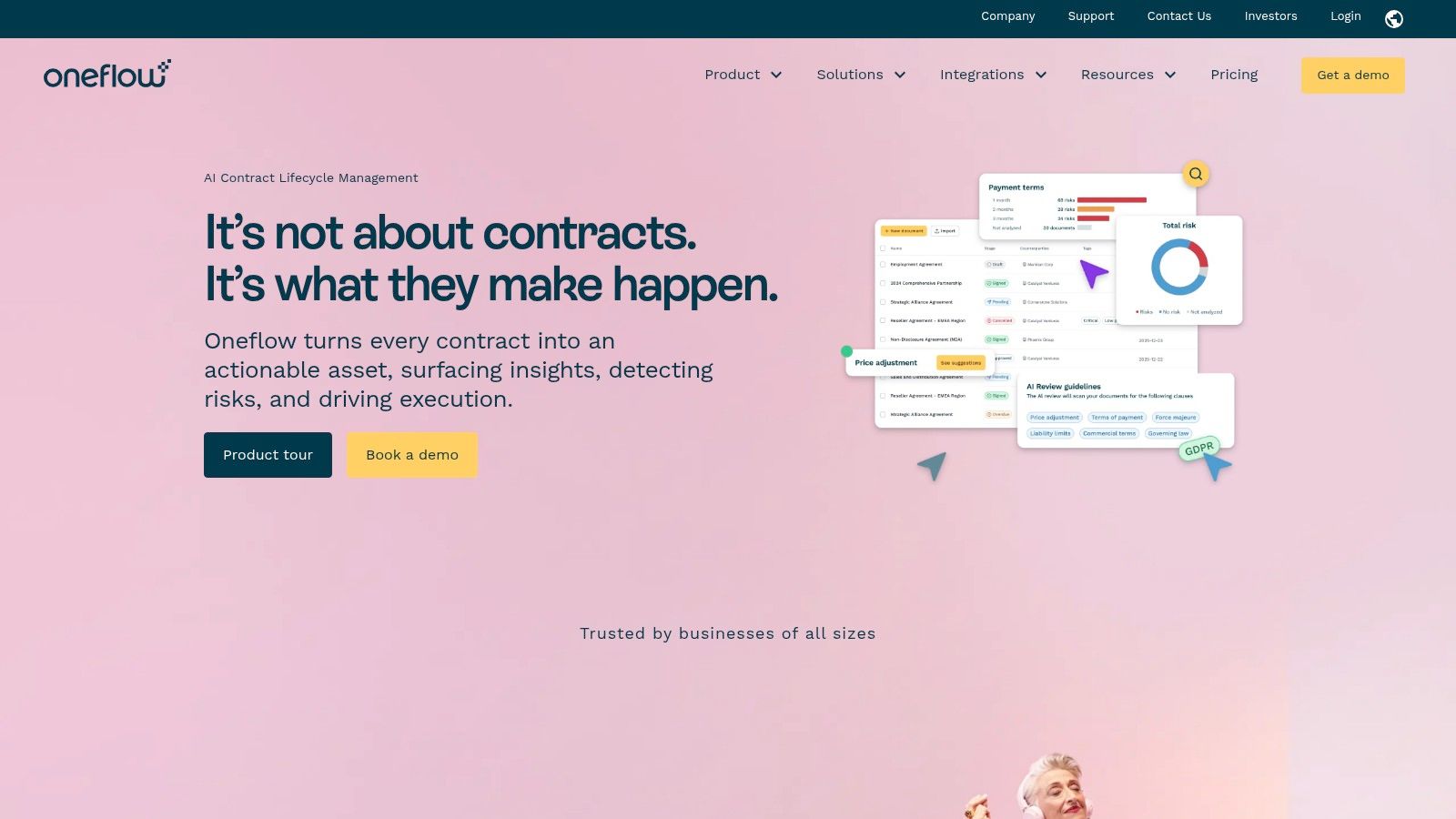
Oneflow takes a different approach from file-centric CLMs. It treats contracts as live digital documents that can be edited and negotiated in the browser. For U.S. SMBs with fast-moving sales cycles, that can reduce version confusion and shorten the back-and-forth between legal and commercial teams.
This approach isn’t ideal for every business. But when multiple stakeholders repeatedly edit the same agreements, live collaboration can remove a surprising amount of friction.
Best for sales and legal teams that co-own contracts
Oneflow supports live co-editing, comments, AI writing and review assistance, metadata, contract calendars, signing, repository functions, and integrations with CRM and storage tools. The platform is especially strong where sales, customer success, and legal all touch the same contract before close.
Its real advantage is post-signature structure. When contract content is created as structured data rather than only uploaded as static files, reporting and tracking become easier later.
The best CLM for a revenue team isn’t always the one with the most legal features. It’s the one sales will actually use without bypassing it.
Keep Oneflow on your shortlist if:
- Your team hates version chaos: Real-time editing addresses a real operational pain point.
- Sales and legal need one shared workspace: The workflow is built for that overlap.
- You need advanced governance carefully validated: More complex controls may sit higher in the product stack.
Explore Oneflow.
10. LinkSquares
LinkSquares belongs on this list because many SMBs underestimate post-signature contract intelligence. They buy for drafting and signatures, then later realize they still can’t answer basic business questions about obligations, renewals, or non-standard terms across the repository.
LinkSquares leans into that problem.
The analytics-first choice for legal-led teams
Its strengths include AI-assisted drafting and review, Microsoft Word integration, templates, clause libraries, reminders, reporting dashboards, obligation tracking, and business-system integrations. The product is especially relevant for in-house legal teams that need both lifecycle workflow and stronger visibility into what has already been signed.
That focus aligns with an undercovered buying issue in 2026 coverage: post-signature intelligence is becoming central to contract value, especially as more platforms add AI extraction, obligation tracking, renewal alerts, and analytics. This 2026 contract software roundup highlights that broader shift from storage toward workflow automation and reporting.
- Strong for repository intelligence: Legal and finance teams benefit when executed contracts become searchable operational data.
- Useful for obligations and renewals: That matters more than most SMBs realize until they miss something important.
- May be more platform than very small teams need: Implementation scope and pricing are usually better suited to companies with an active legal function.
Visit LinkSquares.
Top 10 Contract Management Software Comparison for US Small Businesses (2026)
| Product | Core Capabilities | AI & Unique Features | Target Audience | Integrations & Security | Pricing & Value |
|---|---|---|---|---|---|
| Legitt AI 🏆 | End-to-end CLM: drafting, redlines, approvals, built-in eSign, repo & audit trails | ✨ Lana assistant, clause extraction, risk/deviation analysis, repo-wide insights, Word add-in | 👥 Legal, Sales, Procurement, Finance, SMB → Enterprise | Salesforce, HubSpot, Dynamics, Word, Slack, Zapier, REST APIs; SOC2, ISO27001/27701, GDPR, HIPAA, SSO/MFA, AES‑256 | 💰 Lite & Pro tiers; 15‑day free trial; demo for enterprise, ★★★★★ |
| PandaDoc | Document builder, eSign, approval workflows, proposal-to-contract flows | ✨ Rich templates & editor for proposals; easy eSign | 👥 SMBs, sales teams, proposal owners | Salesforce, HubSpot, Zapier, Google Drive; standard security controls | 💰 Clear public plans + free tier, ★★★★☆ |
| Concord | Drafting, online redlines, unlimited eSign, reminders & workflows | ✨ AI Copilot & extraction; templates & intake forms | 👥 Small → mid-market teams seeking fast adoption | Salesforce, HubSpot, Box/Dropbox/Google Drive, Zapier; SSO on higher tiers | 💰 SMB-friendly transparent plans, ★★★★☆ |
| ContractSafe | Centralized repo with OCR search, renewal alerts, onboarding & support | ✨ OCR “smart search”; unlimited users included | 👥 Small teams, first-time CLM buyers | Salesforce & Zapier on higher tiers; vendor-led onboarding | 💰 Clear packaging; includes onboarding, ★★★★ |
| ContractWorks (Onit) | Repository, OCR search, tagging, alerts, approval workflows, eSign | ✨ Template-based generation; simple admin & unlimited users | 👥 Lean legal & ops teams wanting predictability | SSO, admin controls; narrower integration catalog | 💰 Predictable unlimited-user licensing, ★★★★ |
| Juro | Browser-native creation, negotiation, eSign; high-adoption UX | ✨ AI drafting/review; in-app redlining; no per-seat penalties for casual users | 👥 Sales, procurement, HR, legal; scale-ups & high-velocity teams | Salesforce, HubSpot, Slack, Word, Zapier | 💰 Quote-based; flexible packaging, ★★★★ |
| SpotDraft | Intake → signature, playbooks, Word-connected review, bulk generation | ✨ Bulk generation “campaigns”; clause/playbook management | 👥 Growth-stage legal teams, HR, procurement | Word editor + growing integrations; enterprise controls tiered | 💰 Quote-based; balanced for growth, ★★★★ |
| Contractbook | Template-driven CLM, automations, eSign, guided onboarding | ✨ AI import & data extraction; conditional logic automations | 👥 SMBs needing template + automation clarity | Salesforce (higher tier), HubSpot, Zapier/Make, API | 💰 Transparent USD tiers; entry tier limited, ★★★★ |
| Oneflow | Live co-editing, in-contract comments, e-sign, contract calendar | ✨ Live “structured” contracts for real-time negotiation & reporting | 👥 Sales ↔ Legal collaboration, teams needing live contracts | CRM & Drive integrations; eID-compliant signing | 💰 Pricing/currency varies by region, ★★★★ |
| LinkSquares | Creation, repo analytics, reporting, obligation tracking | ✨ Strong post-signature analytics & Word integration | 👥 In-house legal teams needing deep analytics | Salesforce, Google Drive; enterprise-grade controls | 💰 Quote-based; tends to be higher-tier, ★★★★ |
Making Your Final Decision From Shortlist to Implementation
The best contract management software for a U.S. small business in 2026 isn’t the one with the longest feature list. It’s the one your team can adopt, trust, and extend without creating a second operations burden. That’s the central buying mistake SMBs still make. They compare AI labels and feature grids, but they don’t ask how the system will behave in real workflows between sales, legal, finance, procurement, and leadership.
Three decision filters matter most.
First, decide whether you need a repository-first tool or a full CLM. If your current pain is scattered files, missed dates, and no shared contract record, products like ContractSafe or ContractWorks may deliver value fastest. If your issue starts earlier, such as inconsistent intake, redlining chaos, approval delays, and poor coordination before signature, tools like Legitt AI, Juro, SpotDraft, or Concord are stronger fits.
Second, evaluate workflow coverage, not isolated features. The strongest SMB tools now combine intake, template-driven drafting, negotiation, approvals, repository management, obligations, renewals, and e-signature in one connected process. That matters because each manual handoff creates delay, confusion, and data loss. A contract platform should reduce tool-switching, not formalize it.
Third, test post-signature usefulness before you buy. Many businesses focus on contract creation because that’s the visible part of the process. The bigger long-term payoff often appears after signature, when teams need to search terms, monitor renewals, track obligations, compare third-party paper against standards, and connect contract data to CRM or finance workflows. That’s where tools with stronger contract intelligence create more durable ROI.
A practical shortlist strategy works better than broad demos. Pick three tools based on operating model:
- Choose an end-to-end AI-native option if you want one system across drafting, review, approvals, e-signature, and intelligence.
- Choose a lightweight repository-led option if your main need is centralization and deadline control.
- Choose a collaboration-first option if sales, legal, and business users repeatedly negotiate the same types of agreements.
Then run the same test scenario in each demo. Use one vendor agreement, one customer-facing contract, and one renewal use case. Ask each vendor to show how your team would intake the request, draft or upload the contract, review changes, route approvals, sign, store the final version, and trigger follow-up alerts. That workflow reveals more than any feature page.
The final buying question is simple. Will this platform save your team from avoidable manual work without demanding enterprise-level administration? For most SMBs, that balance determines success more than any AI headline does. If you focus on adoption, workflow coverage, and post-signature intelligence, you’ll choose a CLM platform that supports growth through 2026 and beyond.
If you want a contract platform that combines AI drafting, review, negotiation, e-signature, repository management, renewal tracking, and business-ready contract intelligence in one system, Legitt AI is worth a close look. It’s a strong fit for small businesses that want enterprise-grade workflow and security without turning CLM into a long implementation project.