
In today’s enterprise environment, contracts are no longer static legal instruments stored away after signature. They actively govern revenue realization, compliance posture, service delivery, and long-term commercial relationships. Every contract contains multiple obligations and deadlines-many of which are time-bound, conditional, or recurring. When these are missed, the consequences can be severe, ranging from financial penalties and revenue leakage to regulatory non-compliance and reputational damage.
Despite this risk, most organizations continue to rely on spreadsheets, email reminders, and periodic manual reviews to manage obligations. These approaches were never designed to handle scale, complexity, or real-time monitoring. As contract volumes grow and obligations become increasingly nuanced, manual systems fail silently.
Artificial Intelligence (AI) has emerged as a foundational capability for modern obligation and deadline management. By combining natural language processing (NLP), machine learning, and automation, AI enables organizations to extract, track, monitor, and enforce contractual obligations continuously and accurately.
This article explains how AI-driven obligation tracking works, why traditional methods are insufficient, and how enterprises can implement AI to transform obligation management into a proactive, intelligence-driven process.
What Are Contractual Obligations and Deadlines?
A contractual obligation is any legally binding commitment that requires a party to perform an action, refrain from an action, or maintain compliance with specified conditions. Deadlines define the timeframe within which those obligations must be fulfilled.
Typical examples include payment milestones, delivery timelines, renewal and termination notice periods, service-level commitments, compliance certifications, audit rights, and reporting requirements. These obligations are often embedded deep within legal language, expressed in relative or conditional terms, and spread across multiple clauses, schedules, and amendments.
The inherent complexity of how obligations are written makes them difficult to track manually with accuracy or consistency.
Why Traditional Obligation Tracking Methods Fail
Manual obligation tracking systems struggle because contracts are fundamentally unstructured. Obligation data is buried in paragraphs, not stored in databases. As a result, tracking depends entirely on human interpretation and data entry, which introduces risk and inconsistency.
Additionally, obligations often change over time due to amendments, renewals, or evolving business conditions. Manual systems rarely reflect these changes in real time. Most importantly, traditional tools lack intelligence-they cannot understand priority, risk, or contractual context. As contract volumes increase, these limitations become operationally unsustainable.
 Hi, What do you want to Draft?

Click to upload or drag & drop
pdf, docx up to 5 MB
Click to upload or drag & drop
pdf, docx up to 5 MB
What AI-Driven Obligation and Deadline Tracking Means
AI-driven obligation tracking refers to the use of advanced AI models to interpret contract language, extract obligations and deadlines, and convert them into structured, actionable data that can be monitored continuously.
Instead of relying on periodic reviews, AI systems maintain constant awareness of contractual commitments. They not only identify obligations but also understand timing, conditions, ownership, and risk. This allows organizations to move from reactive compliance to proactive obligation management.
Platforms such as Legitt AI (www.legittai.com) apply AI across the entire contract lifecycle, ensuring that obligations are continuously tracked from execution through completion, renewal, or termination.
Step 1: AI-Based Obligation Extraction
The first step in AI-driven obligation tracking is automatic extraction. Using NLP models trained on legal language, AI can read contracts in the same way a legal professional would-at scale.
AI identifies obligation-indicating language such as “shall,” “must,” or “is required to,” along with time-bound phrases like “within 30 days” or “prior to renewal.” It also determines which party is responsible and whether the obligation is one-time, recurring, or conditional.
The result is structured obligation data that includes the obligation description, responsible party, deadline or trigger, clause reference, and risk level-without manual tagging.
Step 2: Deadline Normalization and Event Modeling
Contracts rarely specify obligations using fixed calendar dates. Instead, deadlines are often relative to events or expressed in legal terms that require interpretation.
AI normalizes these deadlines by calculating relative timelines, distinguishing business days from calendar days, and linking obligations to triggering events such as invoice receipt, delivery, or breach. Recurring obligations, such as annual certifications or periodic reports, are modeled as cycles rather than one-off tasks.
This dynamic modeling ensures that deadlines remain accurate even as underlying conditions change.
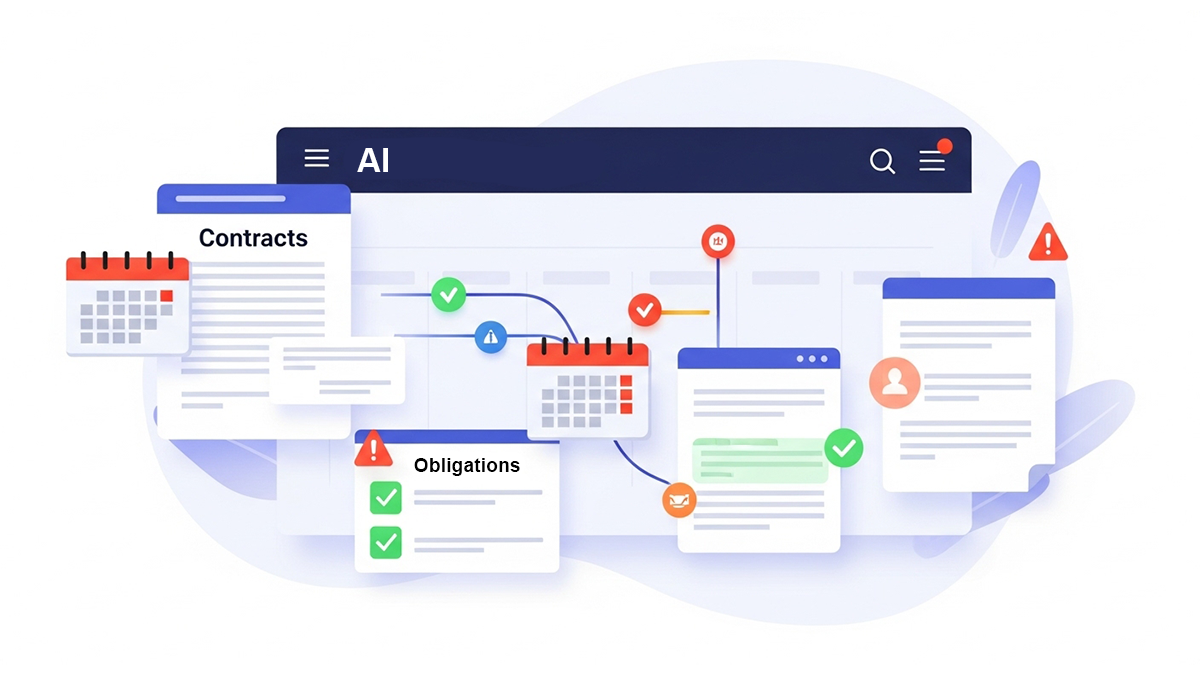
Step 3: Centralized Obligation Ledger
Once obligations are extracted and normalized, they are stored in a centralized obligation ledger. This ledger acts as a single source of truth across all contracts and departments.
The ledger enables real-time visibility into upcoming obligations, overdue commitments, renewal windows, and compliance exposure. Stakeholders can query obligations by contract, counterparty, department, risk level, or timeframe.
Solutions like Legitt AI (www.legittai.com) provide obligation ledgers tightly integrated with contract repositories, ensuring that obligation intelligence remains directly connected to source documents.
Step 4: Intelligent Alerts and Escalations
AI-driven systems continuously monitor obligations and generate intelligent alerts. Unlike basic reminders, these alerts are context-aware and adaptive.
Alerts can trigger at multiple stages, escalate if deadlines approach without action, and notify the appropriate stakeholders automatically. If a contract is amended or renewed, timelines are recalculated without manual intervention.
This ensures that obligations do not rely on individual memory or ad-hoc follow-ups.
Step 5: Workflow Automation and Accountability
Effective obligation tracking requires execution, not just visibility. AI systems integrate obligations into operational workflows.
When an obligation is due, tasks can be created automatically, ownership assigned, and progress tracked. Workflows can integrate with CRM, ERP, finance, and ticketing systems, ensuring obligations move seamlessly across teams.
Legitt AI (www.legittai.com) embeds obligation workflows into sales, legal, finance, and operations processes, ensuring accountability is enforced consistently.
Step 6: Continuous Monitoring and Adaptive Learning
AI systems improve over time by learning from new contracts, amendments, and organizational patterns. They adapt to company-specific templates, language, and risk thresholds.
Whenever a contract is updated, obligations are automatically re-extracted and adjusted. This ensures the obligation ledger remains accurate and current throughout the contract lifecycle.
Step 7: Risk Scoring and Prioritization
Not all obligations carry equal importance. AI assigns risk scores based on financial exposure, regulatory impact, counterparty criticality, and historical performance.
This allows organizations to prioritize high-risk obligations, allocate resources effectively, and prevent costly failures before they occur. Risk-based prioritization transforms obligation management from administrative tracking into strategic risk control.
Organizational Benefits of AI Obligation Tracking
AI-driven obligation tracking benefits multiple functions simultaneously. Legal teams reduce compliance risk and audit effort. Sales teams improve renewal rates and revenue predictability. Finance teams gain better cash flow visibility. Operations teams achieve clearer accountability and SLA adherence.
By centralizing obligation intelligence, organizations break down silos and operate with shared contractual awareness.
Implementation Best Practices
Successful implementation requires more than deploying software. Organizations should centralize contracts, use AI-native extraction, integrate obligations into real workflows, and define clear ownership and escalation paths.
Treating obligation tracking as a core operational capability-rather than a legal side task-delivers the strongest long-term results.
The Future of Obligation Management
The future of obligation management is autonomous. AI will increasingly predict breaches before they occur, recommend renegotiation strategies, and optimize obligations across portfolios.
Enterprises that adopt AI-driven obligation tracking today will be structurally better positioned for compliance, revenue protection, and operational excellence.
Read our complete guide on Contract Lifecycle Management.
FAQs
Can AI accurately identify contractual obligations?
Yes. AI models trained on large legal datasets can identify contractual obligations with high accuracy and consistency. They recognize obligation language, timing constructs, and party responsibility across different contract formats. Accuracy improves further as models learn organization-specific templates and terminology.
Does AI require standardized contract templates?
No. AI works directly on unstructured documents such as PDFs, Word files, and scanned contracts. Using NLP and OCR, AI extracts obligations regardless of formatting or template consistency. This makes AI suitable even for legacy contract repositories.
How does AI handle conditional or event-based obligations?
AI models conditional obligations by linking them to triggering events rather than fixed dates. For example, obligations tied to delivery, invoice receipt, or breach are activated when those events occur. This enables dynamic tracking instead of static deadline assumptions.
What happens when a contract is amended or renewed?
When a contract is amended or renewed, AI automatically re-extracts obligations and recalculates timelines. Superseded obligations are updated or retired, ensuring the obligation ledger always reflects the current contract state. This eliminates manual reconciliation.
Can AI integrate with existing enterprise systems?
Yes. AI obligation platforms typically integrate with CRM, ERP, finance, document management, and workflow systems. This allows obligations to trigger tasks, notifications, and approvals within existing operational tools. Integration ensures obligations translate into action.
Is AI-based obligation tracking secure?
Enterprise-grade AI platforms use encryption, role-based access controls, audit logs, and compliance-ready architectures. Data is protected both at rest and in transit. Many platforms also support private or region-specific deployments.
Does AI replace legal and contract teams?
No. AI augments legal and contract teams by removing manual tracking and administrative burden. Legal professionals remain responsible for interpretation, negotiation, and judgment. AI enables them to focus on higher-value work.
How long does it take to implement AI obligation tracking?
Implementation timelines vary based on contract volume and integrations. Many organizations see initial value within weeks, with full deployment completed in a few months. AI models continue improving after go-live.
Can AI support contracts across multiple jurisdictions?
Yes. AI models can be trained to recognize jurisdiction-specific clauses, regulatory requirements, and legal terminology. This allows consistent obligation tracking across regions while respecting local compliance nuances.
What is the return on investment for AI obligation tracking?
ROI is driven by avoided penalties, reduced revenue leakage, improved renewal capture, lower manual effort, and faster audits. Many organizations achieve payback within the first year. The long-term value comes from sustained compliance and predictability.