A Business Associate Agreement (BAA) is a HIPAA-required written contract between a covered entity and any vendor that touches protected health information (PHI), and it exists to legally permit PHI sharing while allocating breach responsibility. If the agreement isn't in place before the data flows, the vendor relationship may be convenient operationally, but it is not compliant.
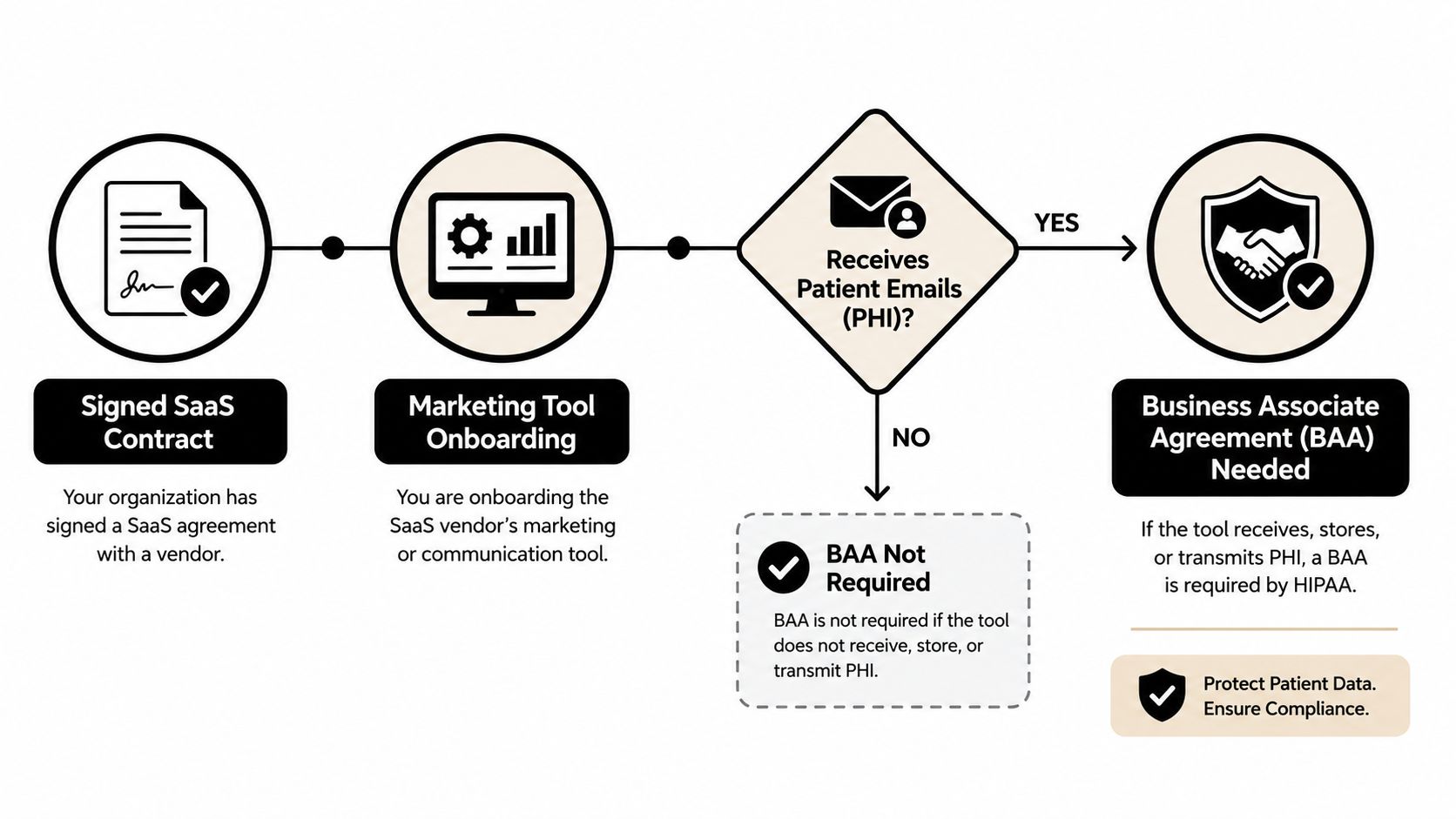
A vendor manager often feels this first in a simple moment. The SaaS contract is signed, the launch date is set, and marketing asks whether the new platform can receive patient email addresses for segmentation or analytics. That's the point where what is a baa stops being a search query and becomes a gatekeeping question, because HIPAA treats the agreement as the control document that allows PHI to move at all. The term also has a very different meaning in everyday English, where baa means the sound a sheep or goat makes, a bleat recognized by major dictionaries and recorded in use since the late 1500s (Merriam-Webster's entry for “baa”).
Why a BAA Matters Before Any PHI Changes Hands
A BAA is the contract that has to be in place before a vendor touches PHI for you. If a SaaS tool will create, receive, maintain, or transmit PHI on your behalf, the agreement must be signed before that work begins. Once the contract is executed, the vendor is no longer just a service provider in business terms. It becomes a legally permitted part of the PHI workflow under HIPAA, and without that contract in place, the data flow is not authorized even if the vendor has strong security controls (Paytia's BAA overview).
The onboarding moment where teams usually get it wrong
The mistake usually appears after procurement has already moved quickly. Legal has approved the order form, IT has reviewed the security questionnaire, and the business team wants to upload patient contact data into the system for reporting, routing, or account setup. That request can sound routine, but once the information is PHI, the BAA is the clause set that decides whether the transfer can happen at all.
Practical rule: security review and BAA review are related, but they are not the same step. A secure vendor still needs the right contract language before PHI is shared.
That is why contract teams should treat the BAA as part of the onboarding workflow, not as after-the-fact paperwork. It belongs with due diligence, approval routing, and the storage of the signed agreement. If your team already manages confidentiality agreements, the process will feel familiar, because both require controlled access and approved terms, which is why our guide on managing NDAs for law can help frame the contract controls involved. For healthcare-specific workflows, this overview of contract management in healthcare shows how the same control mindset carries into PHI-bearing vendor relationships.
Why the word itself causes confusion
The compliance meaning of BAA sits beside an older everyday word. In ordinary English, baa is the sound a sheep or goat makes, and dictionaries record it that way (Merriam-Webster's entry for “baa”). A vendor manager who searches the term can easily land on the animal sound first, then realize the HIPAA meaning is entirely different.
That difference matters because the healthcare meaning is much narrower and much more serious. A BAA is a permission document, a responsibility document, and a control document at the same time. It sets the rules for whether PHI can move, and it is also the place where the parties assign duties if something goes wrong. That is why the BAA is one of the clearest examples of contract language that works well in a modern CLM, since the clause structure is predictable and the obligations can be tracked against a defined vendor workflow, as discussed in this overview of contract management in healthcare.
Defining the Parties and the Four HIPAA-Required Elements
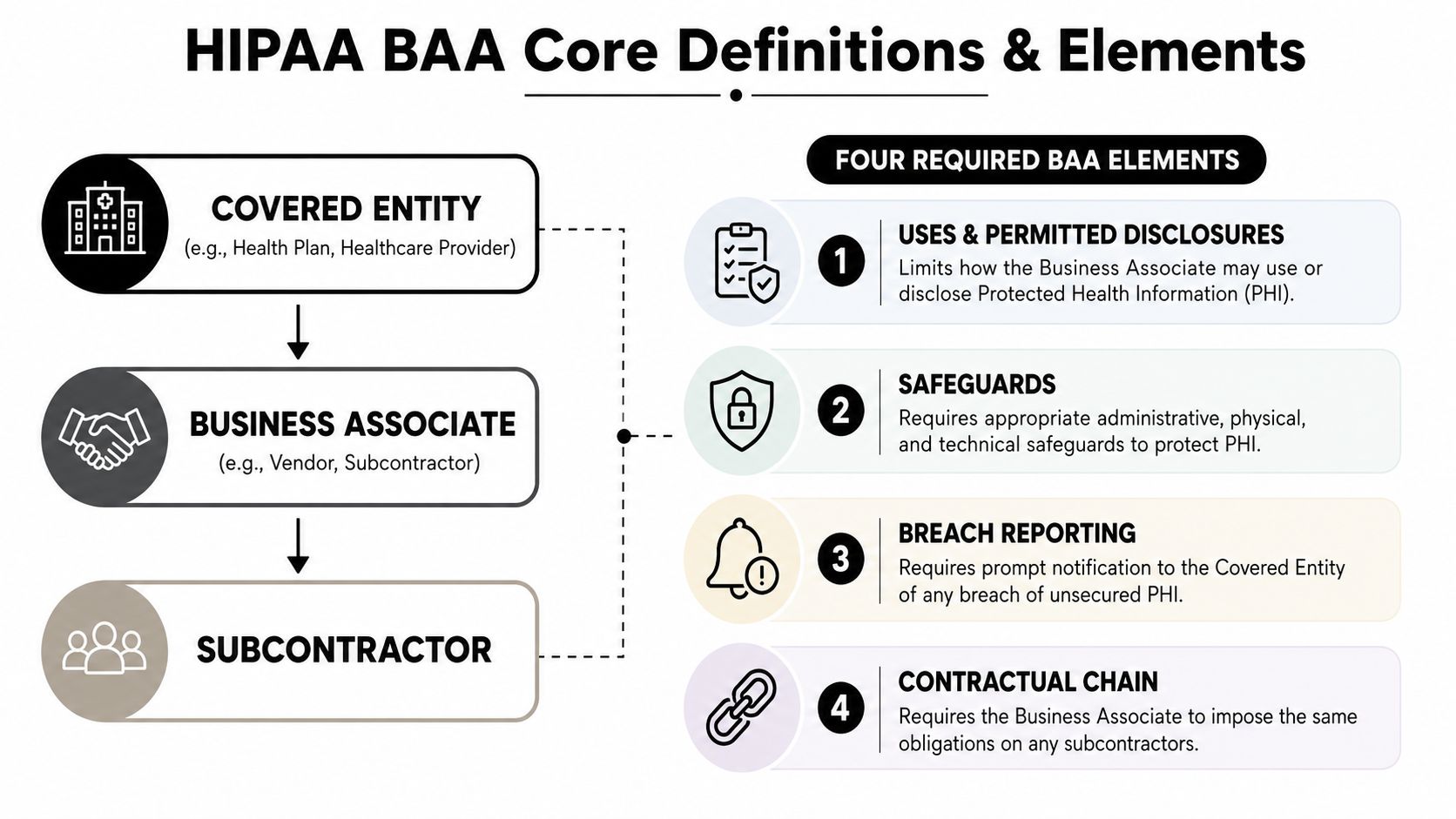
A BAA only works if the parties are clear from the start. The covered entity is the HIPAA-regulated organization, such as a health plan, provider, or clinic. The business associate is the vendor that needs access to PHI to perform a service for that covered entity. A subcontractor is the downstream vendor working for the business associate in the same PHI chain.
The four clauses that make a BAA valid
HIPAA guidance treats a valid BAA as a writing with four core elements. It must be in writing, it must identify the permitted uses and disclosures of PHI, it must include safeguarding provisions, and it must spell out breach reporting and mitigation. These are the clauses that turn the agreement into a working control document, rather than a generic vendor form.
A BAA works like a safety briefing before a flight. It does not stop turbulence, but it tells everyone who is responsible when things go wrong.
That clause set is also why BAAs fit contract intelligence and structured extraction so well. The fields are predictable, the compliance-sensitive language repeats from agreement to agreement, and the review task usually centers on confirming that the right terms are present. In a modern CLM software environment, that makes BAAs a strong candidate for template-driven drafting, clause comparison, obligation tracking, and renewal reminders.
What the structure usually means in practice
Legal teams do not need to reinvent a BAA for every vendor. They need a reliable playbook that captures the required terms, then routes exceptions for review. That is where AI contract review and contract automation help, because the system can extract the same clause set each time while humans focus on exceptions, negotiation, and risk acceptance.
The business value is operational. Teams can draft faster, review more consistently, and keep cleaner records of who can touch PHI and under what terms. That helps compliance work and contract workflow at the same time.
Core BAA Clauses Explained With Sample Language
A useful BAA usually reads like a disciplined checklist, not a philosophical memo. The language has to be concrete enough that procurement can negotiate it, legal can enforce it, and security can map it to actual controls. The exact wording will vary, but the core clause families are familiar across vendor programs.
The clauses most teams should expect to see
A practical BAA often includes language on permitted PHI uses, safeguarding duties, breach reporting, downstream flow-downs, term and termination, and return or destruction of PHI at the end of the relationship. Related guidance also notes that many agreements address liability, audit rights, indemnification, governing law, and dispute resolution even when HIPAA itself does not expressly require every one of those items (HIPAA Vault's BAA guide).
Here is the kind of clause language negotiators usually look for:
- Permitted use language: “Business Associate may use PHI only to perform services for Covered Entity and only as allowed by this Agreement.”
- Safeguards language: “Business Associate will implement appropriate administrative, physical, and technical safeguards to protect PHI.”
- Breach notice language: “Business Associate will notify Covered Entity without unreasonable delay after discovering a breach involving PHI.”
- Downstream obligation language: “Business Associate will ensure any subcontractor that receives PHI agrees in writing to the same restrictions.”
- End-of-term language: “Upon termination, Business Associate will return or destroy PHI, unless retention is required by law.”
If you manage third-party paper regularly, the pain is not knowing what a clause should say. The pain is losing track of who redlined what and which version is live. That's exactly where a contract workflow platform matters, and this guide on creating data processing agreements is a useful contrast point if your team already handles privacy-heavy templates outside healthcare.
Where negotiations usually slow down
Three terms tend to draw the most attention. Indemnification often becomes a risk-allocation debate. Audit rights can expand into operational access questions. Governing law can look like a legal formality until a dispute turns the clause into a real point of negotiation.
The practical move is to keep a clause library inside the CLM and standardize fallback positions. That way legal can redline exceptions, procurement can see approved language, and the business can move without waiting on an email chain to settle every edit.
Covered Entity vs Business Associate vs Subcontractor
A BAA relationship is easiest to understand when you follow the data downstream. A hospital can be the covered entity, the cloud hosting company can be the business associate, and the managed security provider that supports the host can be the subcontractor. Each layer needs the right paper, because HIPAA obligations can flow beyond the first vendor in line.
The role confusion that causes missed agreements
Teams often assume one signed BAA covers the whole chain. It doesn't. If the business associate uses another vendor that will touch PHI, the obligation typically flows down, and that downstream vendor needs its own contractual protection tied to the same data handling expectations (Paytia's BAA overview).
| Roles and Obligations in a BAA Relationship | Role | Primary Duty | Signs BAA With | Key Document |
|---|---|---|---|---|
| Covered entity | Uses PHI for healthcare operations, treatment, or payment and sets the compliance terms for vendors | Protect PHI and control vendor access | Business associate | BAA and vendor file |
| Business associate | Performs services involving PHI on behalf of the covered entity | Follow the BAA and flow terms to downstream parties | Covered entity | BAA and subcontractor list |
| Subcontractor | Supports the business associate and may handle PHI indirectly | Meet the same PHI restrictions through downstream paper | Business associate | Downstream BAA |
The point of the table is simple, liability and documentation do not stop at the first vendor contract. If your cloud provider uses a security subcontractor, that relationship belongs in the inventory too, not just in the procurement folder.
Keep the chain visible. If a vendor can't name its downstream PHI handlers, your BAA program is already behind.
That is why contract repository management matters as much as drafting. You need to know which entity signed what, on what date, and for which data scope. Otherwise, the audit trail disappears when the next renewal cycle starts.
Compliance Risks When the BAA Goes Wrong
A BAA problem usually shows up at the worst possible time. A business associate gets hit with ransomware, PHI is exfiltrated, and the legal, security, and operations teams all start reconstructing the same timeline from different systems. If the BAA is missing, expired, or thin on safeguard language, the response gets harder right away because the organization has to explain why the vendor was handling PHI without the right contract controls.
What failure looks like in practice
The first problem is legal. If there is no valid BAA, PHI sharing with that vendor is not permitted under HIPAA, even if the vendor's technical setup looked secure on paper. The second problem is operational, because people have to search inboxes, shared drives, and ticketing systems just to prove what terms were in place. The third problem is reputational, because the incident now includes both the breach and the vendor governance failure.
A response plan should already answer who does what, which records get pulled, and where the current contract lives. Build your incident response plan before the next event forces the issue. In a BAA program, that same discipline belongs in the contract file, so the team can confirm who has access, what obligations apply, and which version of the agreement governs the relationship.
Why the inventory matters as much as the contract
A disciplined BAA inventory is a risk-control tool. It helps legal answer audit questions quickly, helps security find the right vendor record, and helps procurement see which relationships are due for renewal or review. Searchable repositories and contract intelligence help because the team can surface the actual agreement instead of relying on memory or old email threads.
For compliance leaders, the useful signals are practical. Clean onboarding, faster evidence retrieval, and fewer vendors slipping outside policy all point to a tighter control environment. This contract compliance overview is helpful context if your team is mapping BAAs into a broader control framework.
A Practical BAA Checklist and Sample Clauses
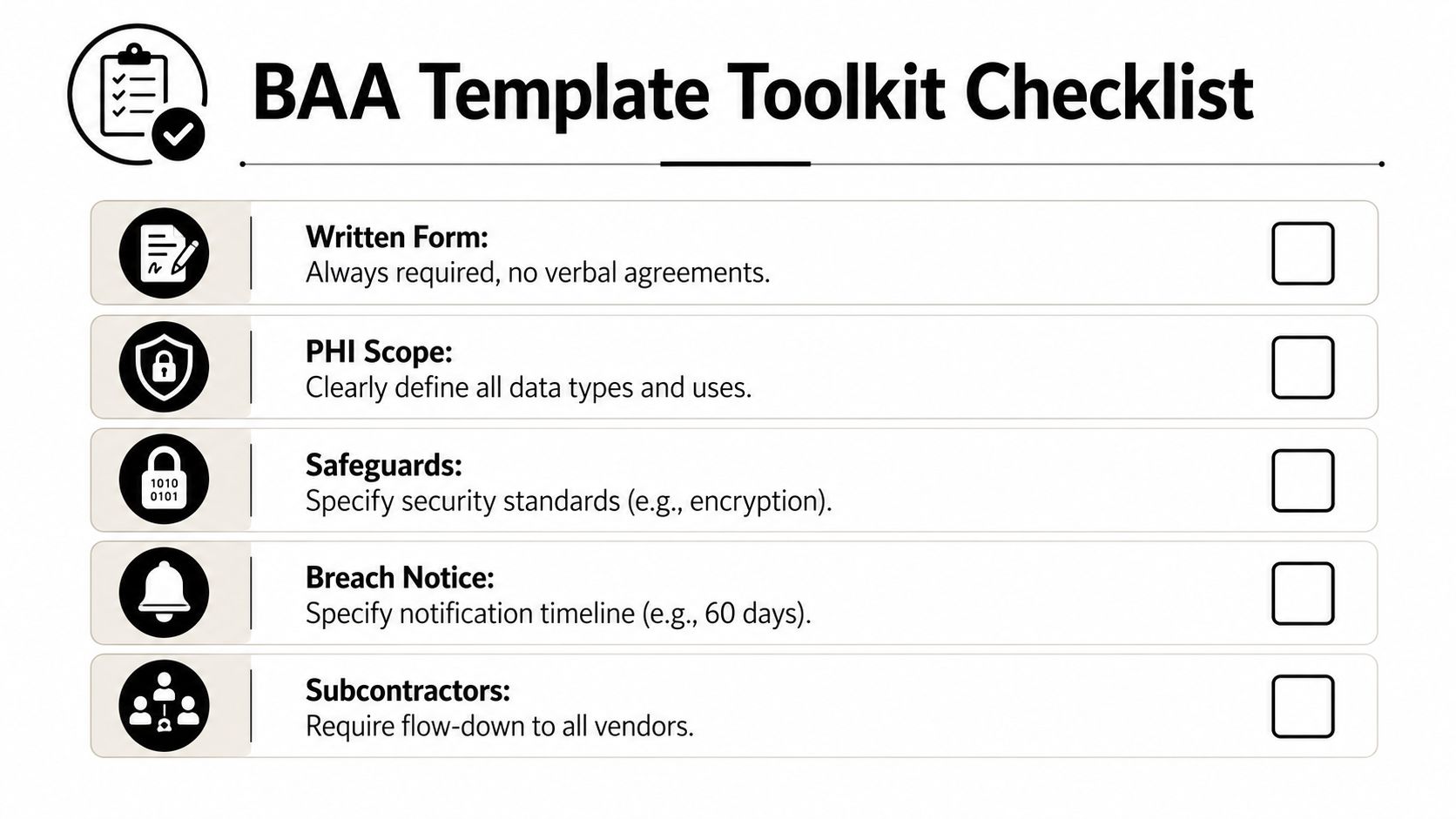
Before any vendor touches PHI, the review should be mechanical. The agreement should be in writing, the PHI scope should be explicit, the safeguard obligations should be described, and the breach notice and subcontractor language should be visible enough for legal to verify quickly. That's not overengineering. It's basic governance.
Pre-execution checklist
- Written form: Confirm the BAA exists as an executed written agreement, not a side email or a verbal assurance.
- PHI scope: Identify which data types the vendor will create, receive, maintain, or transmit.
- Safeguards: Make sure the agreement requires appropriate security protections.
- Breach notice timing: Confirm the notice obligation is stated clearly in the contract.
- Subcontractors: Require flow-down language for any downstream vendor that may handle PHI.
- Term and termination: Tie the BAA to the service term and confirm termination triggers.
- Return or destroy: Add the end-of-term data handling obligation.
- Governing law: Check whether the jurisdiction clause matches your risk posture and negotiation position.
Sample clauses you can adapt
Breach notification: “Business Associate will notify Covered Entity promptly after discovering any use or disclosure of PHI not permitted by this Agreement.”
Termination for material breach: “Covered Entity may terminate this Agreement for material breach if Business Associate fails to cure the breach within the time stated in the notice of breach.”
Return or destruction of PHI: “Upon termination, Business Associate will return or destroy PHI in its possession, subject to legal retention requirements.”
Those clauses are short on purpose. They are meant to be clear, enforceable, and easy to compare against third-party paper. A strong CLM helps teams defend the must-have language, flex on lower-risk commercial terms, and keep a clause library that standardizes positions across many vendors without slowing approvals.
How AI Contract Management Streamlines the BAA Lifecycle
The BAA is one of the easiest contracts to automate because its clause structure is so predictable. That matters in AI contract management and enterprise contract workflows, where legal teams want consistency, procurement wants speed, and security wants a clean record of who can touch PHI. The work starts with drafting, but it doesn't end there.
What the workflow looks like in a modern CLM
An AI-native CLM can generate a jurisdiction-aware BAA template, route it through clause-level review, send it through structured approval workflows, and capture signatures with a clear audit trail. After execution, the system can extract the vendor name, PHI scope, execution date, and renewal date into a searchable repository, then trigger alerts before review deadlines and renewal windows arrive.
That same setup helps with third-party paper too. If a vendor sends its own redline, the platform can surface deviations against the playbook, flag risk, and send the document to the right reviewer instead of routing it blindly through email. This overview of AI contract management and data security is useful background if your team is thinking about how contract automation and privacy controls fit together.
Why teams care in day-to-day operations
- Legal teams get fewer manual reviews and better visibility into exceptions.
- Procurement teams move vendors through onboarding with less back-and-forth.
- Security teams can see which vendors touch sensitive PHI and which controls apply.
- Operations leaders get a repository that doesn't collapse into a folder full of PDFs.
Legitt AI fits naturally into this kind of workflow because it's built as an AI-native CLM for drafting, negotiation, eSignature, repository management, and obligation tracking. In practice, that means the BAA can live inside the same workspace as the rest of the vendor agreement process instead of becoming a separate compliance island. For teams that also want to standardize vendor oversight broadly, vendor management best practices are a sensible next reference point.
FAQs and Next Steps for HIPAA-Ready Vendor Programs
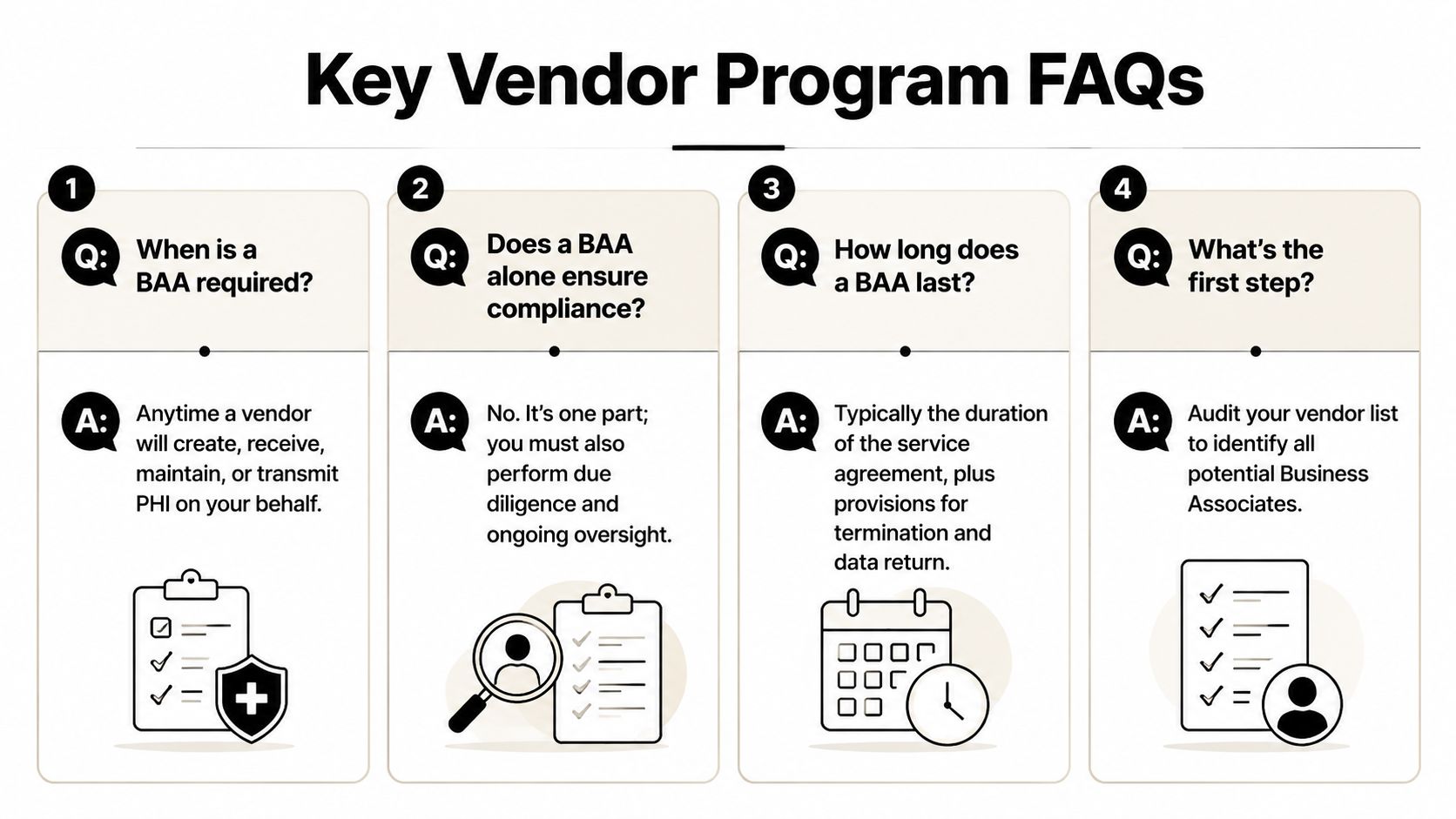
When is a BAA required? Anytime a vendor will create, receive, maintain, or transmit PHI on your behalf.
Does a BAA alone make a vendor HIPAA compliant? No. It's one part of the program, and the covered entity still needs due diligence and ongoing oversight.
How long should a BAA last? It usually tracks the service relationship, with termination and data return language preserved in the agreement.
Is a BAA the same as a Data Processing Agreement? No. They serve different legal frameworks, even though both control how sensitive data is handled.
The cleanest next step is to audit your vendor list, identify every relationship that can touch PHI, and move each executed agreement into a living repository with renewal dates and obligation fields. That is the point where contract intelligence stops being a concept and becomes an operational control.
If your team is ready to turn BAAs into a searchable, trackable part of the vendor lifecycle, Legitt AI gives legal and operations teams one workspace for drafting, review, eSignature, repository management, and renewal tracking. It's a practical way to keep PHI-related contracts visible, current, and easier to govern across the vendor stack.