
Contracts are one of the most important assets in any business, but they are also one of the most time-consuming to review. Legal teams, sales teams, procurement teams, finance teams, and founders all deal with contracts that need to be checked for risk, compliance, commercial terms, obligations, approvals, and negotiation issues. That is exactly why AI contract review software has become one of the fastest-growing categories in legal technology.
Instead of relying only on manual review, businesses are now using AI-powered systems to scan contracts, identify unusual clauses, compare language against templates, highlight missing terms, flag risky provisions, and accelerate negotiations. The right platform can reduce review time, improve consistency, and help teams move faster without losing control.
In this article, we will break down how AI contract review software works, what features matter most, where it creates value, and what businesses should look for before choosing a platform.
What Is AI Contract Review Software?
AI contract review software is a technology platform that uses artificial intelligence to analyze contracts and support legal and business teams during review. Instead of reading every line manually from scratch, users can upload a contract and let the system identify key clauses, summarize risks, compare language against approved standards, and surface potential concerns.
At a basic level, AI contract review tools help users answer questions such as:
- What clauses are present or missing?
- Which terms deviate from the standard template?
- Are there risky obligations, liabilities, or renewal terms?
- Is the payment structure aligned with what was agreed commercially?
- Does this contract comply with internal policies and clause libraries?
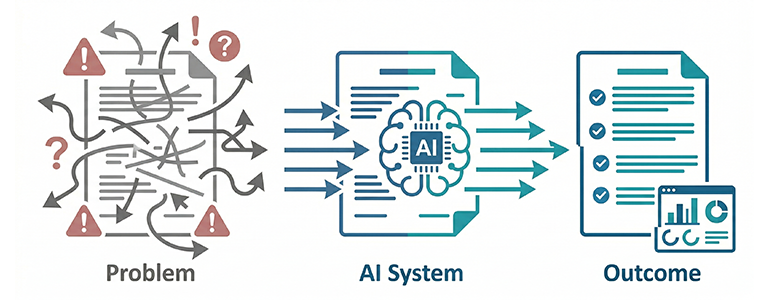
More advanced platforms go beyond simple extraction and use reasoning workflows to assess context, explain why a clause is risky, and recommend better language. This is where modern ai contract review platforms are moving the market forward.
Why Businesses Are Adopting AI Contract Review
Manual contract review is expensive, inconsistent, and slow. A reviewer may spend hours checking indemnity language, limitation of liability, termination terms, pricing clauses, service levels, data protection obligations, renewal terms, governing law, and other commercial provisions. At scale, this becomes a bottleneck.
Businesses are adopting ai contract review software for five main reasons.
First, it saves time. A contract that may have taken one to three hours to review manually can often be triaged in minutes with AI support.
Second, it improves consistency. Human reviewers may focus on different issues depending on workload, experience, or urgency. AI helps enforce a more standardized review process.
Third, it reduces risk. Contracts often contain hidden risks in auto-renewals, uncapped liabilities, one-sided termination clauses, data ownership language, or payment obligations. AI can make those issues easier to catch.
Fourth, it supports business velocity. Sales and procurement teams want faster turnaround times. AI-powered review helps legal teams move more deals without expanding headcount at the same pace.
Fifth, it creates better visibility. When contract review is digitized, organizations can generate analytics, track clause deviations, and learn where risks appear repeatedly across their contract portfolio.
How AI Contract Review Software Works
Most ai contract review software follows a layered workflow. The exact architecture varies by product, but the core logic is broadly similar.
1. Document ingestion
The first step is ingestion. The platform accepts a contract in Word, PDF, or another document format. Some systems also connect directly to CLM tools, CRM platforms, e-signature systems, cloud storage, or email workflows.
Once uploaded, the document is converted into machine-readable text. If the file is scanned, OCR may be used. Clean ingestion matters because poor text extraction can affect every later stage of analysis.
2. Clause detection and segmentation
After text extraction, the AI identifies the structure of the agreement. It detects sections, headings, clauses, tables, annexures, schedules, and signatures. It then segments the document into manageable units so the model can analyze each clause more accurately.
For example, the system may isolate:
- confidentiality
- indemnity
- limitation of liability
- termination
- pricing and payment
- service levels
- intellectual property
- data processing
- renewal and notice periods
This clause-level understanding is the foundation of effective ai contract review.
3. Metadata and key term extraction
The software then extracts key business and legal information such as:
- contract type
- parties
- effective date
- term length
- renewal date
- payment terms
- governing law
- liability caps
- notice periods
- exclusivity
- dispute resolution
- key obligations
This structured extraction allows organizations to search, compare, and report on contracts more easily.
4. Comparison against templates or playbooks
This is where many tools become truly useful. The AI compares the uploaded agreement against approved templates, standard fallback clauses, or internal legal playbooks. It identifies language that is aligned, partially aligned, or not aligned.
For example, if the company’s preferred limitation of liability clause caps exposure at fees paid in the prior 12 months, the AI can flag a contract that contains unlimited liability or a broader cap than approved.
A strong ai contract review platform should not just say that something is different. It should explain how it is different and why that matters.
 Hi, What do you want to Draft?

Click to upload or drag & drop
pdf, docx up to 5 MB
Click to upload or drag & drop
pdf, docx up to 5 MB
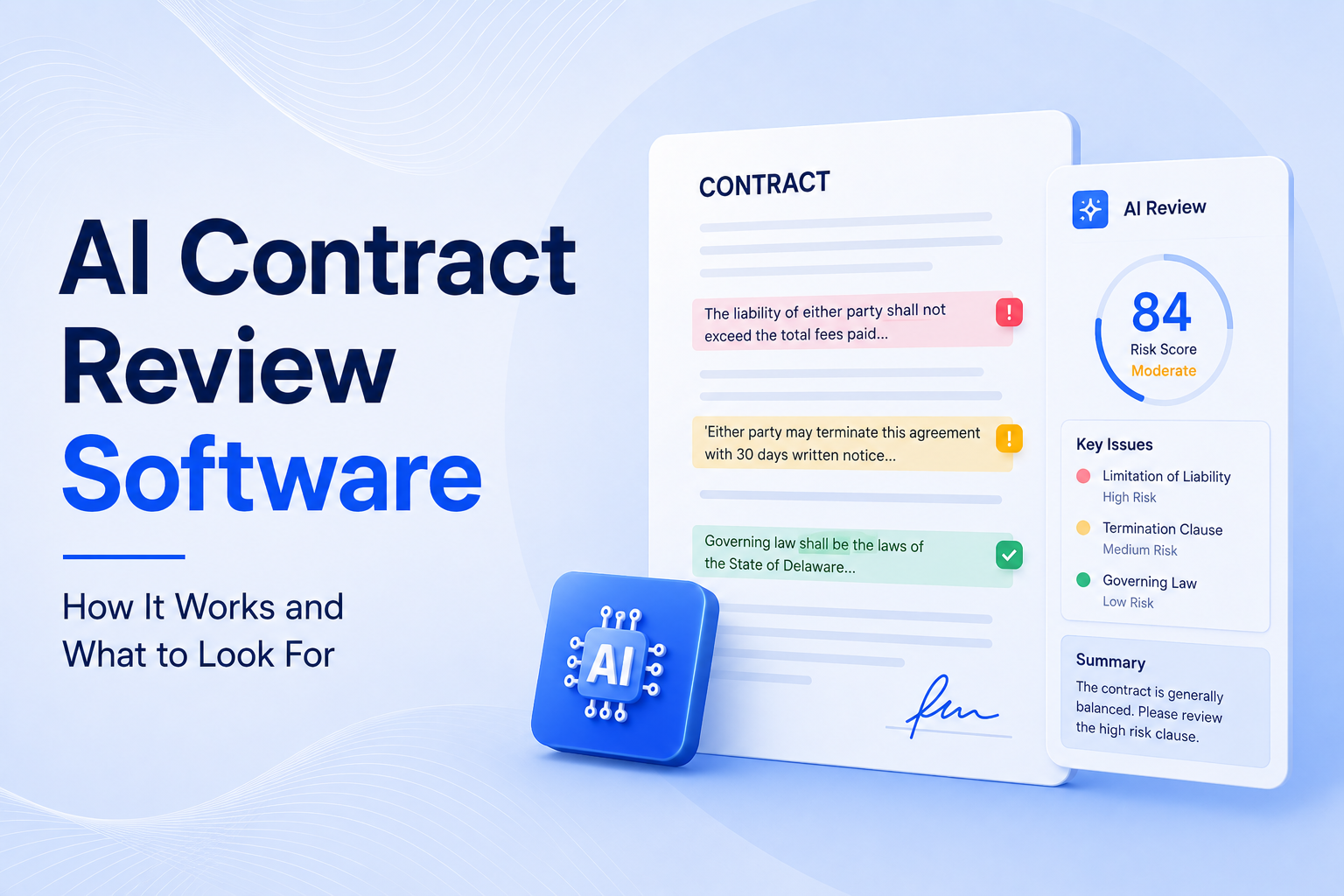
5. Risk scoring and issue highlighting
The software next evaluates risk. This may involve rule-based logic, LLM reasoning, clause classification, or a hybrid of all three. The system highlights specific risks such as:
- missing data protection obligations
- one-sided indemnities
- uncapped liabilities
- ambiguous deliverables
- aggressive renewal terms
- weak termination rights
- unfavorable payment triggers
- vague acceptance criteria
Some tools also generate an overall risk score or clause-level severity rating such as low, medium, high, or critical.
6. Suggested edits and redlines
Advanced AI contract review software does more than identify issues. It proposes alternate wording. In some systems, users can apply redlines directly, compare options, or generate fallback language aligned to their organization’s standards.
This is especially valuable for lean legal teams that need faster first-pass review support.
7. Workflow, approval, and reporting
Finally, the software pushes the results into a workflow. The contract may be routed for approval, escalated for specialist review, or returned with comments. Over time, organizations can analyze review patterns, common clause deviations, and recurring negotiation bottlenecks.
This shift from document review to operational intelligence is one reason why modern platforms such as
Legitt AI are attracting attention. Businesses increasingly want software that does not just read contracts, but helps manage the decision-making around them.
What Makes AI Contract Review Valuable in Practice
The value of ai contract review software depends on how it performs in real business workflows.
For sales teams, it reduces delays in reviewing customer paper and helps deals move faster.
For procurement teams, it improves vendor contract review and highlights commercial or legal exposure before signature.
For in-house legal teams, it reduces repetitive work, improves coverage, and allows lawyers to focus on strategic judgment instead of clause spotting.
For finance and revenue teams, it surfaces pricing, renewal, billing, and commercial commitments more accurately.
For leadership, it creates greater visibility into where the company is exposed and where contracting friction is slowing growth.
When combined with repository intelligence, workflow automation, and obligation tracking, AI contract review becomes part of a much larger contract operating system.
Key Features to Look For in AI Contract Review Software
Not all tools are equal. Some only extract basic metadata. Others support deep review, redlining, workflows, and analytics. Here is what to look for when evaluating ai contract review software.
Accuracy of clause and term extraction
The software should identify clauses and key terms reliably across a wide range of contract types. Accuracy is not just about finding headings. It is about understanding meaning when language varies.
Template and playbook comparison
A strong platform should compare uploaded contracts against your own standards, not just generic rules. That includes clause libraries, fallback positions, review checklists, and internal policies.
Context-aware risk analysis
The best tools do not simply flag keywords. They evaluate contract meaning in context. A liability clause, for example, should be analyzed relative to commercial value, indemnity scope, and exclusions.
Editable outputs and redlining support
The system should help users act on findings. Suggested edits, redline generation, and negotiation-ready alternatives are highly valuable.
Support for multiple contract types
A useful ai contract review system should handle NDAs, MSAs, SaaS agreements, SOWs, procurement contracts, partner agreements, employment contracts, licensing agreements, and more.
Workflow integration
The software should fit into existing business systems such as CRM, CLM, document repositories, email, and e-signature tools. Review cannot happen in isolation.
Search, analytics, and reporting
Review data becomes much more valuable when it can be analyzed across the entire contract portfolio. Organizations should be able to see deviation trends, risk hotspots, renewal exposure, and turnaround metrics.
Security and enterprise controls
Contracts contain highly sensitive data. Look for role-based permissions, encryption, audit trails, secure hosting, data processing controls, and enterprise-ready deployment options.
Explainability
Users should understand why the system flagged a clause. Black-box scoring without reasoning creates adoption problems. Explainable AI builds trust.
Scalability
The right tool should support both single-document review and bulk analysis across hundreds or thousands of agreements.
Common Mistakes to Avoid When Choosing AI Contract Review Software
Many buyers focus too much on demos and too little on real workflow fit. A flashy interface does not guarantee operational value.
One common mistake is choosing a tool that only works well on perfect templates. Real businesses review third-party paper, messy PDFs, legacy agreements, and highly negotiated contracts. The software must perform in the real world.
Another mistake is prioritizing extraction but ignoring actionability. Metadata extraction is useful, but contract review teams also need clause comparison, risk interpretation, and suggested fixes.
A third mistake is failing to consider governance. If the system cannot align with your legal standards, escalation rules, fallback language, and business processes, adoption will be limited.
A fourth mistake is treating AI as a replacement for judgment. Good ai contract review software should augment lawyers and business reviewers, not eliminate human decision-making in sensitive matters.
Where Legitt AI Fits In
As organizations look for practical and scalable ai contract review solutions, platforms like Legitt AI are gaining attention because they connect review with a broader contract workflow. Instead of treating review as a standalone step, Legitt AI supports contract analysis, redlining, repository intelligence, tracking, and post-signature visibility in one environment.
For businesses evaluating modern contract operations, that integrated model matters. The more connected the review layer is to approvals, signatures, obligations, and analytics, the more value the organization gets from every reviewed contract. You can explore more about Legitt AI at legittai.com.
This is especially relevant for teams that want AI not just for contract reading, but for end-to-end contract execution and monitoring.
The Future of AI Contract Review
The market is moving beyond static review tools. The next generation of ai contract review software will be more agentic, more contextual, and more connected to business systems.
We are likely to see stronger multi-document reasoning, better clause negotiation support, richer playbook alignment, and continuous monitoring after execution. Review will not end when the contract is signed. AI will continue tracking obligations, renewals, payment milestones, performance commitments, and risk triggers over time.
This means the future of ai contract review is not just about speed. It is about turning contracts into structured, actionable business intelligence.
Organizations that adopt the right platform now will be better positioned to control risk, shorten deal cycles, improve compliance, and unlock more value from their contract portfolio.
Final Thoughts
AI contract review software is no longer a niche tool. It is becoming a core layer in modern legal and commercial operations. Businesses want faster review, better consistency, stronger compliance, and more visibility into contractual risk. The right software can deliver all of that, but only if it goes beyond surface-level extraction.
When evaluating ai contract review software, look closely at accuracy, playbook alignment, explainability, workflow integration, security, and actionability. A tool that simply highlights clauses is useful. A platform that helps you review, redline, route, analyze, and track contracts at scale is far more powerful.
That is why buyers should think carefully about long-term fit, not just short-term automation. A platform like Legitt AI shows how ai contract review can become part of a broader AI-native contract operating model. To learn more, visit legittai.com and evaluate how the platform aligns with your business needs.