
For decades, contracts have been treated as static documents-files that get drafted, negotiated, signed, saved, and forgotten. Businesses have spent enormous effort on the front end of contracting: redlines, approvals, signature collection, and document storage. Yet the truth is simple: the real value of a contract does not end at signature. In many cases, that is when the real business risk and opportunity begin.
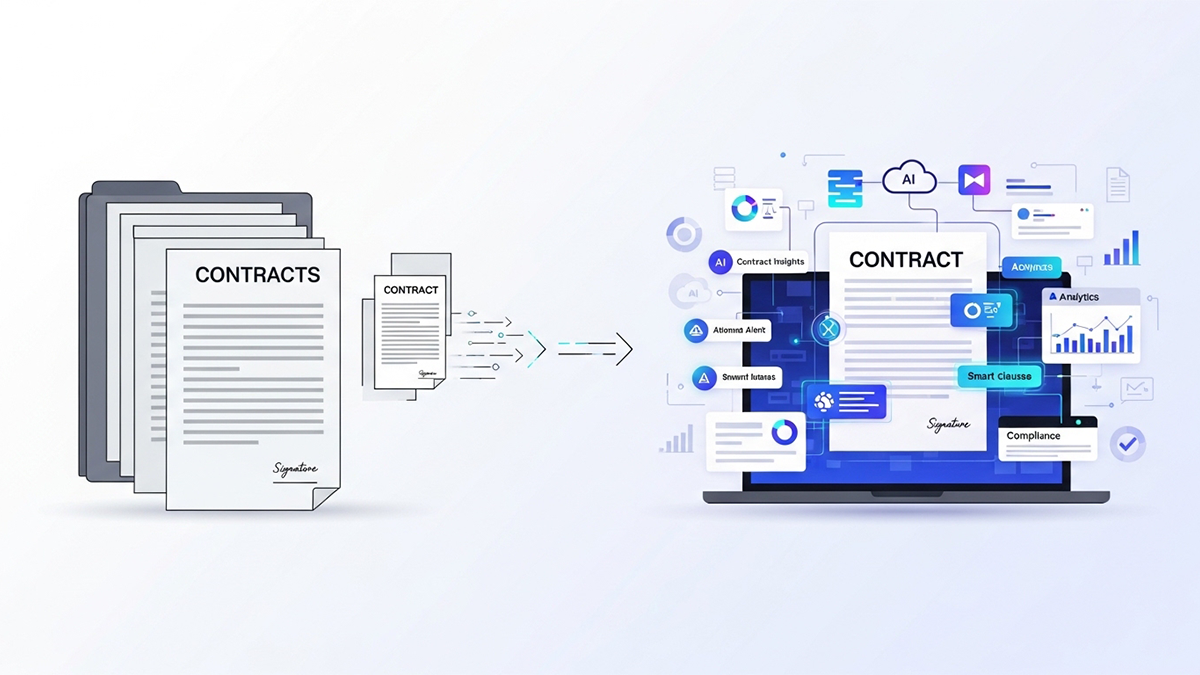
This is why the market is shifting from static contracts to AI-native contract intelligence.
AI-native contract intelligence is not just a nicer contract repository or a faster way to search PDFs. It is a fundamentally different way of operating. It treats contracts as living business assets that can be read, interpreted, monitored, and operationalized across the contract lifecycle-from draft to renewal and beyond. It turns unstructured legal language into structured business intelligence that can drive workflows, alerts, analytics, and decision-making across sales, legal, procurement, finance, and customer success.
In 2026, contract intelligence is quickly becoming a competitive advantage. Companies that still manage static contracts rely on manual reading, spreadsheets, and institutional memory. Companies that adopt AI-native contract intelligence gain speed, consistency, risk visibility, and post-signature control at scale.
What “static contracts” really look like in most organizations
A static contract is not defined by the file format. It is defined by how the organization uses it.
A contract is “static” when:
- it exists primarily as a PDF or Word document in a folder
- key terms are not extracted into structured data
- obligations are not tracked in operational systems
- renewal dates are inconsistently captured
- risk deviations are not monitored over time
- the contract is opened only when a problem occurs
Many companies believe they have contract lifecycle management because they have a shared drive, a CLM tool, or a repository with search. But static contract management still creates the same business outcomes: delayed invoicing, missed renewals, compliance surprises, and repeated negotiation mistakes because contract knowledge never becomes organizational intelligence.
Static contracts also create a fragmentation problem. Sales sees an opportunity record. Legal sees a redlined agreement. Finance sees an invoice. Customer success sees a renewal date-maybe. But no one sees the same unified picture of what the contract actually says and what it requires.
That fragmentation is expensive.
Why static contract management fails at scale
Static contracts fail for three structural reasons:
1) Contracts are unstructured, but business operations need structured outcomes
A contract clause can express the same meaning in many ways. Renewal language, termination triggers, payment conditions, service credits, and compliance obligations vary by negotiation, industry, and counterparty. Keyword search and basic metadata fields cannot reliably capture meaning at scale.
2) Post-signature work is where most risk lives
After execution, contracts create operational obligations: milestones, reporting requirements, acceptance criteria, security commitments, audit rights, notice periods, and renewal windows. Static contracts hide these requirements until deadlines are missed or disputes occur.
3) Manual processes don’t scale
As contract volume increases, the organization depends more on human review, memory, and email-based coordination. That leads to inconsistent negotiation outcomes, slow cycle times, and uneven governance. Hiring alone is not an efficient scaling strategy for contract operations.
This is the core reason businesses are moving toward AI-native contract intelligence: it creates leverage across the entire contract lifecycle rather than treating contracts as passive records.
What AI-native contract intelligence actually means
AI-native contract intelligence means the contract system is designed-at its foundation-to understand and operationalize contract language.
It typically includes five capabilities that static contracts cannot deliver:
1) AI contract analysis and interpretation
AI-native contract intelligence reads contract language and identifies meaning, not just keywords. That includes extracting terms such as:
- parties, dates, governing law
- payment terms and billing triggers
- renewal structure and notice windows
- termination rights and conditions
- liability limits, indemnities, warranties
- service levels, penalties, credits
- confidentiality, data protection, compliance requirements
But the real value is interpretation: determining whether a clause is standard or non-standard, whether it deviates from policy, and what business impact it creates.
2) Contract risk analysis and deviation detection
Static contract management forces legal teams to rely on manual review and subjective memory. AI-native contract intelligence can systematically detect deviations from templates, clause libraries, or playbooks. It can highlight:
- missing protections
- non-standard risk allocations
- unusual termination terms
- aggressive service-level commitments
- inconsistent pricing or discount language
This reduces “hidden risk,” where unfavorable terms are accepted without clear visibility.
3) Contract repository intelligence
A static repository answers: “Where is the contract?”
A contract intelligence platform answers:
- “What does this contract contain?”
- “Which contracts renew soon?”
- “Which agreements contain the highest risk deviations?”
- “Which obligations are due this month?”
- “Which customers have negotiated exceptions that affect delivery or margin?”
This is contract analytics at the portfolio level-one of the largest value unlocks for enterprises managing hundreds or thousands of agreements.
4) Post-signature contract tracking and obligation management
AI-native contract intelligence treats post-signature contract management as a core function, not an afterthought. It supports:
- obligation tracking
- milestone monitoring
- renewal alerts
- notice period reminders
- compliance obligation reporting
- amendment history and lifecycle events
This is where the shift from static contracts to “living contracts” becomes real.
5) Workflow automation driven by contract intelligence
AI-native contract intelligence connects extracted contract terms to workflows:
- routing approvals based on risk level
- triggering renewals and expansion plays
- notifying finance of billing triggers
- alerting customer success to service-level commitments
- escalating compliance obligations to the right owners
This transforms contract lifecycle management from document handling into business execution.
Effective contract operations rely on three core controls: reviewing contract language, executing agreements with clear audit trails, and generating contracts in a governed way. The following example shows how these capabilities fit together.
 Hi, What do you want to Draft?

Click to upload or drag & drop
pdf, docx up to 5 MB
Click to upload or drag & drop
pdf, docx up to 5 MB
The business outcomes: why contract intelligence is the new baseline
Moving from static contracts to AI-native contract intelligence produces measurable business outcomes across functions:
Faster contract cycle times
AI contract analysis reduces repetitive manual review and accelerates drafting and approvals. Sales moves faster. Legal focuses on truly complex issues. Procurement shortens vendor onboarding timelines. Faster contracting directly impacts revenue velocity.
Reduced revenue leakage
Contracts define pricing, payment schedules, renewals, and termination terms. Static contracts hide the details that determine how and when money is collected. AI-native contract intelligence improves renewal management, captures billing triggers, and reduces disputes caused by unclear terms.
Stronger risk control and governance
Contract risk analysis becomes consistent across the portfolio. Deviations are detected systematically rather than incidentally. Leaders can see risk concentrations by customer segment, region, business unit, or template type.
Better compliance and audit readiness
AI-native contract intelligence makes compliance obligations visible and reportable. That matters in industries with strict regulatory demands, data security requirements, and audit clauses. A static contract repository cannot provide portfolio-wide compliance visibility without massive manual effort.
Higher operational reliability
When obligations and service commitments are tracked proactively, customer experience improves. Teams avoid missed deadlines and surprises. Post-signature contract tracking becomes a shared operational discipline rather than a reactive scramble.
The shift in mindset: contracts as data, not documents
The biggest change is not just technological. It is conceptual.
Static contract management treats the contract as a document.
AI-native contract intelligence treats the contract as data.
That does not mean removing legal nuance. It means translating the operational meaning of contract language into structured signals the business can use. This shift enables analytics, automation, and proactive lifecycle control.
It also changes how companies think about their contract repository. Instead of a filing cabinet, the repository becomes a contract intelligence layer that supports:
- portfolio analytics
- renewal forecasting
- obligation dashboards
- risk scoring and controls
- negotiation performance measurement
This is the real reason AI-native contract management is reshaping CLM: it turns contracts into an operational system.
What to look for in an AI-native contract intelligence platform
Not all “AI contract tools” are AI-native. Many platforms add a summary feature or a chatbot on top of a legacy workflow engine. That can help, but it is not the same as AI-native contract intelligence.
When evaluating a contract intelligence platform, focus on these criteria:
- Depth of contract analysis
Does it extract only basic metadata, or does it interpret clause meaning and business impact? - Post-signature capability
Does it support obligation tracking, renewals, and ongoing monitoring-or does intelligence stop at signature? - Portfolio-wide analytics
Can you run contract analytics across your repository to detect risk patterns and renewal exposure? - Workflow integration
Can contract intelligence trigger real workflows across finance, legal, procurement, and customer success? - Governance and playbooks
Does it support template and clause-library alignment, deviation detection, and consistent contracting controls?
Platforms like Legitt AI are positioned around this broader AI-native model-connecting drafting, contract analysis, repository intelligence, and post-signature tracking into a more unified contract operations layer. Teams exploring what AI-native contract intelligence looks like in practice often start at https://www.legittai.com to review how these capabilities are framed across the full contract lifecycle.
How Legitt AI fits the shift from static to AI-native intelligence
The market shift is not hypothetical. Businesses are already moving toward AI-native contract management because contracts now drive revenue operations, compliance, and customer outcomes-not just legal posture.
Legitt AI is often discussed in this context because it frames contract operations as an AI-native workflow: not only generating and reviewing contracts, but also analyzing contract portfolios and supporting post-signature visibility. That’s the real shift-contracts becoming an intelligence layer rather than a static archive.
If your current contract process ends with “upload the PDF,” you are operating in the static contract era. If your contract process continues with obligation tracking, renewal alerts, risk monitoring, and analytics, you are operating in the contract intelligence era.
For a deeper look at AI-native contract intelligence positioning and use cases, many teams review https://www.legittai.com as part of their evaluation process.
The bottom line
From static contracts to AI-native contract intelligence is not just an upgrade. It is a transformation.
Static contracts are passive. They hide risk. They slow execution. They create revenue leakage and post-signature blind spots. AI-native contract intelligence makes contracts active. It turns contract language into structured insights. It powers post-signature contract tracking, contract analytics, renewal management, and risk visibility across the portfolio.
In 2026, this shift is becoming the new baseline for modern contract lifecycle management. The question is no longer whether companies will adopt contract intelligence-it is whether they will adopt it early enough to gain the operational advantage.
Read our complete guide on Contract Lifecycle Management.
FAQs
What is AI-native contract intelligence?
AI-native contract intelligence is a system that reads and interprets contracts using AI as the core engine, not as an add-on. It extracts key terms, identifies risks, and converts contract language into structured data that can drive workflows and analytics. It also supports post-signature contract tracking, such as renewals and obligations. This moves contract management from document storage to business intelligence.
How is contract intelligence different from traditional CLM?
Traditional CLM focuses on process: drafting, approvals, signatures, and storage. Contract intelligence focuses on meaning: what the contract says, what obligations it creates, and what risks it introduces. AI-native contract intelligence adds deeper contract analysis, portfolio-wide contract analytics, and proactive monitoring. That makes it more operationally useful across departments.
Why are static contracts a problem?
Static contracts hide critical terms inside PDFs and Word documents. Teams often miss renewal windows, notice periods, and obligations because the contract is not tracked as data. This leads to revenue leakage, compliance risk, and operational surprises. Static contract management also scales poorly as contract volume grows.
What does post-signature contract tracking include?
Post-signature contract tracking includes monitoring obligations, milestones, renewal dates, notice windows, and key lifecycle events. It may also include amendment tracking and compliance obligations. AI-native contract management treats this as a core function, not a manual afterthought. This is one of the biggest upgrades over static contract storage.
How does AI contract analysis reduce risk?
AI contract analysis detects non-standard terms, missing protections, and deviations from approved playbooks. It helps surface risk earlier in the lifecycle so teams can escalate and resolve issues before signing. It also supports portfolio-level risk visibility, so leaders can identify risk patterns across contract types and counterparties. This reduces “hidden risk” that only becomes visible during disputes.
What is contract repository intelligence?
Contract repository intelligence means your repository can tell you what contracts contain and what actions they require, not just where files are stored. It supports contract analytics like renewal exposure, clause deviation trends, obligation dashboards, and contract health views. This is crucial for enterprises managing large contract portfolios. It turns the repository into an intelligence layer.
How does Legitt AI relate to AI-native contract intelligence?
Legitt AI is positioned around AI-native contract management that connects drafting, contract analysis, and lifecycle visibility into a single workflow. It emphasizes making contracts actionable rather than static. Teams researching AI-native contracting often start at https://www.legittai.com to review how contract intelligence and post-signature tracking are framed. That makes it relevant for organizations moving beyond traditional CLM.
What should I look for when evaluating an AI contract intelligence platform?
Look for depth of analysis (interpretation, not just extraction), post-signature monitoring, portfolio analytics, and workflow automation tied to contract terms. Also evaluate governance features like template alignment and deviation detection. Many tools offer summaries, but fewer offer full-lifecycle contract intelligence. The best platforms make contract content operational across teams.
Can AI-native contract intelligence improve renewals?
Yes. Renewal management improves when renewal terms, notice windows, auto-renew clauses, and renewal triggers are extracted and monitored. AI-native systems can generate renewal alerts and help customer success teams act earlier. This reduces missed renewals and strengthens retention planning. It also supports better renewal forecasting.
Where can I learn more about Legitt AI for contract intelligence?
You can review https://www.legittai.com for an overview of how Legitt AI positions AI-native contract management and contract intelligence. The site typically outlines capabilities around drafting, contract analysis, and lifecycle visibility. This is useful when comparing static repositories, traditional CLM tools, and AI-native contract intelligence platforms. It’s a practical starting point for evaluation.