

Over the past two decades, contract management has evolved incrementally. Organizations have transitioned from paper-based agreements to digital repositories, from manual approvals to workflow-driven systems, and more recently, from static tools to AI-assisted features. Yet, despite this progress, a fundamental limitation persists.
Contracts remain passive artifacts.
They are created, reviewed, negotiated, signed, and stored – but they rarely used for actively in decision-making, execution, or business intelligence. The burden of interpreting, managing, and acting on contracts continues to fall on human teams.
At Legitt AI, we believe this model is no longer sufficient for modern enterprises.
The Structural Limitations of Traditional CLM Systems
Most Contract Lifecycle Management (CLM) platforms today are built around a workflow-centric architecture.
They focus on:
- Document storage and retrieval
- Workflow routing and approvals
- Collaboration and version control
- Execution and archival
While these systems have improved operational efficiency, they remain fundamentally reactive.
Even with AI enhancements, the paradigm has not shifted:
- AI assists, but does not execute
- Insights are generated, but not operationalized
- Data is stored, but not continuously leveraged
This creates systemic inefficiencies:
- Deal cycles slow down due to manual coordination
- Risks remain hidden until late stages
- Revenue opportunities are missed due to lack of visibility
- Teams operate in silos with fragmented information
The problem is not simply inefficiency – it is architectural.
Introducing – The AI Native Contract Operating System
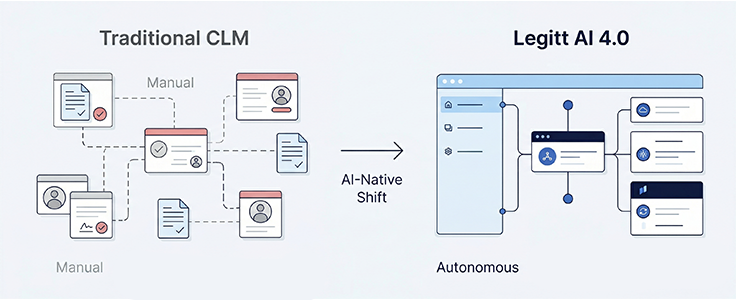
With Legitt AI 4.0, we are introducing a new category: The Operating System for Contracts in an AI-native world
This represents a shift from:
- Managing contracts → Operating contracts
- Supporting workflows → Executing workflows autonomously
- Storing data → Generating intelligence continuously
In this model, contracts are no longer endpoints in a process. They become active, intelligent systems embedded within business operations.
The Three Foundational Pillars
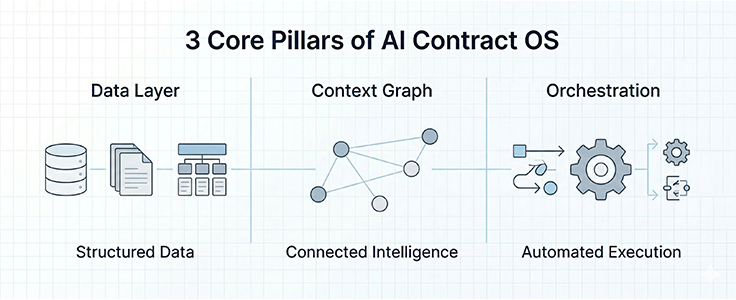
Legitt AI 4.0 is built on three deeply integrated architectural pillars that enable this transformation:
1. The Data Layer – Structuring the Contract Universe
The foundation of Legitt AI 4.0 is a robust and continuously evolving data layer.
This layer is responsible for:
- Ingesting contract data across formats and sources
- Extracting clause-level and metadata-level intelligence
- Structuring unstructured data around the contract activity into a unified schema
- Maintaining relationships between documents, entities, and activities
This transforms contracts from static files into a rich, structured, and queryable data foundation.
The data layer is not merely a storage system – it is a living substrate that powers intelligence across the platform.
2. The Context Graph – Understanding Relationships
Contracts exist within a network of interconnected business elements.
These include:
- Customers and accounts
- Sales opportunities and deal stages
- Clause libraries and templates
- Financial metrics and revenue streams
- Timelines, obligations, and milestones
Legitt AI 4.0 builds a dynamic context graph that captures and continuously updates these relationships.
This enables the system to:
- Understand dependencies across contracts and business processes
- Identify patterns and anomalies across portfolios
- Surface risks and opportunities based on contextual intelligence
- Provide insights that extend beyond individual documents
The context graph acts as the intelligence backbone, enabling the platform to reason holistically rather than operate in isolation.
3. The Orchestration Layer – Driving Intelligent Execution
While the data layer provides structure and the context graph provides intelligence, the orchestration layer provides execution and control.
This layer is responsible for:
- Coordinating AI agents across workflows
- Determining when and how actions should be triggered
- Managing dependencies across tasks and processes
- Monitoring events and continuously optimizing execution
For example:
- A contract upload can trigger automated analysis, review, and approval workflows
- A detected deviation can initiate redlining and stakeholder notifications
- An upcoming renewal can activate alerts, reporting, and negotiation preparation
The orchestration layer transforms the platform into a continuously operating, intelligent system, rather than a sequence of manual steps.
Enabling Intelligent, Actionable Insights
The integration of data, context, and orchestration enables a fundamental shift:
From:
- Static reporting
- Manual analysis
- Reactive decision-making
To:
- Real-time insights
- Automated actions
- Continuous optimization
Organizations no longer need to search for insights – they are generated, surfaced, and acted upon automatically.
Key Capabilities in Legitt AI 4.0
Legitt Co-Work – AI Agents and Custom Agent Builder
Legitt Co-Work introduces a new model of interaction – working alongside AI agents.
Organizations can:
- Utilize pre-built agents for drafting, review, and analysis
- Build custom agents aligned with specific business workflows
This enables:
- Automation of complex processes
- Scalable execution across teams
- Consistent application of business logic
This represents a transition from feature-based systems to agent-driven execution environments.
Context-Aware Intelligence: Advanced Lana Chat
Lana has evolved into a context-aware reasoning interface.
With access to the context graph, Lana can:
- Answer complex, multi-dimensional queries
- Provide insights across contracts, customers, and workflows
- Deliver recommendations based on contextual intelligence
This transforms conversational AI into a decision support system for enterprise operations.
 Hi, What do you want to Draft?

Click to upload or drag & drop
pdf, docx up to 5 MB
Click to upload or drag & drop
pdf, docx up to 5 MB
Advanced “My Work” – A Unified Operational Interface
“My Work” has been redesigned as the central command layer for contract operations.
Users can:
- Upload documents directly into the system
- Initiate workflows and actions
- Trigger agent-driven execution
- Monitor progress across contracts
This creates a single operational interface, reducing fragmentation and improving execution efficiency.
Enhanced Repository Analyzer Dashboard
The repository becomes an analytical intelligence layer.
Capabilities include:
- Identification of high-risk clauses across contracts
- Detection of revenue leakage patterns
- Analysis of negotiation trends
- Monitoring of compliance and performance
This provides organizations with portfolio-level visibility and control.
Customer 360° View
Contracts are central to customer relationships.
The Customer 360° view provides:
- A unified view of all contracts associated with a customer
- Visibility into negotiations, obligations, and renewals
- Insights into customer value and risk exposure
This enables better alignment across sales, legal, and finance functions.
Analyst Reports – Automated Strategic Intelligence
Legitt AI 4.0 introduces AI-generated analyst reports designed for leadership teams.
These reports provide:
- Summarized insights across contracts and portfolios
- Identification of risks and opportunities
- Performance metrics across teams and workflows
This enables data-driven decision-making without manual analysis.
Advanced Redlining and Review
Contract review has been significantly enhanced through:
- Intelligent clause comparison
- Automated deviation detection
- Context-aware recommendations
This reduces negotiation cycles while improving accuracy and consistency.
Enterprise-Grade Scalability
Legitt AI 4.0 is built to operate at enterprise scale.
The platform supports:
- High-volume contract processing
- Multi-tenant and multi-entity architectures
- Distributed systems for real-time execution
- Scalable orchestration of AI agents across workflows
This ensures consistent performance as organizations grow in complexity and volume.
Data Security and Compliance
Security is foundational to the platform.
Legitt AI 4.0 incorporates:
- Enterprise-grade encryption and data protection mechanisms
- Role-based access control and audit trails
- Secure handling of data across workflows and integrations
- Alignment with global compliance standards (GDPR, SOC 2 readiness, ISO frameworks)
This ensures that sensitive contract data is managed with the highest level of governance and security.
Seamless Enterprise Integrations
Legitt AI 4.0 is designed to integrate deeply within enterprise ecosystems.
Key integrations include:
- CRM platforms (Salesforce, Microsoft Dynamics)
- Productivity suites (Google Workspace, Microsoft 365)
- eSignature platforms (DocuSign, Adobe Sign)
- ERP and financial systems (Oracle, SAP, QuickBooks)
- Identity and access systems (Okta and others)
- Business Intelligence tools (Power BI, Tableau, and others)
These integrations ensure that contract intelligence flows seamlessly across systems, enabling organizations to embed insights directly into their operational and analytical workflows.
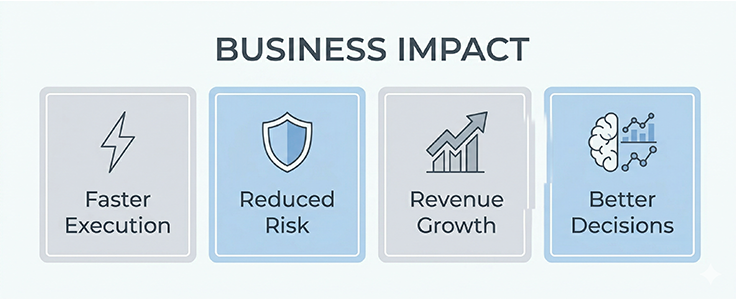
Business Impact
The adoption of Legitt AI 4.0 delivers measurable outcomes:
Operational Efficiency
- Reduced manual effort
- Faster execution of contract processes
Risk Management
- Proactive identification of risks
- Improved compliance and consistency
Revenue Optimization
- Enhanced visibility into renewals and obligations
- Reduction in revenue leakage
Strategic Alignment
- Unified visibility across departments
- Improved decision-making capabilities
A Platform Built for the AI-Native Future
Enterprise software is undergoing a fundamental shift.
In the AI-native world:
- Systems are expected to understand context
- Execution is expected to be autonomous
- Insights are expected to be continuous
Legitt AI 4.0 is designed to meet these expectations.
It is not a traditional CLM platform enhanced with AI. It is an AI-native operating system built specifically for contracts.
A Commitment to Continuous Innovation
With the launch of Legitt AI 4.0, we are introducing a new development cadence. We will release new platform versions every quarter, ensuring:
- Continuous innovation
- Rapid delivery of new capabilities
- Sustained leadership in the market
Our objective is clear:
To remain consistently ahead – not only in features, but in defining how contract systems should operate.
Gist:
Contracts are central to enterprise operations. They influence revenue, risk, compliance, and customer relationships. Managing them effectively requires more than workflows and storage.
It requires systems that can:
- Understand context
- Execute tasks
- Generate insights
- Continuously optimize outcomes
Legitt AI 4.0 represents our vision for this future.
An operating system where contracts are no longer managed – but actively drive business performance. We are proud to bring this to our customers and partners. And we look forward to continuing to redefine what is possible.