
The same clauses appear across hundreds of contracts. The same limitation of liability structure, the same confidentiality obligations, the same data processing terms – drafted slightly differently each time, reviewed slightly differently each time, negotiated slightly differently each time.
This repetition is both a problem and an opportunity. The problem: without a structured approach to clause reuse, every contract consumes fresh legal effort on language that has been reviewed and approved dozens of times before. Standards drift across drafters. Positions that were carefully negotiated in one contract are forgotten in the next. The organization loses institutional knowledge every time a lawyer leaves or a template is not updated.
The opportunity: because the same clauses do appear repeatedly, there is enormous leverage in getting those clauses right once, storing them in a structured library, and reusing them consistently. An AI-powered clause library is the mechanism for capturing that leverage.
What an AI-Powered Clause Library Is
A clause library is a structured collection of pre-approved contract language organized by clause type, use case, and position level. Each entry contains approved language – not a guideline about what the language should say, but actual contractual text that has been reviewed, approved, and is ready to use.
An AI-powered clause library goes further than a static document collection in three ways:
AI-assisted selection. When a contract is being drafted or reviewed, the AI matches the context – contract type, counterparty profile, deal value, jurisdiction – to the appropriate library entry. The right clause is retrieved automatically based on context rather than requiring the drafter to navigate the library manually.
AI-assisted maintenance. When contracts are signed and the executed versions differ from the library language, AI flags the deviation and – if the deviation represents an acceptable negotiated outcome – prompts the library manager to evaluate whether the library should be updated to reflect the new accepted position.
AI-assisted extraction from existing contracts. When building a clause library for the first time, AI reads the existing contract portfolio and extracts clause language that can seed the library. Rather than drafting every clause from scratch, legal teams start with the language actually used in their contracts – selecting the best versions, standardizing where needed, and building from there.
For how clause libraries connect to the broader contract repository, see AI contract repository management: what it is and why it matters.
The Anatomy of a Clause Library Entry
Each entry in a well-structured clause library contains more than just the clause text. A complete entry includes:
The clause type. A standardized label for what this clause does: limitation of liability, mutual non-disclosure, data processing agreement, governing law, termination for convenience, IP ownership, warranty disclaimer. This classification enables the AI to retrieve the right entry when a specific clause type is needed.
The use case scope. When does this entry apply? A limitation of liability clause for a SaaS subscription agreement is different from one for a professional services agreement, which is different from one for a goods purchase. Each use case variant is a separate library entry – same clause type, different appropriate language.
The position level. Most negotiable clause types have multiple positions: the preferred position (what the organization wants), the acceptable position (what the organization will accept without escalation), and the fallback position (the furthest the organization will go before requiring senior approval). The library stores all three – so during negotiation, the next step is already documented rather than requiring ad hoc drafting.
The approved text. The actual contract language, formatted and ready to use. This is the canonical approved version, not a template or a guideline.
Metadata. When was this entry last reviewed? Who approved it? What regulatory framework does it address? Is it jurisdiction-specific? This metadata enables governance – tracking whether library entries are current and ensuring they are maintained as laws and standards change.
Usage notes. Context about when to use this entry versus alternatives, any conditions that must be present for the language to be appropriate, and any known issues with this language in specific counterparty negotiations.
How AI Assists With Clause Library Building
Extracting From Existing Contracts
For organizations building a clause library for the first time, starting from scratch is unnecessarily difficult. The organization already has approved contract language – it is in the executed contracts in the repository. AI extraction reads those contracts, identifies clause types, and extracts the relevant language.
The extraction produces a first draft of the clause library: a collection of how each clause type has actually been written across the portfolio. Legal reviews this collection, selects the best versions (or drafts improved versions), and promotes the selected language to approved library entries.
This approach is faster than drafting a library from scratch and produces language that reflects the organization’s actual contracting practice rather than aspirational standards that may not survive contact with real negotiations.
Identifying Variation and Inconsistency
AI extraction across the portfolio reveals how much variation exists in language for the same clause type. If the limitation of liability clause appears in 50 different formulations across the portfolio, legal can see the full range, identify which formulations are most protective, and standardize toward the best versions.
This variation analysis is valuable for two purposes: identifying where standardization would improve consistency, and understanding what the range of positions actually is in practice. A clause library entry that specifies a position the organization has never actually achieved in negotiation is aspirational, not practical.
Flagging Outdated Language
As laws change and standards evolve, clause library entries need to be updated. AI monitoring can flag entries that may be affected by regulatory changes – data protection clauses after a significant GDPR ruling, for example, or governing law clauses after a material change in relevant jurisdiction law.
This monitoring does not replace legal judgment about whether an update is needed, but it surfaces the question rather than relying on the library maintainer to notice regulatory changes and proactively update the library.
Connecting Clause Libraries to Contract Workflows
A clause library that exists as a document but is not connected to the contract drafting and review workflow delivers limited value. The connection points that make a clause library operationally effective:
Contract generation. When a contract is generated from a template, the AI selects clauses from the library based on contract context – inserting the appropriate limitation of liability variant for a SaaS agreement, the appropriate data processing clause for a vendor with access to personal data, the appropriate governing law for a contract in a specific jurisdiction. The generated contract starts from approved library language rather than a static template.
For how this connects to vendor contract automation specifically, see vendor contract automation with prebuilt clause libraries.
AI contract review. When AI reviews an incoming counterparty contract, it compares the counterparty’s clause language against the library entries for each clause type. Deviations from library positions are flagged with the approved alternative language from the library. The library is the reference standard against which counterparty language is assessed.
For how AI review uses clause library positions to generate redlines, see how AI contract review actually works.
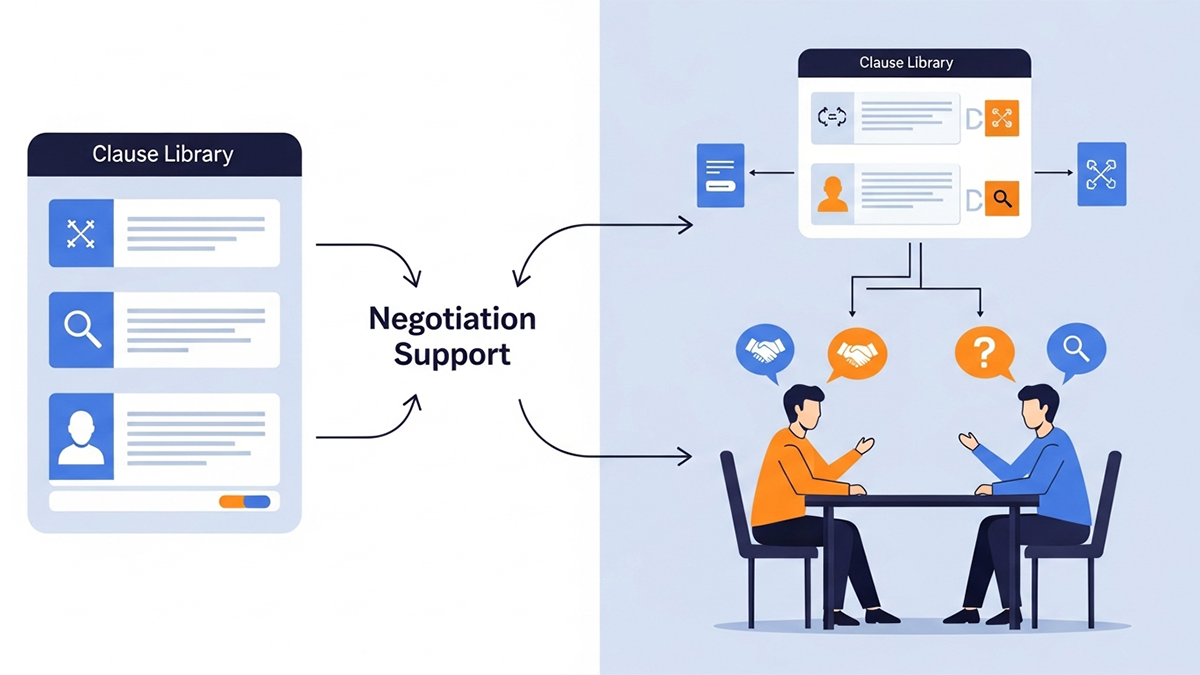
Negotiation support. During negotiation, when the counterparty proposes language outside the preferred position, the library provides the next acceptable position and the fallback position – both already approved and ready to propose. Negotiators do not need to draft or seek approval for alternative language during the negotiation; the approved alternatives are already available.
Post-signature learning. When a contract is signed with language that differs from the library entry, the deviation is recorded. Over time, this record reveals which library positions are consistently accepted versus consistently negotiated away – informing updates to the library to reflect actual achievable positions rather than aspirational ones.
Governance: Who Owns the Clause Library and How Is It Maintained
A clause library is a legal asset. Its governance model should reflect that.
Ownership. The clause library should have a designated owner – typically a senior lawyer or legal operations manager – who is responsible for its accuracy and currency. Without designated ownership, library maintenance becomes nobody’s job and entries go stale.
Approval process. New entries and changes to existing entries should go through a defined approval process. For standard clause types, approval by the designated library owner may be sufficient. For clause types with significant risk implications, approval by the general counsel or a designated senior reviewer may be required.
Review cadence. The library should be reviewed at a defined interval – annually at minimum – to identify entries that need updating. The review should be informed by: changes in applicable law, changes in the organization’s risk appetite, and the post-signature learning data showing which positions are actually being achieved in negotiations.
Version history. Previous versions of clause entries should be retained with effective dates. This version history is important for understanding what language governed historical contracts, and for demonstrating to auditors or in litigation that the organization’s standard position at a specific time was documented and approved.
Access control. Legal team members with appropriate authority can modify library entries. Other users can view library entries (to understand what the standard positions are) but cannot modify them. Read access may be extended more broadly – to sales and procurement teams who need to understand what standard terms look like – while write access remains restricted.
Clause Library vs Contract Template: Understanding the Relationship
Clause libraries and contract templates are related but distinct.
A contract template is the structural framework of a contract: the sections, headings, recitals, definitions, and boilerplate that define the overall agreement structure. A template may have some fixed language and some placeholder sections that get populated for each specific contract.
A clause library is the content that fills the operative sections of a template. Rather than having fixed clause text embedded in the template itself, an AI-powered system draws from the clause library to populate the template based on the contract context.
This separation of structure (template) from content (clause library) offers significant advantages:
- Clause updates apply across all contracts. When a clause library entry is updated, all future contracts using that entry reflect the update automatically. In a system where clause text is embedded in templates, updating one clause requires updating every template that contains it.
- Context-appropriate selection. A single template can generate different contracts for different contexts by drawing different clause variants from the library. The professional services agreement template produces different limitation of liability language for a $10K engagement versus a $1M engagement because the library has different entries for each context.
- Consistent standard across drafters. Multiple people using the same template library produce contracts with consistent approved language rather than each drafter introducing variation based on their memory of what the standard position is.
Summary
An AI-powered clause library converts the institutional knowledge embedded in an organization’s approved contract language into a structured, reusable, AI-accessible asset. It eliminates repetitive drafting effort, enforces consistency across contracts and drafters, provides a reference standard for AI contract review, and creates a structured negotiation support tool.
Building and maintaining a clause library is a legal operation investment – it requires deliberate work upfront and ongoing governance to stay current. The return on that investment is a contract function that spends less time re-solving solved problems and more time on the work that actually requires legal judgment.
Related reading in this cluster:
- AI contract repository management: building the system
- AI contract repository analyzer: auditing your existing portfolio
Related reading from other clusters:
- Vendor contract automation with prebuilt clause libraries
- AI contract review best practices: building an effective playbook
- Smart contract analysis: what AI reads and flags
- How AI contract review actually works
FAQs
What’s the difference between a normal clause library and an AI-powered one?
A normal library just stores text. An AI-powered library can recognize clauses in documents, map them to your standards, detect variations, suggest alternates, and guide users during negotiation. It’s active, not passive.
Do we need to tag every clause manually for AI to work?
No. AI can auto-extract common clauses (Confidentiality, IP, Liability, Termination, Payment). You can then enrich them with your own metadata (required, negotiable, risk level). Over time, the system can learn from what your company actually signs.
Can the AI spot clauses that are named differently but mean the same thing?
Yes. That’s one of the biggest advantages. Even if the counterparty calls it “Ownership of Deliverables” and you call it “Intellectual Property Rights,” AI can still map them if the intent matches.
How does this help non-legal users like sales or customer success?
They can upload or paste customer terms and immediately see what’s non-standard and what the approved reply is. That reduces legal bottlenecks and makes your front-line teams more autonomous.
Can we store multiple approved versions of the same clause?
Absolutely. AI-powered libraries work best with multiple tiers: strict, standard, and fallback/market version. The AI can pick the right one based on context or user choice.
What happens if a counterparty sends a clause we’ve never seen before?
AI will still classify it and tell you where it fits (e.g. “this is a data security clause”). You can then decide to add it to the library, reject it, or rewrite it. This is how the library grows.
Can the system explain why our version is safer?
Yes. You can attach rationale or negotiation notes to each clause (“We cap liability to 12 months’ fees to limit exposure”). AI can surface that explanation to users during negotiation.
Does this work for multilingual or region-specific clauses?
It can. If your library includes region-specific variants (EU, GCC, US states), AI can suggest the right version based on jurisdiction data in the contract or company profile.
How does this integrate with approval workflows?
If AI detects the user picked a higher-risk variant (e.g. mutual indemnity), it can automatically trigger an approval or nudge. That keeps legal in the loop only when it matters.
Is this only for new contracts, or can we use it on our existing repository?. Is this only for new contracts, or can we use it on our existing repository?
You can (and should) run it on existing contracts. That’s how you find non-standard terms already in force and bring them into your analytics and renewal strategy.