
In contract-heavy businesses, the devil is almost always in the variations. Two clauses might look harmlessly similar-same heading, similar tone, same legal topic-but a single extra sentence, a reordered obligation, or a missing indemnity line can change risk, ownership, timelines, or even revenue. This is exactly where most legal, sales, and procurement teams lose time: not in drafting the first version, but in comparing the next versions.
Legitt AI is built to fix that problem.
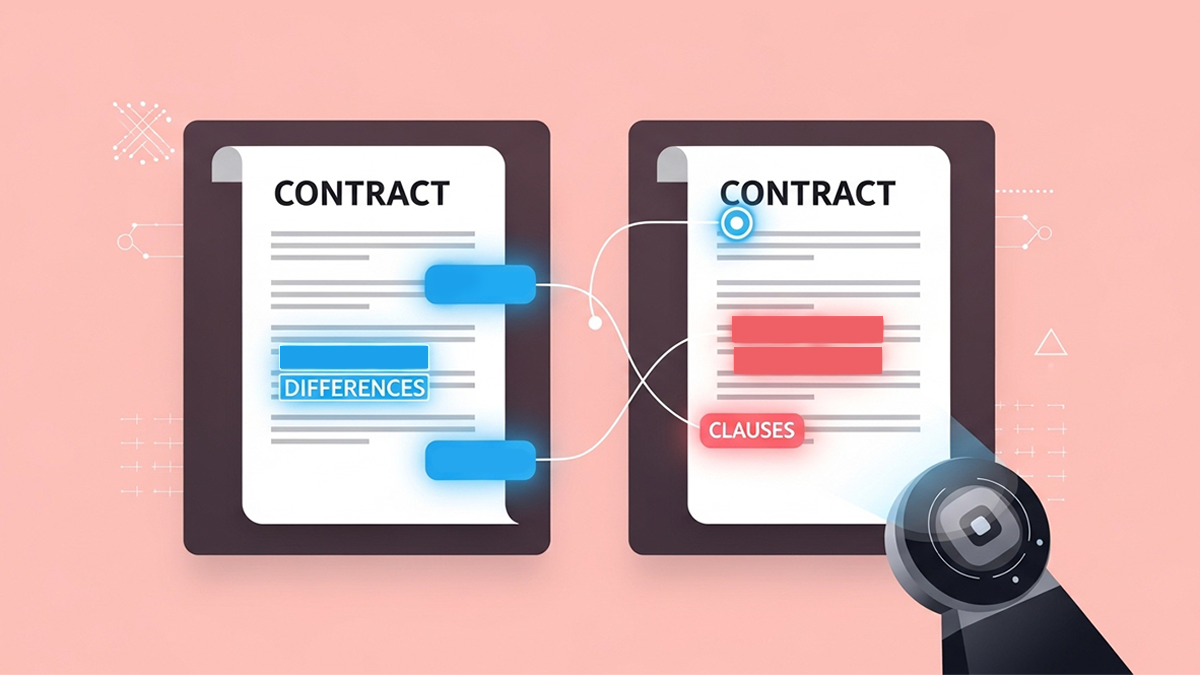
Instead of scrolling through long documents and trying to visually detect what changed, Legitt AI’s clause comparison and variation-spotting engine surfaces what actually matters: what clause is this, how does it differ from our standard, is it allowed, and what should we do now? Let’s break down how this works, why it matters, and how you can turn clause comparison from a reactive chore into a proactive control point in your contract lifecycle.
1. The Real Problem: Clauses Drift Faster Than People Notice
In most organizations, contracts don’t go wrong because someone added something obviously bad. They go wrong because clauses drift.
- A customer adds a “mutual” to a previously one-sided confidentiality clause.
- A vendor removes “time is of the essence.”
- A counterparty shifts IP ownership from “developed under this agreement” to “developed in connection with this agreement.”
- Someone changes “will” to “may.”
- A single limitation of liability cap is made “per claim” instead of “in the aggregate.”
Individually, these changes don’t look dramatic. But they affect enforceability, liability, delivery risk, and even revenue recognition. Manual review can catch some of it. Manual review at scale? Almost never.
Legitt AI’s approach is simple: treat clauses as data, not just text. Once clauses are identified, named, and tied to your company’s approved library, any deviation becomes measurable.
2. How Legitt AI Identifies and Normalizes Clauses
Your system already has a clause library-explicitly (a real internal clause bank) or implicitly (the clauses your legal team keeps pasting in every contract). Legitt AI can ingest that library and treat it as the source of truth.
When a new contract comes in-whether uploaded, fetched from a repository, or generated through your AI editor-Legitt AI:
- Extracts clauses from the contract (e.g. “Confidentiality,” “Indemnification,” “Payment Terms,” “IP Ownership,” “Termination,” “Governing Law,” “Warranties”).
- Maps them to your company’s versions (from your company_id-based clause store).
- Checks which ones are required and which ones are optional.
- Flags variations-places where the clause is present, but not in the same form as your standard.
So instead of “here’s a 24-page agreement,” you get “here are 4 clauses that don’t match your standard.” That’s a better day.
3. Spotting Variations Instantly
The heart of this feature is variation detection.
A “variation” isn’t just red text. It can be:
- A clause that exists but has different wording than your standard.
- A required clause that is missing.
- A clause that has been made reciprocal when yours is one-way.
- A clause where commercial terms (payment days, liability caps, service levels) have been subtly reduced.
- A clause whose name is the same, but intent has been altered.
Legitt AI doesn’t rely only on string comparison. It uses semantic-level understanding to answer: Is this clause doing the same thing as our clause? That’s important because counterparties often rewrite your clause in their own words. A human can tell “yes, this is just rephrased,” but humans get tired and miss details. AI doesn’t.
So your output looks like:
- Available clauses in contract: what the counterparty sent.
- Company clause library: what you expect.
- Varying clauses: what doesn’t match.
- Varying required clauses: what is risky right now.
That last list is the gold. That’s what your legal approver, sales lead, or contract ops person wants to see.
4. Why This Matters for Standardization and Risk
Clause variation isn’t just a legal problem-it’s a consistency problem.
If you let contracts go out with slightly different IP, slightly different liability, slightly different payment rules, over time your company loses the ability to:
- Report consistently (because obligations differ).
- Enforce consistently (because some contracts say “must” and others say “may”).
- Renew easily (because customers insist on “what we signed last time”).
- Negotiate faster (because no one knows what the current approved version is).
By detecting clause variation instantly, Legitt AI acts like a guardrail. It keeps every new or incoming contract aligned to the company’s clause standard. And when it’s not aligned, it tells you exactly where and why.
5. Powering Workflows: Not Just “This Is Different,” But “Do This Next”
Comparison alone is nice. Comparison + action is better.
Once Legitt AI identifies varying or missing clauses, you can route them into:
- Approval workflows (e.g. “IP clause changed → send to legal”)
- Playbooks (e.g. “Customer asked for mutual indemnity → offer alt-clause 2”)
- Assistant prompts (e.g. “Rewrite this clause to match company standard but keep customer’s liability cap”)
- Nudges / inbox items (e.g. “3 contracts have non-standard termination; review before signature.”)
This makes clause comparison an operational feature, not a passive one. You don’t just see the variation-you resolve it.
6. Fits Perfectly With AI-Native Drafting
If you’re already drafting contracts with Legitt AI’s editor or multi-agent system, clause comparison becomes even more powerful.
- When a user pastes a customer MSA → AI highlights non-standard parts.
- When someone uploads a signed contract → AI maps it back to your library so you can analyze portfolio risk.
- When building automated playbooks → AI can tell “this clause is required by finance” vs “this clause is negotiable.”
That’s the bridge between AI drafting and AI governance: draft freely, but compare strictly.
7. Portfolio-Level Use: Compare Not Just One Contract, but 100
A big hidden benefit: once clauses are extracted and normalized, you can run the same comparison across your entire repository.
Questions like:
- “How many of our vendor contracts have customer-friendly IP ownership?”
- “Which contracts don’t have termination for convenience?”
- “How many NDAs have 3-year confidentiality instead of 5-year?”
- “Which customer contracts removed our auto-renewal?”
All of these become answerable because clause comparison has already done the heavy lifting of identifying and mapping clauses. This is exactly what contract analytics tools try to do-but AI-driven clause detection makes it faster and less rigid.
8. The Net Outcome
With Legitt AI’s clause comparison and variation spotting, you get:
- Faster reviews – reviewers see only what changed from the standard.
- Fewer missed risks – because AI checks clauses semantically, not just by string.
- Better enforcement of company policy – required clauses can’t silently disappear.
- Cleaner negotiation history – you can tell why a clause was changed.
- Stronger repository analytics – once clauses are structured, you can report on them.
In short: it’s the difference between “we hope no one missed anything” and “we know this is aligned.”
Read our complete guide on Contract Lifecycle Management.
FAQs
What exactly does “clause comparison” do in Legitt AI?
It takes the clauses extracted from an incoming or drafted contract and compares them against your company’s clause library. It then tells you which clauses match, which are missing, and which have been modified in a way that matters (semantically or commercially).
Do I need to already have a clause library for this to work?
It helps a lot. If you already maintain standard clauses (IP, Confidentiality, Termination, Payment, Liability, Warranties), Legitt AI can treat those as the baseline. If you don’t, Legitt AI can still extract common clauses from your existing contracts and help you build that library over time.
How is this better than “track changes” in Word?
Track changes shows what text changed. Legitt AI shows what clause changed and whether it deviates from policy. That’s a higher-level view. It doesn’t matter if the counterparty rewrote the whole paragraph-AI can still tell if it’s doing the same job or not.
Can it detect missing required clauses?
Yes. If your company marks some clauses as required (e.g. IP ownership, governing law, limitation of liability), Legitt AI can flag their absence. This is useful when counterparties send their own paper.
What about small wording tweaks-does it flag everything?
It’s designed to reduce noise. Legitt AI looks at intent and structure, not just literal text. So it focuses on meaningful variations-like liability caps, ownership, mutual vs one-way obligations, time periods-rather than harmless rephrasing.
Can I route variations into approval workflows?
Yes. That’s where this becomes powerful. Non-standard or varying clauses can trigger your approval or negotiation workflows, so business users don’t accidentally approve risky language.
Does this work on scanned PDFs or only clean Word/HTML contracts?
If your pipeline extracts text from scanned PDFs (OCR) and sends the contract text to Legitt AI, it can work on that too. Cleaner source → better clause detection, but the system is designed to handle real-world contract inputs.
Can I use this for vendor, customer, and internal agreements alike?
Absolutely. Clause comparison is contract-type agnostic. As long as there is a baseline to compare against (your internal standard or a past contract), Legitt AI can spot variations.
How does this help with audits or portfolio reviews?
Because clauses are extracted and normalized, you can run portfolio-wide queries: “show me all contracts where limitation of liability is missing,” or “show me contracts with non-standard termination.” That’s extremely useful for compliance and renewal teams.
Can Legitt AI suggest a corrected or company-standard version automatically?
Yes. After detecting a variation, Legitt AI can propose the standard version of that clause or even rewrite the counterparty’s version to bring it closer to your policy-keeping their intent but restoring your safeguards.