
Contracts are around us in the business world. The sales team signs agreements with customers. The procurement team manages contracts with vendors. The human resources team takes care of employment agreements. The finance team keeps track of payment terms.. Even with thousands of contracts stored away most organizations cannot answer a simple question: What are our actual obligations and liabilities in these agreements?
This is what we call the contract visibility gap. It is becoming a risk for contract teams in 2026. Recent research shows that 95% of contract management teams have trouble identifying obligations and liabilities in their contracts. The problem is not that they do not have contracts. It is that they do not really understand what is in those contracts. Important details like renewal dates, compliance requirements and payment obligations are hidden in documents creating risks that get bigger with every new agreement.
In this article we will explore why contract visibility is important, what causes the gap and how modern contract management approaches are solving the problem.
What is the contract visibility gap?
The contract visibility gap is the difference between the number of contracts an organization has and the useful information they can get from them. A company might have 10,000 contracts. If teams cannot quickly find the ones with specific clauses, obligations or risks those contracts are basically useless.
This gap shows up in ways. For example:
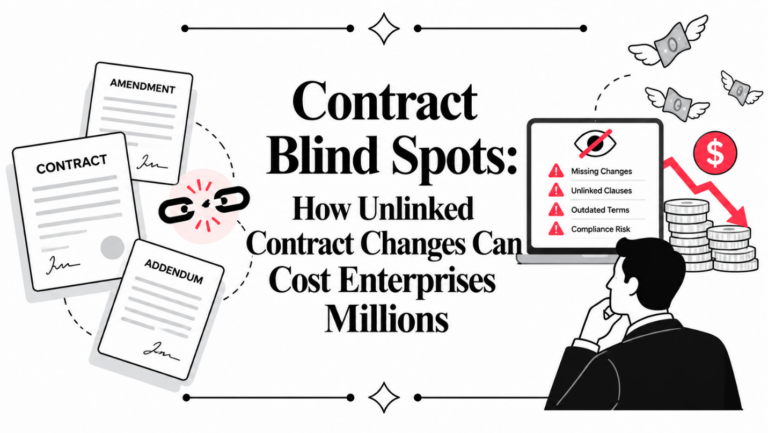
– We miss renewal dates and automatic renewal clauses that trigger extensions.
– We do not know about payment obligations that can surprise us with costs.
– Compliance requirements are buried in vendor agreements that teams do not know exist.
– Liability exposures are hidden in service level agreements or indemnification clauses.
– There are terms across similar contracts that create confusion.
– We do not monitor third-party risk because we do not track obligations.
The visibility gap is not new. It is getting more dangerous. As organizations sign contracts, deal with stricter regulations and rely more on third-party vendors the cost of not knowing what is in their agreements has never been higher.
Why does the visibility gap exist?
There are three reasons for the contract visibility gap:
1. We store contracts. We do not really manage them.
Most organizations treat contract repositories like filing cabinets. Contracts are stored. They are not analyzed. Teams have to search match keywords and rely on memory to find relevant agreements. When a legal question comes up like “Do we have a -compete clause with this vendor?” or “What are our payment terms?” someone has to manually review the documents. This approach does not work well.
2. Contracts are spread across departments and systems.
Sales contracts are in customer relationship management systems. Procurement agreements are in procurement platforms. Human resources employment contracts are in human resources systems. Finance tracks payment terms separately. No single team has visibility into all agreements and no system connects them. This means critical information is not available to those who need it.
3. We do not track obligations.
Even when contracts are centralized most organizations do not systematically. Track obligations. What does each party have to do? When are deliverables due? What happens if terms are breached? These questions require contract analysis, which is time-consuming and prone to errors when done manually. As a result, obligations are not. Compliance deadlines are missed.
What is the impact of visibility on business?
The visibility gap is not an operational problem. It has real financial and legal consequences.
1. Financial losses are an issue.
Hidden payment obligations and missed renewal dates cost organizations a lot of money. A vendor contract with a renewal clause that no one noticed might lock the company into another year of service at outdated rates. We might miss volume discounts because teams do not know what has already been negotiated. Duplicate vendor relationships might happen because procurement does not know existing agreements exist. These gaps create revenue losses that add up over time.
2. Compliance risk is another concern.
Regulatory requirements are getting stricter. Laws like GDPR, HIPAA, SOC 2 and industry-specific regulations impose obligations on organizations and their vendors. If those obligations are not visible and tracked, compliance becomes reactive rather than proactive. Teams discover violations after audits not before. The cost of fixing problems. And the damage to reputation. Is much higher than the cost of visibility.
3. Operational disruption is a problem.
When teams do not know what is in their contracts they cannot execute them effectively. Service level agreements are not monitored. Performance metrics are not tracked. Disputes arise because expectations were not clear. Vendor relationships deteriorate because obligations were not understood. The result is friction that slows down business.
4. Third-party risk exposure is an issue.
As organizations rely more on vendors for services contract visibility becomes crucial for risk management. If we do not know what our vendors are obligated to do. Or what they are allowed to do with our data. We cannot manage third-party risk. Data breaches, service failures and compliance violations by vendors become our problem if we did not know the risks existed.
Stop letting hidden clauses and missed renewals drain your revenue. > Closing the contract visibility gap doesn’t have to take weeks of manual review. With LegittAI, you can automatically extract key obligations, centralize your agreements, and turn static documents into active business intelligence.
 Hi, What do you want to Draft?

Click to upload or drag & drop
pdf, docx up to 5 MB
Click to upload or drag & drop
pdf, docx up to 5 MB
How Modern CLM Closes The Visibility Gap
Forward-thinking organizations are closing the visibility gap using three approaches:
1. Intelligent Contract Extraction
Modern contract lifecycle management platforms use intelligence to automatically extract key data from contracts. This data includes obligations, payment terms, renewal dates, liability clauses and compliance requirements. The extracted data is then indexed. This transforms documents into structured data that can be searched, analyzed and tracked. Teams can now quickly find answers to questions like “Show me all contracts with auto-renewal clauses” or “Which vendor agreements have data privacy obligations?”
2. Centralized Contract Intelligence
of contracts living in separate systems modern CLM platforms create a single source of truth. All contracts are. Connected. This includes sales contracts, vendor agreements, employment contracts and service agreements. They all live in one place with metadata and obligation tracking. This eliminates silos. Ensures critical information is accessible to everyone who needs it.
3. Obligation Management And Tracking
Modern CLM systems do not just store contracts; they track what needs to happen. Renewal dates trigger alerts. Compliance obligations are assigned to parties. Performance metrics are monitored. Payment terms are flagged before they are due. This transforms contracts from documents into active management tools that drive business execution.
Real-World Impact
A mid-market technology company had 500 vendor contracts. They used methods to identify vendors with data privacy obligations under GDPR. This took weeks of contract review. With CLM and intelligent extraction the same analysis took hours. The company identified 47 vendors with GDPR obligations. Avoided compliance violations.
A healthcare organization managed 1,200 patient service agreements. Without visibility into renewal dates they renewed contracts at rates. By implementing contract management they identified 89 contracts with auto-renewal clauses. They renegotiated terms before renewal. Saved $2.3 million annually.
These are not outliers. Organizations across industries discover that closing the visibility gap delivers financial and operational benefits.
What This Means For Businesses
The contract visibility gap is no longer acceptable. Regulators expect organizations to know what’s in their agreements. Boards expect CFOs to understand contract-related exposure. Customers expect vendors to honor their obligations. Employees expect terms of employment.
For contract teams this means:
– Invest in visibility first. Ensure you can see and understand what’s in your contracts.
– Centralize contract data. Eliminate silos by bringing all contracts into a system.
– Extract obligations systematically. Use AI-powered extraction to identify and track what needs to happen.
– Contracts to business systems. Integrate contract data with CRM, ERP and finance systems.
– Monitor compliance continuously. Track obligations in time and alert responsible parties.
For procurement and legal teams closing the visibility gap means:
– Reducing contract cycle time by eliminating searches.
– Improving compliance by tracking obligations.
– Reducing financial leakage by identifying missed discounts and auto-renewals.
– Strengthening vendor relationships by ensuring both parties understand obligations.
– Enabling negotiation by understanding what’s already been agreed to.
The Future Of Contract Visibility
As AI capabilities advance contract visibility will become more sophisticated. Conversational search will let teams ask natural language questions about their contract portfolio. Predictive analytics will flag risks. Automated obligation management will ensure nothing falls through the cracks.
But the foundation remains the same: organizations need to see and understand what’s in their contracts. The visibility gap won’t close on its own. It requires investment in contract lifecycle management platforms.
Conclusion
The contract visibility gap is one of the underestimated risks in modern business. Thousands of contracts sit in repositories. Their contents remain invisible. This creates leakage, compliance risk and operational disruption.
Closing the gap requires moving beyond contract storage to intelligent contract management. Modern contract lifecycle management platforms use AI-powered extraction, intelligence and obligation tracking. The result is visibility, faster decision-making, reduced risk and improved business outcomes.
If your organization struggles to answer questions about contracts you have a visibility gap. The good news is that closing it is now possible. The question is: how longer can you afford to leave that gap open?
FAQs
What exactly is the contract visibility gap?
It is the disconnect between the total number of contracts an organization has signed and the actual, usable data they can extract from them. It means having the documents but not knowing the specific obligations, renewal dates, or risks hidden inside them.
Why is contract visibility important for businesses?
Visibility allows businesses to proactively manage their agreements rather than reactively dealing with expired terms, missed renewals, or compliance breaches. It turns static documents into actionable business intelligence.
How do I know if my company has a contract visibility gap?
If your team relies on memory to track renewals, uses manual spreadsheets, or takes days to answer a simple question like "What are our payment terms with Vendor X?", you have a visibility gap.
What is the difference between contract storage and contract management?
Contract storage is simply keeping files in a digital cabinet (like a shared drive). Contract management involves tracking the lifecycle of the agreement, including extracting data, monitoring obligations, and setting alerts for key dates.
Who in the organization is most affected by poor contract visibility?
While it impacts the entire business, Legal, Procurement, Finance, and Sales teams feel the pain most acutely. They are the ones tasked with managing risk, negotiating terms, and ensuring revenue is collected or saved.
How do hidden contract terms affect vendor relationships?
When expectations and deliverables aren't clearly tracked, disputes arise. If one party fails to meet a Service Level Agreement (SLA) because they forgot it was in the contract, it creates friction and damages trust.
How does the visibility gap impact third-party risk management?
You cannot manage risks you cannot see. If you do not know what your vendors are contractually obligated to do regarding security, data privacy, or performance, your business assumes all the risk of their potential failures.
Can't we just use a spreadsheet to track our contracts?
While spreadsheets are a common starting point, they are static. They don't send automated alerts, they rely on humans to update them perfectly, and they quickly become outdated the moment a contract is amended.
How does artificial intelligence improve contract visibility?
AI can "read" contracts at scale. Platforms like LegittAI automatically identify and extract critical data—like dates, parties, liability caps, and compliance terms—instantly turning text into searchable, trackable dashboards.
Can modern CLM systems integrate with our existing business tools?
Yes. Modern CLM platforms are designed to integrate seamlessly with the tools your teams already use, such as Salesforce, HubSpot, ERPs, and financial software, ensuring data flows across the whole organization.
Read our complete guide on Contract Lifecycle Management.