
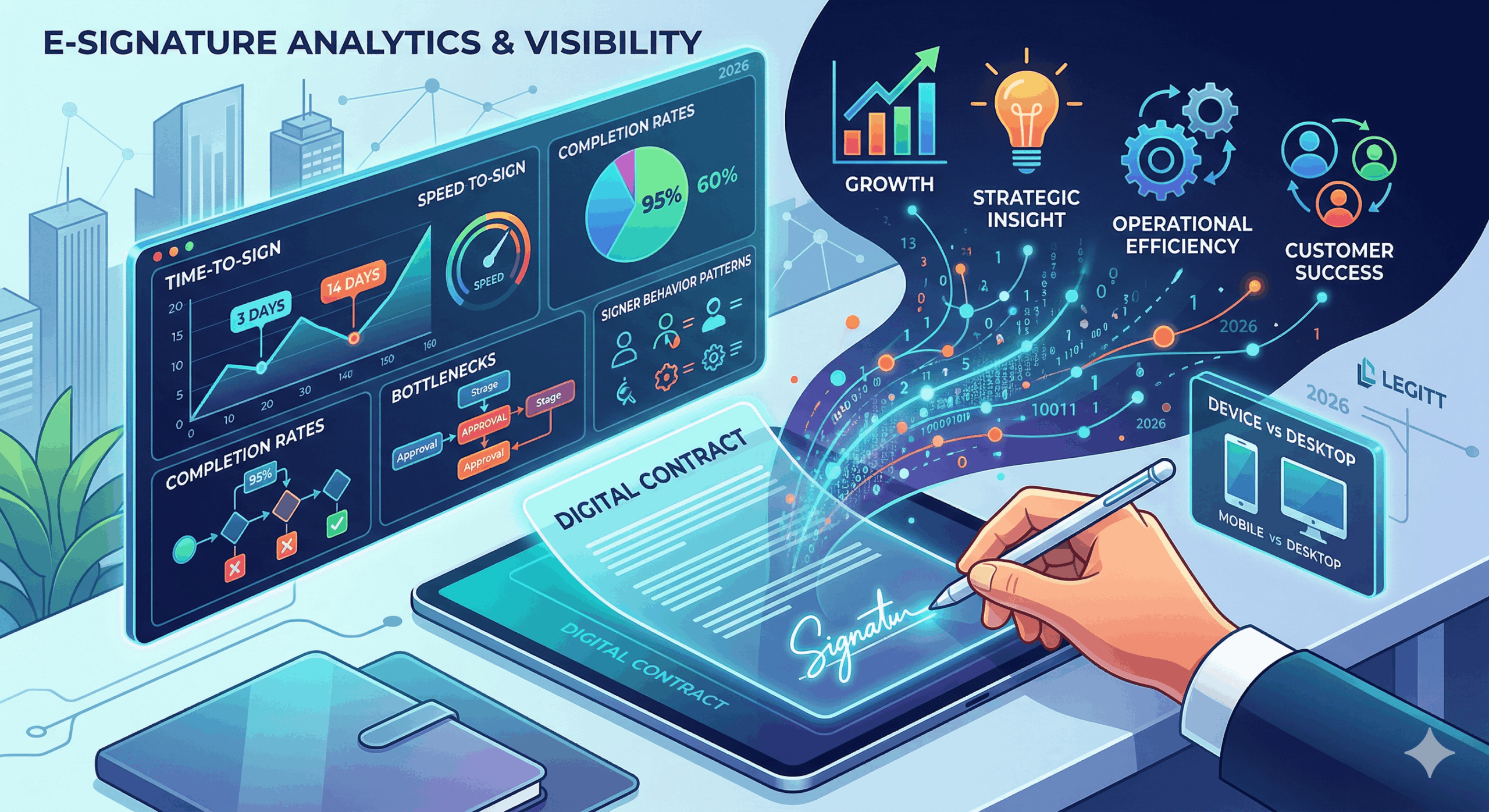
E-signature platforms have been viewed as instruments of document execution over the years. Send a contract, gather signatures, save the file. That is all. However, in the future, in 2026, progressive organizations are posing an entirely new question: What can our e-signature data tell us about our business as we actually run it?
The shift is significant. E-signatures enable an abundance of operation information including time to sign, blockers in approval processes, document type completion rates, patterns of signer behavior, etc. However, this data is still regarded by many businesses as a by-product, but not a strategic asset. Revenue and operations are becoming more dependent on digital agreements, and extracting intelligence out of e-signature workflow is turning into a competitive advantage. Firms that are able to visualize, quantify and automate their online contracting procedures are accelerating, ending transactions more swiftly and smoothly decreasing operational strain. The article will investigate the issue of why e-signature analytics are important today, what insights progressive teams are deriving, and how to create a presence into your digital processes.
Why E-signature Analytics Is Important Now.
E-signatures occupy a very sensitive point of convergence in business today. They relate sales, legal, operations, finance and customer success. Each signature is a workflow milestone, a decision point or a revenue event. However, in most organizations, there is no insight into what goes on in these workflows.
Take the case of a normal situation: A sales force makes 100 contracts within a month. 75 of them are signed. 25 not. Why? Where do deals stall? What are the most abandoned types of documents? What signers are the slowest to sign? These questions are not answered without analytics. They are actionable with analytics.
The business case is clear. When you can find out the reason, 25% of contracts are not being signed, then you can remedy the underlying cause. It is possible that the papers are too lengthy. Perhaps the experience of signing on mobile is disorienting. Perhaps some of the approval chains are causing bottlenecks. The problem is uncovered by analytics. Then you can solve it.
The Facts in your E-Signatures Workflows.
The current e-signature systems are able to produce rich data on each phase of the signing process. The initial step towards operational intelligence building is comprehension of available data.
Completion Measures: What is the number of documents sent, opened, signed, and abandoned? The completion rates are a pointer to the rate of workingness of your signing experience. The completion rate is 95 percent which indicates smooth workflow. A 60 percent completion rate is an indication of a problem in the process.
Time-to-Sign Analytics: Time is required to sign documents? Mean time to sign, median time and patterns of distribution are all important. When it normally takes 3 days to sign contracts, but 14 days to sign one type of document, it is an indication. Perhaps, the document is not that simple. Perhaps, the approval chain is excessive. Possibly, the signers do not know what they are signing.
Identification of Bottlenecks: At what point do workflows stop? With e-signature analytics, it is possible to identify the point in a multi-party approval chain where the delay occurs. Is it the first singer? The legal review? The finance approval? The workflow can be redesigned once you know.
Signer Behavior Patterns: What fast signers are there? Which are slow? What are the documents that they commonly sign? Which of them do they deny or renounce? The behavioral data assists the teams in knowing who has been involved and with whom they need to have a follow-up and areas where there is friction.
Document Type Performance: There are varying completion rates of the different documents. Contracts could be 90 percent completed. Amendments might have 70%. Addendums might have 50%. Knowledge of the document types that are underperforming can guide teams to restructure them or redefine work processes.
Device and Platform Insights: Mobile or desktop? What are the highest abandonment rates of any device? When the abandonment rate is 40% on mobile whereas percentage completion is 95% on desktop, it is a UX issue to resolve.
Geographic and Temporal patterns.
Geographic and time-related trends that affect business functions are also indicated by e-signature data.
Time Zone Effects: Does signing contracts through time zones make them longer? Is there delay in asynchronous workflows? It is possible to use analytics to demonstrate the influence of geographic distribution on the speed of signing.
Trends Seasonally: Are there periods of the year when there are more signings? Is there a seasonal difference in completion rates? The knowledge of such patterns aids in the process of resource planning and forecast.
Day-of-Week Effects: Do contracts that are signed on Monday have better completion rates in comparison to contracts signed on Friday? Do weekends create delays? These trends update workflow optimization.
In the e-signatures analysis, the most common use is by leading organizations.
The proactive businesses are already gaining a competitive edge with e-signature information.
Sales leaders apply analytics to find out what deals are hanging and why. In the event that there is no activity on a pending contract after 5 days, the automatic alerts give follow-up. In the event that some forms of documentation are always under performing, the sales can liaise with legal to streamline them. In case the high abandonment of mobile signing is observed, it may be promoted by using sales to promote desktop signing or to make the mobile experience more efficient.
Legal and Compliance: Legal teams rely on analytics to gain insight on the approval bottlenecks. In case review by the law is taking 3 days, that is where process improvement can be made. When some of the types of contracts are rejected at very high rates, it is an indication that the reasons may be wrong template design or legal terminology.
Operations and Finance: E-signature analytics give Operations teams an opportunity to predict cash flow and revenue recognition. Assuming that it takes an average of 10 days to sign a contract, it will affect the recognition of revenue. In the case where some groups of customers exhibit a higher abandonment rate then that will impact on the accuracy of the pipeline.
Customer Success: Analytics can be used by customer success teams to detect customers who are at risk. When a customer normally takes 2 days to sign documents but suddenly takes 10 days, that may be an indication of disengagement or internal problems that may need to be investigated.
If you want the same level of visibility that top sales and legal teams are using to close deals faster, it is time to upgrade your workflow. See how our advanced analytics can pinpoint your bottlenecks and accelerate your revenue.

Click to upload or drag & drop
pdf, docx up to 5 MB
Measurables: E-Signature Key Performance Indicators.
The first step in building an analytics program is the definition of what to measure. These are some of the key KPIs that progressive organizations monitor.
Completion rate: It is the percentage of documents sent, which are fully signed. Target: 90%+. When the rate of your completion is less than 80, find out the reasons.
Average Time to Sign: What is the send to final signature time? Compare against industry standards, as well as against your own past. When time to sign is getting long, it is an indicator of process degradation.
Abandonment Rate: Percent of documents that were opened and not signed. High abandonment implies problematic signing experience or lack of clarity in the purpose of the document.
First-Signer Completion Rate: How many documents receive one or more signatures? This shows whether the preliminary signing process is effective.
Multi-Party Completion Rate: On documents that need various signatures, what is the percentage of full completion? This broadcasts approval chain bottlenecks.
Mobile vs. Desktop Completion: Compare the rates of completion in devices. A mobile that is considerably smaller, that is the UX problem.
Signer Engagement: What number of signers view documents? What is the length of time they review? Do they go through the whole paper or simply sign? Measures of engagement can help to understand whether agreements are being read by signers.
Rework Data-driven Process Redesigns.
The analytics should be useful in that it leads to action. Here is the way of utilizing e-signature data to enhance workflows.
Determine Bottlenecks: Time-to-sign data can be used to determine where workflows are stalling. When it is 5 days to review the law and 1 day to other actions, then that is your bottleneck. Then redesign: Parallelize approvals? Is it possible to develop an expedited procedure of low-risk documents? Is it possible to computerise review of standard contracts?
Streamline High-Abandonment Documents: When some types of document have 40% abandonment, redesign them. Make them shorter. Use clearer language. Add progress indicators. Pilot the redesign and gauge improvement in rates of completion.
Mobile optimization: In case the completion rate through mobile signing is considerably low, consider mobile UX. Test on actual devices. Simplify the signing flow. Make buttons larger. Reduce scrolling. Test progress on mobile completed changes.
Personalize Signing Experiences: Workflow personalization using signer behavior data. In the event of some signers who are habitually 10 days late, remind them by day 3. In case there are always some signers who sign within 24 hours, there is no need to send them reminders. When some signers often decline signing certain documents, mark them manually.
Automate Follow-Up: Automatically follow-up using analytics. In case the document has not been signed after 3 days, remind me. In case a signer does not sign within 24 hours after opening a document, send a follow-up. In case a document is not processed, activate a manual outreach process.
What this implies on businesses.
E-signature analytics has ceased to be a choice. With the adoption of digital agreements as the key feature of the business, it is becoming a table stakes to have the ability to see, measure, and optimize these workflows.
Those organizations which invest in e-signature visibility today will gain an estimated advantage:
Reduced Deal Cycles: You reduce the time to deal after recognizing and removing bottlenecks.
Increased Completion Rates: With the streamlining of workflows, based on data, you would increase the rate of document signings.
Greater Accuracy in Forecasts: You make more accurate predictions of revenue and cash flow by knowing the patterns of signing.
Enhanced Customer Experience: You simplify work processes and make signers have improved experiences by optimizing to mobile.
Operational Efficiency: You can save on human resource and time through automation of follow-up and manual work and increase the capacity of the team to work on something more important.
The businesses that will be victorious in 2026 are those who will consider e-signature data as a strategic asset, rather than a side-story. They are posing tough questions on their processes, they are relying on data to find out what is going wrong, and they are continuously improving on what they are learning.
Conclusion
E-signatures have also progressed to be more of a signature tool instead of a signing tool. The information created by digital agreement processes gives the picture of how your business is actually running, where deals are blocked, which processes are working, which are not working, and where there is friction.
Progressive organizations are already deriving competitive advantage out of this data. They are detecting bottlenecks, streamlining operations and increasing completion rates. They are applying analytics to predict more, serve their customers and run efficiently.
You are losing a major prospect in case you still consider e-signatures as a document signing tool. Begin with defining what to measure. Next create visibility in processes. Make use of data to find problems. Re-design according to what you know. Measure again. Repeat.
The companies which master the e-signature analytics will be more successful in speed, closing deals within a shorter period and working more effectively than other companies that consider digital agreements a commodity. When assessing your e- signature strategy, ask yourself whether your existing platform allows you the visibility and analytics you require to streamline your workflows. Newer tools such as Legitt provide an extensive analytics and reporting functionality to assist teams to generate intelligence in their digital agreement processes and constantly enhance their processes.
FAQs
What are e-signature analytics?
E-signature analytics refers to the process of extracting and analyzing the data in digital document processes including: sign times, drop-off points, and user behavior to obtain actionable business intelligence.
What is the difference between e-signature analytics and rudimentary e-signatures?
Basic e-signatures are merely a digital signature that is captured in order to execute a document. Analytics make that process an information source which is a quantification of how and when the execution occurs to streamline business operation overall.
Why is visibility into the signing process important?
Deals cannot be put on hold quietly. It enables companies to be able to know the stage in the approval chain that a document is, in order to identify the bottlenecks before they affect the revenues.
Can analytics help increase document completion rates?
Yes. Knowing which point signers are leaving a document (e.g. a particular page, on mobile devices), you can redesign the workflow to eliminate frustration and increase compliance.
Where can e-signature data be the most helpful?
The most benefiting teams are Sales, Legal, Operations, and Customer Success teams. It assists the sales forecasts at the close-out times, legal streamline reviews and operations to correctly project revenue recognition.
What is meant by a high rate of abandonment?
The high abandonment rate (documents opened, but not signed) is a possible indication of incomprehensible legal language, the imperfect format of the document, or a bad experience, especially on mobile.
How can I track multi-party approval bottlenecks?
Advanced analytics track the exact timestamp for every signer in a sequence. If a document consistently stalls at the second signer (e.g., legal review), the data will flag that specific step as the bottleneck.
Can I see whether a signer used a mobile device or desktop?
Yes, modern platforms track device and platform usage. Comparing mobile versus desktop completion rates is crucial for identifying responsive design issues.
How do I use data to fix a broken signing workflow?
Start by looking at your time-to-sign and abandonment metrics. If data shows delays always happen at the internal review stage, you can restructure the process to run approvals in parallel rather than sequentially.
How do time zones affect document turnaround times?
Analytics can reveal delays caused by asynchronous workflows across different geographies, helping teams adjust send times or expectations for international deals.
Read our complete guide on Contract Lifecycle Management.