
Here is a situation every sales team knows.
The deal is basically done. The prospect said yes. Now someone needs to send a contract. So the rep leaves Salesforce, opens a different tool, hunts for the right template, manually copies in the account name, deal value, and contact details from the CRM they just left, and then sends the document off for a separate approval process before it finally reaches the customer.
By the time the contract lands in the customer’s inbox, it’s been two days. The momentum from the close conversation is gone. And Salesforce – the system of record for the entire deal – still shows the opportunity as open because nobody updated it yet.
This is what broken contract management looks like inside a Salesforce environment. And as explored in Why Traditional CLM Is No Longer Enough, it’s more common than most RevOps and legal teams want to admit.
Why Salesforce Alone Isn’t Enough for Contracts
Salesforce is exceptional at what it was built to do – track pipeline, manage relationships, forecast revenue. What it was not built to do is handle the full contract lifecycle. Drafting, negotiation, approvals, signing, and post-signature tracking all require capabilities that live outside the CRM by default.
So teams bolt on additional tools. A document generation platform here. An e-signature tool there. A shared drive for storing signed contracts. An email thread for approvals. The result is a contract process that technically works but requires four or five context switches per deal – and leaves Salesforce perpetually out of date.
The average sales rep spends 20 to 30 minutes per deal just re-entering data that already exists in Salesforce into a contract template. Multiply that across a team of twenty reps closing fifty deals a month and you have a significant chunk of selling time going to copy-paste.
The fix is not replacing Salesforce. It’s bringing the contract process inside it. That’s exactly what Legitt AI’s Salesforce integration was built to do.
What It Actually Looks Like When CLM Lives Inside Salesforce
When contract lifecycle management is properly integrated with Salesforce, the deal flow changes completely. Here is what the same close scenario looks like with Legitt AI connected to your CRM:
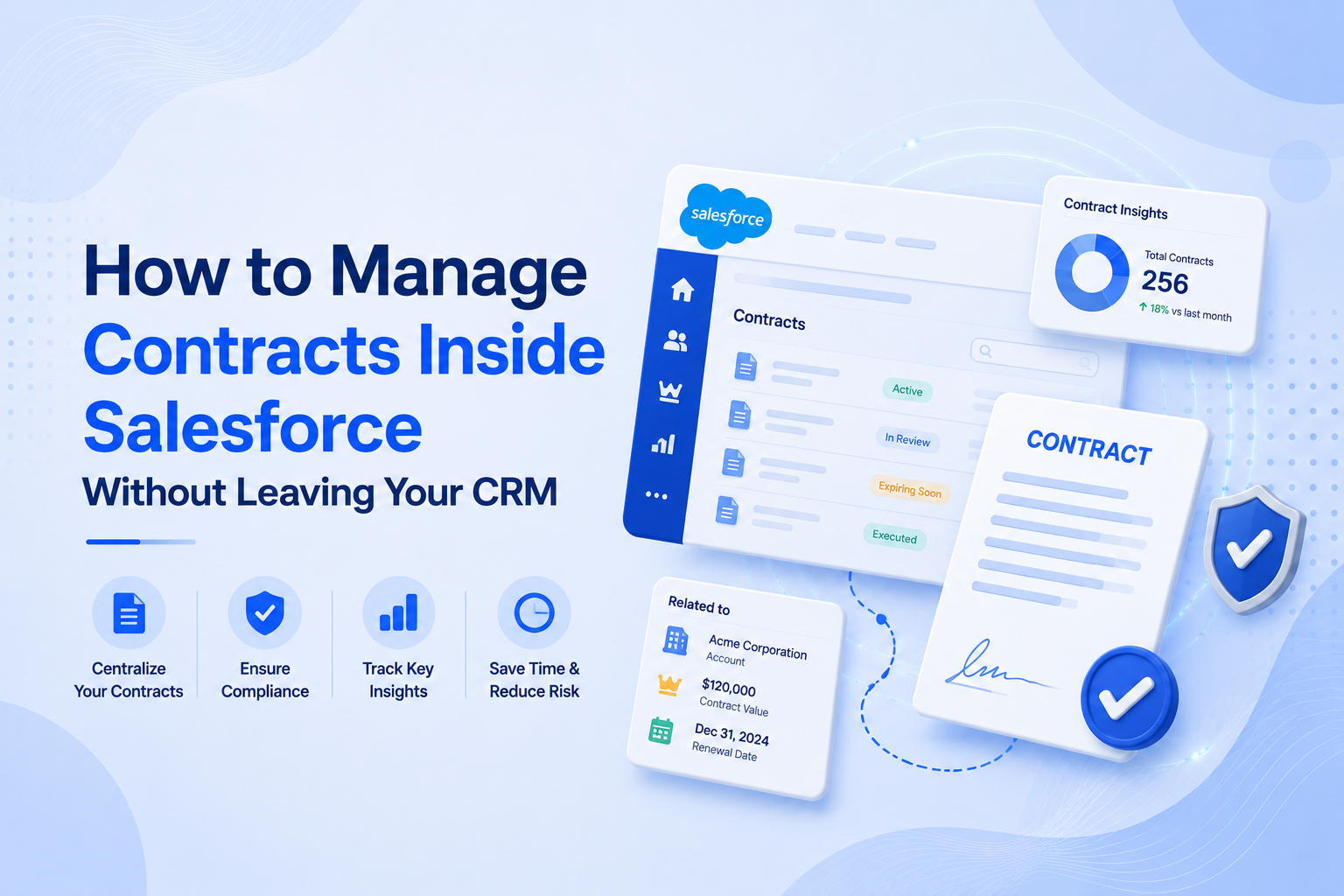
The rep is in the Salesforce Opportunity. Deal is done. They click to initiate a contract – right there, without opening another tab. Legitt pulls the account name, deal value, products, pricing, and contact details automatically from the Opportunity record. The contract populates in seconds. No manual entry. No switching tools.
The contract goes through the approval workflow – also configured inside the integration – and approvers get notified without the rep having to chase anyone. Once approved, it goes out for signature. When the customer signs, the executed document saves directly back to the Salesforce Opportunity. The stage updates automatically. A renewal task gets created for the account owner with a configurable lead time.
The whole thing – from initiation to signed contract back in Salesforce – can happen in under an hour on a straightforward deal. For a deeper look at what this means for revenue teams specifically, see Why Salesforce Needs an AI-Native Contract Intelligence Layer.
The Four Things That Actually Change
1. Data Entry Disappears
Every piece of information that already lives in Salesforce – account details, pricing, products, contact names, signatory information – gets pulled into the contract automatically using Legitt’s AI Contract Generator. Reps stop being data entry operators and start being what they were hired to be.
The downstream effect matters too. When contract data comes from Salesforce rather than being typed manually, accuracy goes up. Wrong client names, outdated pricing, and incorrect deal values – the kind of errors that cause contracts to come back for correction – stop happening as often.
2. Approvals Stop Being a Black Hole
One of the biggest delays in most contract processes is the approval stage. A contract gets sent to legal. Legal is busy. It sits in an inbox for three days. The rep has no visibility into where it is or when it will move.
With Legitt AI inside Salesforce, approvers are pulled in automatically based on configured workflows. Reminders go out without manual follow-up. Every action gets logged with a timestamp. The rep can see exactly where the contract is at any point – and so can their manager, and so can operations.
3. Salesforce Stays Accurate
The bidirectional sync is the part that operations and finance teams care about most. Every contract event – status changes, approval milestones, signature completion, renewal dates – writes back to Salesforce automatically as Activity records and field updates.
This means pipeline reporting reflects reality. Forecasting is based on actual contract status, not on what a rep remembered to update last Tuesday. For teams already thinking about broader contract visibility, Contract Visibility Gap: Why Most Organizations Miss Hidden Risks covers exactly what happens when this sync breaks down.
4. Renewals Get Managed Before They Become Emergencies
Post-signature, Legitt creates renewal tasks in Salesforce for the account owner with configurable lead time. This connects directly to Legitt’s Obligations Management layer – so renewal dates, payment milestones, and contract obligations all stay tracked in one place, not scattered across emails and calendar reminders.
Setting It Up – Faster Than You’d Expect
One of the more common objections to integrating a CLM with Salesforce is the assumption that it’s a long IT project. Configuration takes weeks. Data mapping takes longer. By the time it’s live, the team has moved on to something else.
The Legitt AI Salesforce integration is built to go the other direction. Average setup time is under 30 minutes. It connects through the Salesforce AppExchange, maps to your existing Opportunity objects, and pulls your contract templates and company settings automatically.
There is no separate login for reps. No new interface to learn. The contract process just appears inside the Salesforce environment they already use every day.
92% reduction in contract-to-close cycle time. A contract drafted from Salesforce data in 60 seconds. 100% bidirectional sync – every event written back to Salesforce automatically. These are the numbers Legitt AI customers report after going live.
The setup time being short matters because it means teams can go live, see results, and build internal momentum quickly. See how How Legitt Extends Salesforce Beyond Traditional CLM for a full picture of what the platform does beyond the basics.
Who This Changes the Most
Sales Teams
Contracts stop being the thing that slows down the close. Reps initiate, track, and complete the contract process from inside the tool they’re already in all day. See how Legitt AI specifically supports sales contract management for teams running high-volume deal cycles.
Legal and Compliance Teams
Approvals come through a structured workflow rather than ad hoc email requests. Every contract is templated and consistent. Audit trails are automatic. For legal teams managing risk and compliance across a portfolio of agreements, having contract data in Salesforce removes a major visibility gap.
Revenue Operations
Pipeline data becomes reliable. Forecasting improves because contract status is reflected in Salesforce in real time. Teams running revenue operations find that renewal visibility alone – knowing exactly when contracts expire and having tasks auto-created – changes how proactively the team manages accounts.
Finance Teams
Payment terms, contract values, and renewal dates flow into Salesforce automatically. No more chasing reps for contract details. No more reconciling what the CRM shows against what the signed document actually says.
Related Reading
If this is useful, these cover related ground worth exploring:
→ Why Salesforce Needs an AI-Native Contract Intelligence Layer
→ How Legitt Extends Salesforce Beyond Traditional CLM
→ Why Traditional CLM Is No Longer Enough
→ Contract Visibility Gap: Why Most Organizations Miss Hidden Risks
→ Why Contract Management Matters More Than Ever
Get Started
Legitt AI’s Salesforce integration is available now for Legitt Pro customers. Setup takes under 30 minutes and includes a live walkthrough tailored to your deal workflow – not a generic product demo.
If your team is running contracts through Salesforce and the process still involves tool switching, manual data entry, or approval delays, it’s worth seeing what the alternative looks like.
Book a live demo – legittai.com/salesforce