
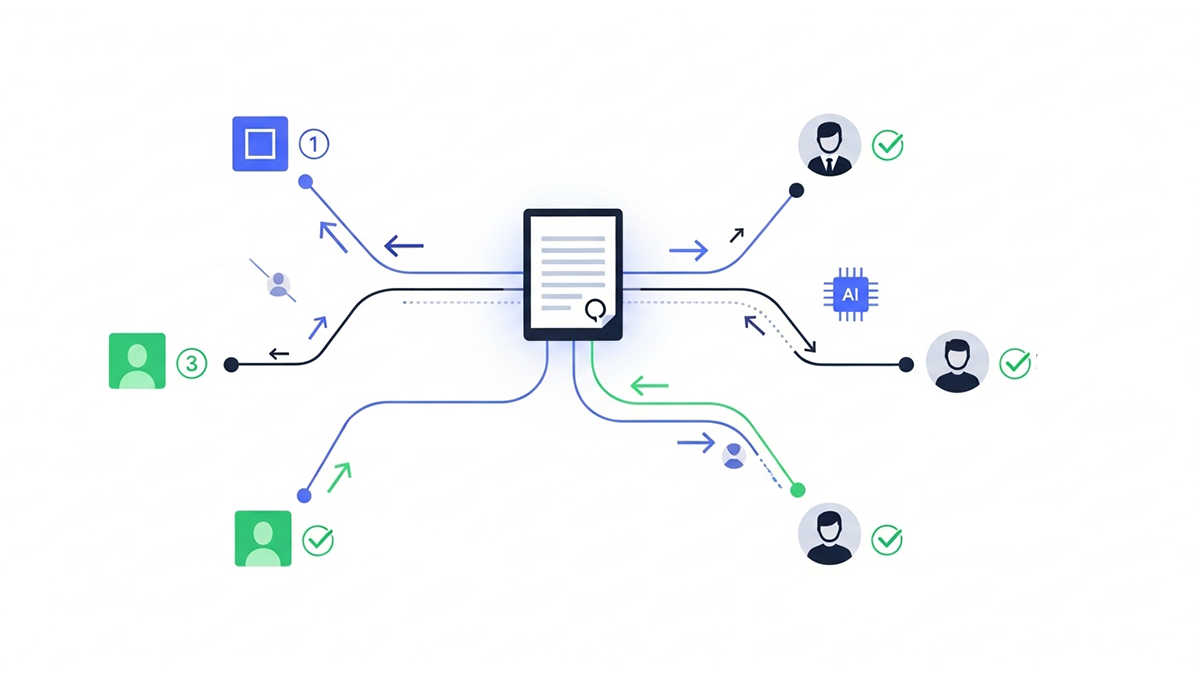
As enterprises expand globally, contracts increasingly involve multiple parties, subsidiaries, affiliates, and external stakeholders. A single agreement may require signatures from a parent company, one or more regional entities, joint venture partners, internal approvers, and external vendors-each with specific signing authority, order dependencies, and compliance requirements.
Managing multi-party and multi-entity signing at scale is no longer a logistical challenge alone; it is a governance, compliance, and risk issue. Without structured controls, organizations face delays, unauthorized execution, invalid signatures, and audit failures.
Modern e-signature and contract lifecycle platforms, powered by AI and workflow automation, now enable enterprises to orchestrate complex signing scenarios with precision. This article explains how multi-party and multi-entity signing works, why signing order and delegation matter, how parallel signing accelerates execution, and how organizations can manage these workflows at scale with confidence.
Understanding Multi-Party and Multi-Entity Signing
Multi-party signing refers to contracts that require signatures from more than two parties. Multi-entity signing adds another layer of complexity by involving multiple legal entities within the same organization or corporate group.
Common examples include:
- Global master agreements signed by a parent company and local subsidiaries
- Tri-party or quad-party commercial agreements
- Vendor contracts involving holding companies and operating entities
- Consortium, joint venture, or partnership agreements
- Enterprise deals requiring internal countersignatures from legal, finance, and executives
Each signer may have different authority levels, signing sequences, and jurisdictional requirements, making manual coordination error-prone.
Why Traditional Signing Processes Fail at Scale
Many organizations still manage complex signing through emails, shared folders, and manual follow-ups. These approaches break down rapidly as the number of parties and entities increases.
Key failure points include:
- Unclear signing order leading to premature or invalid execution
- Unauthorized signers acting on behalf of entities
- Lack of visibility into signing progress
- Delays caused by sequential dependencies
- No audit trail for delegation or authority
At scale, these failures translate into stalled deals, compliance violations, and legal exposure.
The Importance of Signing Order
Signing order defines the sequence in which parties must sign an agreement. In many contracts, order is legally and commercially significant.
For example:
- Internal approvals may be required before external signature
- Parent entity signatures may precede subsidiary execution
- Regulatory or escrow conditions may depend on execution sequence
AI-powered contract platforms enforce signing order automatically, ensuring the document moves only to the next authorized signer once prerequisites are met. This prevents accidental execution and ensures legal enforceability.
Delegation of Signing Authority
Delegation is a critical component of multi-entity signing. Enterprises often authorize specific individuals to sign on behalf of legal entities, departments, or regions.
Challenges arise when:
- Delegations are informal or undocumented
- Authority limits are exceeded
- Temporary or substitute signers are required
- Delegation varies by contract type or value
Modern systems allow delegation rules to be codified, tracked, and enforced. AI-driven platforms such as Legitt AI (www.legittai.com) ensure that only authorized signers can execute contracts for a given entity and automatically block signatures that exceed delegated authority.
 Hi, What do you want to Draft?

Click to upload or drag & drop
pdf, docx up to 5 MB
Click to upload or drag & drop
pdf, docx up to 5 MB
Parallel Signing: Speed Without Compromising Control
Parallel signing allows multiple parties to sign simultaneously rather than sequentially. This is essential for reducing cycle time in complex agreements.
Parallel signing is particularly effective when:
- Parties are independent and do not require sequential review
- Internal approvals are already completed
- Time-to-close is critical
AI-enabled workflows determine which signers can act in parallel and which must follow a sequence. This balance ensures speed while preserving governance and compliance.
Managing Multi-Entity Signing Across Jurisdictions
Multi-entity contracts often span jurisdictions with different legal and regulatory requirements. Signing authority, execution formalities, and enforceability standards may vary by country.
AI-powered platforms account for:
- Entity-specific signing rules
- Jurisdictional execution requirements
- Compliance with local e-signature laws
- Audit and evidence standards
By embedding these rules into the signing workflow, organizations reduce the risk of invalid or non-compliant execution.
Visibility and Real-Time Orchestration
One of the biggest challenges in multi-party signing is visibility. Stakeholders often lack real-time insight into who has signed, who is pending, and where delays occur.
Modern platforms provide:
- Real-time signing dashboards
- Status tracking by party and entity
- Automated reminders and escalations
- Clear ownership and accountability
Legitt AI (www.legittai.com) offers centralized visibility across complex signing workflows, allowing legal and operations teams to manage execution proactively rather than reactively.
Auditability and Legal Defensibility
In complex signing scenarios, auditability is as important as execution speed.
AI-powered signing systems maintain:
- Detailed logs of signer identity and authority
- Timestamped execution records
- Delegation and approval trails
- Evidence of signing order and completion
This ensures contracts are defensible in audits, disputes, and regulatory reviews.
Scaling Multi-Party Signing with AI
At enterprise scale, manual configuration of signing workflows becomes impractical. AI enables scalable orchestration by dynamically determining:
- Required signers based on contract content
- Signing order based on risk and policy
- Eligibility for parallel execution
- Escalation paths for delays or exceptions
Platforms like Legitt AI (www.legittai.com) use AI to automate these decisions, allowing organizations to manage hundreds or thousands of complex agreements without operational bottlenecks.
Best Practices for Enterprise-Scale Signing
To manage multi-party and multi-entity signing effectively:
- Define clear signing authority matrices
- Separate approval from execution workflows
- Use parallel signing wherever legally permissible
- Enforce signing order automatically
- Maintain audit-ready execution records
The goal is to enable speed with certainty, not speed at the expense of control.
The Future of Complex Contract Execution
The future of contract execution is intelligent, adaptive, and autonomous. AI will increasingly predict signing delays, recommend workflow optimizations, and ensure compliance before issues arise.
Enterprises that invest in AI-driven signing orchestration today will achieve faster deal closures, stronger governance, and greater confidence in every executed agreement.
Read our complete guide on Contract Lifecycle Management.
FAQs
What is multi-party and multi-entity signing?
Multi-party signing involves more than two external parties executing a contract, while multi-entity signing includes multiple legal entities within the same organization. These scenarios require careful coordination of authority, order, and compliance. AI-powered systems help manage this complexity reliably.
Why is signing order important?
Signing order ensures that contracts are executed in a legally and commercially valid sequence. Certain approvals or entity signatures may be required before others. Enforcing order prevents premature or invalid execution.
How does delegation of signing authority work?
Delegation allows authorized individuals to sign on behalf of legal entities within defined limits. AI-powered platforms enforce delegation rules automatically and prevent signatures that exceed authority. This reduces legal and compliance risk.
What is parallel signing and when should it be used?
Parallel signing allows multiple parties to sign at the same time. It is best used when parties are independent and no sequential dependency exists. Parallel signing significantly reduces contract cycle time.
Can AI prevent unauthorized signers?
Yes. AI-powered systems validate signer identity and authority against predefined rules. Unauthorized signers are blocked automatically, ensuring only eligible individuals can execute contracts.
How does AI improve signing speed?
AI reduces manual coordination by automating signer routing, reminders, and escalations. It also enables parallel signing where appropriate. This shortens time-to-sign without compromising governance.
Are multi-entity signatures legally enforceable?
Yes, when executed correctly with proper authority and compliance. AI-powered platforms ensure execution follows jurisdictional and entity-specific requirements, supporting enforceability.
Can signing workflows adapt to contract risk?
Yes. AI dynamically adjusts signing order, approvals, and parallelization based on contract value, risk, and complexity. High-risk contracts receive additional controls automatically.
Is the signing process auditable?
AI-powered systems maintain comprehensive audit trails, including signer identity, timestamps, delegation records, and execution order. This supports audits and dispute resolution.
What is the business impact of scalable signing orchestration?
Scalable signing orchestration reduces deal delays, prevents execution errors, and increases confidence in contract validity. Over time, it enables faster growth with stronger governance.