Your vendor list probably lives in five places right now. Procurement has a spreadsheet. Legal has a contract folder. Finance tracks invoices in the ERP. Business owners keep renewal dates in their inboxes. Security stores diligence documents in a separate portal. When something goes wrong, a missed renewal, an expired certificate, a pricing dispute, nobody has the full picture fast enough.
That's why vendor management software matters. But in practice, many teams buy a VMS and still struggle because the system manages the vendor record better than it manages the contract reality behind that record. A supplier can look green on a scorecard while the actual agreement contains weak service levels, auto-renewal language, or obligations no one is monitoring.
The strongest approach combines vendor operations with contract intelligence. Legal ops, procurement, finance, and business teams need one workflow for onboarding, review, approval, execution, obligations, renewals, and performance. That's where modern CLM, AI contract review, contract automation, eSignature, and repository management stop being separate legal tech categories and start acting like operating infrastructure.
What Is Vendor Management Software
A growing company usually reaches the same breaking point. It starts with a manageable number of vendors. Then new software tools, agencies, consultants, logistics providers, and contractors pile up. Suddenly, basic questions become hard to answer.
Who approved this vendor? Which contract is active? Has insurance expired? Are rate cards current? Is this renewal intentional or accidental?
Vendor management software is the system teams use to manage the full vendor lifecycle in one place. That usually includes onboarding, due diligence, document collection, risk checks, performance tracking, contract visibility, renewal management, and offboarding. In simple terms, it gives the business one operational record for each vendor instead of scattered records across email, spreadsheets, shared drives, and disconnected apps.
The category is expanding quickly. The global vendor management software market was valued at USD 11.59 billion in 2025 and is projected to reach USD 13.62 billion in 2026, with a 15.1% CAGR, according to The Business Research Company's vendor management software market report. That growth makes sense. Enterprises are under pressure to control spend, reduce supplier risk, and move faster without adding more manual review steps.
What a VMS does in day-to-day work
A practical VMS should help teams:
- Centralize vendor records: Keep core profile data, contacts, documents, and approvals together.
- Standardize onboarding: Route intake, diligence, legal review, and business approval through one process.
- Track ongoing status: Monitor active relationships instead of treating onboarding as a one-time event.
- Support offboarding: Capture exit steps, final payments, data return, and termination obligations.
For organizations working in public sector or regulated buying environments, tools focused on Software for Government contracting can also help teams identify and manage vendor ecosystems with more structure.
Why the definition is no longer enough
The old definition of a VMS focused on supplier records and workflows. That's too narrow now. If the system can't connect a vendor's score, risk profile, and renewal status to the actual contract language, it leaves legal and commercial exposure hidden in plain sight.
Practical rule: If your team can't move from a vendor profile to the signed agreement, key clauses, and live obligations in a few clicks, your vendor management process is still partly manual.
Teams that want a stronger operating model should also look at vendor management best practices, especially around policy design, ownership, and approval logic.
The Core Problems Vendor Management Systems Solve
The first problem isn't lack of software. It's lack of a shared system of record. Most vendor issues start long before a dispute or audit. They start when information gets split across functions and nobody owns the full lifecycle.
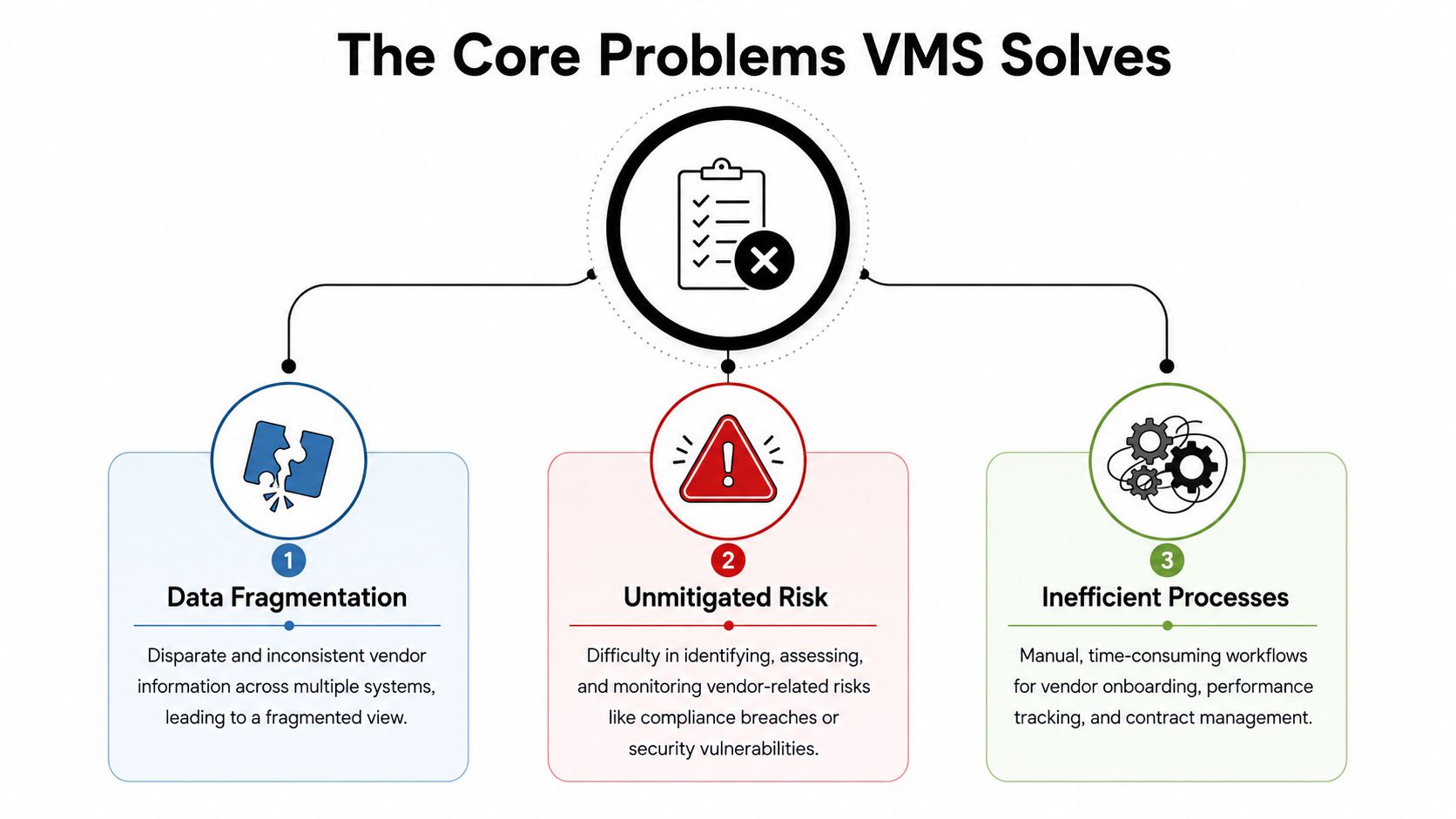
A robust VMS resolves data fragmentation by creating a centralized supplier repository that acts as a single source of truth for vendor profiles, including financial details, compliance documents, certifications, and performance history, as outlined in GEP's guide to vendor management systems. That sounds basic. In practice, it changes decision-making.
Data fragmentation blocks control
When vendor data sits in separate tools, teams waste time validating simple facts. Procurement checks pricing in one system. Legal checks executed terms somewhere else. Security requests updated documentation over email. Finance asks whether a vendor is approved at all.
That fragmentation creates several practical failures:
- Duplicate work: Different teams request the same document multiple times.
- Bad reporting: Leadership sees spend and performance in separate reports that don't align.
- Weak forecasting: Renewal exposure and budget commitments become harder to model.
- Slow decisions: Every issue turns into manual fact-finding.
Hidden risk isn't really hidden
The risk exists in plain sight, but it's buried in disconnected records. A vendor may still appear active even though a compliance document has lapsed, an insurance certificate expired, or a service obligation is already being missed. Without centralized tracking, those issues surface late.
Vendor risk management works best when teams review the relationship and the agreement together, not as separate workflows.
That's why mature teams don't stop at vendor profiles. They also connect contractual obligations, renewal triggers, and clause deviations to the operational vendor record. In this context, AI contract analysis for vendor risk management becomes useful, especially for legal ops and procurement teams handling large volumes of third-party paper.
Manual workflows create operational drag
Many companies still run onboarding through forms, inboxes, shared folders, and follow-up meetings. That approach doesn't scale well. Every exception needs a person to remember what comes next. Every approval depends on someone noticing the request.
A well-implemented VMS reduces that drag by assigning ownership, standardizing intake, and keeping the process visible. The value isn't just efficiency. It's consistency. Teams make better decisions when they use the same workflow, review criteria, and supporting records every time.
Key Features of Modern Vendor Management Software
A feature list by itself isn't very useful. What matters is whether the software supports the actual vendor lifecycle your team runs today, and the one you want to run next year.
In 2022, about 63% of new vendor management solutions launched included AI-driven features for supplier risk analysis and contract management, according to Business Research Insights on the vendor management software market. That shift matters because modern teams need more than storage. They need systems that surface risk, route work, and connect vendor actions to contract terms.
Onboarding and due diligence
The initial intake process is frequently a source of difficulty. Intake arrives from the business, but the required checks vary by vendor type, spend category, geography, and data access.
The right software should support:
- Structured intake forms: Capture business owner, service scope, spend expectations, and risk flags upfront.
- Document collection: Gather tax forms, insurance, security questionnaires, certifications, and policy acknowledgments.
- Approval routing: Send requests to procurement, legal, security, finance, or business approvers based on rules.
- Status visibility: Show where onboarding is blocked and who needs to act.
A good onboarding workflow doesn't just collect paperwork. It prevents incomplete requests from moving forward.
Risk, compliance, and contract-connected controls
Risk scoring is useful, but isolated scoring often misses the commercial and legal terms that define exposure. A vendor that handles sensitive data or mission-critical services should be assessed through the lens of the signed contract, not just a questionnaire.
That's where contract intelligence helps. Tools such as Legitt AI can connect contract drafting, review, approval workflows, eSignature, repository management, obligation tracking, and renewal alerts so vendor teams can see not only who the supplier is, but also what the agreement requires. That's especially important when teams need to track contractual obligations and deadlines with AI.
Operational advice: Don't approve a vendor based only on onboarding completion. Approve them when diligence, contract terms, and business ownership all align.
Performance, SLAs, and financial administration
Once the vendor is live, software has to support active management. That includes service issues, milestones, invoice alignment, and renewal preparation.
A practical workflow often looks like this:
| Workflow area | What strong software supports |
|---|---|
| Performance tracking | SLA monitoring, issue logs, review cycles, scorecards |
| Financial control | PO linkage, invoice checks, pricing validation, spend visibility |
| Contract administration | Renewal reminders, amendment tracking, term history |
| Reporting | Vendor dashboards by category, risk, owner, and status |
Finance teams also benefit when vendor records connect cleanly to purchasing and billing workflows. If your process includes invoice reconciliation, this guide to purchase invoices for UK businesses is a useful reference for aligning operational and finance terminology.
VMS vs CLM Where They Overlap and Diverge
A lot of buying confusion comes from treating VMS and CLM as interchangeable. They aren't.
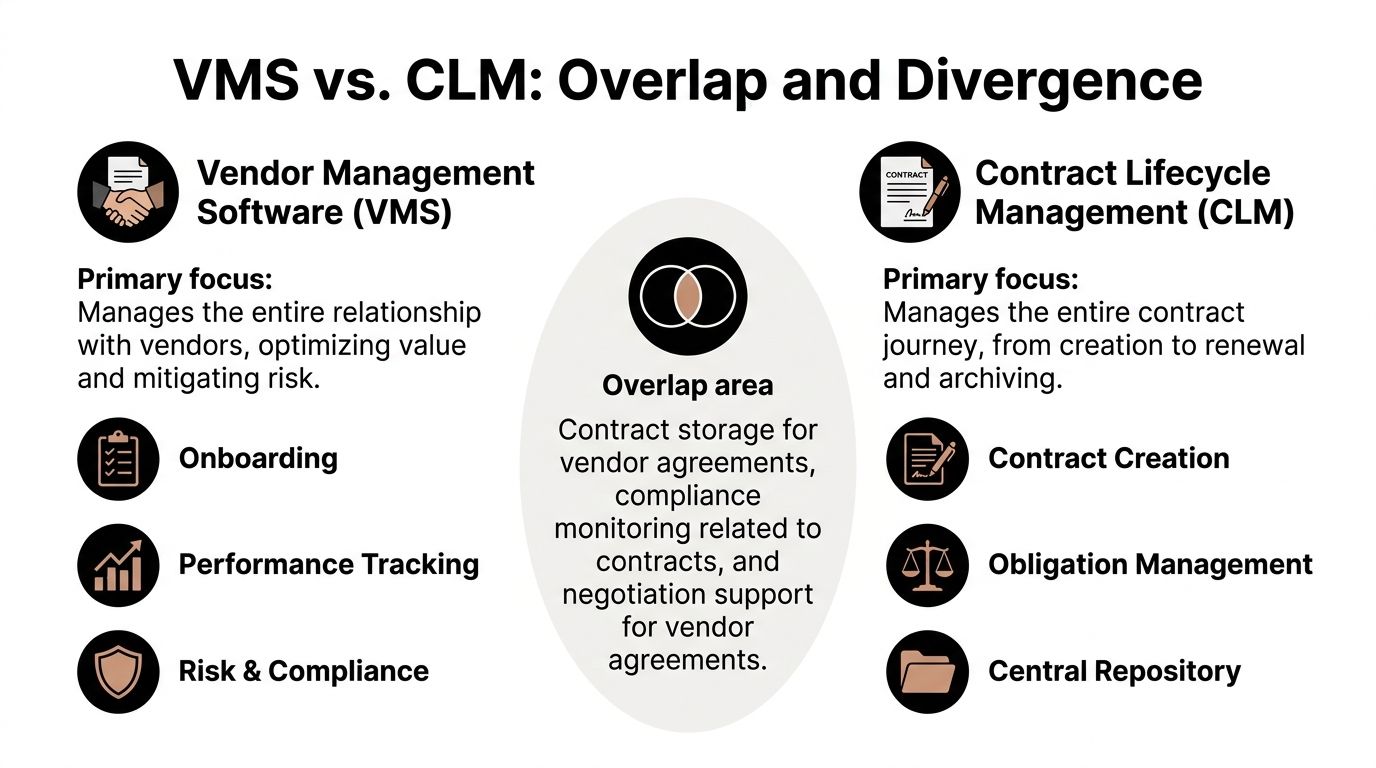
Vendor management software manages the vendor relationship. Contract lifecycle management software manages the legal and commercial agreement that governs that relationship. One tracks the party. The other tracks the obligations, rights, approvals, deviations, and lifecycle of the paper.
Where they overlap
There is real overlap, especially in these areas:
- Contract storage: Vendor teams need access to the current agreement.
- Compliance visibility: Certain obligations affect vendor eligibility and performance.
- Approval workflows: Both systems often touch review and sign-off steps.
- Renewal awareness: Commercial continuity depends on timing and notice windows.
That overlap is why many teams assume a VMS is enough. Usually, it isn't.
Where traditional VMS falls short
The weakness shows up at clause level. A VMS may show contract start date, end date, owner, and attached PDF. But that doesn't mean the business can answer critical questions quickly.
Does the agreement auto-renew? Is there a benchmarking clause? Are there service credits? What notice period applies to termination for convenience? Which obligations survive termination? Has the vendor paper deviated from your standard fallback position?
Recent data shows 68% of organizations face revenue leakage due to unmonitored contract renewals and deviations, yet vendor tools rarely ingest CLM data to auto-alert on renewal risk or deviation clauses, according to Paylocity's overview of vendor management software. That's the core gap. A vendor score without contract intelligence is incomplete.
A simple way to think about the split
| System | Primary job | Common blind spot without the other system |
|---|---|---|
| VMS | Manage the vendor relationship | Misses clause-level obligations and legal deviations |
| CLM | Manage the contract lifecycle | May not reflect ongoing vendor performance and operational status |
Teams evaluating platforms should understand contract lifecycle management in practical terms, especially if they want AI contract review, contract analytics, repository search, contract intelligence, and approval automation to support procurement and legal operations together.
If the VMS tells you who the vendor is, CLM tells you what the vendor actually promised.
For enterprise workflows, the combination is what drives real control. Procurement gets cleaner onboarding and supplier oversight. Legal gets contract review, fallback language, redlines, deviations, and obligation management. Finance gets better visibility into renewals, amendments, and commercial exposure. Sales and operations get fewer surprises.
How VMS Delivers ROI Across Your Organization
ROI doesn't come from “having vendor software.” It comes from removing slow handoffs, reducing missed obligations, and shortening the distance between request and execution.
Organizations that deploy dedicated contract management software report an 80% faster average cycle time from bid submission to signed agreement, according to ContractSafe's contract management statistics. In vendor workflows, that speed changes how several teams operate.
Legal and legal ops
Legal teams benefit when intake is cleaner and contracts arrive with context already attached. The requester, vendor profile, risk category, diligence documents, and commercial owner should travel with the legal review.
That reduces time spent chasing basics and increases time spent on actual risk issues such as indemnity, security terms, limitation of liability, service levels, audit rights, and renewal language.
Procurement and finance
Procurement gains an advantage from structured records. It's easier to compare suppliers, challenge duplicate spend, and identify agreements that should be consolidated, renegotiated, or terminated. Finance benefits when invoice review, vendor status, and contract terms line up instead of living in separate systems.
Useful ROI signals include:
- Fewer approval bottlenecks: Requests move through predefined workflows instead of ad hoc email threads.
- Less renewal leakage: Teams see key dates and obligations before the commercial damage is done.
- Cleaner budget planning: Committed vendor spend becomes easier to track against live agreements.
For adjacent operating models, this overview of insights into HR outsourcing value is a useful reminder that vendor oversight often reaches beyond procurement into workforce and service delivery decisions.
Sales, operations, and business owners
Operational teams care about speed and continuity. They want approved vendors live quickly, but they also need confidence that pricing, timelines, data handling, and service commitments are documented and trackable.
The strongest ROI appears when business teams stop treating signed contracts as archived files and start using them as live operating documents.
That's where CLM and contract intelligence change the outcome. Renewals, obligation tracking, repository search, AI contract review, and contract analytics help teams act before value leaks out of the agreement. For teams focused on revenue and supplier performance, this perspective on contract management and revenue realization is especially relevant.
A Checklist for Choosing and Implementing VMS
Most VMS selections fail before implementation starts. The software demo looks polished, but the buying team hasn't agreed on the operating model, approval policy, or system boundaries. As a result, the platform becomes another repository instead of a working control layer.
What to evaluate before you buy
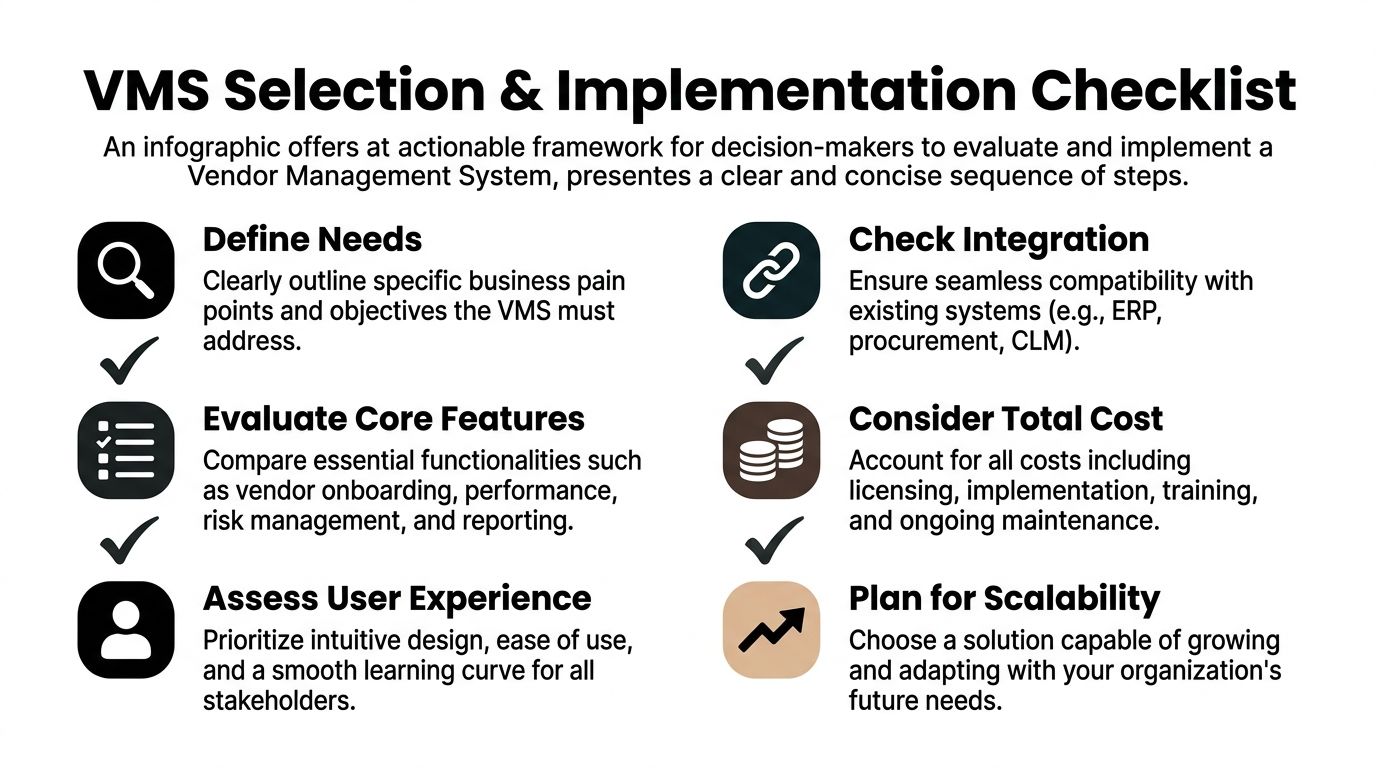
Use this checklist during selection, not after signature.
- Workflow fit: Can the system handle your real onboarding path, including legal review, security diligence, finance checks, and business approval?
- Contract connection: Does it link to CLM, contract review, eSignature, renewal tracking, and obligation management, or does it only attach PDFs?
- Integration depth: Check how it connects with ERP, procurement, CRM, document tools, and collaboration platforms.
- Usability: Business users won't follow a process they find slow or confusing.
- Reporting quality: You need usable dashboards by owner, vendor category, contract status, renewal timeline, and risk area.
Security isn't optional
Expert-level VMS solutions require security controls such as AES-256 encryption, MFA, RBAC, and validation through SOC 2 Type II or ISO 27001 certifications, as described in Workday's vendor management system overview. For legal and procurement teams, this matters because vendor records often include confidential pricing, diligence materials, contact data, and signed agreements.
A short evaluation table helps keep the team honest:
| Evaluation area | What to ask |
|---|---|
| Security | Are encryption, MFA, access controls, and third-party certifications documented? |
| Data model | Can the platform store vendor data and connect it to contract metadata? |
| Approval logic | Can you set routing by spend, vendor type, or risk level? |
| Implementation support | Who configures workflows, trains users, and handles change requests? |
How to implement without losing momentum
Rollout should be staged. Start with one vendor segment or one business unit, then expand after the workflow is stable. Don't begin by migrating every historical record.
A practical implementation sequence usually works best:
- Define policy first: Set intake rules, approval thresholds, legal triggers, and ownership.
- Map the workflow: Identify who submits, who reviews, who approves, who signs, and who monitors after execution.
- Pilot with real transactions: Test on live vendor requests, not sandbox examples.
- Train by role: Business users, procurement, legal, and finance need different training.
- Measure adoption qualitatively: Look for fewer email approvals, fewer missing documents, and better renewal visibility.
Implementation note: If policy decisions stay unresolved, software configuration will expose the confusion. It won't fix it.
Frequently Asked Questions About Vendor Management
Is vendor management software the same as procurement software
No. Procurement software usually focuses on sourcing, purchasing, approvals, and spend control. Vendor management software focuses on the ongoing vendor relationship, including onboarding, diligence, risk tracking, documents, performance, and status management. In many organizations, both need to work together.
Can small and mid-sized businesses benefit from vendor management software
Yes, if they have repeat vendor onboarding, compliance requirements, or contract-heavy buying. Smaller companies often feel the pain earlier because a few people carry procurement, legal ops, finance, and operations work at the same time. The key is choosing software that fits the process instead of forcing enterprise complexity onto a lean team.
What should legal teams look for in a VMS
Legal should care less about dashboard polish and more about workflow discipline. Check whether the platform supports contract intake context, approval routing, repository visibility, renewal management, obligation tracking, redline coordination, and integration with CLM and eSignature tools. If the contract stays outside the operating workflow, legal risk will too.
How long does it take to see value from a VMS
Teams usually see value first in process control, not analytics. The early gains come from cleaner onboarding, fewer missing documents, clearer approval ownership, and better visibility into live vendor status. Larger ROI appears when the VMS is connected to contract lifecycle management, contract review, repository search, renewals, and contract intelligence.
If your team wants vendor management to do more than store supplier records, Legitt AI is worth evaluating as part of the workflow. It supports AI-powered contract drafting, review, negotiation, structured approvals, eSignatures, repository management, renewals, obligations tracking, and contract intelligence, which helps legal, procurement, and operations teams connect vendor oversight to the actual agreements that govern risk and value.