
AI-native contract analysis is one of the most important shifts happening in contract technology today. As businesses manage more agreements, more legal complexity, and more operational pressure, the old way of handling contracts is no longer enough. Traditional contract review processes are too slow, too manual, too fragmented, and too dependent on human memory. Basic search tools and legacy contract lifecycle management platforms help organize documents, but they do not truly understand what is written inside those contracts.
That is where AI-native contract analysis changes the game.
To understand what AI-native contract analysis really means, it is important to move beyond buzzwords. It does not simply mean adding an AI summary button to a contract repository. It does not mean running keyword search across PDFs. It does not mean generating a short overview of a document and calling that intelligence. Real AI-native contract analysis means the system is built from the ground up to read contracts, interpret contract language, extract meaningful terms, identify risks, detect deviations, track obligations, surface commercial insights, and make the contents of the contract operational across the business.
In simple terms, AI-native contract analysis turns a contract from a static file into structured, usable business intelligence.
This matters because contracts are not just legal paperwork. They define pricing, liabilities, obligations, renewal rights, payment mechanics, service commitments, compliance requirements, notice periods, ownership rights, indemnities, and escalation paths. When that information remains trapped in unstructured documents, businesses lose visibility. They miss deadlines. They overlook obligations. They misread risk. They create revenue leakage. They slow down approvals. They weaken forecasting. They increase legal and operational exposure.
AI-native contract analysis solves this by helping organizations understand not just that a contract exists, but what the contract actually means.
AI-native contract analysis is more than contract summarization
A major misconception in the market is that AI contract analysis is the same as contract summarization. It is not.
Contract summarization can be useful. A short overview of a document helps someone quickly understand the general subject matter. But a summary alone does not create operational intelligence. It does not reliably capture every key clause. It does not necessarily extract all renewal terms, payment triggers, obligations, fallback positions, liability exceptions, or non-standard deviations. It does not compare the contract against a playbook. It does not create ongoing monitoring.
AI-native contract analysis goes much further.
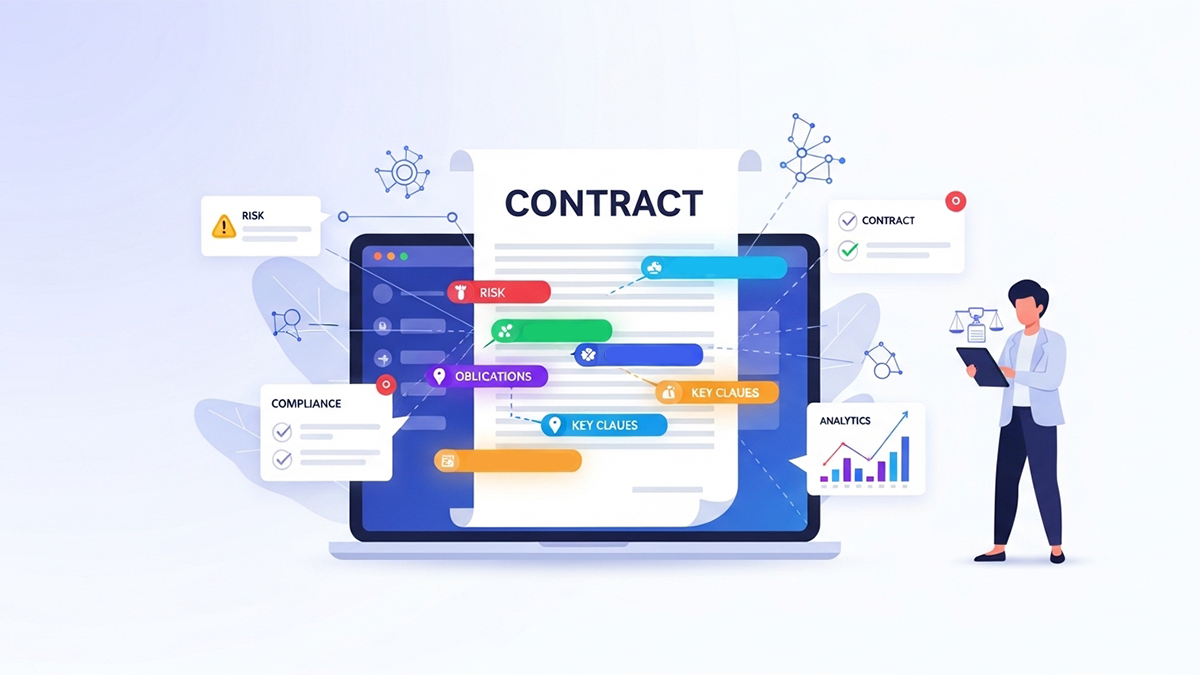
A true AI-native contract intelligence system can:
- extract structured metadata from unstructured agreements
- identify clause presence and clause absence
- compare contract language against approved templates
- detect non-standard terms and risk deviations
- surface obligations, milestones, and deadlines
- classify pricing and payment structures
- monitor renewals, notice periods, and termination triggers
- support post-signature contract analysis across the lifecycle
This is the difference between reading faster and understanding deeper.
Businesses often assume they have contract visibility because they can search for words in a repository. In reality, keyword search is shallow. Contracts use variable language. The same idea can be expressed in many different ways. A simple search may miss critical meaning because the exact keyword is not present. AI-native contract analysis is designed to understand legal and commercial meaning, not just literal word matches.
That is why AI-native contract analysis is becoming central to modern contract management and contract intelligence.
In practice, modern contract operations combine structured contract review, AI-assisted contract creation, and secure execution. Together, these capabilities help organizations maintain accuracy, traceability, and compliance throughout the contract lifecycle.
 Hi, What do you want to Draft?

Click to upload or drag & drop
pdf, docx up to 5 MB
Click to upload or drag & drop
pdf, docx up to 5 MB
The “AI-native” part is what really matters
Many platforms now advertise AI features. But not all of them are truly AI-native.
An AI-added system usually starts as a traditional contract management tool and later adds small AI features on top. It may provide a summary, a chatbot, or a few extraction fields. These features can help, but the underlying architecture still treats contracts as documents first and intelligence second.
An AI-native contract analysis platform is built differently. AI is not an add-on. It is the foundation. The platform is designed to interpret contract language, structure its meaning, and continuously make that intelligence actionable for legal, sales, finance, procurement, and operations teams.
That difference matters because contracts are inherently unstructured. They are negotiated, variable, and context-dependent. The wording changes across industries, counterparties, jurisdictions, and use cases. A truly effective system must be built to handle ambiguity, clause variation, and legal nuance at scale.
This is why businesses increasingly look for AI-native contract intelligence instead of basic document automation. They want systems that can:
- reason over complex contract language
- identify patterns across thousands of agreements
- support contract risk analysis at scale
- turn contract data into workflows, alerts, dashboards, and decisions
That is a very different outcome from simply attaching an AI tool to an old repository.
Contracts are unstructured, but businesses need structured outcomes
One of the core reasons AI-native contract analysis matters is that contracts are written in natural language, but businesses operate on structured decisions.
A contract may say payment is due “within thirty days of acceptance of milestone completion.” Another may say the first invoice is triggered “upon written confirmation of successful delivery.” Another may tie payment to implementation, approval, or usage thresholds. From a legal writing perspective, these may be different phrasings. From a business perspective, they all affect billing, cash flow, and operational readiness.
The same is true for renewals, termination rights, liability caps, service-level commitments, audit clauses, data security obligations, and price escalation mechanisms.
If these terms remain buried in documents, downstream teams must manually interpret them. That leads to inconsistency, delay, and missed action. AI-native contract analysis helps by translating variable legal language into structured outputs the business can use.
This enables:
- cleaner contract metadata
- better contract repository intelligence
- faster reporting
- stronger contract risk analysis
- accurate obligation tracking
- proactive renewal management
- improved revenue and compliance visibility
This is what “contract intelligence platform” should actually mean. It should not just store agreements. It should understand them and support business action.
AI-native contract analysis is valuable before signature and after signature
Another common mistake is assuming contract analysis matters only during review. In reality, AI-native contract analysis is critical both before signature and after signature.
Before signature, it helps organizations:
- review redlines faster
- compare terms against templates and clause libraries
- identify non-standard provisions
- detect negotiation risk
- support legal review automation
- accelerate approvals
This reduces cycle time and improves consistency. Sales moves faster. Legal maintains control. Procurement and finance get better visibility before commitments are made.
But the real long-term value often comes after signature.
After a contract is signed, businesses still need to understand:
- what obligations were created
- which milestones must be tracked
- when notices must be sent
- how and when payments are triggered
- what renewal terms apply
- whether service-level commitments exist
- what conditions can trigger penalties, credits, or termination
Without post-signature contract analysis, businesses frequently lose visibility the moment the document is archived. That is when missed renewals, untracked obligations, and revenue leakage begin.
AI-native contract analysis keeps the contract alive across the full lifecycle. It makes contract review automation part of a broader contract operations model, not just a one-time legal event.
Real AI-native contract analysis includes risk, revenue, and operations
To understand what AI-native contract analysis really means, it helps to look at the kinds of outcomes it should produce.
It should not stop at identifying legal clauses. It should help the business understand the operational, commercial, and financial impact of those clauses.
For example:
- A payment term affects billing and cash flow.
- A renewal clause affects retention forecasting.
- A liability cap affects risk exposure.
- A service-level commitment affects delivery operations.
- A termination right affects churn probability.
- A compliance clause affects audit readiness.
- A customer-specific security obligation affects implementation workload.
This is why contract analysis software must be more than a legal review tool. It must function as a cross-functional intelligence system.
Modern businesses need contract analysis that connects legal meaning to business outcomes. That is where AI-native contract analysis becomes strategically important. It helps legal teams reduce risk, finance teams improve accuracy, sales teams maintain better visibility, procurement teams manage supplier terms, and leadership teams understand the health and strength of the contract portfolio.
This is also where Legitt AI becomes highly relevant. A platform like Legitt AI is not just about generating or storing contracts. It is about helping businesses make contract data actionable across drafting, review, analytics, repository intelligence, and post-signature visibility.
AI-native contract analysis is not just extraction — it is interpretation
Some vendors reduce AI contract analysis to field extraction. Extraction matters, but extraction alone is not enough.
Pulling out a contract date, a counterparty name, or a renewal date is useful. But that is only the beginning. Real contract analysis requires interpretation.
For example:
- Is the renewal automatic or optional?
- Is the liability clause standard or unusually broad?
- Is the payment schedule fixed, milestone-based, or conditional?
- Is the termination right one-sided?
- Does the indemnity language exceed policy?
- Does the service commitment create operational risk?
- Are there conflicting clauses that require review?
These are questions of meaning, not just presence.
AI-native contract analysis is valuable because it can move from extraction toward interpretation. It can identify not just what is written, but what the language implies for risk, compliance, commercial execution, and ongoing management. That is what makes it significantly more powerful than basic OCR, keyword tagging, or document indexing.
This is one of the reasons businesses researching advanced contract analysis software often look at platforms like Legitt AI and resources at https://www.legittai.com to understand what a more complete AI-native contract intelligence model looks like.
AI-native contract analysis improves contract repositories
Most companies already have a contract repository of some kind. But many repositories are passive. They store files, maybe some metadata, and perhaps basic search. That is useful, but limited.
A passive repository tells you where a contract is.
An AI-native contract repository tells you:
- what the contract contains
- what risks it introduces
- what obligations it creates
- when it renews
- which clauses are non-standard
- how it compares with similar agreements
- which contracts require attention now
This is a major upgrade in business visibility.
AI-native contract analysis transforms the repository from a storage layer into an intelligence layer. It enables portfolio-wide contract analytics, risk reporting, renewal planning, and obligation tracking. Instead of opening one PDF at a time, teams can analyze patterns across hundreds or thousands of agreements.
That creates stronger governance and much better decision-making. Legal can identify clause drift. Finance can monitor payment structures. Procurement can compare supplier commitments. Revenue teams can track renewal exposure. Executives can see the health and strength of contracts across the organization.
This is what modern AI contract management should deliver.
Why businesses need AI-native contract analysis now
The need for AI-native contract analysis is increasing because contracts are becoming more central to business performance.
Modern agreements are more complex. They include more customized language, more compliance expectations, more security commitments, and more detailed commercial logic. At the same time, businesses are under pressure to move faster. Legal teams are expected to accelerate review. Sales teams need shorter cycle times. Finance teams need tighter forecasting and collections. Operations teams need better visibility into delivery obligations. Leadership needs clearer insight into risk and contract health.
Manual review cannot scale to this environment.
Traditional contract review methods depend heavily on individual reviewers, email chains, spreadsheets, and memory. That model breaks when contract volume grows, when teams are distributed, and when visibility needs become portfolio-wide rather than document-by-document.
AI-native contract analysis solves that scaling problem. It allows businesses to review faster, monitor better, search deeper, and act more proactively. It improves consistency while reducing dependency on manual interpretation. It creates a stronger contract lifecycle from negotiation to renewal.
That is why AI-native contract analysis is not just a legal technology trend. It is becoming a core business capability.
For organizations that want stronger control over risk, revenue, obligations, and contract performance, AI-native contract analysis is quickly becoming essential. And for businesses evaluating how to bring contract intelligence into daily operations, platforms like Legitt AI and the capabilities showcased at https://www.legittai.com are increasingly important reference points in the market.
The real meaning of AI-native contract analysis
So what does AI-native contract analysis really mean?
It means contract technology that is built to understand contracts, not just store them. It means going beyond summaries, beyond search, and beyond basic metadata extraction. It means interpreting contract language, identifying risk, tracking obligations, surfacing renewals, comparing terms, and turning legal documents into structured intelligence that supports business action.
It means treating contracts as living business assets.
That is the real shift. AI-native contract analysis is not just about reading documents faster. It is about making contracts visible, understandable, and operational across the full lifecycle. It helps organizations move from document management to contract intelligence, from reactive review to proactive control, and from isolated legal processes to connected business execution.
That is why AI-native contract analysis matters so much now. It is not a feature. It is a foundation for modern contract operations.
Read our complete guide on Contract Lifecycle Management.
FAQs
What is AI-native contract analysis?
AI-native contract analysis is the use of AI as the core engine for understanding contracts, not just as an added feature. It reads contract language, extracts key terms, identifies risks, and turns unstructured agreements into structured business intelligence. This goes beyond simple summaries or keyword search. It helps businesses operationalize contract data across legal, finance, sales, and operations.
How is AI-native contract analysis different from traditional contract review?
Traditional contract review is largely manual and depends on people reading, interpreting, and tracking contract terms document by document. AI-native contract analysis automates much of that interpretation and can scale across large contract portfolios. It identifies risks, obligations, renewal terms, deviations, and commercial details much faster. This improves speed, consistency, and visibility.
Is AI-native contract analysis the same as contract summarization?
No, contract summarization is only one small part of the process. A summary gives a high-level overview, but it may not reliably identify every important clause, risk, or business implication. AI-native contract analysis goes deeper by extracting, classifying, comparing, and monitoring contract terms. It is designed for action, not just readability.
Why does AI-native contract analysis matter for businesses outside legal teams?
Contracts affect far more than legal. They shape billing, renewals, compliance, service delivery, procurement commitments, and revenue forecasting. AI-native contract analysis helps finance, sales, operations, and leadership understand the actual business impact of contract terms. That makes it a cross-functional capability, not just a legal tool.
What does a strong AI contract analysis platform actually do?
A strong AI contract analysis platform should extract key metadata, detect non-standard clauses, identify obligations, track renewal terms, flag risk, and support portfolio-wide contract analytics. It should also help users compare contracts against templates and approved language. Most importantly, it should turn contract content into structured, actionable intelligence. That is what makes it truly useful at scale.
Does AI-native contract analysis help after a contract is signed?
Yes, and that is one of its biggest advantages. After signature, businesses still need to track obligations, milestones, payment triggers, notice windows, and renewal dates. Without post-signature analysis, these details often disappear into archived documents. AI-native contract analysis keeps those commitments visible and manageable throughout the lifecycle.
How does Legitt AI fit into AI-native contract analysis?
Legitt AI is relevant because it supports a broader AI-native approach to contracts, including drafting, review, repository intelligence, analytics, and post-signature visibility. Instead of treating contracts as passive files, it helps make contract data actionable. That is exactly what businesses need from modern AI contract analysis. More information is available at https://www.legittai.com.
Can AI-native contract analysis improve a contract repository?
Yes, it can significantly improve a contract repository by turning it into a source of intelligence instead of simple storage. It helps classify contracts, identify risks, surface renewals, track obligations, and analyze trends across the portfolio. This makes repositories more useful for decision-making and governance. It also reduces the need to open and manually review every document.
How should companies evaluate an AI-native contract analysis solution?
Companies should look beyond summaries and ask whether the system can truly interpret contract meaning. They should evaluate extraction depth, risk analysis, obligation tracking, renewal monitoring, repository intelligence, and integration readiness. Platforms like Legitt AI are often reviewed because they align more closely with full-lifecycle contract intelligence. A good place to start is https://www.legittai.com.
Will AI-native contract analysis become standard in contract management?
Yes, it is highly likely to become a standard part of modern contract management. As contract volume and complexity increase, manual review alone cannot provide the speed or visibility businesses need. AI-native contract analysis helps organizations scale review, strengthen governance, and improve operational control. That makes it increasingly essential for companies managing contracts at any meaningful scale.