
The business case for AI-native contract management is stronger now than ever. Contracts are no longer just legal documents that sit in folders after signature. They are operational, financial, and strategic assets that shape how revenue is recognized, how obligations are delivered, how risk is managed, and how customer and supplier relationships are governed. As contract volume increases and deal structures become more complex, traditional contract lifecycle management systems are no longer enough.
This is where AI-native contract management becomes essential.
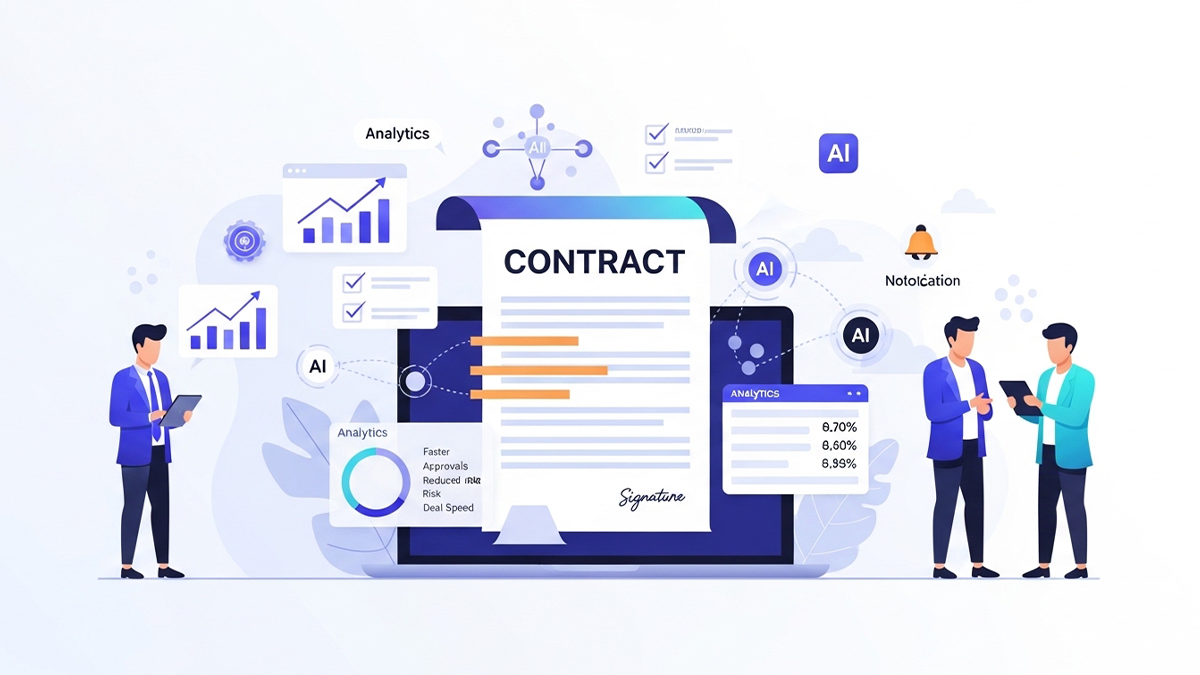
AI-native contract management does not simply digitize paperwork. It transforms contracts into structured, usable business intelligence. It helps organizations draft faster, review more accurately, identify risk earlier, track obligations more consistently, monitor renewals proactively, and analyze contract data across the full lifecycle. Instead of treating contracts as static files, AI-native contract management treats them as active sources of operational insight.
That distinction matters because most businesses still manage contracts in fragmented ways. Some rely on email chains, shared drives, Word documents, spreadsheets, and disconnected approval workflows. Others use legacy contract lifecycle management software that improves storage and routing but still does not truly understand what is written in the contract itself. In both cases, the result is the same: slow execution, hidden risk, missed obligations, revenue leakage, and weak visibility.
The business case for AI-native contract management is built on solving those problems at scale.
In practical terms, AI-native contract management helps businesses reduce contract turnaround time, improve legal consistency, strengthen compliance, increase forecast accuracy, reduce missed renewals, and make post-signature execution more reliable. It connects legal language to business outcomes. That is why the market is increasingly moving beyond basic workflow software toward AI-native CLM and contract intelligence platforms.
Why traditional contract management creates business friction
To understand the business case for AI-native contract management, it helps to start with the limitations of traditional contract management.
In many organizations, contract processes still depend heavily on manual work. Drafting may begin from older templates. Negotiation happens through email and redlined documents. Approvals move across disconnected teams. Key terms are manually copied into spreadsheets or CRM fields. Signed contracts are uploaded into a repository, then largely forgotten until a renewal date is missed or a dispute arises.
This creates friction at every stage.
Before signature, businesses deal with:
- slow drafting and repeated manual edits
- inconsistent use of approved language
- delayed legal review
- unclear approval paths
- poor visibility into deviations and exceptions
After signature, the problems often get worse:
- obligations are not tracked reliably
- payment terms are misunderstood
- notice periods are missed
- renewal opportunities are lost
- non-standard risk terms remain buried in documents
- teams operate without clear visibility into contractual commitments
These issues are not minor process inefficiencies. They create measurable business costs. They extend sales cycles, reduce margin control, increase legal exposure, create operational surprises, and weaken customer experience. In high-volume environments, the cost compounds quickly.
The business case for AI-native contract management begins with eliminating these friction points and turning contract data into something the business can actually use.
AI-native contract management improves speed and cycle time
One of the clearest benefits of AI-native contract management is speed.
Contract delays slow revenue. They create bottlenecks between sales, legal, procurement, finance, and leadership. A deal can be negotiated commercially, but if the contract process is slow, the business still loses time. That affects close rates, customer experience, and internal efficiency.
AI-native contract management improves speed in several ways. It can support faster drafting from approved templates and clause libraries. It can identify non-standard language during review. It can compare incoming redlines against playbooks. It can help classify risk faster and route approvals more intelligently. It can reduce the amount of repetitive manual reading required for common contract types.
This acceleration matters because contract cycle time is not just a legal metric. It is a revenue metric.
Faster contract turnaround means:
- quicker deal closure
- faster vendor onboarding
- reduced internal friction
- better use of legal resources
- higher responsiveness to customers and counterparties
The value compounds when contract volume increases. A company reviewing a handful of contracts per month may tolerate manual processes. A company handling hundreds or thousands of contracts cannot. AI contract management becomes a scale advantage because it helps businesses process more agreements with greater consistency and less delay.
This is a major part of the business case for AI-native CLM: it improves business velocity without requiring proportional increases in headcount.
In practice, modern contract operations combine structured contract review, secure execution, and controlled contract creation. These capabilities help organizations maintain consistency, traceability, and compliance throughout the contract lifecycle.
 Hi, What do you want to Draft?

Click to upload or drag & drop
pdf, docx up to 5 MB
Click to upload or drag & drop
pdf, docx up to 5 MB
AI-native contract management reduces hidden risk
Contracts carry legal, financial, and operational risk. The challenge is that much of this risk remains hidden when contracts are treated as documents rather than data.
A contract may include a non-standard liability cap, one-sided indemnity language, weak termination rights, unclear payment conditions, aggressive service-level commitments, or automatic renewal terms that create unexpected exposure. In traditional workflows, these issues can be missed because they are buried in dense text and reviewed inconsistently.
AI-native contract management helps reduce this hidden risk.
A strong AI-native contract management platform can:
- detect clause deviations
- compare language against approved standards
- highlight unusual obligations
- surface missing protections
- identify renewal and notice risks
- flag terms that require escalation
This does not eliminate the need for legal judgment. But it creates a much stronger first layer of contract intelligence so that risky issues are found earlier and handled more consistently.
That is where the business case becomes very concrete. Hidden risk often becomes visible only when it turns into a problem: a payment dispute, a missed renewal notice, an unexpected service credit, a compliance issue, or a conflict over obligations. By the time the issue becomes visible, the cost is already high.
AI-native contract management reduces that cost by increasing early visibility.
AI-native contract management improves post-signature execution
A major weakness of traditional contract lifecycle management is that it often focuses too heavily on pre-signature steps and too little on post-signature execution.
Many systems are good at:
- creating templates
- routing approvals
- collecting signatures
- storing final agreements
But the business value of a contract does not end at signature. In many ways, that is when the real work begins.
After signature, organizations need to know:
- what obligations must be fulfilled
- when milestones are due
- how billing is triggered
- when renewals or notice periods occur
- what compliance commitments must be maintained
- what customer-specific or supplier-specific terms require attention
When these details are not surfaced clearly, execution becomes reactive. Teams find issues only after a deadline is missed, an invoice is challenged, or a customer raises a concern. That creates revenue leakage, missed opportunities, and operational friction.
AI-native contract management strengthens post-signature contract management by keeping the contract active throughout its lifecycle. It supports obligation tracking, renewal visibility, milestone awareness, and contract repository intelligence. It ensures the contents of the agreement continue to inform day-to-day operations rather than disappearing into an archive.
This is one of the strongest business arguments for AI-native contract management: it improves not just contract creation, but contract performance.
AI-native contract management creates better contract intelligence
The word “intelligence” is central to the business case.
A traditional repository tells you where a contract is stored. An AI-native contract management platform tells you what the contract contains, what it means, what risks it creates, and what actions it requires. That is a far more valuable capability.
Contract intelligence helps businesses answer questions such as:
- Which contracts renew in the next 90 days?
- Which agreements contain non-standard liability terms?
- Which customers have milestone-based payment terms?
- Which suppliers have unfavorable termination rights?
- Which contracts include obligations that need immediate follow-up?
- Which business units are accepting the most legal deviations?
These are not just legal questions. They are business questions.
With AI-native contract management, contracts become searchable and analyzable in a deeper way. The platform can move beyond simple keyword search and basic metadata into structured contract analytics. That means businesses can manage their contract portfolio more proactively and make better decisions based on what is actually written in their agreements.
This is where platforms like Legitt AI stand out. Legitt AI reflects the shift from static contract storage to active contract intelligence by helping businesses connect contract drafting, review, analysis, repository visibility, and post-signature tracking in one more integrated model.
AI-native contract management supports revenue protection
One of the most compelling parts of the business case is revenue protection.
Contracts directly affect how and when a business gets paid. They define payment terms, invoicing conditions, acceptance milestones, renewal rights, pricing escalators, discount structures, and termination rights. If these details are not managed well, revenue suffers.
Common problems include:
- delayed invoicing due to unclear payment triggers
- missed renewals because notice windows were not tracked
- lost upsell opportunities because contract terms were not visible
- margin erosion from non-standard concessions
- disputes caused by ambiguous or inconsistent language
AI-native contract management helps reduce these issues by making contract terms more visible and operational. It enables better alignment between what was sold, what was signed, and what should happen next. Finance can work from clearer payment logic. Sales can understand what was actually committed. Customer success can prepare for renewals and service obligations more effectively.
This is why AI contract management is increasingly viewed not only as a legal technology investment but as a revenue operations investment.
When contracts are managed intelligently, businesses protect revenue more effectively and reduce leakage that would otherwise go unnoticed.
AI-native contract management strengthens compliance and governance
Compliance is another critical driver.
Modern contracts often include data security requirements, privacy obligations, audit rights, reporting commitments, regulatory language, and industry-specific clauses. Businesses that manage contracts manually often struggle to maintain consistent visibility into these commitments across a large contract portfolio.
AI-native contract management helps strengthen compliance by making these terms easier to identify, track, and report on.
A strong system can help organizations:
- identify required compliance clauses
- detect deviations from policy
- monitor obligations tied to reporting or audits
- classify contract types and risk categories
- surface contracts that require closer review
This improves governance in two major ways. First, it reduces inconsistency during drafting and negotiation. Second, it improves ongoing visibility after signature.
For legal and compliance leaders, this matters because governance is not just about approving language once. It is about understanding where the business is exposed and where commitments are accumulating over time. AI-native contract management provides that visibility in a much more scalable way than manual review or spreadsheet tracking.
AI-native contract management scales better than manual hiring alone
Another important business argument is scalability.
When contract volume grows, businesses often try to solve the problem by adding more people. More legal reviewers. More contract managers. More operations staff. Sometimes that is necessary, but it is not always efficient. Manual scaling raises costs quickly and can still leave major visibility gaps.
AI-native contract management creates leverage.
It allows teams to:
- review more contracts without proportional headcount increases
- standardize drafting and review
- reduce repetitive manual work
- improve consistency across distributed teams
- handle larger contract portfolios with better oversight
This does not replace experienced professionals. It makes them more effective. Legal teams can focus more on complex issues and negotiation strategy instead of repetitive first-pass review. Finance teams can work with clearer contract-backed information. Operations teams can rely less on manual follow-up and institutional memory.
The business case here is straightforward: AI-native contract management improves output per team member. It supports growth without forcing the business to scale only through manual effort.
AI-native contract management improves enterprise decision-making
The final piece of the business case is strategic visibility.
Contracts reflect the real commercial commitments of the business. They show what customers are agreeing to, what vendors are being promised, where risk is being accepted, and how obligations are distributed. Yet in many organizations, this information is trapped in documents and never analyzed at the portfolio level.
AI-native contract management changes that.
It enables leadership teams to see:
- contract health across the organization
- recurring deviation patterns
- renewal exposure
- risk concentrations
- payment structures that affect cash flow
- obligation trends that affect operations
That kind of insight improves enterprise decision-making. It helps leaders understand not just individual agreements, but the overall strength and quality of the contract portfolio.
This is also why businesses evaluating modern contract operations increasingly look at platforms like Legitt AI and resources such as https://www.legittai.com. They are not just looking for document workflow tools. They are looking for AI-native contract intelligence that supports faster execution, lower risk, stronger governance, and better business visibility. For organizations building a stronger contract operations model, reviewing capabilities at https://www.legittai.com is often part of understanding what a more advanced AI-native approach can offer.
The real business case for AI-native contract management
So what is the business case for AI-native contract management?
It is the ability to move faster, reduce risk, protect revenue, improve compliance, strengthen post-signature execution, and scale contract operations with greater visibility and less manual friction. It is the shift from treating contracts as documents to treating them as active business assets.
In 2026 and beyond, that shift is becoming essential.
Businesses that continue relying on fragmented manual workflows or legacy CLM systems will face slower cycle times, weaker visibility, higher leakage, and more operational surprises. Businesses that adopt AI-native contract management will be better positioned to manage contract complexity at scale.
That is the core business case: better speed, better control, better intelligence, and better outcomes across the full contract lifecycle.
Read our complete guide on Contract Lifecycle Management.
FAQs
What is AI-native contract management?
AI-native contract management is a modern approach to contract lifecycle management where AI is built into the core of the platform. It helps businesses draft, review, analyze, track, and manage contracts by understanding the contract language itself. Instead of only storing documents or automating routing, it turns contracts into structured intelligence. That makes contracts more useful across legal, finance, sales, procurement, and operations.
Why is there a strong business case for AI-native contract management?
The business case is strong because contracts affect revenue, risk, compliance, and operational performance. AI-native contract management helps businesses reduce delays, identify risk earlier, track obligations more reliably, and improve renewal visibility. It also reduces dependency on manual processes that create inconsistency and hidden costs. In short, it improves both efficiency and control.
How does AI-native contract management improve contract cycle times?
It improves cycle times by reducing repetitive manual work during drafting and review. It can support faster template-based drafting, faster deviation detection, and better routing of approvals based on risk and contract type. This reduces bottlenecks between sales, legal, procurement, and finance. Faster contract turnaround often translates directly into faster revenue recognition and better responsiveness.
Can AI-native contract management reduce legal and commercial risk?
Yes, that is one of its most important benefits. It can identify non-standard clauses, missing protections, unusual obligations, and renewal risks earlier in the process. This gives teams a stronger first layer of visibility before issues become expensive problems. While it does not replace legal judgment, it significantly improves consistency and early risk detection.
Why is post-signature contract management important to the business case?
Because the value and risk of a contract continue long after signature. Businesses still need to manage obligations, milestones, payment terms, notice periods, and renewals. If these details are not tracked, teams become reactive and costly issues can be missed. AI-native contract management keeps contracts active and useful after execution, which strengthens overall contract performance.
How does AI-native contract management support revenue protection?
Contracts define payment timing, renewal rights, pricing structures, and customer commitments. If these terms are not visible, businesses can miss invoices, lose renewals, or create billing disputes. AI-native contract management makes those terms easier to track and operationalize. That helps reduce revenue leakage and supports stronger revenue operations.
Can Legitt AI help with AI-native contract management?
Yes, Legitt AI is relevant for businesses looking to move beyond basic contract workflow tools into AI-native contract intelligence. It supports drafting, review, repository intelligence, and post-signature visibility in a more integrated way. That makes it useful for organizations that want contracts to become actionable business assets rather than static files. More information is available at https://www.legittai.com.
Does AI-native contract management help with compliance?
Yes, it can significantly improve compliance and governance. It helps identify required clauses, detect deviations from policy, and surface contracts with terms that may require additional oversight. It also supports better tracking of audit, reporting, and regulatory obligations. This gives legal and compliance teams stronger portfolio-wide visibility.
How should businesses evaluate an AI-native contract management platform?
They should look beyond basic automation and ask whether the platform can truly interpret contract meaning. Key areas to evaluate include drafting support, clause analysis, risk detection, obligation tracking, renewal monitoring, repository intelligence, and analytics. Platforms like Legitt AI are often considered because they align with this broader AI-native model. A practical starting point is reviewing capabilities at https://www.legittai.com.
Will AI-native contract management become standard?
Yes, it is likely to become a standard expectation for modern contract operations. As contracts become more complex and more central to business performance, traditional manual workflows and basic CLM tools will become less effective. AI-native contract management offers the speed, control, and intelligence businesses increasingly need. That makes it more of a strategic requirement than an optional upgrade.