
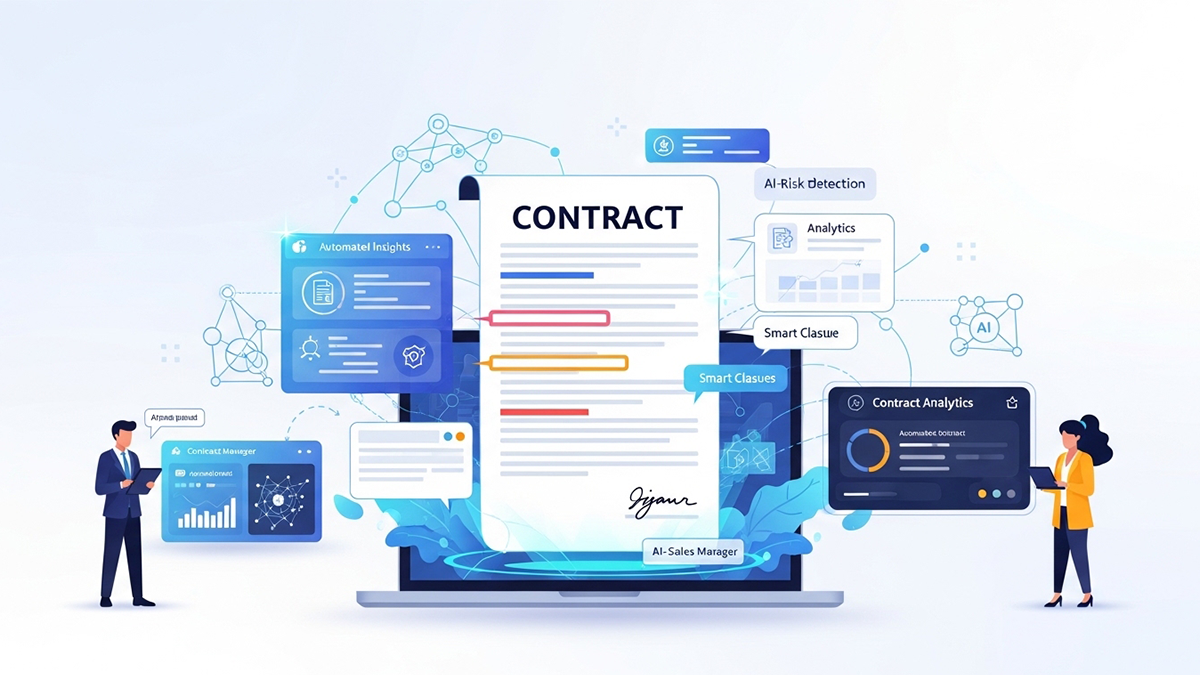
In 2026, contract management is no longer just about storing agreements, routing approvals, and collecting signatures. The category has changed. Businesses now expect contract systems to do more than organize documents. They expect them to understand contracts, interpret contract language, surface risk, track obligations, monitor renewals, support negotiation, and connect contract data to revenue, legal, procurement, finance, and operations.
That shift is exactly what AI-native contract management means in 2026.
For years, contract lifecycle management software focused on workflows. It helped teams create templates, send contracts for review, manage approvals, and maintain a digital repository. Those capabilities still matter. But on their own, they are no longer enough. Modern businesses are dealing with more contracts, more customized terms, more legal scrutiny, and more pressure to move faster without increasing risk. In that environment, traditional contract lifecycle management has become too passive.
AI-native contract management changes the model.
Instead of treating contracts as files that move through a system, AI-native contract management treats contracts as living business assets. It reads what is written inside them. It extracts key terms. It identifies clause deviations. It detects risk. It tracks obligations. It alerts teams to renewals, deadlines, and notice periods. It turns contracts into structured, searchable, and actionable intelligence across the full contract lifecycle.
In simple terms, AI-native contract management in 2026 means moving from contract storage to contract intelligence.
That matters because contracts are not just legal paperwork. They shape how businesses make money, manage commitments, control risk, and deliver outcomes. A contract defines pricing, billing triggers, liabilities, renewals, service levels, payment schedules, termination rights, compliance requirements, and commercial obligations. If that information remains trapped inside static documents, then businesses are operating with incomplete visibility.
In 2026, the market is moving toward systems that do not just hold contracts, but actively understand them.
AI-native contract management is different from traditional CLM
To understand what AI-native contract management means in 2026, it helps to first understand what it is not.
It is not just a traditional CLM platform with a chatbot added on top. It is not just OCR plus keyword search. It is not just an e-signature workflow connected to a document repository. And it is not simply a contract summary generator.
Traditional contract lifecycle management software is process-centric. It focuses on templates, routing, approvals, storage, and version control. These are important functions, but they mostly manage the movement of the contract, not the meaning of the contract.
AI-native contract management is meaning-centric.
It is built to interpret what the contract actually says. It is designed to transform unstructured legal and commercial language into structured business intelligence that teams can act on. A true AI-native contract management platform can:
- extract critical terms from contracts
- identify missing, non-standard, or risky clauses
- compare agreements against playbooks and approved templates
- surface obligations, milestones, and deadlines
- track renewals, notice windows, and termination events
- analyze contract health across a full repository
- support post-signature contract management at scale
That is a very different capability set from a legacy document workflow system.
In 2026, businesses no longer want software that simply moves contracts from one stage to another. They want AI contract management software that helps them understand contracts, govern them, and operationalize them across the business.
In practice, modern contract systems combine structured contract review, AI-assisted contract creation, and secure execution. These capabilities help organizations maintain consistency, transparency, and compliance throughout the contract lifecycle.
 Hi, What do you want to Draft?

Click to upload or drag & drop
pdf, docx up to 5 MB
Click to upload or drag & drop
pdf, docx up to 5 MB
In 2026, AI-native means AI is the foundation, not the feature
One of the most important differences in 2026 is the distinction between AI-added and AI-native systems.
Many older platforms now offer AI features. They may include summaries, extraction tools, clause suggestions, or natural language search. Those features can be useful. But if the core platform was built as a conventional workflow tool, then AI often remains a layer on top of an architecture that still treats contracts as passive documents.
AI-native contract management means the opposite.
In an AI-native contract platform, AI is not an extra feature. It is the engine of the product. The system is designed from the ground up to analyze contract language, interpret meaning, create structured outputs, and support continuous contract intelligence across the lifecycle.
That matters because contracts are inherently variable. They are negotiated documents written in natural language. The same legal or commercial concept can be expressed in multiple ways. A simple keyword search often misses real meaning. Static metadata fields cannot capture nuanced obligations, layered payment logic, or complex renewal mechanics.
An AI-native contract management platform in 2026 is expected to handle this complexity. It should be able to understand contract variation, detect deviations, support contract review automation, and make contract insights available to multiple teams in real time.
This is why the phrase “AI-native CLM” matters so much now. It signals a shift from AI as a convenience to AI as the core intelligence layer of contract operations.
AI-native contract management in 2026 is about full lifecycle visibility
A major reason AI-native contract management is becoming essential is that contract risk does not begin and end at signature.
Older contract systems often focused heavily on pre-signature stages:
- drafting
- redlining
- approvals
- negotiation
- e-signature
These remain critical, but they are only part of the story. In 2026, businesses increasingly recognize that the bigger operational challenge is what happens after signature.
Once a contract is signed, teams still need to know:
- what obligations were created
- when invoices can be issued
- which milestones must be met
- when renewal windows open
- when notice must be given
- what service-level commitments apply
- which clauses create ongoing risk
- what amendments have changed the commercial position
This is where AI-native contract management becomes far more valuable than static CLM software.
It keeps the contract alive after execution. It helps businesses manage post-signature contract intelligence instead of archiving the agreement and hoping someone remembers the details later. It brings visibility to deadlines, obligations, revenue triggers, and renewal risks. That is a core requirement in 2026 because businesses now need contract systems that support execution, not just approval.
This is also why modern contract lifecycle management increasingly overlaps with contract intelligence, contract analytics, and business operations. The contract is no longer treated as the end of the process. It becomes the beginning of operational accountability.
AI-native contract management connects legal, revenue, and operations
In 2026, contract management is no longer only a legal department concern. It sits at the intersection of multiple teams.
- Legal teams care about clause risk, deviations, governance, and compliance.
- Sales teams care about cycle time, approvals, pricing language, and renewals.
- Finance teams care about payment terms, billing triggers, and revenue timing.
- Procurement teams care about supplier obligations and commercial protections.
- Operations and customer success teams care about delivery commitments, service levels, and notice periods.
A static contract repository cannot support all of these needs well. An AI-native contract management system can.
That is because AI-native contract management turns legal text into business signals. It helps different teams work from the same contract reality. Instead of reading a PDF and interpreting it differently in every department, teams can access structured insights based on what the agreement actually says.
For example:
- Legal can see risk deviations and clause exceptions.
- Finance can see payment conditions and invoice triggers.
- Sales can see negotiated commercial commitments.
- Customer success can track renewal dates and service obligations.
- Leadership can evaluate portfolio-wide contract health.
This is what makes AI contract management strategically important in 2026. It is not just about efficiency. It is about alignment.
This is also where platforms like Legitt AI are gaining relevance. A platform such as Legitt AI reflects this shift by supporting contract drafting, review, analysis, repository intelligence, and post-signature tracking in one more connected model. Businesses evaluating what modern AI-native contract management should look like often explore examples at https://www.legittai.com to see how contract intelligence can support a broader business workflow.
AI-native contract management in 2026 is not just automation — it is interpretation
A lot of software in the contract space still talks about automation. Automation matters, but in 2026, automation alone is not enough.
Automating document routing or approval reminders is useful. Automating signatures is useful. Even automating extraction of a few metadata fields is useful. But the real value of AI-native contract management is not just moving faster. It is understanding better.
That means interpretation.
A strong AI-native contract management platform should not just extract that a renewal clause exists. It should help determine whether that renewal is automatic, conditional, open-ended, or subject to notice. It should not just identify that a payment term exists. It should help classify whether payment is fixed, milestone-based, usage-based, conditional, or contingent on acceptance. It should not just detect a limitation of liability clause. It should help assess whether the clause aligns with policy or introduces unusual exposure.
This is where AI-native contract intelligence becomes much more powerful than basic automation.
In 2026, businesses are increasingly looking for contract management software that can interpret business impact, not just document structure. They want systems that understand how contract language affects revenue, risk, compliance, delivery, and long-term account value.
That is a much higher standard than legacy CLM software was built to meet.
Contract repositories in 2026 must be intelligent, not passive
Most organizations already have some type of contract repository. But in many cases, those repositories are still passive.
A passive repository stores contracts and maybe tags them with limited metadata. It may allow full-text search. It may help teams find a document faster. That is helpful, but it is not enough for modern contract operations.
In 2026, a contract repository is expected to be intelligent.
That means the repository should be able to tell the business:
- which contracts renew soon
- which agreements contain non-standard clauses
- which customers have risky termination rights
- which suppliers have unfavorable liability language
- which contracts include missed obligations
- which payment terms create collection risk
- which agreements need attention now
This is what AI-native contract management enables. It transforms the repository into a contract intelligence layer.
Instead of simply answering, “Where is the contract?” the system answers:
- “What does the contract mean?”
- “What actions does it require?”
- “What risks does it contain?”
- “How does it compare to others?”
- “What business events should happen next?”
This is a fundamental redefinition of contract lifecycle management in 2026. Businesses no longer want document archives. They want intelligent contract systems that improve decision-making.
That is why solutions like Legitt AI are increasingly part of the conversation. Businesses exploring AI-native contract repository intelligence often look at https://www.legittai.com to understand how modern contract platforms can evolve beyond storage into actionable analysis.
AI-native contract management in 2026 supports speed without sacrificing control
One of the biggest pressures on businesses in 2026 is the need to move faster while maintaining governance.
Sales teams want faster contract turnaround. Procurement teams want faster supplier onboarding. Legal teams are under pressure to reduce bottlenecks. Finance wants clean billing terms. Leadership wants stronger visibility. At the same time, no one wants to increase contract risk just to save time.
This is where AI-native contract management becomes especially valuable.
It helps accelerate:
- drafting from approved templates and clause libraries
- redline review
- deviation detection
- playbook comparison
- approval routing based on risk
- contract analysis across high-volume portfolios
But it also helps maintain control:
- non-standard clauses can be flagged earlier
- risky terms can be escalated faster
- obligations can be captured more consistently
- renewal deadlines can be tracked proactively
- repository-wide risk patterns can be surfaced to leadership
That balance of speed and governance is what modern businesses are looking for. In 2026, contract management software is expected to reduce friction without sacrificing oversight. AI-native contract management is increasingly the model that delivers that balance best.
In 2026, AI-native contract management is becoming a competitive advantage
The final and most important point is this: AI-native contract management in 2026 is no longer just operational software. It is becoming a competitive advantage.
Companies that understand their contracts better can:
- close deals faster
- reduce legal bottlenecks
- improve renewal capture
- avoid missed obligations
- reduce revenue leakage
- strengthen compliance readiness
- improve contract forecasting
- gain better visibility into portfolio-wide risk
Companies that still treat contracts as static documents are at a disadvantage. They rely more on manual review, spreadsheets, email threads, and institutional memory. That makes them slower, less predictable, and more exposed to hidden risk.
AI-native contract management changes that. It gives businesses a more scalable way to control the legal and commercial backbone of their operations. It supports better decision-making across the contract lifecycle. It turns the contract from a document to be filed away into a business asset to be actively managed.
That is what AI-native contract management means in 2026.
It means contract systems that understand, interpret, and operationalize agreements across drafting, negotiation, execution, and post-signature performance. It means AI-native CLM that delivers speed, control, visibility, and intelligence at the same time. And it means the future of contract lifecycle management belongs to platforms that can transform contracts into real business intelligence.
Read our complete guide on Contract Lifecycle Management.
FAQs
What does AI-native contract management mean in 2026?
AI-native contract management in 2026 means contract software where AI is the core intelligence layer, not just an added feature. It helps businesses draft, review, analyze, track, and manage contracts by understanding what the contracts actually say. This includes extracting terms, identifying risks, monitoring obligations, and surfacing renewals. It is a much broader and deeper model than traditional CLM.
How is AI-native contract management different from traditional CLM?
Traditional CLM mainly focuses on templates, approvals, workflows, storage, and e-signatures. AI-native contract management adds interpretation and contract intelligence on top of those workflow functions. It helps teams understand the meaning of clauses, payment terms, obligations, and risks across the lifecycle. That makes it more useful for legal, finance, sales, procurement, and operations.
Why is AI-native contract management important in 2026 specifically?
In 2026, businesses are dealing with more contract volume, more customized deals, tighter compliance demands, and greater pressure to move faster. Manual contract management cannot scale well in that environment. AI-native contract management helps teams maintain speed while improving control and visibility. That makes it especially valuable in today’s operating environment.
Does AI-native contract management help after contracts are signed?
Yes, and that is one of its biggest advantages. It helps businesses track post-signature obligations, payment triggers, milestones, notice periods, amendments, and renewals. Without this kind of visibility, many important terms disappear into repositories and are only discovered when problems arise. AI-native systems keep the contract active throughout its lifecycle.
Is AI-native contract management only for legal teams?
No, it is valuable across the business. Legal teams use it for governance and clause control, but sales teams use it for cycle-time improvement, finance uses it for billing and revenue timing, and customer success can use it for renewals and obligations. Procurement and operations also benefit from stronger visibility into supplier and delivery commitments. It is a cross-functional business capability.
What should a good AI-native contract platform do?
A good AI-native contract platform should support drafting, clause analysis, deviation detection, contract review automation, repository intelligence, obligation tracking, and renewal monitoring. It should also help teams compare contracts against templates and approved playbooks. Most importantly, it should turn contract content into actionable intelligence, not just static files. That is what separates true AI-native contract management from basic contract software.
How does Legitt AI fit into this category?
Legitt AI fits into this category because it reflects the shift from passive contract handling to AI-native contract intelligence. It supports contract creation, review, analysis, and post-signature visibility in a more connected workflow. That makes it relevant for businesses looking for modern contract lifecycle management, not just storage and approvals. More information is available at https://www.legittai.com.
Can AI-native contract management improve a contract repository?
Yes, significantly. Instead of a passive repository that only stores files, AI-native contract management can turn the repository into an intelligence source. It can identify risks, track renewals, surface obligations, and reveal patterns across the full contract portfolio. That makes contract repositories far more useful for governance and decision-making.
How should businesses evaluate AI-native contract management software?
Businesses should look beyond surface-level AI features and ask whether the platform can truly interpret contracts. They should evaluate drafting support, clause intelligence, risk detection, post-signature tracking, repository analytics, and integration readiness. Platforms like Legitt AI are often reviewed because they align closely with this broader AI-native model. A practical starting point is https://www.legittai.com.
Will AI-native contract management become the standard?
Yes, it is very likely to become the standard direction of the market. As contracts become more complex and more central to revenue, compliance, and operations, businesses need systems that do more than route documents. AI-native contract management provides the speed, visibility, and control needed to manage modern agreements effectively. That makes it increasingly essential rather than optional.