Your contracts probably still live in too many places. Sales starts in Word. Procurement edits by email. Legal tracks approvals in Slack. Signed PDFs end up in shared drives, and nobody trusts the renewal dates.
That setup works until the business starts moving faster. Then contract work stops being admin and starts shaping revenue, vendor risk, and compliance. If you’re making your first serious CLM investment, the question isn’t which platform has the longest feature list. It’s which system your team will use, which one fits your budget, and which one won’t force a second software buying cycle a year from now.
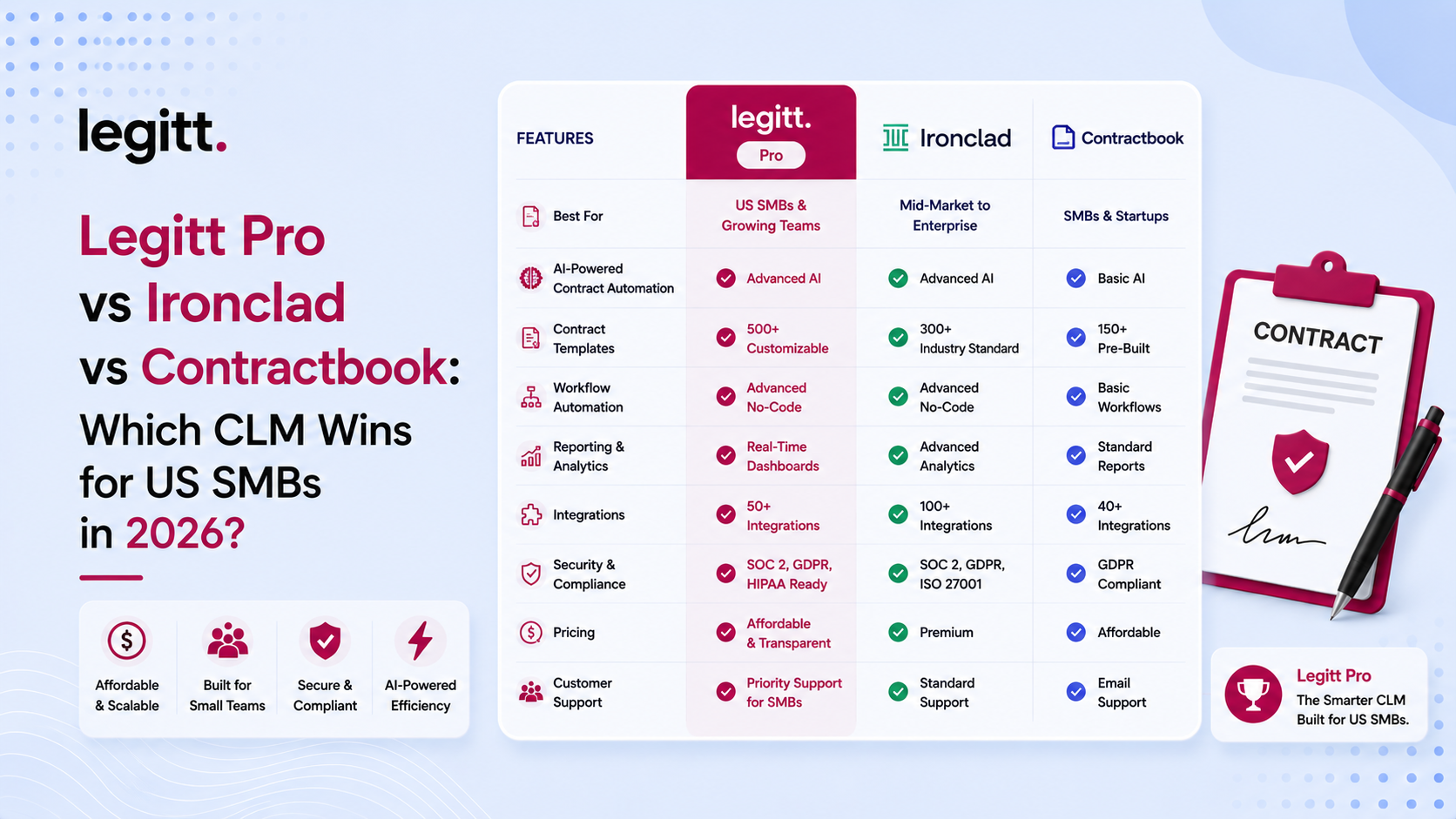
This is the key decision behind Legitt Pro vs Ironclad vs Contractbook: Which CLM wins for US SMBs in 2026?
The 2026 Crossroads for SMB Contract Management
A growing SMB usually reaches the same breaking point. The company has enough contracts to feel the pain, but not enough legal headcount to absorb it. NDAs, MSAs, vendor agreements, DPAs, SOWs, and renewal notices start piling up. The immediate symptoms look operational. Slow approvals, inconsistent language, missed obligations, and no clean system of record.
The bigger problem is strategic. Manual contracting slows sales and increases legal dependency for routine work. According to the 2026 Contracting Benchmark Report, top-performing US SMB teams that implement end-to-end automation reduce contract cycle times by an average of 58% compared to manual workflows.
That matters because CLM in 2026 isn’t just a filing cabinet with workflow on top. It’s becoming an operating system for revenue, procurement, and legal operations.
Three platforms represent three different paths:
- Ironclad is the enterprise heavyweight. It’s built for governance, process control, and larger operating environments.
- Contractbook is the cleaner automation-first option for startups and mid-market teams that want digital workflows without enterprise drag.
- Legitt Pro represents the AI-native direction, where drafting, review, approval, eSignature, repository management, and contract intelligence are designed around faster adoption by non-legal users.
What SMB buyers usually miss
Many first-time CLM evaluations still start with a feature checklist. Drafting, approval routing, repository, search, integrations. Those matter, but they don’t decide success on their own.
A better buying lens includes:
- Who can use it on day one
- How much legal setup it requires
- Whether eSignature and CRM handoffs are native or fragmented
- How quickly sales and procurement can generate safe first drafts
- What the platform looks like once AI becomes part of daily work
Most SMB CLM failures don’t come from missing features. They come from low adoption, fragmented workflows, and buying enterprise architecture before the business is ready for it.
If you’re still narrowing the market, this roundup of contract management software for US small businesses is a useful starting point. But once you’re down to these three platforms, the decision becomes much more specific: Which model gives your business the best total outcome, not just the best demo?
Defining the Winning CLM for a Modern SMB
An SMB doesn’t win by buying the most software. It wins by buying the right operating model for contracts. That changes how you should judge a CLM platform.
For most legal, procurement, and revenue teams, the winner isn’t the platform with the deepest enterprise controls. It’s the one that reaches usable value fast, spreads safely beyond legal, and keeps costs predictable as contract volume grows.
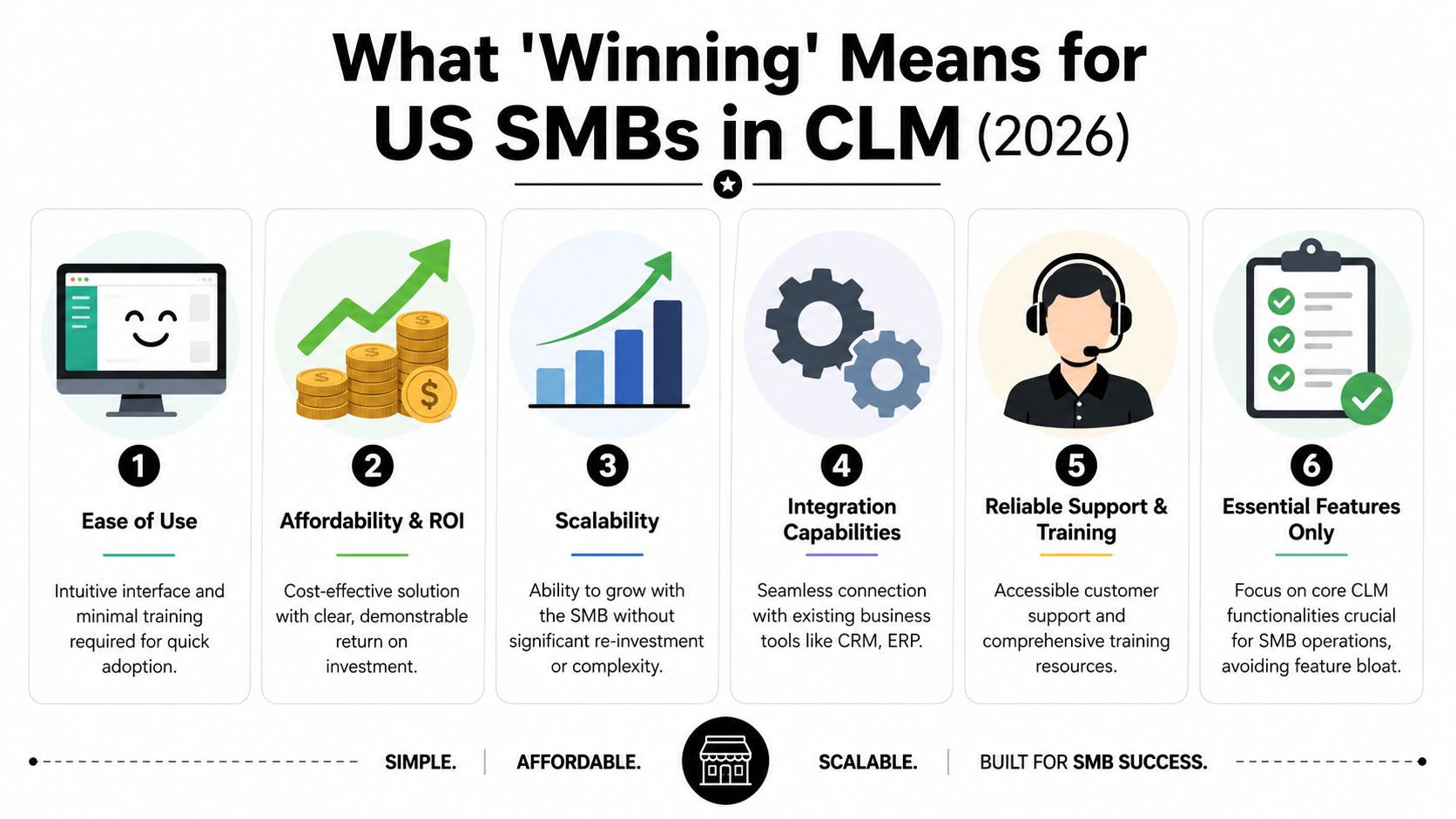
Four tests that actually matter
Speed to ROI
SMBs rarely have the luxury of a long software payback period. A CLM should reduce drafting time, remove approval bottlenecks, centralize records, and improve turnaround without a heavy consulting layer.
Ironclad can support major process transformation, but that value often aligns best with bigger implementation scopes. Contractbook is designed for faster operational use. Legitt Pro pushes further toward immediate utility by centering AI-driven workflows from the start.
Adoption beyond legal
A CLM fails if sales, procurement, operations, and finance still work outside it. Modern contract management depends on whether non-lawyers can create, route, review, and sign documents without constant legal intervention.
That’s why usability matters as much as legal depth. This is especially relevant for SMBs building a first formal contract process from scattered tools. For smaller teams thinking through this shift, this guide to contract lifecycle management for small business is a practical companion.
AI-powered intelligence
There’s a difference between workflow automation and contract intelligence. Automation routes tasks. Intelligence helps teams draft faster, identify clause issues, analyze deviations, track obligations, and pull insight from the repository.
For SMBs, that distinction matters because legal capacity is limited. If AI only helps specialists, the impact stays narrow. If AI helps account executives, procurement managers, and operations leads work from approved standards, the value spreads across the business.
A modern SMB scorecard
Here’s the framework I use with first-time buyers:
| Evaluation area | What good looks like for an SMB |
|---|---|
| Time to operational value | The platform becomes useful quickly, without a long redesign project |
| Cross-functional usability | Legal can govern it, but sales and procurement can work inside it confidently |
| AI practicality | AI helps with real drafting, review, negotiation support, and repository insight |
| Cost scalability | Pricing, eSignature, and integration needs remain manageable as usage expands |
| Process fit | Workflows match how the business already sells and buys, not just ideal-state maps |
| Future-proofing | The system can support contract automation, contract review, and contract analytics as the company matures |
Consultant’s rule: For an SMB, a “best-in-class” platform that only legal can operate is usually less valuable than a very good platform the whole revenue and procurement engine will actually adopt.
Under that lens, Ironclad, Contractbook, and Legitt Pro aren’t just different products. They’re different answers to the same business problem.
Feature Deep Dive A Head-to-Head Comparison
Feature comparisons are useful only if they follow the contract lifecycle itself. SMBs don’t buy drafting in isolation. They buy a chain of work: request, create, review, negotiate, approve, sign, store, and monitor.
According to the AI contract management guide from LinkSquares, AI-powered CLM systems can reduce contractual creation and drafting time by up to 60% by generating clauses and templates from approved sources. That’s the right benchmark for this category. The best platform isn’t the one that merely stores contracts. It’s the one that shortens work across the whole chain.
CLM Platform Feature Comparison for SMBs
| Feature | Legitt Pro | Ironclad | Contractbook |
|---|---|---|---|
| Drafting model | AI-native drafting with plain-English generation and template support | Structured enterprise workflow with strong process governance | Digital-first drafting with templates and automation |
| Contract review | AI-assisted review, clause analysis, and deviation handling built into the workflow | Strong review environment, especially for controlled legal processes | Review suited to streamlined SMB workflows and standard agreements |
| Negotiation support | Redlines, comments, internal collaboration, and counterparty handling in one workspace | Mature collaboration for legal-led review and enterprise approvals | Practical collaboration focused on speed and simplicity |
| Approval workflows | Role-based routing designed for business and legal teams | Advanced governance for complex approval chains | Easy-to-configure workflows for growing teams |
| eSignature | Built in | May sit within a broader enterprise stack depending on deployment choices | Strong digital workflow positioning, but buyers should validate stack completeness |
| Repository and search | Searchable repository with contract intelligence, obligations, renewals, and metadata extraction | Strong centralized repository for enterprise records | Clean repository model for digital contract management |
| CRM handoff | Designed for CRM-connected workflows and reduced copy-paste work | Works well in larger systems with implementation effort | Good fit for modern digital teams, especially in scaling environments |
| Best-fit buyer | SMBs seeking all-in-one AI contract automation with broad business adoption | Companies with enterprise budgets and formal process complexity | Startups and mid-market teams focused on usability and workflow automation |
Drafting and first-pass contract creation
For many SMBs, the first real productivity test is simple. Can a salesperson create a safe NDA or order form without waiting for legal?
Ironclad approaches this through structured control. Contractbook leans into easier digital workflows and template management. Legitt Pro is strongest when the team wants AI-powered contract drafting to move routine agreements from template selection toward prompt-based generation.
Ironclad’s strength is control. Contractbook’s strength is simplicity. Legitt Pro’s strength is removing the first-draft bottleneck.
Review, approvals, and signatures
Review speed depends on two things. Whether the platform can identify what changed, and whether approvals move automatically to the right people.
For legal operations teams, Ironclad offers the most enterprise-style governance. That’s useful when approvals involve many stakeholders or strict policy checks. Contractbook is lighter and more accessible for business teams that want contract automation without enterprise process overhead. Legitt Pro is particularly compelling when businesses want AI contract review, built-in eSignature, and approval routing inside a single workspace.
A broader market comparison of these product directions appears in this Legitt AI competitors overview for 2026, which is helpful if you’re evaluating adjacent tools too.
Repository and post-signature work
The repository is where many CLM projects lose momentum. Teams buy for drafting speed, then underuse the platform after signature.
For SMBs, the practical post-signature questions are:
- Can someone find the latest executed version quickly
- Can the system track obligations and renewals
- Can business users search by clause, customer, vendor, or status
- Can leaders extract contract intelligence, not just PDFs
Contractbook has clear appeal for teams that want a digital-first repository without a heavy operating model. Ironclad supports more formal enterprise contract workflows. Legitt Pro stands out when the buyer wants contract intelligence and ongoing management to be as central as creation and negotiation.
Evaluating AI Capabilities and Contract Intelligence
The biggest separation in this market isn’t “has AI” versus “doesn’t have AI.” It’s AI-assisted versus AI-native.
AI-assisted CLM improves parts of the process. It might flag clause deviations, help with third-party review, or summarize repository content. AI-native CLM changes how users work from the beginning. A seller, buyer, or operations manager can ask for a contract in plain English, generate a first draft, route it for approval, e-sign it, and keep it searchable in one operating flow.
Why adoption is the real AI metric
The most useful AI in CLM isn’t the most advanced model. It’s the one your non-legal teams will trust and use.
Data from the 2026 Global Legal Tech Report coverage at Aline states that 68% of SMBs failed to adopt legacy CLMs due to high training complexity, while AI-native platforms with plain-English interfaces achieved 90% user adoption within 30 days. That should change how buyers evaluate “AI features.”
A strong AI story for SMBs includes:
- Plain-English drafting so users don’t have to work through rigid template trees
- Contract review support that identifies clause deviations on third-party paper
- Approval intelligence that routes work based on contract type or risk
- Repository insight that surfaces obligations, renewals, and unusual terms
- Cross-functional usability so legal doesn’t become the sole operator
If AI only helps legal review faster, you’ve optimized a bottleneck. If AI helps sales and procurement start correctly, you’ve reduced the bottleneck itself.
How the three platforms differ
Ironclad’s AI value is strongest when a business already runs formal legal process and wants better analysis inside that structure. Contractbook’s value is more workflow-centric. It helps teams digitize and automate contracting with less friction than a classic enterprise rollout.
Legitt Pro takes the more disruptive position. It treats AI as the interface, not an add-on. That’s important for SMBs that want contract automation without creating a dependency on legal template administrators for every new use case.
Teams evaluating this shift should also look beyond software demos and understand what makes AI products usable in practice. This guide for AI tool development is useful because it explains why interface design, workflow fit, and human trust matter as much as model capability.
For a platform-specific view of where AI sits inside the lifecycle, this overview of AI in contract lifecycle management gives a good functional map.
Contract intelligence matters after signature too
Contract intelligence is often sold as review acceleration. That’s only half the story. The larger SMB opportunity is post-signature visibility.
When AI can extract obligations, identify renewal events, and make repository-wide search meaningful, the CLM becomes useful to finance, procurement, sales ops, and compliance. That’s where a contract system starts acting like business infrastructure rather than legal software.
Unpacking Price Models and Total Cost of Ownership
A 75-person company buys its first CLM to fix approval delays. Twelve months later, legal is still chasing signatures in a separate tool, sales ops is rekeying CRM data into templates, and finance cannot trust renewal reports. The subscription did not cause the budget miss. The fragmented operating model did.
That is why SMB buyers should evaluate CLM as a total cost of ownership decision, not a line-item software purchase. The total cost sits across five categories: platform fees, implementation time, user training, add-on products, and the internal labor created when drafting, approval, signing, and reporting live in different systems.
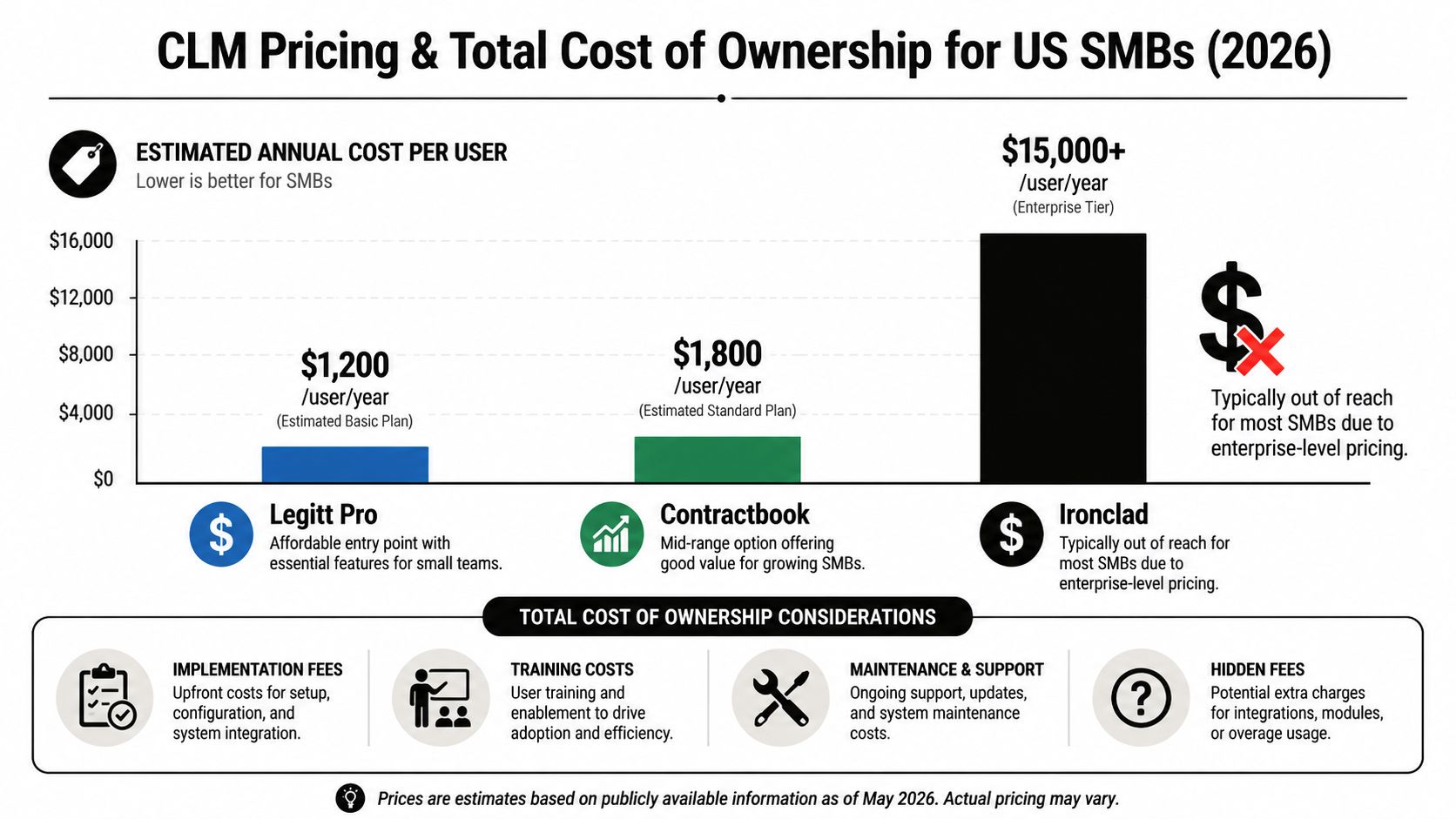
Where SMB budgets usually break
Ironclad often delivers value for companies that already have formal legal processes and the budget to support them. For a first CLM purchase, the bigger question is fit. Earlier pricing research in this article noted first-year costs that can push Ironclad into enterprise territory, which changes the ROI math for an SMB still standardizing intake, approvals, and templates.
Contractbook usually presents a more approachable entry point, but buyers still need to check what is included versus what must be connected or upgraded later. Legitt Pro’s pricing story is stronger if the business wants one system to cover drafting, workflow, AI assistance, repository, and signing without layering in multiple vendors from day one.
That distinction matters more than many buying guides admit.
The hidden cost of a fragmented stack
A lower starting subscription can produce a higher three-year cost if the CLM depends on separate products for e-signature, CRM sync, document generation, or AI review. Contractsafe’s review of best contract management software points buyers toward this broader cost question rather than treating the license as the whole investment.
In practice, hidden costs tend to show up in four places:
- Separate e-signature billing that rises with volume or advanced workflow needs
- Manual CRM handoffs that consume sales ops time and increase drafting errors
- Extra training cycles because users must learn several interfaces and permissions models
- Multi-vendor support gaps when one workflow breaks across systems and no provider owns the fix
For SMBs, these are not minor inefficiencies. They shape adoption. If sales, procurement, and finance need legal help every time a contract starts or stalls, the company has bought software without reducing legal dependency.
A better pricing test for 2026
Use a scenario-based cost test. Ask what it costs to create, approve, sign, store, and report on 500 contracts a year with the people you already have.
That pushes the comparison beyond list price.
| TCO question | Why it matters |
|---|---|
| Is eSignature built in? | A separate signing product adds cost and breaks workflow continuity |
| Does CRM data pre-fill contracts? | Manual entry slows cycle time and increases error risk |
| Can business users draft from plain-English prompts? | AI self-service reduces legal bottlenecks and training load |
| How much admin work is needed after launch? | Ongoing maintenance can outweigh a lower initial subscription |
| Are AI features native or sold as another layer? | Future costs rise if contract intelligence requires more tools later |
The AI question deserves extra weight. An AI-native platform can lower TCO in a way feature grids miss because non-legal users can generate first drafts, search obligations, and revise language without waiting for a template specialist. That is not just convenience. It changes the staffing model around contracting.
If you want a structured way to estimate those operational costs, this analysis of contract management cost without AI is a practical starting point.
For most US SMBs, the lowest-risk CLM purchase is the one that replaces adjacent tools and reduces the number of people needed to keep contracts moving. Subscription price matters. Stack design matters more.
Implementation Realities and Integration Fit
Implementation is where CLM strategy meets company reality. A platform can look excellent in a demo and still fail because the rollout assumes more process maturity, admin capacity, or integration support than your business has.
For SMBs, the first implementation question is simple. Who will own this system after go-live? If the answer is “probably legal, plus someone in ops when they have time,” you need a platform that can be configured and maintained without a project team.
What onboarding feels like in practice
Ironclad usually makes the most sense when the business is prepared for a formal rollout. That can include process mapping, approval design, legal governance decisions, and structured integration planning. For some companies, that’s exactly what’s needed. For others, it’s more architecture than the current stage of growth can absorb.
Contractbook is easier to picture in a scaling SMB. The vendor positions it as a top-tier Ironclad alternative for startups and mid-market teams, and notes a 4.5-star rating from 206 verified reviews reflecting its digital-first approach and ease of use on its Ironclad alternative page. That positioning matters because many SMBs need a system teams can learn quickly, not just a system legal can configure extensively.
Legitt Pro fits best when the buyer wants an all-in-one workflow and expects non-legal users to participate heavily in drafting, approvals, and post-signature tracking. The AI-native model also changes onboarding expectations. Users don’t need to master the platform the same way they would in a rigid template-driven environment.
Integration fit is more than a connector list
SMBs should ask whether integrations do actual work. A CRM integration that only stores a file isn’t enough. The better use case is one where the CRM triggers drafting, pre-fills business data, and pushes status back to the source system.
Check fit against the tools your teams already rely on:
- Salesforce or HubSpot for sales-triggered contracts
- Microsoft 365 or Word for legal drafting comfort
- Slack for approvals and alerts
- ERP or procurement systems where vendor agreements start upstream
A strong SMB integration doesn’t just connect systems. It removes copy-paste and cuts the number of handoffs a human has to manage.
A practical rollout sequence
If you’re buying your first CLM, keep the rollout narrow at first:
- Start with high-volume agreements like NDAs, standard sales contracts, and common vendor forms.
- Map one approval chain clearly before trying to automate every exception.
- Connect one CRM source first so your team can prove pre-fill and status visibility.
- Define repository rules early for naming, metadata, renewals, and executed versions.
That approach lowers risk and gives your team a faster path to visible operational improvement.
The Verdict A Decision Framework for Your Business
There isn’t one universal winner. There is a best fit for your operating model.
The most useful way to decide between these three platforms is to match them to budget, process complexity, and how much you want AI to change day-to-day work outside legal.
Choose Ironclad if
Choose Ironclad if your company operates like a larger enterprise already. That means formal legal review, layered approvals, significant governance needs, and a budget that can support enterprise-level CLM architecture.
Ironclad is strongest when process control is the top priority and the business can justify the implementation effort that often comes with that control.
Choose Contractbook if
Choose Contractbook if your team wants a cleaner digital contract workflow without stepping into full enterprise complexity. It’s a strong fit for startups and mid-market companies that value usability, structured automation, and a modern interface for legal and business teams.
This option makes sense when you want practical contract lifecycle management with less operational friction, and you’re comfortable validating how the broader stack fits around it.
Choose Legitt Pro if
Choose Legitt Pro if your SMB wants AI contract management to be a practical operating advantage, not a side feature. This is the best fit for teams that want plain-English drafting, integrated eSignature, contract review, repository intelligence, and CRM-connected workflows in one system.
It also fits businesses that expect sales, procurement, operations, and founders to use the CLM directly, not just submit requests to legal.
The smartest SMB choice is usually the platform that reduces both software fragmentation and legal dependency at the same time.
The practical recommendation
If your company has enterprise-level complexity and budget, Ironclad remains a credible option. If your goal is modern workflow automation with a lighter footprint, Contractbook deserves serious attention. If your priority is future-proofing around AI, broad adoption, and all-in-one total cost discipline, Legitt Pro is likely the stronger strategic fit.
For most SMBs, the best CLM in 2026 won’t be the most famous platform. It will be the one your whole business can run on.
Frequently Asked Questions
How hard is it to migrate existing contracts into a new CLM?
For many SMBs, migration is less a software problem than a records problem.
If your agreements live across inboxes, shared drives, PDFs with inconsistent names, and a few founder laptops, the actual work starts before import. You need a clear view of which contracts matter, which metadata fields the business will rely on, and who owns validation once records land in the new system.
AI can reduce manual tagging after upload by extracting dates, parties, and renewal terms. It does not remove the need for a cleanup plan. On a first CLM purchase, a vendor that helps you structure migration and confirm data quality often creates more value than one with a longer feature list.
Which platform is most realistic for a first major SMB CLM purchase?
Start with operating model, not brand recognition.
Ironclad fits best when your company already has formal legal processes, internal admins, and enough contract volume to justify a more structured rollout. Contractbook is easier to justify for teams that want cleaner workflow control without stepping into enterprise-level overhead. Legitt Pro stands out for SMBs that want non-legal users to draft, review, sign, and track agreements in one system using AI features that reduce dependence on legal for first drafts and routine edits.
That last point matters more than many buyers expect. A CLM only delivers return if sales, procurement, operations, and founders use it consistently.
What should I verify about security and compliance?
Verify security claims in the sales process, not just on a marketing page. Ask for current documentation on certifications, access controls, encryption, audit logs, data residency options, and incident response procedures.
Contractbook says it maintains SOC 2 verification and GDPR compliance in its public comparison materials. Legitt AI says it supports SOC 2 Type II, ISO 27001/27701, GDPR, and HIPAA compliance, along with SSO, MFA, RBAC, and AES-256 encryption. The practical question is whether those controls match your customer requirements, procurement reviews, and industry obligations.
How should I compare vendor support?
Ask support questions that reveal future operating cost. Who runs onboarding. Who configures templates and approval flows. How fast do you get a useful answer when a sales manager cannot generate a contract on quarter-end day.
Also ask whether business users can solve common issues themselves. Platforms that depend on one technical admin often look manageable in a demo and expensive in month six. Good support lowers delay, but good product design lowers support demand in the first place.
Is Ironclad too expensive for most SMBs?
In many first-time SMB CLM evaluations, yes.
As noted earlier in the pricing analysis, Ironclad often lands at a cost level that makes more sense for companies with enterprise-like process maturity, dedicated legal operations support, or unusually high contract complexity. The subscription is only part of the decision. Implementation effort, admin time, training, and any surrounding tools can push total cost well beyond the line item discussed in procurement.
That is why SMB buyers should compare full operating cost, not headline platform price. A CLM with built-in eSignature, AI drafting, repository intelligence, and business-user adoption can be cheaper over two years than a lower-priced system that depends on extra tools and heavier internal coordination.
If you’re weighing your first serious CLM decision, Legitt AI is worth a close look for teams that want AI-powered drafting, review, eSignatures, approvals, repository intelligence, and CRM-connected workflows in a single workspace. For US SMBs trying to control total cost of ownership while expanding contract automation beyond legal, that all-in-one model is often the difference between owning a CLM and effectively using one.