
Microsoft Dynamics is a powerful business platform. It helps organizations manage sales pipelines, customer relationships, finance, operations, service workflows, and enterprise reporting in one connected ecosystem. For many businesses, Microsoft Dynamics is central to revenue operations, customer engagement, and day-to-day execution. But even with all of its strengths, Microsoft Dynamics has a critical limitation: it does not natively understand the contracts that define the commercial, legal, and financial reality of a business relationship.
That is the missing layer.
A company may use Microsoft Dynamics to manage leads, opportunities, quotes, customer records, invoices, and account performance. But the most important terms of the deal often live outside the system, buried inside contracts, amendments, order forms, statements of work, renewal notices, email threads, and shared repositories. Those documents contain the actual rules of the relationship: pricing commitments, payment terms, auto-renewal clauses, liabilities, obligations, service levels, compliance commitments, and termination rights. If Microsoft Dynamics cannot understand those documents, then the platform only sees part of the truth.
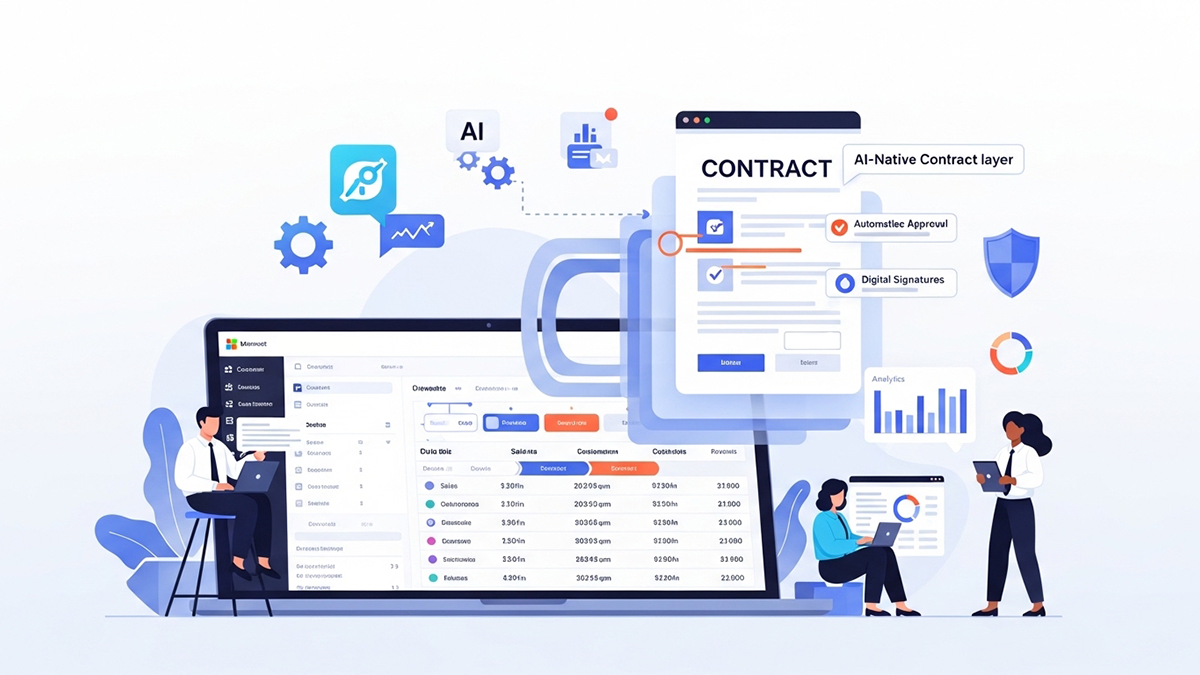
This is why Microsoft Dynamics needs an AI-native contract layer.
An AI-native contract layer transforms contracts from static files into structured business intelligence. It reads contract language, extracts key data, identifies deviations, tracks obligations, detects risk, monitors renewal terms, and connects contract insights back into the business systems that rely on them. Instead of simply attaching a signed PDF to a customer record, an AI-native contract layer makes the contents of the contract operational, searchable, and actionable across the full lifecycle.
For modern businesses, this is no longer optional. Contract complexity is increasing. Deal structures are becoming more customized. Legal and compliance expectations are growing. Finance teams are under pressure to improve cash flow and reduce leakage. Sales teams are expected to move faster without sacrificing control. In that environment, Microsoft Dynamics needs more than CRM and ERP visibility. It needs contract intelligence.
Microsoft Dynamics is strong at workflows, but contracts are unstructured
Microsoft Dynamics excels at managing structured data. It is highly effective with records, workflows, fields, objects, automations, dashboards, and system integrations. It is built to organize business processes and provide operational clarity. But contracts do not naturally exist as structured data.
Contracts are long-form, negotiated, language-heavy documents. They are full of legal clauses, pricing logic, service commitments, payment conditions, notice periods, renewal mechanics, indemnity terms, exceptions, and customer-specific obligations. Two contracts for similar deals can look very different because the language changes, the fallback clauses differ, and the commercial terms evolve during negotiation.
This creates a major operational gap.
Microsoft Dynamics can tell you the opportunity value, the account owner, the projected close date, or the invoice status. But it cannot inherently interpret whether:
- the contract includes auto-renewal
- payment is tied to milestones
- service credits apply under certain conditions
- non-standard liability caps were accepted
- the customer negotiated a unique termination right
- pricing escalators apply at renewal
- notice periods create a hidden churn risk
Without an AI-native contract layer, this intelligence stays locked inside documents. Teams are then forced to rely on manual review, manual data entry, and disconnected processes to move contract information back into Dynamics. That slows down execution and creates inconsistencies across sales, finance, legal, and customer success.
A contract layer built with AI solves this by reading and structuring the meaning of the contract itself. It turns the language of the agreement into usable data. That is what makes Microsoft Dynamics more complete as a business platform.
The signed contract is the real source of truth
Many businesses treat Microsoft Dynamics as the source of truth for customer and revenue data. In reality, the signed contract is often the final source of truth.
The quote may suggest one pricing structure. The sales forecast may assume a certain payment schedule. The customer record may reflect a projected renewal date. But the signed contract determines what the customer is actually obligated to pay, what the business is required to deliver, what exceptions were granted, and what risks were accepted.
That distinction matters because contract language directly impacts revenue, profitability, and operational performance.
A contract may move payment terms from upfront billing to phased billing. It may include milestone-based acceptance before invoicing. It may give the customer additional termination rights. It may contain performance-based obligations. It may cap annual increases or create an automatic renewal unless notice is given in a specific window. These are not small details. These are core business realities.
If Microsoft Dynamics is not connected to contract intelligence, then it is often tracking an expected deal, not the actual signed deal.
An AI-native contract layer fixes this by extracting and operationalizing the real terms of the agreement. It allows Microsoft Dynamics contract management to go beyond document attachment and become contract-aware. That means finance can invoice with more precision, legal can track deviations, sales can understand what was truly negotiated, and leadership can forecast based on actual contract terms rather than incomplete assumptions.
This is one of the strongest reasons businesses need contract lifecycle management for Microsoft Dynamics that includes AI-native contract intelligence.
Manual contract handoffs create inefficiency and revenue leakage
In many organizations, the process between sales execution and signed contract management is still fragmented. Sales teams work in Microsoft Dynamics. Legal teams review contracts in email, Word documents, or separate systems. Finance teams may only see summary terms after signature. Customer success teams often inherit the account with incomplete visibility into service obligations and renewal mechanics.
This creates dangerous handoffs.
A deal moves through Dynamics, gets approved, and is sent for contract review. Redlines happen outside the platform. Terms change during negotiation. The agreement is signed. A document is uploaded. Then, if someone remembers, a few fields are manually copied back into the system.
This manual model creates predictable problems:
- key obligations are missed
- renewal dates are not captured accurately
- payment triggers are misunderstood
- non-standard clauses go untracked
- legal exceptions disappear into email threads
- customer-specific commitments are not passed to downstream teams
These are not minor administrative issues. They are direct sources of revenue leakage, compliance exposure, slower collections, poor customer experience, and operational inefficiency.
An AI-native contract layer reduces these problems by automatically extracting contract data and syncing contract intelligence into Microsoft Dynamics workflows. It can identify payment terms, notice periods, milestones, renewals, obligations, deviation patterns, and risk points without relying on humans to manually summarize dense legal language.
That is how AI contract management becomes a real business advantage. It reduces friction, improves data quality, and ensures the contract is actively informing business execution.
Why AI-native matters more than AI-added
Many vendors now promote AI features. But there is an important difference between software with a few AI add-ons and a truly AI-native contract layer.
AI-added systems often offer summaries, search enhancements, or basic chat over documents. These features can be helpful, but they do not fundamentally change how contracts are managed. The contract is still treated as a file that users read manually.
AI-native contract management is different. In an AI-native architecture, contract intelligence is the foundation. The platform is built to interpret contract language, structure the meaning, detect risks, compare clauses, extract metadata, monitor obligations, and support downstream decisions. AI is not a side feature. It is the engine that turns contract text into operational intelligence.
This matters greatly for Microsoft Dynamics contract management because the value is not just reading contracts faster. The value is making Microsoft Dynamics smarter.
An AI-native contract layer can:
- enrich account and opportunity records with real contract terms
- trigger alerts for renewals and notice periods
- surface hidden obligations to account teams
- identify contract risk patterns across customers
- improve finance visibility into billing triggers
- support legal oversight of non-standard language
- enhance reporting with contract-backed insights
This is where platforms like Legitt AI stand out. Legitt AI is designed around making contracts actionable, not just stored. It supports the shift from passive contract storage to active contract intelligence, which is exactly what businesses need when running sales, finance, and operations through Microsoft Dynamics.
In practice, modern contract workflows inside Microsoft Dynamics combine AI-driven contract generation, structured contract review, and secure execution. These capabilities help ensure contracts remain accurate, traceable, and compliant across the lifecycle.
 Hi, What do you want to Draft?

Click to upload or drag & drop
pdf, docx up to 5 MB
Click to upload or drag & drop
pdf, docx up to 5 MB
Microsoft Dynamics needs contract intelligence before signature and after signature
A common mistake is to view contracts only as pre-signature legal documents. In reality, contracts matter throughout the full customer lifecycle.
Before signature, businesses need:
- faster drafting using templates and clause libraries
- guided contract generation
- better control over redlines and deviations
- faster approvals
- stronger alignment between sales and legal
- visibility into risk before signing
After signature, the need becomes even more critical. Businesses need visibility into:
- payment schedules
- milestone commitments
- notice deadlines
- service-level requirements
- amendment history
- renewal terms
- escalation clauses
- compliance obligations
- termination rights
This is where an AI-native contract layer becomes indispensable. It does not stop at drafting or review. It continues to monitor and surface what matters after the contract is signed. That is essential for post-signature contract tracking, which is often the biggest blind spot in traditional CRM and ERP environments.
When integrated into Microsoft Dynamics, this contract intelligence can improve account management, forecasting, service execution, billing operations, and renewal planning. It helps teams act before risks become problems. It creates a more proactive business model instead of a reactive one.
The post-signature blind spot is where risk grows
For many companies, once a deal is marked complete in Microsoft Dynamics, attention shifts to the next opportunity. But the real work begins after signature.
This is when the business must actually deliver on the terms of the agreement. The contract may contain onboarding requirements, SLA targets, reporting obligations, customer-specific security terms, payment dependencies, benchmarking rights, early termination clauses, or renewal conditions. If these details are not extracted and monitored, teams operate with incomplete information.
That creates a serious post-signature blind spot.
Without an AI-native contract layer, customer-facing teams may not know what has been promised. Finance may not align billing to contractual triggers. Legal may not know where non-standard clauses are accumulating across the portfolio. Leadership may not see which contract structures are increasing risk, delaying collections, or creating renewal challenges.
An AI-native contract layer solves this by keeping contracts alive after signature. It transforms contracts into ongoing intelligence, not archived paperwork. It enables Microsoft Dynamics to support not just transaction management, but commitment management.
This is where businesses increasingly look at Legitt AI because it helps unify drafting, review, contract intelligence, repository visibility, and post-signature tracking in a more connected way. Companies evaluating AI-native contract management often start by reviewing platforms like https://www.legittai.com to understand how contract intelligence can strengthen their core business systems.
Unified business intelligence is the next step for Microsoft Dynamics
The real strategic benefit is not just better contract storage. It is unified business intelligence.
When Microsoft Dynamics is connected to an AI-native contract layer, businesses can align:
- opportunity data
- customer data
- contract terms
- payment conditions
- renewal signals
- legal deviations
- obligation timelines
- contract health and risk indicators
That alignment changes how organizations operate.
Sales leaders gain a clearer view of what was truly negotiated. Finance leaders get better insight into billing timing and revenue confidence. Legal teams can track deviation trends and policy exceptions. Customer success teams can manage commitments more accurately. Executives can assess the health and strength of contracts across the full portfolio, not just at the point of signature.
This is what modern contract intelligence platforms enable. They turn contract lifecycle management from a document process into a business intelligence layer.
That is why the future of Microsoft Dynamics contract management is not just about attaching files, routing approvals, or storing signed agreements. It is about making contract content operational.
This is exactly why Legitt AI is increasingly relevant in this category. It helps businesses move beyond conventional CLM workflows and toward AI-native contract intelligence that supports drafting, review, analytics, and post-signature execution. For companies looking to modernize contract lifecycle management for Microsoft Dynamics, exploring solutions at https://www.legittai.com is becoming an important step in the evaluation process.
Why Microsoft Dynamics needs this now?
The business environment is changing quickly. Enterprise deals are more customized. Customers negotiate more aggressively. Legal scrutiny is increasing. Finance teams need tighter control over cash flow and collections. Operations teams need better visibility into obligations. Sales teams need to move faster while maintaining compliance and margin discipline.
In this environment, Microsoft Dynamics without contract intelligence is incomplete.
Microsoft Dynamics remains essential for running core business workflows, but it does not natively solve contract understanding. It does not independently interpret contract clauses, track non-standard terms, detect hidden renewal risk, monitor obligations, or convert legal language into structured operational data. That requires an AI-native contract layer.
The next major evolution in Microsoft Dynamics contract management will not come only from better forms, more dashboards, or additional workflow automations. It will come from connecting Microsoft Dynamics to an AI-native contract intelligence layer that can read, reason over, and operationalize contracts at scale.
The businesses that adopt this approach will gain faster contract cycles, stronger governance, better post-signature visibility, lower revenue leakage, and more accurate forecasting. They will manage contracts as living business assets rather than static legal documents.
That is the real future of AI contract management. And for businesses built on Microsoft Dynamics, it is quickly becoming a strategic necessity.
Read our complete guide on Contract Lifecycle Management.
FAQs
What is an AI-native contract layer?
An AI-native contract layer is a system that reads and understands contracts using AI, then turns the content into structured business data. It extracts terms like renewal dates, obligations, payment conditions, risks, and clause deviations. Instead of just storing documents, it makes contract content operational across sales, finance, legal, and service teams. This is what makes AI-native contract management more valuable than basic document storage.
Why does Microsoft Dynamics need a contract layer?
Microsoft Dynamics is strong at managing structured records, but contracts are unstructured and language-heavy. Important business terms often stay trapped in agreements, amendments, and statements of work. Without a contract intelligence layer, teams must rely on manual interpretation and data entry. That creates delays, risk, and incomplete visibility across the business.
How does contract intelligence improve Microsoft Dynamics contract management?
It improves Microsoft Dynamics contract management by making the system aware of actual signed terms. It can surface renewal windows, payment triggers, legal deviations, obligations, and post-signature commitments directly into business workflows. This reduces manual work and improves accuracy across teams. It also helps Microsoft Dynamics become a more complete system of commercial truth.
Is this only useful for legal teams?
No, it benefits sales, finance, customer success, procurement, and operations as well. Sales teams can move faster with better drafting and approval control, while finance teams can improve billing accuracy. Customer success teams gain visibility into obligations and renewals. Legal teams still benefit, but the value extends across the entire business.
What is the biggest risk of not having an AI-native contract layer?
The biggest risk is that important contract terms stay hidden in documents and never become operational. That can lead to missed renewals, incorrect invoicing, compliance gaps, missed obligations, and revenue leakage. It also makes forecasting less reliable because the system reflects estimates rather than signed commitments. Over time, these small misses compound into major business issues.
How is AI-native different from traditional CLM software?
Traditional CLM software often focuses on document storage, workflows, approvals, and e-signature routing. AI-native contract management goes further by interpreting the contract itself and generating structured intelligence from the text. It can reason over clauses, detect deviations, track obligations, and surface insights continuously. That makes it much more useful for operational decision-making.
Can Legitt AI help businesses using Microsoft Dynamics?
Yes, Legitt AI can be highly relevant for businesses using Microsoft Dynamics because it helps connect contract drafting, contract review, repository intelligence, and post-signature tracking in a more intelligent way. It supports businesses that want contracts to actively inform revenue and operational workflows. That makes it a strong fit for companies looking to add AI-native contract intelligence on top of existing systems. More details are available at https://www.legittai.com.
Why is post-signature contract tracking so important?
Post-signature contract tracking is important because the business must actually deliver what was promised after the deal is signed. Obligations, service levels, payment schedules, notice windows, and renewal conditions all affect profitability and customer satisfaction. If those terms are not tracked, teams become reactive and issues are discovered too late. A strong contract layer helps keep post-signature execution aligned with the agreement.
How can companies evaluate an AI contract management platform?
Companies should start by identifying where they currently lose contract visibility, such as renewal dates, clause deviations, obligations, or payment terms. Then they should assess whether their current tools only store contracts or actually understand them. AI-native platforms like Legitt AI should be evaluated on drafting, analysis, contract repository intelligence, risk visibility, and integration readiness. A practical place to review capabilities is https://www.legittai.com.
Will AI-native contract intelligence become standard for Microsoft Dynamics users?
Yes, it is very likely to become a standard layer for businesses that depend on Microsoft Dynamics for revenue, finance, and customer operations. As contracts become more complex, companies need systems that understand contractual commitments, not just record transactional data. AI-native contract intelligence supports stronger forecasting, better compliance, lower leakage, and improved lifecycle execution. That makes it increasingly essential for modern enterprise operations.