
Sales teams do not lose momentum only at the top of the funnel. They often lose it at the exact point where a deal should be closing: the handoff from quote to contract. That is why quote-to-contract speed has become one of the most important performance levers in modern revenue operations.
Salesforce has already recognized this operational pressure. Its Revenue Management and Revenue Lifecycle Management messaging explicitly focuses on helping businesses go from opportunity to quote to contract more efficiently, and Salesforce says its platform helps speed up new sales and renewals by allowing reps to create and update contracts at any stage of the customer lifecycle.
But even with strong CRM and revenue workflow tooling, many organizations still hit friction at the contract stage. The quote exists. The opportunity is real. The commercial intent is clear. Yet the contract process slows everything down through manual drafting, legal bottlenecks, disconnected tools, repetitive reviews, and delayed approvals.
This is where Salesforce and Legitt become a powerful combination for faster quote-to-contract cycles.
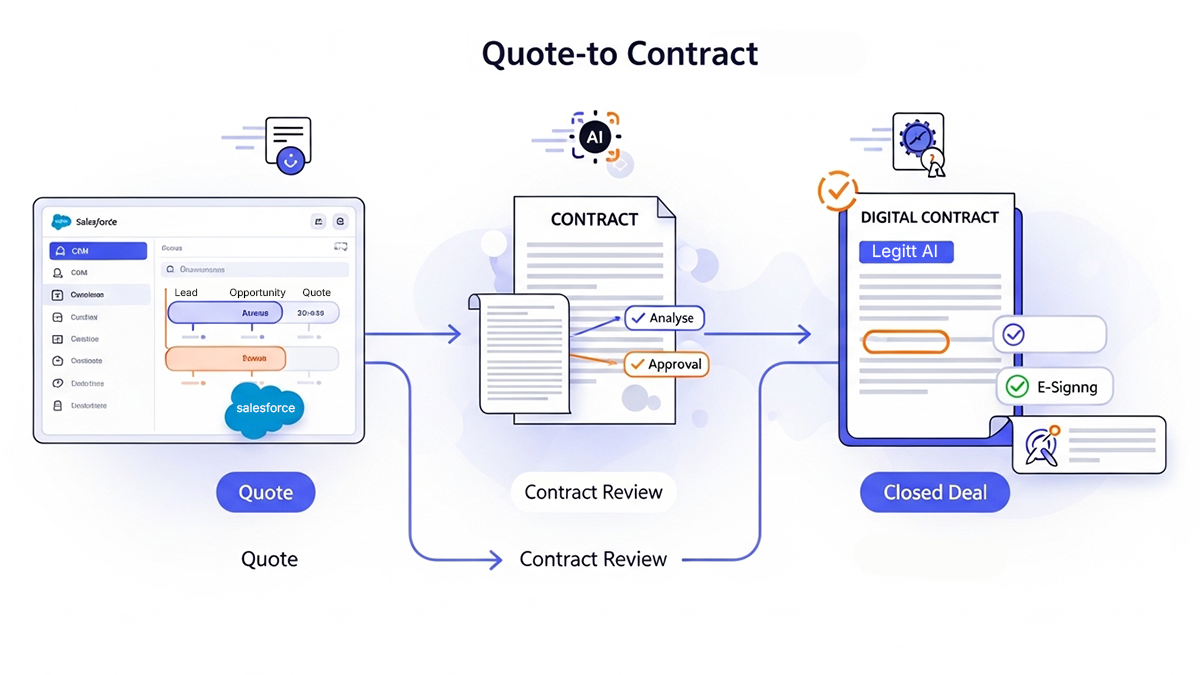
Legitt’s Salesforce-specific positioning is built around this exact gap. Its Salesforce integration content says Salesforce workflows often stall at the most critical moment-closing the deal-and frames Legitt AI as a way to align sales and legal, eliminate bottlenecks, and move from opportunity to revenue faster. In practical terms, that means Salesforce provides the CRM and revenue workflow backbone, while Legitt adds an AI-native contract layer that helps accelerate the final steps between quote approval and executable agreement.
That is why the Salesforce + Legitt combination matters so much now: it helps compress one of the most expensive delay points in the revenue lifecycle.
Why quote-to-contract speed matters more than ever
The quote-to-contract stage is where revenue motion either accelerates or stalls. A rep can build the right opportunity, generate the right quote, and reach verbal alignment with the customer-but if contracting drags, the deal can slip, the buyer can cool off, or internal teams can lose urgency.
Salesforce’s own Revenue Lifecycle Management materials make this clear by positioning revenue operations as one connected process spanning product catalog, pricing, CPQ, contract lifecycle management, and billing. Trailhead’s Revenue Lifecycle Management overview places CPQ and contract lifecycle management in adjacent parts of the same broader revenue stack. Salesforce’s quote-to-cash messaging also emphasizes managing the revenue lifecycle on one connected platform, reinforcing that contracts are not separate from revenue execution-they are central to it.
That means quote-to-contract is not just a legal handoff. It is a revenue conversion stage.
When this stage is slow, businesses feel it in several ways:
- delayed bookings
- longer sales cycles
- more deal slippage
- slower renewals
- extra legal workload
- weaker buyer experience
That is why businesses increasingly care about faster quote-to-contract cycles, not just faster quoting.
Salesforce provides the quote-to-contract foundation
Salesforce is already designed to support the broader revenue lifecycle. Its Revenue Management page says businesses can go from opportunity to quote to contract more efficiently, and Salesforce explicitly highlights contract creation and updates as part of that process. It also states that legal teams can create contract templates and manage clause libraries that sellers can use during contracting.
This matters because Salesforce is not just a CRM record system in this context. It is increasingly positioned as a connected quote-to-cash and quote-to-contract platform. Salesforce’s pricing and product pages also confirm that Agentforce Revenue Management includes CPQ features, allowing sales teams to quickly create accurate quotes, while Revenue Lifecycle Management software is positioned around streamlining forecasting, billing, compliance, and related revenue processes.
So the baseline is already strong:
- Salesforce manages the opportunity
- Salesforce supports quote creation through CPQ
- Salesforce supports contract creation and lifecycle workflows
- Salesforce keeps sales, finance, and legal closer to one shared process
But for many organizations, the contract stage is still where real-world friction appears. That is because workflow alone is not always enough to remove the manual effort of drafting, review, and negotiation.
Where quote-to-contract cycles usually break down
Even in a Salesforce-centered environment, quote-to-contract delays usually come from five recurring issues.
1. Manual contract drafting
Reps or legal teams often still rely on copying data into templates, adjusting clauses manually, and checking details one document at a time.
2. Fragmented systems
Sales works in Salesforce. Legal works in a separate document flow. Approvals happen elsewhere. This creates context switching and handoff delay.
3. Repetitive legal review
Even low-risk, high-volume contracts may get pushed through manual review loops because the system is not intelligent enough to distinguish routine from non-standard.
4. Slow approvals
The commercial quote may be ready, but contract approvals lag because clause deviations and routing logic are not automated enough.
5. Post-quote contract rework
The longer the contract step takes, the more likely the deal gets reopened, terms change, or the buyer asks for adjustments that create another cycle of delay.
This is exactly the kind of bottleneck Legitt’s Salesforce content is designed to address. Legitt’s sales-efficiency article says its Salesforce integration streamlines sales workflows, automates contracts, and helps teams close deals faster with less effort. It specifically states that contracts can be generated directly inside Salesforce from opportunities or accounts, using relevant data and pre-approved templates.
That is the critical point: the biggest quote-to-contract gains come from reducing the manual work between quote approval and contract execution.
How Legitt extends Salesforce for faster quote-to-contract execution
Legitt extends Salesforce by adding AI-native contract generation, contract review, and contract workflow acceleration on top of Salesforce’s CRM and revenue foundation.
Legitt’s Salesforce integration content describes the combination as “conversational contracting, from request to renewal,” while its Salesforce-focused blog says Legitt augments Salesforce with AI-driven intelligence, automation, and end-to-end contract orchestration. Legitt also states that users can create, negotiate, sign, and track contracts without leaving the CRM environment.
That means the value of the integration is not just data sync. It is contracting speed.
The combination works because each side plays a different role:
Salesforce contributes:
- opportunity and account context
- CPQ and quote workflow
- CRM record integrity
- revenue lifecycle continuity
Legitt contributes:
- AI contract generation
- AI contract review
- contract automation
- tighter in-CRM contract execution
- faster movement from quote-ready to signature-ready
This is why the integration is compelling for teams focused on faster quote-to-contract cycles. It reduces the distance between “quote approved” and “contract out for signature.”
In practice, faster quote-to-contract cycles depend on three capabilities: generating contracts directly from CRM data, reviewing contract terms efficiently, and executing agreements with reliable audit trails.
 Hi, What do you want to Draft?

Click to upload or drag & drop
pdf, docx up to 5 MB
Click to upload or drag & drop
pdf, docx up to 5 MB
Legitt reduces manual drafting after the quote is ready
One of the biggest gains comes from automated contract generation.
Legitt’s Salesforce sales-efficiency article explicitly says Legitt AI can auto-generate contracts from Salesforce opportunity data. It also says reps can create contracts directly from opportunities or accounts in Salesforce, with Legitt pulling in relevant data and applying pre-approved templates so the contract is ready in minutes without leaving the CRM.
That is a major quote-to-contract advantage.
Instead of:
- exporting details from the quote
- manually entering them into a template
- checking names, pricing, dates, and terms
- re-routing for basic correction
the contract can begin from the live CRM and quote data.
This reduces:
- drafting time
- copy/paste errors
- document inconsistencies
- dependency on repetitive manual work
In a fast-moving sales environment, even small reductions here compound quickly. Every manual drafting step removed from the quote-to-contract workflow helps shorten the overall close window.
Legitt helps legal focus on exceptions instead of routine contracts
The second major gain is review efficiency.
Legitt’s Salesforce integration article says legal teams gain visibility into contracts without being overwhelmed by routine drafting because Legitt automatically applies clause libraries and flags risks, allowing legal to focus on non-standard terms or high-value negotiations. Its broader Salesforce integration content also positions Legitt as enhancing Salesforce with legal intelligence and AI-powered contract analysis.
That matters because traditional quote-to-contract delays often come from legal reviewing too many low-risk documents the same way.
A smarter quote-to-contract model separates:
- routine contracts that should move quickly
- exception contracts that actually need deeper review
When legal only needs to concentrate on unusual clauses, negotiated deviations, or higher-risk deals, standard quote-to-contract workflows move much faster.
This is one of the clearest ways Salesforce and Legitt accelerate contract velocity together:
- Salesforce keeps the commercial process structured
- Legitt reduces legal drag on routine paper
Salesforce and Legitt improve quote-to-contract continuity inside one operating flow
Another reason this combination matters is workflow continuity.
Salesforce’s contract and revenue lifecycle positioning is built around connected processes across sales, finance, and legal. Salesforce says CLM on CRM helps unify sales, finance, and legal teams. Legitt builds on that by explicitly saying users can generate and manage contracts without leaving Salesforce.
This is important because disconnected contracting creates friction:
- sales exports data
- legal re-enters data
- updates happen in email
- contract status becomes unclear
- reps lose visibility into progress
Keeping the contract flow closer to Salesforce reduces those disconnects. It lets the quote-to-contract stage stay tied to the same opportunity and account context that the sales team already manages.
That continuity improves:
- visibility
- accountability
- response time
- rep adoption
- buyer experience
And for quote-to-contract performance, continuity often matters as much as raw automation.
Faster quote-to-contract cycles also improve the buyer experience
The operational benefit is obvious, but the buyer-side benefit is just as important.
Legitt’s Salesforce sales-efficiency article notes that customers receive contracts faster and with fewer errors, making the buying journey smoother. It adds that immediate delivery of accurate contracts improves trust and helps businesses close deals faster.
That aligns with real sales behavior. Buyers notice when the contract step is smooth:
- the quote converts quickly
- the agreement reflects what was discussed
- turnaround is fast
- revisions are limited
- the close feels coordinated
They also notice when the contract step is chaotic:
- slow delivery
- repeated changes
- inconsistent terms
- long silences between approvals
A faster quote-to-contract workflow is not just an internal efficiency play. It is also part of the customer’s closing experience. That is why this matters beyond legal ops or revenue ops. It directly affects close confidence.
Salesforce and Legitt fit the broader shift from quote-to-cash to quote-to-revenue
This article is about quote-to-contract, but the bigger strategic context is quote-to-revenue.
Salesforce’s revenue lifecycle messaging makes clear that quoting, contracting, billing, forecasting, and compliance are increasingly treated as one connected commercial flow. Salesforce’s 2024 Revenue Cloud announcement also described new capabilities aimed at scaling and automating the quote-to-cash process from quoting and contracting to fulfillment on a unified platform for sales, finance, and legal teams.
That means quote-to-contract speed is not isolated. It affects:
- time to booking
- time to order
- time to billing
- time to revenue realization
The faster a business moves from quote to clean contract, the more efficiently the rest of the revenue lifecycle can proceed.
That is the larger strategic reason the Salesforce + Legitt combination matters. It does not just help one document move faster. It helps compress a revenue-critical transition point in the broader quote-to-cash and quote-to-revenue process.
For teams evaluating that model, the Legitt AI website and the Salesforce integration pages on https://legittai.com are natural starting points because they frame the integration specifically around streamlining sales workflows and accelerating contract execution inside the CRM.
Why this combination is increasingly relevant in 2026
In 2026, the market expectation is no longer just “Can we generate quotes fast?” It is also “Can we turn approved quotes into executable contracts without delay?”
Salesforce is already moving hard in that direction through Revenue Lifecycle Management, CPQ-connected workflows, and contract capabilities on CRM. Legitt AI is increasingly relevant because its positioning is directly aligned with the remaining gap: intelligent contract generation, review, and execution speed layered into Salesforce-centered workflows.
That is why this pairing is compelling for businesses that want:
- shorter sales cycles
- less legal bottleneck
- fewer quote-to-contract delays
- cleaner contract generation from CRM data
- stronger sales-to-legal coordination
- faster progression from quote to revenue
The Legitt AI website reflects this broader direction as well, especially in its Salesforce-related content focused on contract automation, sales efficiency, and in-CRM contract operations.
The bottom line
Salesforce and Legitt are a strong combination for faster quote-to-contract cycles because they solve different parts of the same revenue problem.
Salesforce provides the opportunity, pricing, quote, and revenue workflow foundation. It is already positioned to help teams move from opportunity to quote to contract more efficiently. Legitt extends that foundation by adding AI-native contract generation, AI-assisted review, and in-CRM contract execution designed to reduce manual work and accelerate deal closure.
The result is a faster, cleaner, more connected quote-to-contract workflow:
- less manual drafting
- fewer bottlenecks
- smarter review
- better buyer experience
- faster movement from quote to executable agreement
For modern revenue teams, that is not a small operational win. It is one of the clearest ways to improve close speed at the exact moment where deals are most likely to stall.
Read our complete guide on Contract Lifecycle Management.
FAQs
What does “quote-to-contract” mean?
Quote-to-contract is the stage where an approved quote is converted into a formal contract ready for negotiation, signature, and execution. It sits between quoting and the broader quote-to-cash or quote-to-revenue process. This stage is often where deals slow down because manual drafting and legal review introduce friction. Salesforce’s revenue lifecycle materials explicitly frame opportunity, quote, and contract as connected steps.
How does Salesforce support quote-to-contract workflows?
Salesforce says its Revenue Management platform helps businesses go from opportunity to quote to contract more efficiently. It also states that reps can create and update contracts at any stage of the customer lifecycle, while legal teams can manage templates and clause libraries for use during contracting. In addition, Salesforce confirms that Agentforce Revenue Management includes CPQ features for building accurate quotes quickly.
Where do quote-to-contract delays usually happen?
They usually happen in contract drafting, legal review, approval routing, and data handoff between systems. Even when a quote is ready, teams often lose time because contract terms are assembled manually or reviewed through disconnected workflows. That is why the quote-to-contract step is often a hidden bottleneck in revenue operations. It is not just a legal step; it is a conversion step.
How does Legitt AI help speed up quote-to-contract?
Legitt AI’s Salesforce sales-efficiency content says it auto-generates contracts from Salesforce opportunity data and allows users to create contracts directly from opportunities or accounts in Salesforce. It also states that pre-approved templates are applied so contracts can be ready in minutes without leaving the CRM. That reduces manual drafting effort and shortens the path from approved quote to contract-ready document.
Does Legitt AI reduce legal bottlenecks?
Yes, that is one of the main ways it is positioned. Legitt says it automatically applies clause libraries and flags risks so legal teams can focus on non-standard terms or high-value negotiations instead of routine drafting. That helps standard contracts move faster while preserving legal oversight where it matters most. This is a major factor in accelerating quote-to-contract cycles.
Can users generate contracts inside Salesforce with Legitt?
Yes. Legitt’s Salesforce integration content explicitly says organizations can create, negotiate, sign, and track contracts without leaving their CRM environment. That reduces context switching and keeps the quote-to-contract flow closer to the opportunity and account records already managed in Salesforce. More details are available on the Legitt AI website at https://legittai.com.
Why is faster quote-to-contract important for revenue teams?
Because delays at this stage delay bookings, billing, and revenue realization. A fast quote is not enough if the contract process slows everything down afterward. Salesforce’s quote-to-cash and revenue lifecycle positioning makes clear that contracting is a core revenue workflow, not a side process. Faster contract turnaround improves the speed of the broader revenue engine.
How does the Salesforce and Legitt combination improve buyer experience?
Legitt’s Salesforce sales-efficiency article says customers receive contracts faster and with fewer errors, which makes the buying process smoother and builds trust. A cleaner quote-to-contract process reduces delays, cuts confusion, and makes the closing experience feel more professional. That can directly help close deals faster. The benefit is not only internal; it is customer-facing too.
Where can businesses review the Salesforce and Legitt integration?
A practical starting point is the Salesforce integration content on the Legitt AI website, including https://legittai.com and Legitt’s Salesforce-focused blog posts. Those pages outline how Legitt positions its role in streamlining sales workflows, automating contracts, and reducing quote-to-contract friction. They are useful for comparing a standard Salesforce workflow with a more AI-native contract layer.
Is this really about quote-to-contract, or is it part of a bigger revenue strategy?
It is both. Quote-to-contract is a specific bottleneck, but it sits inside the larger quote-to-cash and quote-to-revenue process. Salesforce’s Revenue Lifecycle Management materials and Revenue Cloud messaging position quoting, contracting, and downstream revenue operations as part of one connected flow. Legitt AI fits into that broader strategy by helping compress the contract stage specifically.